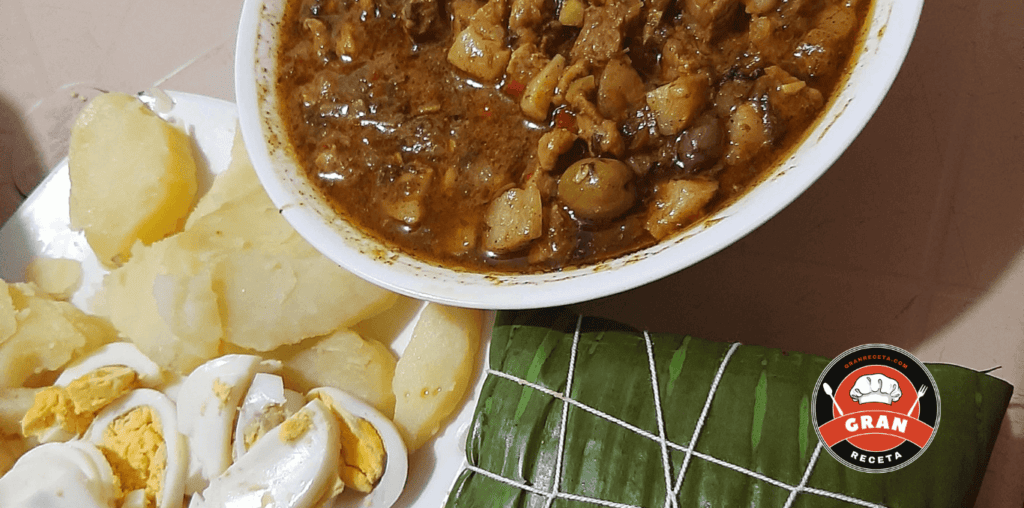
Hallacas are what a Venezuelan family makes instead of Christmas dinner from a single oven: forty parcels of corn dough and marinated stew, wrapped in plantain leaf, tied with twine and boiled. If you know tamales, the shape will be familiar and almost nothing else will. The meat marinates a full day before it’s cooked, the dough is colored and enriched with lard steeped in annatto seeds, and each hallaca is topped with olives, capers and raisins before it’s folded shut. A batch of 40 takes two days, about six hours of actual work, and each one weighs around 8 oz and runs 513 calories. And there isn’t one hallaca: the Spanish Wikipedia records nine regional versions that change the meat, the dough or the garnish.
How do you make Venezuelan hallacas? Marinate beef, pork and chicken with vegetables, spices and red wine for 24 hours. The next day cook the stew until dry, mix a dough of precooked corn flour with warm broth and annatto lard, flame the plantain leaves, spread the dough, add stew with olives, capers and raisins, wrap, tie with twine and boil 90 minutes. That’s 1530 minutes across two days for 40 hallacas.
What a hallaca is, and how old it is
The hallaca is Venezuela’s Christmas dish, eaten between early December and the first days of January and almost never the rest of the year. There is evidence of it in Venezuela around 1749, according to the Spanish Wikipedia, through the account of the Italian Jesuit missionary Felipe Salvador Gilij; it was only later, under Antonio Guzmán Blanco after 1870, that the country’s symbols and traditions began to consolidate, this one among them.
The line every Venezuelan has heard belongs to the writer Arturo Uslar Pietri, who called it “an exemplary compendium of the process of mestizaje. In it are: the raisin and the olive of Romans and Greeks, the caper and the almond of the Arabs, the meat of the cattle of the settler captains of Castile, the corn and the banana leaf of the Indians.” It isn’t just a nice phrase; all of those are still in the recipe, and dropping the raisins or the capers changes the dish.
The nine regional hallacas
The recipe below is the Caracas version, the most widespread one and the one Venezuelans abroad usually make. It’s worth knowing that the family next door may make a different one. Per the Spanish Wikipedia, in the east the stew carries a sweet note of papelón and is garnished with potato rounds and hard-boiled egg; in Margarita it’s made with fish; in Zulia the corn dough is sometimes replaced with green plantain and the stew made with coconut milk; in Lara it uses goat meat and cocuy liquor; in the Andes the stew goes in raw with chickpeas; in Trujillo black beans replace the stew; and in Guayana the dough is denser and drier.
None of them is the correct one. If your Venezuelan friend’s family puts egg in, they’re making the eastern version, not making a mistake.
What to buy outside Venezuela
Two items decide whether this works at all. The first is the corn flour: it has to be precooked corn flour, the kind sold as masarepa for arepas (P.A.N., Goya, Juana), not cornmeal and not the masa harina used for Mexican tamales, which is nixtamalized and behaves differently. It hydrates instantly with warm liquid and needs no cooking, which is why the dough comes together in minutes.
The second is the leaves. Frozen plantain leaves, sold in 1-2 lb packs in Latin and Asian markets, work exactly like fresh ones: thaw, wipe, flame. Corn husks are not a substitute, not because of size but because the plantain leaf perfumes the dough as it boils, and that smell is half the dish. Foil is a last resort.
Ají dulce is the flavor you’ll miss most. It looks like a habanero and has none of the heat, and there’s no exact match in a US supermarket; mini sweet peppers with a pinch of sugar get you closest. Annatto seeds (onoto, achiote) are in the Latin aisle; paprika gives you the color but not the aroma.
The stew, and why it marinates for a day
The 24 hours aren’t decoration. Salt in contact with the meat overnight seasons it right through instead of only on the surface, and the wine’s acidity softens the fibers of working cuts like chuck and pork shoulder. Skip it and you get meat that was cooked with seasonings on top, which is the whole difference between any wrapped tamal and the one people remember.
It cooks without water. The beef, pork, chicken and bacon release enough liquid, and the 2 cups of wine make up the rest. Add water and the stew takes twice as long to dry.
And it must end up dry. This is the rule that decides the batch. A stew with visible liquid turns to steam inside the leaf during the boil, and the steam splits the dough: the hallaca opens and the filling ends up in the pot. The last 15 minutes go uncovered, and the stew should hold a furrow when you drag a spoon through it.
The dough, a ratio you can scale
The ratio is 1 kg of precooked corn flour to 1.2 liters of warm broth, which is where the 5½ lb and 12½ cups in this batch come from. With less broth the dough cracks as you fold it; with more it sticks to your hands and won’t spread. You’re aiming for soft modeling clay: it gives when you press it and doesn’t tear when you bend it.
The broth should be warm, not boiling, since very hot liquid gelatinizes the starch too fast and leaves lumps. And 250 g of the annatto lard goes in, which is what makes the dough pliable and gives it the orange color that says hallaca before you taste anything.
Steep the annatto, don’t boil it. Seeds into the lard over low heat for about five minutes, until the fat is deep orange, then strain. If the lard smokes the seeds scorch and the whole batch of dough turns bitter; if it stays pale, your hallaca comes out the color of a plain arepa.
How day two goes
Day one is 30 minutes: chop, mix, refrigerate. Day two is five and a half hours, and the split surprises first-timers: the stew and the dough are done in two hours, but assembling 40 hallacas takes two more, at about three minutes each once you have a rhythm. That’s why hallacas are made as an assembly line with several people, each at a station: one spreads the dough, one adds stew and garnish, one wraps and ties.
You can also split it over three days, which is how I do it alone: marinate, then cook the stew and flame the leaves, then dough, assembly and boiling.
Step by step
Assembly, three minutes each
Set the table before you start: leaves cut and stacked by size, dough in one bowl, cold stew in another, garnishes in separate cups, twine cut into 24-inch lengths and a dish of annatto lard.
Grease the large leaf. Put a 5-oz ball of dough in the center and press it out with wet fingers to an 8-inch circle about ¼ inch thick: thicker and the center stays raw, thinner and it tears in the pot. Two heaping tablespoons of stew go in the middle with the garnishes on top, always with an inch of bare dough around them. Fold the leaf so the dough closes over the filling, fold the ends down, wrap with the strip crosswise and tie, three turns each way, with real tension.
They boil covered for 90 minutes with the water over them, and they don’t get opened hot: 20 minutes of rest so the dough sets.
Who this recipe is for
- If it’s your first time → make half a batch, 20 hallacas, with half of everything; same technique, and assembly takes an hour
- If you can’t find plantain leaves → frozen ones work identically; foil is the last resort and costs you the aroma
- If you can’t find ají dulce → finely chopped mini sweet peppers with a pinch of sugar for every three
- If you don’t want to use lard → butter and oil in equal parts for the dough; correct texture, less aroma
- If you’re cooking alone → spread it over three days, with the stew and the leaves the day before assembly
What ruins a batch
Warm or wet stew at assembly. The most expensive mistake, because you find out after they’re boiled. The liquid becomes steam, the dough splits, and the hallaca opens in the pot.
Leaves that weren’t flamed. They crack at the first fold and you start the parcel again. It takes 10 seconds a side.
Dough too thin. Under ¼ inch it tears while boiling and the filling escapes. Over ½ inch the center stays raw.
Filling out to the edge. The stew needs an inch of bare dough around it so the dough can close on itself. Touch the edge and the hallaca won’t seal.
Tying loosely. The twine has to bite. A loose parcel opens 20 minutes into the boil and water gets in, leaving the dough waterlogged.
Hallaca, Mexican tamal, Colombian tamal
They share the idea of corn dough steamed or boiled in a wrapper, and little else. The hallaca marinates its meat a day ahead, sits its garnishes on top of the filling, folds rectangular and boils for 90 minutes. A Mexican tamal steams in a corn husk with whipped masa and usually one filling. The Colombian tamal mixes the vegetables into the dough, wraps round and boils for over two hours, and the valluno version marinates its meat too, which makes it the closest cousin of the three.
Make ahead, storage and reheating
Hallacas are built to last the month, and that’s their point. Cooked and unopened they keep up to 4 days in the fridge, according to the USDA window for cooked dishes, and they should be chilled within a couple of hours of leaving the pot. Frozen they keep 3 months; freeze them cooked and whole, still in the leaf, which is the best packaging there is for this.
To reheat, 20 minutes in boiling water straight from the freezer, a little less from the fridge. In the microwave, 3 minutes with the leaf on and a cup of water beside it, though the dough comes out drier. What doesn’t work is reheating them opened on a plate: the dough dries and loses the fat that keeps it tender.
Questions people ask
How many hallacas does a pound of corn flour make? About 7, at 5 oz of dough each. The 5½ lb in this recipe make the 40, and the broth ratio is always 1.2 liters per kilo of flour.
Can I use masa harina instead of masarepa? No. Masa harina is nixtamalized corn for Mexican tamales and tortillas; it tastes different and behaves differently with warm broth. Look for “precooked corn flour” or “masarepa” on the bag.
Can I make it all in one day? You can, but there’s no marinade and the stew loses half its depth. If you only have one day, marinate at least 6 hours and salt the meat from the start.
Why do hallacas open while boiling? Three causes, all visible before the pot: wet stew, dough that’s too thin, or loose twine. If one opens, pull the rest out and check the tying before you continue.
Can I freeze them raw? Yes, though I prefer freezing them cooked. Raw ones go from freezer to pot and need a full two hours rather than an hour and a half, and the dough sometimes cracks in the freezer.
Is a hallaca a tamal? It belongs to the same family, and Venezuelans will tell you it isn’t one. In practice: plantain leaf instead of husk, marinated stew, olives, capers and raisins, and Christmas only.
Nutrition
Per hallaca, one fortieth of the batch (about 8 oz / 230 g), calculated from the USDA database for the meats, corn flour, lard, olives, capers and raisins: about 513 kcal, 56 g carbohydrate, 22 g fat of which 8 g saturated, 18 g protein, 3 g fiber, 5 g sugar and 560 mg sodium.
The dough carries about half the calories and nearly all the carbohydrate; the three meats bring the protein and much of the fat. One hallaca is a full meal, which is why in Venezuela it’s eaten on its own or with ham bread and chicken salad, never as a side.
On a Venezuelan Christmas Eve table the hallaca sits with pan de jamón, roast pork leg and chicken salad, and Venezuelan quesillo closes the night. In Colombia I’ve learned to make them in December alongside lechona and natilla, and we end up comparing: here the tamal is a Sunday thing, there the hallaca belongs to one season only. What doesn’t change from one country to the other is that nobody makes them alone. The first time I made them far from home there were three of us and it took eight hours, and when the first one was opened at the table nobody said anything for a while. Josnaisis.