
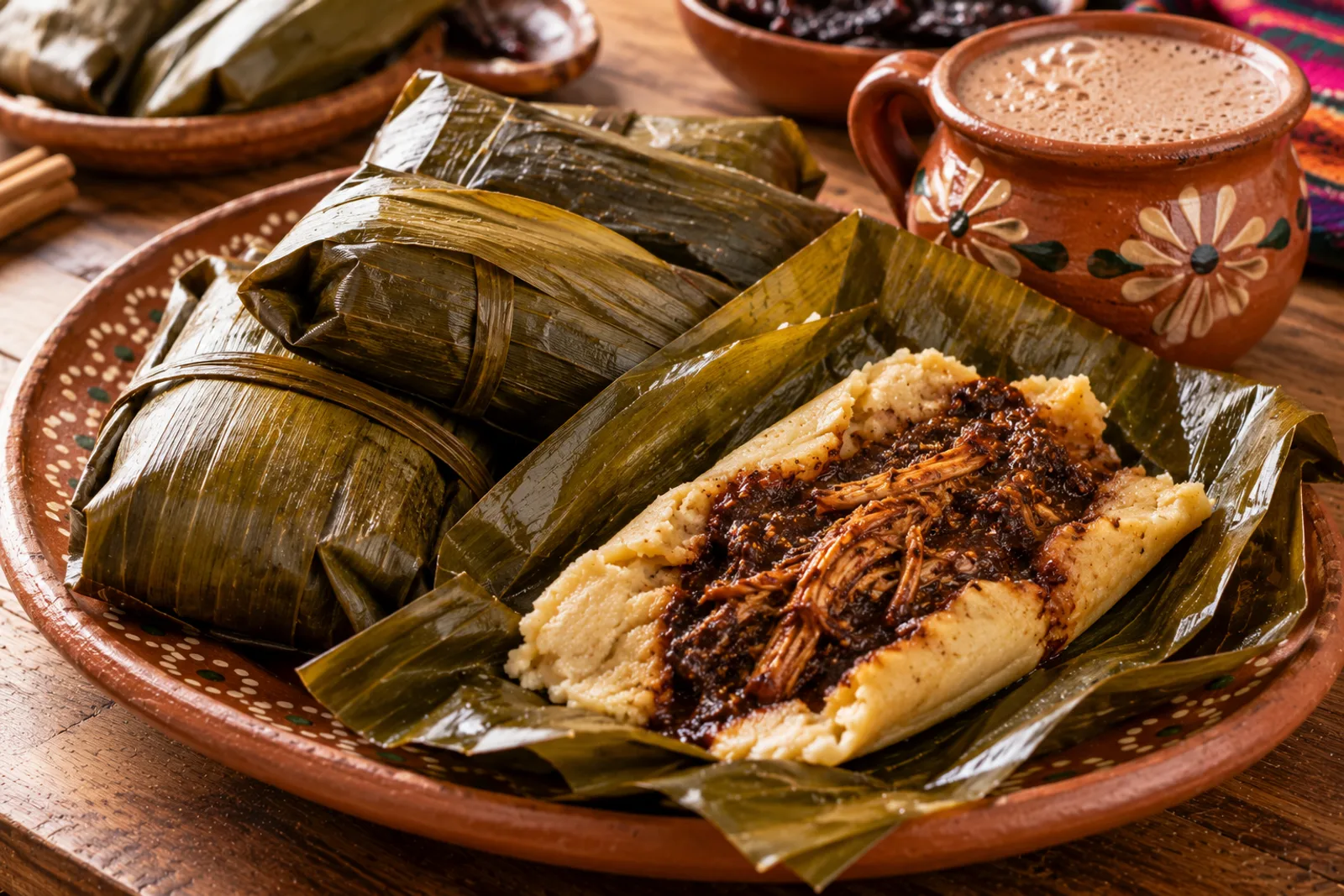

Oaxacan tamales are flat banana-leaf parcels about 5 by 4 inches (12 × 10 cm), holding a thin layer of soft, lard-enriched corn masa around a spoonful of mole negro and shredded chicken. Steamed for 75 to 90 minutes, they come out moist and almost creamy, and the leaf leaves a faint grassy smell in the masa. This recipe makes 16, with how to soften frozen leaves so they don’t tear, where to buy them in the US and UK, homemade mole or a jarred-paste shortcut, a fold you can learn on the third try, and quantities for a party.
What are Oaxacan tamales?
How do you make Oaxacan tamales? Beat 1 kg (2.2 lb) of corn masa with 250 g (9 oz) of lard and about 1⅔ cups of chicken broth until it spreads like thick mashed potatoes. Spread ½ cup on a flame-softened banana leaf, add thick mole negro and shredded chicken, fold into a flat parcel and steam 75 to 90 minutes, until the masa peels cleanly off the leaf. Makes 16 in about 220 minutes.
A tamal (tah-MAHL; tamales in the plural) is corn dough steamed or boiled inside a wrapper. In central Mexico and in Mexican shops in the US, “Oaxacan tamale” usually means this one: banana leaf instead of corn husk, filled with mole, the dark chile sauce of Oaxaca in southern Mexico. In Oaxaca itself there are many other tamales, and this one is usually just named for its mole. The sauce is the same Oaxacan mole negro made from scratch that’s served over chicken, kept thicker here.
The masa is what sets them apart from husk-wrapped tamales like green chicken tamales or rajas con queso tamales. Those are whipped until a pinch floats and come out fluffy and upright; this masa is softer and wetter, spread thin, and the leaf keeps it tender. Other banana-leaf tamales are boiled for hours with raw filling: the Colombian valluno tamale, with its masa cooked first, the Colombian chicken tamales with potato and carrot and Nicaraguan nacatamales with pork and rice.
How long it takes. About 220 minutes for 16, roughly 115 of them hands-on. With the chicken and mole made the day before, tamale day is about 200 minutes, 105 of them steaming and resting. A homemade mole needs its own day.
How hard. Medium. Nothing is technically difficult; what needs attention is softening the leaves without scorching them, keeping the mole thick, and the first two or three folds.
Shopping for a US or UK kitchen
The recipe makes 16 tamales about 5 × 4 in (12 × 10 cm), two per person as a meal. Each one takes about 3½ oz (100 g) of prepared masa, 2 tablespoons of mole and 1¼ oz (35 g) of chicken.
Banana leaves
- US. Sold frozen in 1 lb (450 g) packs in Latin and Asian markets and in the freezer case of many supermarkets. Buy 2 packs for 16 tamales, and a third the first time, because a few always split as you unfold them.
- UK. Frozen in Asian, Caribbean and Latin American shops, and from online grocers. Fresh leaves turn up in some Asian shops; they’re cleaned and softened the same way.
- No banana leaves? Parchment inside and foil outside will make the parcel, but you lose the leaf’s aroma and the masa tastes flatter.
Corn husks aren’t a swap here: this masa is too soft to hold its shape in a husk. If husks are all you have, make the whipped masa from the green tamales and fill it with this mole.
Masa
- Fresh, unprepared masa from a tortillería is best. Some Mexican supermarkets in the US sell it by the pound. If you buy prepared masa for tamales, it already has fat and salt: skip the lard and salt and just add broth.
- Masa harina, dried nixtamalized corn flour (Maseca is the common brand). 400 g (3½ cups) plus 600 ml (2½ cups) hot water replaces 1 kg (2.2 lb) fresh masa. It’s in the Hispanic aisle in the US, and online or in Latin shops in the UK.
- Not cornmeal, polenta or arepa flour. None of them is nixtamalized, and the tamale won’t taste like a tamale.
- Lard gives the classic flavor, and UK supermarkets sell it in blocks. Vegetable shortening (Crisco, or Trex in the UK) behaves the same and tastes neutral. Oil can’t be beaten, so the masa ends up denser.
This masa uses 250 g lard per kilo (about 4 oz per pound) and plenty of broth. Husk tamales usually take more fat and less liquid so the dough rises and stands up.
Mole, homemade or from a jar
- Homemade. If you’re making mole negro for a dinner anyway, set aside 2 cups (500 ml) before thinning it all the way. It freezes for months, so it can be made weeks ahead.
- Mole paste, the honest shortcut. Oaxacan mole negro paste comes in jars or blocks from Mexican shops and online. About 9 oz (250 g) plus broth fills 16 tamales. It’s good and saves you a day; what you give up is control over bitterness and sweetness, and some brands run sweet. Mole poblano or red mole paste works, but the tamale comes out sweeter and redder, and it’s no longer mole negro.
Thin the paste with less broth than the label suggests: label ratios are for pouring over chicken, and a tamale filling needs to be much thicker.
Equipment
A steamer or tamale pot of about 10 quarts (10 liters) with a rack, a stand or hand mixer, a large skillet or griddle for the leaves, and a big spoon for spreading. No tamale pot? A tall stockpot with a rack or an upturned metal colander in the bottom works, as long as the water stays below the tamales. No mixer? Beat the masa by hand with a wooden spoon for 15 to 20 minutes.
How to make Oaxacan tamales
Softening the leaves
Frozen leaves come out stiff and crack when folded. Thaw them in the bag, wipe both sides with a damp cloth and pass them over heat a few seconds per side, always moving. Watch the color: dull green turns glossy dark green and the leaf goes supple, like fabric. Left still over the flame it scorches brown and turns brittle. The slower option is simmering the leaves for about 20 minutes, until they lose their bright green; they come out very supple, but need drying before you use them.
Thick, cold mole
Runny mole is the most common failure. For filling, it should coat a spoon and not drip, and a finger drawn across the back leaves a clean line. Thin mole leaks through the folds while steaming and soaks the masa. Let it cool before assembling; it thickens further and is easier to spoon.
A softer masa than husk tamales
Beat the lard alone until white, then add the masa and warm broth in turns. You’re after thick mashed potatoes that spread: the back of a spoon pushes it into a thin, unbroken layer, and it sits on the spoon without sliding off. It doesn’t need to pass a float test; the goal isn’t fluff but a moist, thin layer. Don’t taste it raw: cook a teaspoon on a dry skillet and taste that. It should be a little too salty, because steaming mutes it.
The fold
Glossy side of the leaf up. ½ cup of masa spread into a 5 × 4 in (12 × 10 cm) rectangle, ¼ in (5 mm) thick, with at least 2½ in (6 cm) of bare leaf on every side. A tablespoon of mole, the chicken and another tablespoon of mole on top, kept inside the edges of the masa. Fold the near side of the leaf over the filling, then the far side, and the masa edges meet to seal it. Tuck the ends underneath and the parcel lies flat. The tie is optional if the parcels sit folds-down in the pot.
Steaming time and the doneness test
75 to 90 minutes from the boil, over medium heat, tamales lying flat in layers. A coin in the water tells you it’s still there: if the rattling stops, pour boiling water down the side of the pot, never cold water over the tamales.
At 75 minutes take one out, wait 5 minutes and open it. It’s done when the masa peels cleanly off the leaf, feels firm and looks opaque. Straight from the pot it always looks raw and sticky, so don’t judge it before those 5 minutes. If it sticks, steam 10 to 15 minutes more and test again. When they’re done, leave them 15 minutes covered with the heat off.
When Oaxacan tamales go wrong
- Split leaves. They went from freezer to folding, or skipped the flame. If one splits as you fold, slip a scrap underneath as a second layer.
- Masa sticks to the leaf. Not enough steam, or opened too soon. Wait and test again.
- Soggy tamale, mole leaking out. Thin mole or too much of it. Two tablespoons per tamale is plenty.
- Hard, dry masa. Too little broth or fat, or the pot boiled dry. The masa has to spread before you assemble.
- Bland masa. Nobody checked the salt before assembling. Steam always mutes it; cook a teaspoon on a skillet and adjust.
Heat, kids and allergens. Mole negro is barely spicy; it’s more bitter and sweet than hot, and plenty of children like it. Homemade mole contains almonds, peanuts, sesame and bread, and commercial pastes often have peanuts, sesame and crackers or bread, so check the label for allergies or celiac disease. The corn masa itself is gluten-free.
Scaling up for a tamale party
Count 2 tamales per guest as the main dish, 1 if there’s other food. Everything scales by the kilo (2.2 lb) of masa.
| Tamales | Masa | Lard | Chicken | Mole | Leaves |
|---|---|---|---|---|---|
| 16 | 1 kg (2.2 lb) | 250 g (9 oz) | 800 g (1.75 lb) | 500 ml (2 cups) | 2 × 1 lb packs |
| 32 | 2 kg (4.4 lb) | 500 g (1.1 lb) | 1.6 kg (3.5 lb) | 1 liter (4 cups) | 4 packs |
| 48 | 3 kg (6.6 lb) | 750 g (1.65 lb) | 2.4 kg (5.3 lb) | 1.5 liters (6 cups) | 6 packs |
| 80 | 5 kg (11 lb) | 1.25 kg (2.75 lb) | 4 kg (8.8 lb) | 2.5 liters (10 cups) | 10 packs |
Beyond 32, beat the masa in 2 kg (4.4 lb) batches and use two pots or steam in two rounds. A crowded pot takes longer to cook through the middle: test at 90 minutes and allow 15 more.
Other ways to make them
- With pork or turkey. Swap the chicken for the same weight of cooked, shredded pork shoulder or turkey.
- Meat-free. Shortening in the masa, vegetable broth, and sautéed mushrooms with the mole. Check the paste label; some contain lard.
- Smaller, for a buffet. 8 × 8 in (20 × 20 cm) leaves, ⅓ cup of masa and half the filling make about 24; start testing at 60 minutes.
What drives the cost. The mole, especially homemade with chilhuacle chiles, and outside Mexico the banana leaves. Boneless thighs are usually cheaper than breasts and stay juicier.
Make ahead, store and reheat
- Day before. Poach the chicken, make or thin the mole, and clean and cut the leaves. I’d rather steam the tamales the same day and reheat them than leave raw ones overnight with the mole sitting against the masa.
- Serving. Unwrap on the plate; the leaf isn’t eaten. A hot corn drink is the classic partner: Mexican champurrado, thick chocolate atole, or coffee. A spoonful of extra hot mole on top is welcome.
- Fridge. Cooled, in their leaves, in a closed container: 3 to 4 days. Refrigerate within 2 hours of leaving the pot.
- Freezer. Cooked, cooled and still wrapped, in freezer bags: best quality for 2 to 3 months. No need to thaw.
- Reheating. Steam them in their leaves 15 to 20 minutes from the fridge or 25 to 30 minutes from frozen, until piping hot in the center, 165°F (74°C). On a dry skillet over medium heat, still wrapped, about 10 minutes, turning: the leaf chars and the masa picks up a smoky edge. In the microwave, wrapped, in 1-minute bursts until the center steams.
Oaxacan tamales FAQ
Do you eat the banana leaf? No. It wraps and perfumes the masa; open it on the plate and set it aside.
How many tamales per pound of masa? About 7 at this size, ½ cup of masa each; 16 per kilo (2.2 lb). With ⅓ cup each you get roughly 24 smaller ones per kilo.
Why are my tamales raw in the middle after 90 minutes? Usually a pot packed too full, heat so low the water isn’t boiling, or parcels squeezed so tight the steam can’t get through. Check that steam escapes around the lid and leave gaps between the parcels.
Can I use parchment paper instead of banana leaves? Yes, with foil over it to hold the shape. They cook in the same time, but you lose the leaf’s aroma.
Nutrition
Per tamale (1 of 16), with homemade mole negro and chicken thighs, calculated ingredient by ingredient from the recipe:
- Calories: 342 kcal
- Protein: 13 g
- Carbohydrates: 25 g
- Fat: 22 g, of which 8 g saturated
- Fiber: 3 g
- Sodium: 573 mg
About two fifths of the calories come from the lard in the masa. With commercial mole paste the numbers vary by brand, especially sugar and sodium.
Banana leaves are the part of these tamales that feels most familiar to me, because they’re what Venezuelan hallacas are wrapped in, softened with the same flame trick. I always buy one extra pack for the first batch, and whenever I make mole negro I freeze two cups, unthinned, just for this, which keeps tamale day to a single afternoon. Josnaisis.