
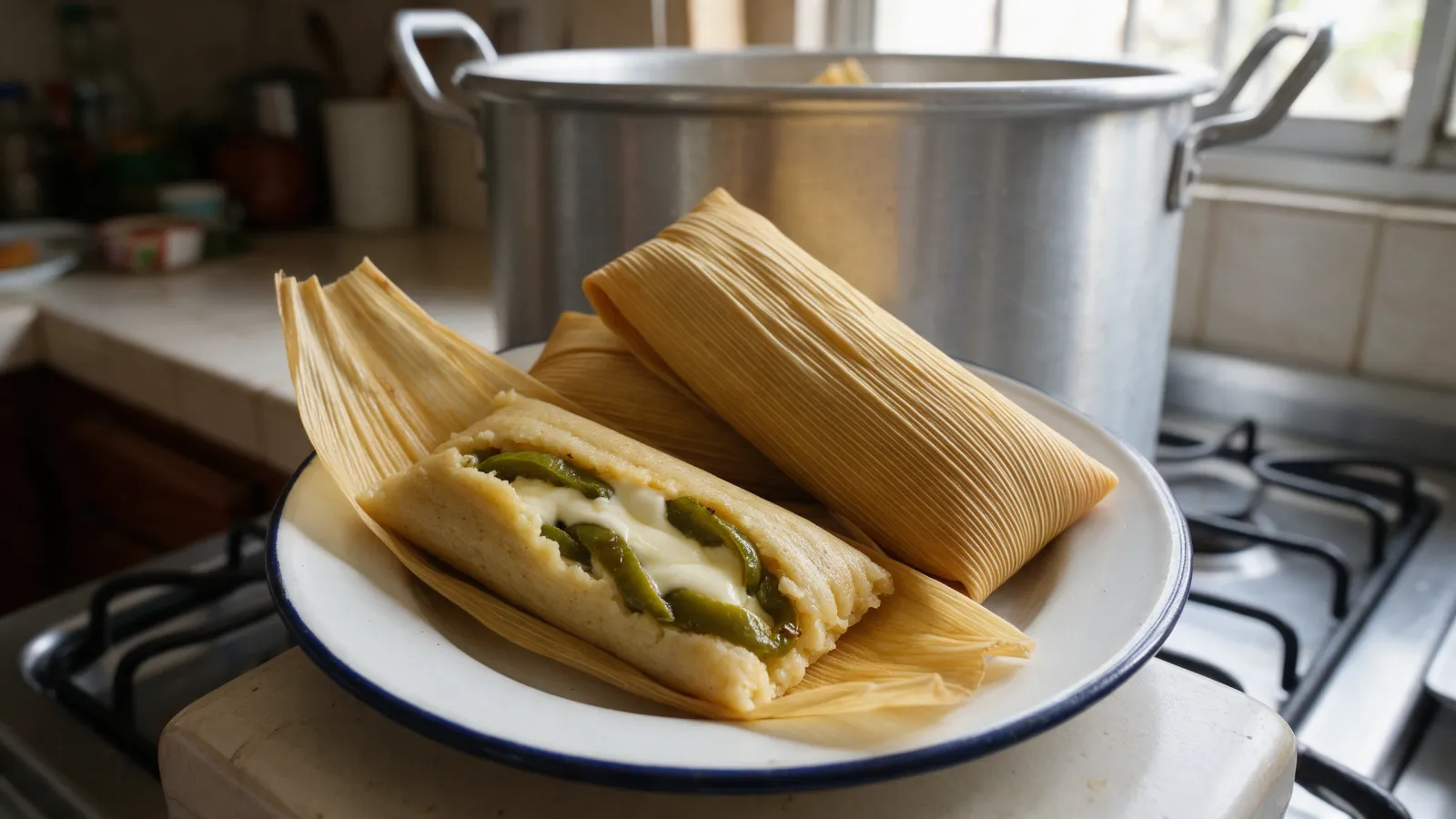

Tamales de rajas con queso (tah-MAH-lehs deh RAH-hahs kon KEH-so) are the meatless tamales of a Mexican tamale spread: soft corn dough wrapped around strips of charred poblano pepper and a stick of melting cheese, folded in a corn husk and steamed. Because there’s no meat in the filling, they turn fully vegetarian with two swaps, vegetable shortening for the lard and vegetable broth for the chicken stock, and nobody at the table will notice the difference in texture. This batch makes 24, takes just over 3 hours with half of it hands-off, and freezes for months.
What are rajas con queso tamales, and who are they for?
How do you make rajas con queso tamales? Char, peel and slice 4 poblano peppers, then cook the strips with onion and tomato until the pan is dry. Whip masa with 300 g (1½ cups) of lard or shortening per kilo (2.2 lb), salt, baking powder and warm broth until a pinch floats in cold water, spread it on soaked corn husks, add the strips and a stick of Oaxaca cheese, fold and steam 60 to 75 minutes. 185 minutes for 12 servings of 2 tamales.
“Rajas” means strips, and in a Mexican kitchen it almost always means roasted poblano peppers cut into ribbons. A poblano is the large, dark green, mild chile sold in most US supermarkets, sometimes mislabeled as pasilla. In some homes the strips go into the tamale on their own with cheese; in others, as here, they’re cooked first with tomato and onion, which gives a juicier filling but needs one extra bit of care. In Mexico these are one of the standard flavors at Christmas posadas and on Candelaria, February 2, alongside green chicken tamales and pink sweet tamales.
Who they’re for. A crowd with vegetarians in it, a holiday tamalada, or anyone who wants a freezer full of ready meals. Making 24 takes barely more work than 12.
Who might skip them. Anyone after a quick dinner: it’s 185 minutes, 90 of them hands-on. Anyone avoiding dairy, since the cheese is half the filling. And heat-seekers, unless they swap in jalapeños.
Difficulty, honestly medium. Nothing is technically hard. Three things decide the result: masa that floats, a filling that goes in dry, and cheese that’s completely sealed in.
Shopping for a US or UK kitchen
The exact quantities are in the recipe card: 1 kg (2.2 lb) of fresh masa, 300 g (10.5 oz) of lard, 4 poblanos, 400 g (14 oz) of tomatoes, 300 g (10.5 oz) of cheese and 40 husks for 24 tamales.
| Ingredient | What it is | US | UK | If you can’t find it |
|---|---|---|---|---|
| Masa harina for tamales | dried, ground nixtamalized corn, coarser than tortilla masa harina | Hispanic aisle of most large supermarkets | Mexican online grocers | tortilla masa harina, slightly denser tamales |
| Corn husks | dried husks, sold in bags | Hispanic aisle | Mexican online grocers | parchment and foil squares, flatter flavor |
| Poblano peppers | large, mild green chile | most supermarkets | rare | Anaheim peppers, or green bell peppers plus 1 jalapeño |
| Oaxaca cheese | Mexican stretched-curd melting cheese | Latin grocers, many supermarkets | online | Monterey Jack, or low-moisture block mozzarella |
| Lard | rendered pork fat | baking or meat aisle | supermarket baking aisle | vegetable shortening, same weight |
One trap: cornmeal, polenta and masarepa (precooked arepa flour) are not masa harina. That corn hasn’t been cooked with lime, and the tamale tastes like cornbread or arepa. The conversion for masa harina follows the bag’s own ratio of 2 cups of flour to 1½ cups of water: 400 g (3½ cups) of masa harina plus 600 ml (2½ cups) of hot water replaces 1 kg (2.2 lb) of fresh masa. Store-bought prepared masa already contains fat and salt, so it only needs whipping with broth.
Which cheese melts best?
Oaxaca cheese is the classic: it melts and pulls into strings, like a saltier mozzarella. Monterey Jack is the easy US swap, and in the UK a block of low-moisture mozzarella, not the fresh ball in brine, which leaks water. Queso fresco and panela soften but don’t melt, so you get a soft square of cheese rather than a stretchy center; still good, just different. Keep the sticks to about 12 g (scant ½ oz) each. Thicker ones can reach the end of the steaming time with a cold middle.
Poblano or jalapeño, and how hot they get
A poblano measures 1,000 to 2,000 Scoville units, and most of that heat lives in the white ribs, not the seeds. Strip the ribs and these tamales are mild enough for most children. For heat, swap 1 or 2 of the poblanos for 3 or 4 jalapeños cut into thin strips. In the UK, where poblanos are hard to find, green bell peppers with a single jalapeño get close: sweeter, a little less grassy, but they char, peel and slice the same way. Leftover rajas con crema work as a filling too, as long as they’re made with little or no cream, which separates in the steamer.
Lard, shortening or oil, and going vegetarian
Lard is a solid fat, and whipping it traps the air that floats the test ball and puffs the tamale. Vegetable shortening does exactly the same job with a neutral flavor, and with shortening and vegetable broth the tamales are vegetarian. If you cook for strict vegetarians, check the cheese label too, since some cheeses are made with animal rennet. Oil can’t be whipped, so the tamales come out denser and the float test stops meaning anything; I don’t use it here.
The float test, and how to check it isn’t lying
Half a teaspoon of plain masa should float in a glass of ice-cold water. It floats because the air whipped into the fat makes the little ball lighter than the same volume of water, and that same air expands in the steam and makes the tamale fluffy. Some cooks use warm water; I use ice water so the lard in the ball stays firm while I watch it.
To see that the test is telling you the truth, drop two balls: one of masa before whipping, which sinks straight to the bottom, and one after the full 15 minutes, which bobs up. And always test without filling. A ball with a crumb of cheese or pepper in it is heavier and sinks even when the masa is perfect.
How long to whip. Fifteen minutes in total: 5 for the lard alone, until it turns white, then 10 more with the masa and broth at medium speed. A hand mixer may need 2 or 3 extra minutes per 2.2 lb (1 kg) batch. By hand with a wooden spoon, count on 20 to 30 minutes per kilo.
Steaming without a tamale pot, and how to tell they’re done
A tamalera is just a tall pot with a raised rack. An 8 to 10 quart (8 to 10 liter) stockpot does the same job: put a folding steamer basket or a metal colander inside, or set a heatproof plate upside down on three balls of aluminum foil. Keep 1½ in (4 cm) of water below the rack, never touching the tamales, with a coin in the bottom that rattles as long as there’s water. When it goes quiet, top up with boiling water. Two dozen tamales fit upright in my 10-quart pot.
Timing. A full pot of 24 takes 60 to 75 minutes from the boil, then 15 minutes resting covered off the heat; a small batch of 6 to 8 is usually ready around 40 minutes. Pull one tamale out, wait 5 minutes and unwrap it. If the husk peels off clean, they’re done. Fresh from the steam the masa always looks raw and the cheese runs, and that’s the moment people give them another half hour they didn’t need.
What you can do ahead. Char, peel and cook the strips and cut the cheese the day before; they keep covered in the fridge. Whipped masa keeps overnight too: let it sit out 30 minutes, rewhip it 2 or 3 minutes with a splash of warm broth and redo the float test.
Hosting a tamalada for 30 to 50
Count 2 tamales per guest and 24 tamales per 2.2 lb (1 kg) of fresh masa. Whip the masa in 2.2 lb batches, because a home stand mixer won’t handle more, and plan one 10-quart pot per 24 tamales, or several rounds of steaming.
For 50 guests that’s 100 tamales: 9.2 lb (4.2 kg) of fresh masa, 2¾ lb (1.25 kg) of lard, 17 poblanos, 3¾ lb (1.7 kg) of tomatoes and 2¾ lb (1.25 kg) of cheese. Allow one husk per tamale plus about 15 per pot for lining. Split the jobs: one person handles the peppers the day before, one or two whip and float-test each batch, three or four form an assembly line (dry husks, spread masa, fill and fold), and one minds the pots and the husk test.
Mistakes that ruin cheese tamales
- Pasty inside → the filling went in wet. Cook the tomato until the pan is dry and cool the strips before filling.
- Cheese glued to the husk → it escaped at one end. Seal it fully in masa and keep the stick shorter than the masa.
- Heavy, dense tamales → under-whipped masa or too little fat. Don’t fold one until the ball floats.
- Masa stuck to the husk → not enough steam, or opened too soon. Wait 5 minutes; if it still sticks, 10 to 15 minutes more.
- Masa cracks when folded → too dry. Beat in 50 ml (3 tbsp) more broth.
- Scorched pot → it ran dry. Listen for the coin and top up with boiling water.
Heat level, 1 out of 5 with ribbed-out poblanos; 2 with the ribs of one pepper left in; 3 with jalapeños. Kids usually love them for the stretchy cheese; taste a strip first, since the odd poblano runs hot, and remind them the husk isn’t eaten. Allergens: milk, from the cheese. No gluten, egg or nuts, but check the baking powder and masa harina labels for celiac guests.
Other ways to make them
- Short on time → store-bought prepared masa and jarred roasted poblanos from a Latin grocer. You skip charring and whipping the lard, and the day drops to about 2 hours.
- Vegetarian → vegetable shortening, same 300 g (1½ cups) per kilo, and vegetable broth.
- Vegan → shortening, vegetable broth and no cheese; add 150 g (1 cup) of corn kernels to the strips so the filling isn’t skimpy.
- Spicier → jalapeño strips for 1 or 2 of the poblanos, or a spoonful of tomatillo salsa verde under the cheese.
- Strips and cheese only → skip the tomato and onion. Faster, and the filling can never make the masa soggy.
- Lighter → 200 g (1 cup) of fat per kilo instead of 300: about 75 kcal less per serving and a slightly firmer tamale.
If you’ve eaten Colombian tamales, these are a different dish. The Colombian chicken tamales on this site use banana leaves and a kneaded masa with bone-in meat and vegetables; the Mexican kind is small, whipped and filled with a single spoonful.
What a batch costs
Using US prices from August to October 2026, 24 tamales cost about $19.28, or 80 cents a tamale:
| Ingredient | Amount | Price used | Cost |
|---|---|---|---|
| Corn husks | 8 oz (227 g) bag | $8.99 a bag | $8.99 |
| Oaxaca cheese | 10.5 oz (300 g) | $3.79 for 10 oz | $4.01 |
| Lard | 10.5 oz (300 g) | $11.12 for a 4 lb tub | $1.84 |
| Tomatoes | 14 oz (400 g) | $1.977 per lb | $1.74 |
| Chiles (Anaheim price as reference) | 1.1 lb (500 g) | $1.49 per lb | $1.64 |
| Masa harina for tamales | 3½ cups (400 g) | $3.31 for 4.4 lb | $0.66 |
| White onion | 5 oz (150 g) | $1.22 per lb | $0.40 |
Broth, oil, garlic, salt and baking powder aren’t counted. The husks are almost half the bill, though one bag covers more than one batch; without them the masa and filling come to $10.29, 43 cents a tamale. The cheese is the next biggest cost. In Mexico the vegetables are the cheap part: on October 9, 2026, Mexico City’s Central de Abasto wholesale market had poblanos at 21 pesos a kilo, which puts the peppers, tomato, onion and garlic here at about 26 pesos for 24 tamales.
Serving, storing and reheating
Taste and texture. Soft, fluffy masa tasting of toasted corn, smoky strips sweetened a little by the tomato, and melted cheese that stretches as you break the tamale open.
How they’re served. Hot, in the husk, which each person unwraps on the plate. In Mexico they go with a warm masa drink, either atole or champurrado, its chocolate version, and on Candelaria the person who found the figurine in the rosca de reyes on January 6 is the one who brings the tamales. For a meal, add beans and extra salsa.
Fridge. No more than 2 hours out of the fridge, then 3 to 4 days at 40°F (4°C) or below, in their husks in a closed container.
Freezer. Steamed, cooled, in their husks, in airtight bags with the air pressed out: best quality for 3 to 4 months.
Reheating. Steam again: 15 to 20 minutes from the fridge, about 30 minutes from frozen without thawing, to 165°F (74°C) in the center. In the microwave, wrap them in a damp towel and heat in 1-minute bursts; overdo it and the masa hardens. On a dry skillet in the husk, turning, they get a toasty outside.
FAQ
What cheese goes in rajas con queso tamales? Oaxaca, asadero or Chihuahua cheese, all of which melt. Outside Mexico, Monterey Jack or low-moisture block mozzarella. Queso fresco softens but doesn’t melt.
Are cheese and pepper tamales vegetarian? Only if the masa uses vegetable shortening and vegetable broth. Traditional versions use lard and chicken broth.
Are rajas tamales spicy? Barely, with poblanos and the ribs removed: a poblano tops out around 2,000 Scoville units. Swap in jalapeños and they get noticeably hotter, since a jalapeño can reach 8,000.
How do I know the masa is whipped enough? Drop ½ teaspoon of plain masa into ice-cold water. If it floats, it’s ready; if it sinks, beat 2 to 3 minutes more and test again, which usually means around 15 minutes of whipping in all.
How long do cheese tamales steam? A full pot of 24 takes 60 to 75 minutes from the boil, then 15 minutes resting covered. They’re done when the husk peels away clean.
How many tamales do I need for 50 people? About 100, at 2 per guest: 9.2 lb (4.2 kg) of fresh masa, 2¾ lb (1.25 kg) of lard and 2¾ lb (1.25 kg) of cheese.
Can I freeze rajas con queso tamales? Yes. Steam them, cool them and bag them in their husks, and they hold their best quality for 3 to 4 months; from frozen, about 30 minutes back in the steamer brings them to 165°F (74°C) in the center.
Nutrition
Worked out ingredient by ingredient from the recipe card, with 400 g of masa harina standing in for the fresh masa, all the lard, asadero values for the Oaxaca cheese, green chile values for the cleaned poblanos and a low-sodium broth. Each serving is 2 tamales:
- Calories: 483 kcal
- Protein: 10 g
- Carbohydrates: 32 g
- Fat: 35 g, of which 14 g saturated
- Fiber: 3 g
- Sugars: 4 g
- Sodium: 830 mg
One tamale is about 241 kcal. Nearly two thirds of the calories come from the lard and cheese. Leave the cheese out and a serving falls to about 394 kcal; cut the fat to 200 g per kilo and it lands near 408.
Poblanos are a rare find where I live in Colombia, so my rajas tamales are usually green bell pepper with one jalapeño and a local melting cheese. My first batch had a wet tomato filling that turned the masa to paste. These days the tomato stays in the pan until the bottom is dry, and the tamales come out clean every time. Josnaisis.