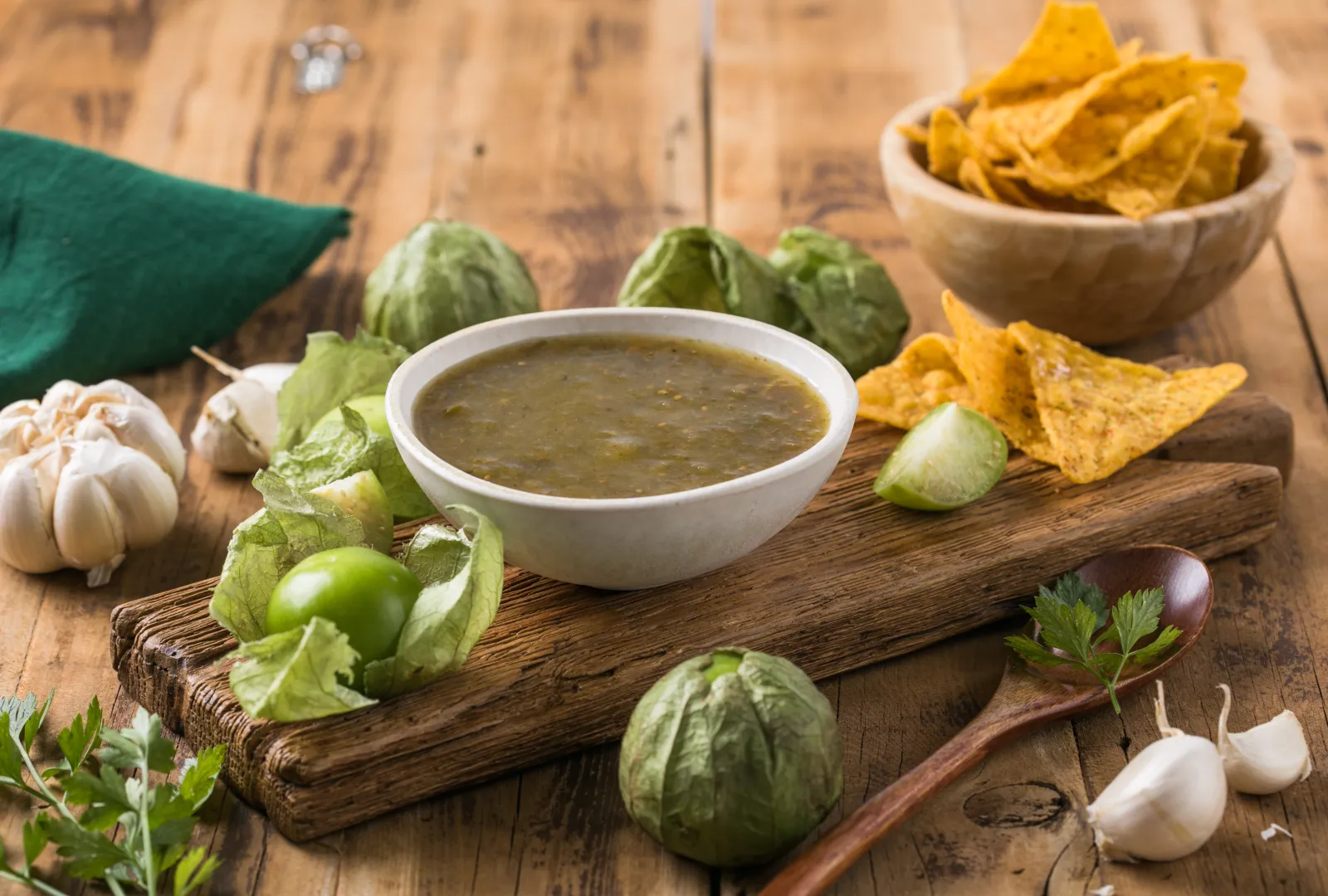

Salsa verde (SAHL-sah VEHR-deh) is the green table salsa of Mexico, and it isn’t made from green tomatoes. It’s made from tomatillos, small, tart fruits wrapped in a papery husk that look like unripe tomatoes and behave like nothing else in the produce aisle. Simmered with a couple of serrano chiles and blended with onion, garlic and cilantro, 1.1 lb (500 g) of them gives you about 22 oz (630 g) of salsa in 20 minutes, roughly what a large store-bought jar holds. Below you’ll find the boiled version, the raw and roasted ones and when each wins, how many chiles for the heat you want, and what to buy if you live in the UK, where fresh tomatillos are hard to find.
How do you make salsa verde at home?
How do you make tomatillo salsa verde? Simmer 1.1 lb (500 g) of husked tomatillos with 2 serrano chiles for 8 to 10 minutes, until they turn from bright to olive green without bursting. Drain, then pulse in a blender with white onion, garlic, cilantro and salt, adding fresh water only if the blades stall. It thickens as it cools. 20 minutes for 10 servings.
That’s the whole method, and the only skill involved is watching the pot. Tomatillos go from underdone to burst in about two minutes, and the color tells you when: bright grass green at the start, a softer olive green when they’re ready. Pull them as each one turns.
Boiled, raw or roasted, which one to make
All three use the same five ingredients. What changes is the heat, and with it the color, the flavor and what the salsa is good for.
- Boiled is the all-rounder and the one in the recipe card. It’s smooth, gently tart and sets slightly in the fridge, which is what you want for chilaquiles verdes, green chicken enchiladas, the creamy sauce for enchiladas suizas or the filling of green chicken tamales. Blended with toasted pumpkin seeds and simmered gently, the same tomatillo base becomes the broth of chicken pozole verde.
- Raw takes 10 minutes. Quarter the tomatillos and blend them uncooked with the rest, using one serrano instead of two (raw chile tastes hotter) and 2 tablespoons of lime juice if you like it extra sharp. Bright green, very fresh, best eaten the same day.
- Roasted is the taco salsa. Spread tomatillos, chiles, onion and garlic on a foil-lined sheet and roast at 450°F (230°C) for 15 to 20 minutes, or under the broiler, turning once, until blistered and blackened in spots. Pull the garlic early if it darkens fast. Smoky, slightly sweet and thick enough to sit on a taco, it’s the one I serve with tacos al pastor.
What you need, and where to buy tomatillos
The exact amounts are in the recipe card. For scaling, I work per 100 g (3.5 oz) of tomatillos: 8 g (0.3 oz) of white onion and 2 g of cilantro, plus one garlic clove and two serranos per 500 g (1.1 lb) batch.
What a tomatillo is, and why a green tomato won’t do
Tomatillos are Physalis philadelphica, a relative of the tomato in a different genus, sold inside a papery husk that grows from the flower’s calyx. Their tartness and green color are the whole point of the salsa, and they carry natural pectin, the same thing that sets jam. That’s why salsa verde thickens in the fridge.
The green tomatoes sold at farmers markets in late summer are something else: ordinary tomatoes, Solanum lycopersicum, picked unripe. They’re wetter, milder and taste grassy rather than sharp. Physalis, the cape gooseberries sold in little packs in UK supermarkets, share the husk and the genus but are sweet and fruity. Neither makes salsa verde.
How to pick tomatillos. Firm, filling or splitting the husk, green just starting to turn yellowish. Chef José Ramón Castillo, interviewed by the Mexican site Directo al Paladar, points to that yellowish tinge as the sign a tomatillo won’t be bitter. Skip any with black, slimy husks or soft spots. Unwashed, in their husks, they keep about two weeks in the fridge.
If you can’t find fresh tomatillos
| Option | Where | What to do | What changes |
|---|---|---|---|
| Fresh tomatillos | most US supermarkets, near the chiles; occasional UK greengrocers | the recipe as written | nothing, it’s the reference |
| Canned whole tomatillos, 794 g (28 oz) tin | US Latin aisle; Ocado and Sous Chef in the UK | drain, skip the boiling, halve the salt | softer, slightly sharper, olive green from the start |
| Unripe green tomatoes | farmers markets, late summer | boil the same way, add the juice of 1 lime, reduce 5 minutes in a pan | wetter and milder; a decent green sauce, not salsa verde |
| Ripe tomatoes and lime | anywhere | only in an emergency | you’ve made salsa roja |
Canned tomatillos come cooked, with salt and citric acid in the brine, so they need no simmering. Simmer just the chiles for 5 minutes, drain the tins, blend everything and add half the salt before tasting. The label on the 2.8 kg catering tin gives 70 % tomatillo, which would put a 794 g (28 oz) tin at about 550 g (1.2 lb) of tomatillos: one batch.
Serrano or jalapeño
Serranos are the classic choice: slim, about 6 g (0.2 oz) each, with a clean heat of 10,000 to 23,000 Scoville units according to the University of Arizona Cooperative Extension. Jalapeños are bigger, about 14 g (0.5 oz) each by USDA data, fleshier, and measure 2,500 to 5,000 units, so one jalapeño brings roughly the heat of half a serrano. In the UK, where serranos are scarce, green jalapeños or the long green chillies sold in supermarkets work; taste a sliver first.
The white ribs and seeds hold most of the heat. For flavor without much burn, split the chile and scrape them out.
Equipment
A 2-quart (2-liter) saucepan, a slotted spoon and a blender. A stick blender in a tall jug does the same job. A molcajete, the Mexican basalt mortar, gives a chunkier, rustic salsa: grind garlic, salt and chile to a paste, then onion, then crush in the cooked or roasted tomatillos. Ten minutes of arm work, and it’s where the roasted version shines.
Why salsa verde turns bitter or runny, and how to fix it
Both problems start in the pot, and both are easier to prevent than to fix.
Bitter salsa.
- Underripe tomatillos — deep green with no yellow tinge. Pick the ones turning yellowish.
- The sticky film left on — the Mexican newspaper Excélsior names it as a source of bitterness. Rub it off under running water.
- Blending with the cooking water — Castillo says it holds the bitter taste. Pour it away and blend with fresh water.
- Already bitter? A pinch of baking soda, under ⅛ teaspoon for the batch, raises the pH and softens it. Overdo it and the salsa tastes soapy, so I try a little more salt and a pinch of sugar first.
Runny salsa.
- Burst tomatillos soak up water. Pull each one as it turns olive.
- Too much water in the blender. Start with none; cooked tomatillos release their own.
- Already thin? Let it cool first, because it thickens. If it’s still loose, fry it: 1 tablespoon of oil in a skillet over medium heat, salsa in, 5 to 10 minutes stirring until a spoon leaves a trail. That fried salsa is the version for enchiladas and chilaquiles.
Jelly-like after a night in the fridge? That’s the tomatillo pectin setting, not spoilage. Stir in a tablespoon or two of hot water.
Kids and allergens. Two serranos land at about 3 out of 5. For children, blend the tomatillos, onion, garlic, cilantro and salt first, pour off their share, then blend the chiles into the rest. The salsa contains no gluten, dairy, eggs, nuts or fish. If cilantro tastes soapy to someone at your table, leave it out; the salsa is flatter but works.
Make ahead, batch sizes and storage
One batch, 1.1 lb (500 g) of tomatillos, makes about 2½ cups (630 g): ten ¼-cup servings, enough for a taco night for 4 to 6. Each kilo (2.2 lb) of tomatillos gives about 5 cups.
For a party of 12 to 20, triple it: 3.3 lb (1.5 kg) of tomatillos simmered together in a large pot, then blended in two or three loads so the blender jar is never more than two-thirds full.
The day before is the best time to make boiled or roasted salsa verde; it thickens and the flavors settle overnight. Raw salsa is better the same day, because its color dulls and the raw onion grows sharper.
Fridge. USDA FSIS guidance for cooked leftovers: no more than 2 hours at room temperature, then 3 to 4 days in a closed jar in the fridge. The avocado version keeps 1 to 2 days before it browns.
Freezer. Boiled and roasted salsa freeze well in ½-cup portions or ice-cube trays, 3 to 4 months for best quality per FSIS. It weeps a little water when thawed; stir it back in, or bring it to a boil in a skillet for 2 minutes. Raw salsa loses its freshness and the avocado version doesn’t freeze.
Variations worth making
- Salsa verde with avocado. Blend 1 Hass avocado (about 135 g / 4.8 oz of flesh) into the cooled boiled or raw salsa for 10 seconds. Creamy, pale green, milder, pourable: the taqueria salsa. It isn’t guacamole, which is mashed and chunky, and it adds about 23 calories per serving.
- Fried salsa for cooking. The boiled salsa, fried 5 to 10 minutes in a tablespoon of oil. Deeper color, thicker body, it clings to tortillas. Loosened with stock, it’s also the braising sauce for chicken in salsa verde.
- Milder, greener. Two seeded jalapeños instead of serranos, and a handful more cilantro.
What it costs
At US advertised supermarket prices in the USDA AMS weekly retail report for October 9, 2026, tomatillos averaged $0.99 a pound, cilantro $0.97 a bunch and jalapeños $1.45 a pound. One batch comes to about $2.28, or 23 cents a serving, and half of that is the cilantro bunch you only use a third of.
In the UK the cost is the tin: Ocado listed the 794 g La Costeña tin at £3.95 in October 2026, so a batch made from canned tomatillos costs about twice the US fresh version.
Salsa verde FAQ
Is salsa verde better boiled or roasted? Boiled if you’re cooking with it, for enchiladas, chilaquiles or tamales: it’s smoother and more neutral. Roasted if it goes on tacos or grilled meat: more flavor and body.
Why is my salsa verde bitter? Underripe tomatillos, the sticky film left on the skins, or blending with the cooking water. Choose tomatillos turning yellowish, rinse them well and blend with fresh water. A pinch of baking soda rescues a bitter batch.
Can I use green tomatoes instead of tomatillos? You’ll get a green sauce, not salsa verde: wetter and milder. Add lime juice and reduce it 5 minutes. Canned tomatillos are the much closer swap.
Are canned tomatillos good for salsa verde? Yes. Drain them, skip the boiling, and halve the salt, because the brine already has some.
How long does homemade salsa verde last? Three or four days in a closed jar in the fridge, following USDA FSIS guidance for cooked leftovers. With avocado, a day or two.
Can you freeze salsa verde? Boiled and roasted, yes, for three or four months. Stir or briefly boil after thawing.
Why did my salsa verde turn to jelly? Tomatillos are rich in pectin, which sets as the salsa chills. A spoonful of hot water loosens it.
Nutrition per serving
Per ¼-cup (60 g / 2 oz) serving, calculated ingredient by ingredient from USDA FoodData Central (SR Legacy) with the amounts in this recipe, salt included:
- Calories: 19 kcal
- Protein: 1 g
- Carbohydrates: 4 g
- Fat: 1 g
- Fiber: 1 g
- Sugars: 2 g
- Sodium: 176 mg
Tomatillos have 32 calories per 100 g (3.5 oz), so the number that matters here is sodium, nearly all of it from the salt. With ½ teaspoon instead of ¾, it drops to about 118 mg a serving.
I grew up in Venezuela with guasacaca, an avocado and vinegar sauce, on the table, and in Colombia every meal comes with ají; salsa verde I learned later, from tins, and it took me a while to trust the color over the clock. These days I make the boiled one on Sundays, pour off Dylan’s share before the chiles go in, and spoon the rest over everything, including the Colombian cheese arepas I make for breakfast. Pull the tomatillos when they turn olive, and the rest takes care of itself. Josnaisis.