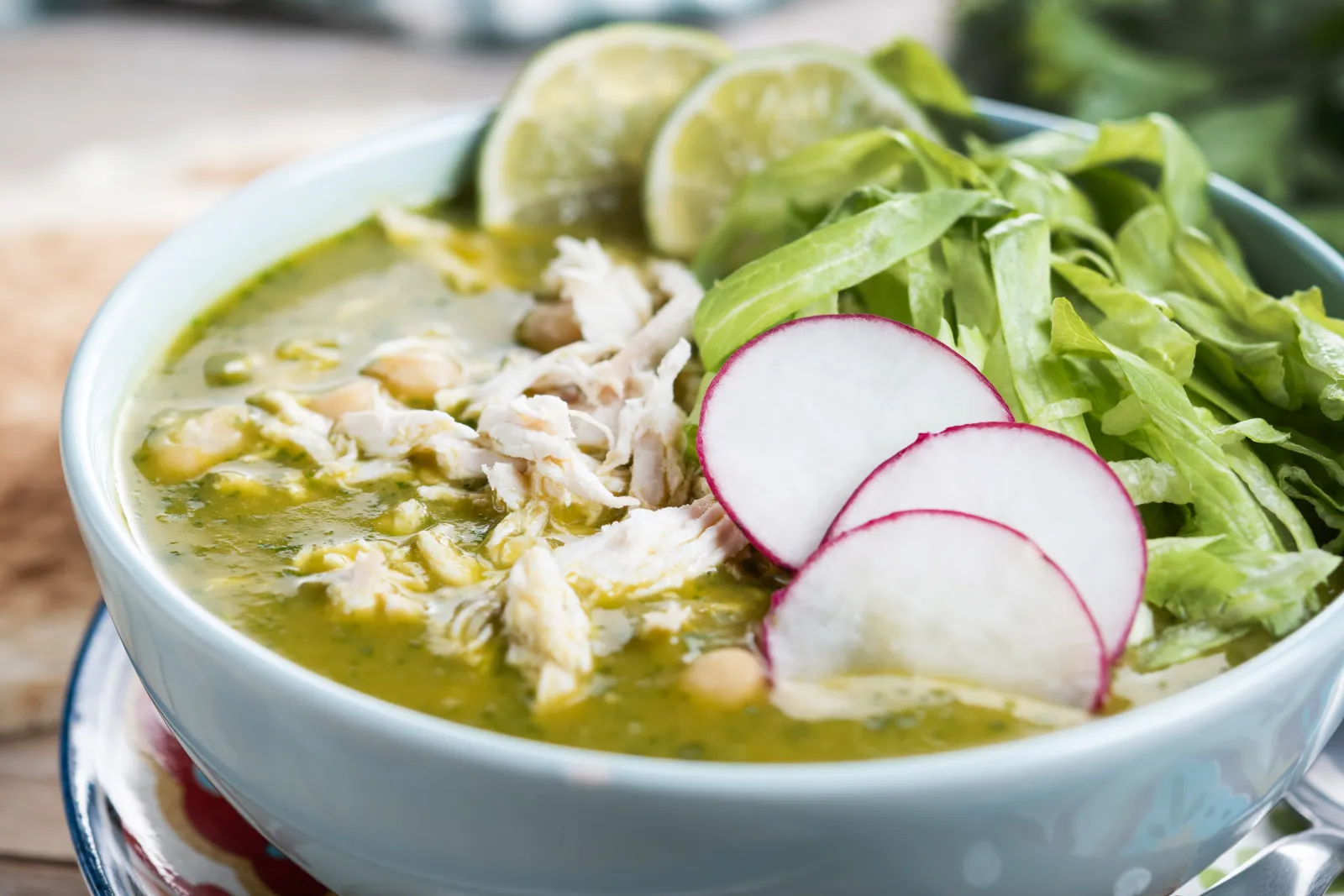

Pozole verde (poh-SOH-leh VEHR-deh) is the green member of Mexico’s hominy soup family, and its color comes from somewhere you might not expect: ground pumpkin seeds. They’re blended with tomatillos, fresh green chiles, cilantro and epazote, and that sauce thickens a chicken or pork broth full of big, chewy hominy kernels until it coats a spoon. In the state of Guerrero it’s the Thursday pozole, per México Desconocido, and it comes to the table with avocado and pork rinds on top of the usual radish, lime and oregano. Made with chicken thighs, it’s on the table in 90 minutes, which is about half the time a pork pozole rojo takes.
What is pozole verde, and is it worth making?
How do you make pozole verde? Simmer 1.5 kg (3.3 lb) of bone-in chicken thighs for 35 minutes in 2.5 liters (10½ cups) of water with onion and garlic. Meanwhile, toast pepitas, simmer tomatillos and serranos, and blend everything with broth, cilantro, epazote and lettuce; cook the sauce 10 minutes over medium-low. Add hominy, sauce and shredded chicken for 20 minutes at a gentle simmer. 90 minutes for 6 servings.
It’s worth it if you like soups with some body. The broth is tart from the tomatillos, nutty from the toasted seeds and thick without any flour or cream, which also means it’s dairy-free. The hominy is soft and springy, closer to a small dumpling than to sweetcorn.
Who it’s for. A weekend lunch for 6, a Mexican Independence Day party on September 15, a holiday crowd that already has a main course, or a family with kids who find red chile sauces too strong.
Who might skip it. Anyone with a seed allergy, since the pepitas can’t be left out. And anyone after a 30-minute weeknight soup: even with an Instant Pot it’s about 65 minutes.
Red or green? Pozole rojo is built on dried guajillo and ancho chiles and usually pork; it takes 150 minutes and holds happily on the stove for hours, which is why I make pozole rojo for big Christmas parties. Green pozole is quicker, lighter (548 kcal a bowl against 671), fresher in flavor, and has one fragile step: the sauce.
Difficulty, medium. Nothing is technically hard. Burnt pepitas make it bitter, and a hard boil after the sauce goes in makes it split.
Shopping list, with US and UK swaps
The exact amounts are in the recipe card: 2.6 lb (1.2 kg) drained hominy, 3.3 lb (1.5 kg) bone-in chicken, 1.1 lb (500 g) tomatillos and ¾ cup (100 g) pepitas for 6 bowls.
Chicken or pork
Bone-in thighs and drumsticks are my default. The bones give the broth body; leaving the skin off keeps it from turning greasy. They’re cooked through and tender in 35 minutes and survive another 20 in the sauce, where breast meat dries out. In Mexico City’s wholesale market on October 9, 2026, the SNIIM listed breast at 112 pesos a kilo and leg-and-thigh at 43, so thighs are also 2.6 times cheaper.
Pork works too: 600 g (1.3 lb) neck bones and 900 g (2 lb) shoulder, simmered 90 minutes instead of 35. Richer, about 770 kcal a bowl.
Canned or dried hominy
Canned is already nixtamalized (treated with lime, the mineral) and bloomed open. Rinse it well, weigh it drained, and add it for the last 20 minutes. Dried hominy for 6 is 1 lb (450 g), soaked overnight and simmered about 90 minutes until the kernels open, separately while you make everything else. Making your own nixtamal from raw field corn is a project for another day; the red pozole recipe walks through it.
Pepitas and tomatillos
Use raw, hulled, unsalted green pumpkin seeds. They’re 49 % fat by USDA data, which is what makes the broth silky and also what separates if the pot boils hard. Published recipes range from ½ cup for 12 (Pati Jinich) to 2 cups for 8 to 10 (Williams-Sonoma); I settle on ¾ cup (100 g) for 6.
Tomatillos look like small green tomatoes in a papery husk. Peel off the husk and rinse away the sticky film underneath. In the UK, where fresh ones are hard to find, La Costeña’s 794 g (28 oz) can of whole tomatillos holds about 550 g of fruit, close to what this pot needs; drain it and skip the simmering step. My salsa verde made with tomatillos goes deeper into when they turn bitter.
Epazote and hoja santa
Epazote is a pungent, resinous herb sold dried in Latin markets and online. Two fresh sprigs are enough for the pot; with dried, start small and taste. Hoja santa is a large anise-scented leaf some cooks use instead. If you can’t find either, add another handful of cilantro and accept a flatter broth. The lettuce is there for color, not flavor.
Equipment. A 6 to 8 quart pot, a blender, a fine sieve, a skillet and a wide saucepan. No sieve? Blend 1 minute longer; you’ll feel a little grit from the seed skins, nothing worse.
The 90-minute plan, and what to make ahead
The whole sauce, from toasting to straining, fits inside the 35 minutes the chicken simmers by itself.
Make ahead. The day before, cook and shred the chicken (keep it moist with a ladle of broth), strain the broth and make the sauce. Refrigerate everything in shallow containers within 2 hours. On the day, bring the broth to a boil, add hominy, sauce and chicken for 20 minutes at a gentle simmer, and slice the toppings meanwhile: 35 minutes. The sauce sets almost solid in the fridge because tomatillos are rich in pectin; it loosens as soon as it hits the hot broth.
Instant Pot or pressure cooker. Chicken, water, onion and garlic at high pressure for 15 minutes, then a 10-minute natural release; published chicken-thigh versions run from 12 to 20 minutes. Make the sauce while the pressure builds and drops. Then, lid off, hominy and sauce on sauté-low for 20 minutes, never under pressure. About 65 minutes total.
The green sauce, and how to keep it from splitting
This is the step that decides the bowl. Four things, and why I do each:
- Toast lightly over medium-low. The seeds puff and pop within about 5 minutes. Pushed to brown, they turn bitter and start releasing their oil early.
- Blend the pepitas alone with 1 cup (250 ml) of broth first. You get a smooth paste. Thrown in with the tomatillos, some seeds stay whole and those are the bits that separate later.
- Cook the sauce 10 minutes over medium-low. Williams-Sonoma fries the ground seeds 2 minutes as a paste and then cooks them 5 with the tomatillo purée; Pati Jinich goes 15 to 18. Ten is where I’ve landed.
- Gentle simmer in the pot. Small bubbles at the edge, for 20 minutes. Hank Shaw notes at Honest Food that a long cook dulls this kind of pumpkin seed sauce to drab olive; a hard boil also breaks it.
If it splits anyway, you’ll see beads of green oil on top and a sandy texture. Lower the heat, blend two ladles of the soup for 30 seconds and stir them back in. In my kitchen it comes back together almost completely. The bright color doesn’t.
Mistakes that ruin pozole verde
- A bitter pot → burnt pepitas, tomatillos that burst, or their cooking water in the blender. Discard that water; blend with broth.
- A split, grainy sauce → a rolling boil after the sauce went in. Keep it at a bare simmer from then on.
- Army-green color → the sauce cooked too long. Blending a couple of raw lettuce or radish leaves in at the end brings some brightness back.
- Thin broth → too few pepitas or boneless meat. ¾ cup (100 g) for 6, and bones in the pot.
- Too salty → canned hominy liquid carries salt. Rinse it, and season at the end.
- Dry chicken → breast meat, or thighs simmered too long. Thighs, 35 minutes.
Kids and allergens. It’s usually a better sell to kids than red pozole: shredded chicken and a milder, fresher flavor, especially with jalapeños. Pumpkin seeds are a seed, not a tree nut, but anyone with a seed allergy can’t eat this. Check tostada labels for wheat if you’re cooking gluten-free. No dairy, egg or fish; the pork rinds on the table are pork.
Scaling for 6, 10 or 15
Per person: 7 oz (200 g) drained hominy, 9 oz (250 g) bone-in chicken, 1⅔ cups (400 ml) water and about 0.6 oz (17 g) pepitas, with tomatillos at five times the weight of the seeds.
| Guests | Drained hominy | Chicken | Water | Tomatillos | Pepitas | Serranos | Pot |
|---|---|---|---|---|---|---|---|
| 6 | 1.2 kg (2.6 lb) | 1.5 kg (3.3 lb) | 2.5 L (10½ cups) | 500 g (1.1 lb) | 100 g (¾ cup) | 3 | 6-8 qt |
| 10 | 2 kg (4.4 lb) | 2.5 kg (5.5 lb) | 4 L (17 cups) | 850 g (1.9 lb) | 170 g (1¼ cups) | 5 | 10-12 qt |
| 15 | 3 kg (6.6 lb) | 3.75 kg (8.3 lb) | 6 L (6.3 qt) | 1.25 kg (2.75 lb) | 250 g (2 cups) | 7-8 | two 10 qt |
For 15, blend the sauce in three batches and cook it in a wide pan so it heats evenly. Two pots beat one huge one: a single 20-quart pot takes too long to come back to a simmer and tempts you to crank the heat, which is exactly what splits the sauce.
Versions to choose from
- Short on time → canned hominy and the Instant Pot, about 65 minutes.
- Pork, or half and half → pork alone 90 minutes; or pork 55 minutes first, then chicken on top for the last 35. The half-and-half pot is my party version.
- Lighter → skip the pork rinds and avocado. The base bowl is 548 kcal.
- Vegetarian → vegetable stock and 800 g (1¾ lb) chunky mushrooms instead of chicken, 20 minutes. The pepitas still give body.
- Seafood → Rick Bayless publishes a green pozole with mussels or clams.
- Guerrero-style table → add diced avocado and pork rinds (chicharrón) to the radish, lime and oregano.
What pozole verde costs
At August 2026 BLS average prices, bone-in chicken legs were $1.670 a pound, so the 3.3 lb here cost $5.52. USDA’s retail report for October 9, 2026 put tomatillos at $0.99 a pound, white onions at $1.22 and cilantro at $0.97 a bunch. Everything in those two datasets comes to $9.05, about $1.51 a bowl.
What drives the price. The meat. Pork shoulder, in the BLS “all other pork” category at $3.737 a pound, would cost $12.36 for the same weight. Neither dataset tracks hominy, pepitas or epazote, so I’m leaving them out rather than guessing; outside the US they’re the imported part of the bill.
Yield. 6 big bowls of about 850 g (30 oz) each, a full meal. As a first course, 9 or 10.
Serving, storing and reheating
At the table. Deep bowls, plenty of hominy and chicken, and small dishes of sliced radishes, shredded lettuce or cabbage, chopped onion, dried oregano, lime wedges, diced avocado, pork rinds and tostadas. A pitcher of agua de jamaica cuts through the tart broth. For a green-themed Mexican spread, green chicken enchiladas or green chicken tamales use the same tomatillo base, and in December a mug of thick champurrado closes the night. If you love chicken soups thickened without cream, Colombia does it with potatoes in Bogotá-style ajiaco.
Fridge. USDA FSIS: no more than 2 hours at room temperature. The FoodSafety.gov chart gives soups and stews with meat 3 to 4 days at 40°F (4°C) or below. Cool it in shallow containers, toppings stored separately.
Freezer. 2 to 3 months for best quality, per the same chart, with chicken, hominy and sauce together. In my experience the sauce sometimes separates a little after thawing; the two-ladle blending trick fixes it. The hominy comes out slightly softer.
Reheating. Over medium-low heat, stirring, to 165°F (74°C) in the center, the FSIS leftovers temperature. Go gently, since a hard boil splits the sauce, and add ½ cup (120 ml) of water per 2 bowls if it thickened. In the microwave, 1-minute bursts with a stir between.
Pozole verde questions
What’s the difference between red and green pozole? The sauce. Red uses dried guajillo and ancho chiles; green uses tomatillos, pumpkin seeds and fresh green chiles. Red with pork needs 150 minutes, while green with chicken is done in 90.
Is it pozole or posole? The same dish. “Posole” is the spelling you’ll often see on US labels and menus.
Does pozole verde have pumpkin seeds? The Guerrero style does, and they’re what thicken it. Without them you get a thinner chicken soup with green salsa. If what you want is chicken braised in the sauce itself, with no hominy or seeds, that’s chicken in salsa verde.
Why did my pozole verde sauce split? It boiled too hard. Pumpkin seeds are 49 % fat, and a rolling boil separates it. Keep a gentle simmer; blend two ladles and stir them back to fix it.
Is pozole verde spicy? Mildly, about 2 out of 5 with three seeded serranos for 6. Two jalapeños make it 1 out of 5.
What can I use instead of epazote? Nothing matches it. Extra cilantro gives a good, flatter broth.
Can I make it in an Instant Pot? Yes. Pressure-cook the chicken on high for 15 minutes and let it release naturally for 10; then add hominy and sauce and keep the lid off, never under pressure.
How much do I need for 15 people? 3 kg (6.6 lb) drained hominy, 3.75 kg (8.3 lb) bone-in chicken, 6 liters of water, 1.25 kg (2.75 lb) tomatillos and 250 g (2 cups) pepitas, split between two pots.
Can you freeze pozole verde? Yes, 2 to 3 months. Reheat gently and re-blend a little if the sauce separates.
Nutrition per bowl
Per serving, about 850 g (30 oz) without toppings, calculated from USDA FoodData Central (SR Legacy) using this recipe’s amounts, counting 1.1 kg (2.4 lb) of meat on 1.5 kg of bone-in thighs (my estimate), canned hominy with its sodium and the broth not skimmed:
- Calories: 548 kcal
- Protein: 46 g
- Carbohydrates: 40 g
- Fat: 23 g, 4 g of it saturated
- Fiber: 9 g
- Sugars: 8 g
- Sodium: 1,297 mg
The fat splits roughly evenly between pepitas, chicken and the oil in the sauce. Canned hominy brings 534 mg of the sodium and the added salt 581 mg, so a thorough rinse is the easiest cut. A sixth of an avocado adds about 40 kcal; two tostadas, about 115.
Pumpkin seeds in Venezuela were something you scraped out and threw away, so the first time I ground them into a sauce I didn’t trust it until the broth thickened in front of me. My first pot split because I let it boil while I set the table. Now it sits on the lowest flame and the table gets set in peace. Josnaisis.