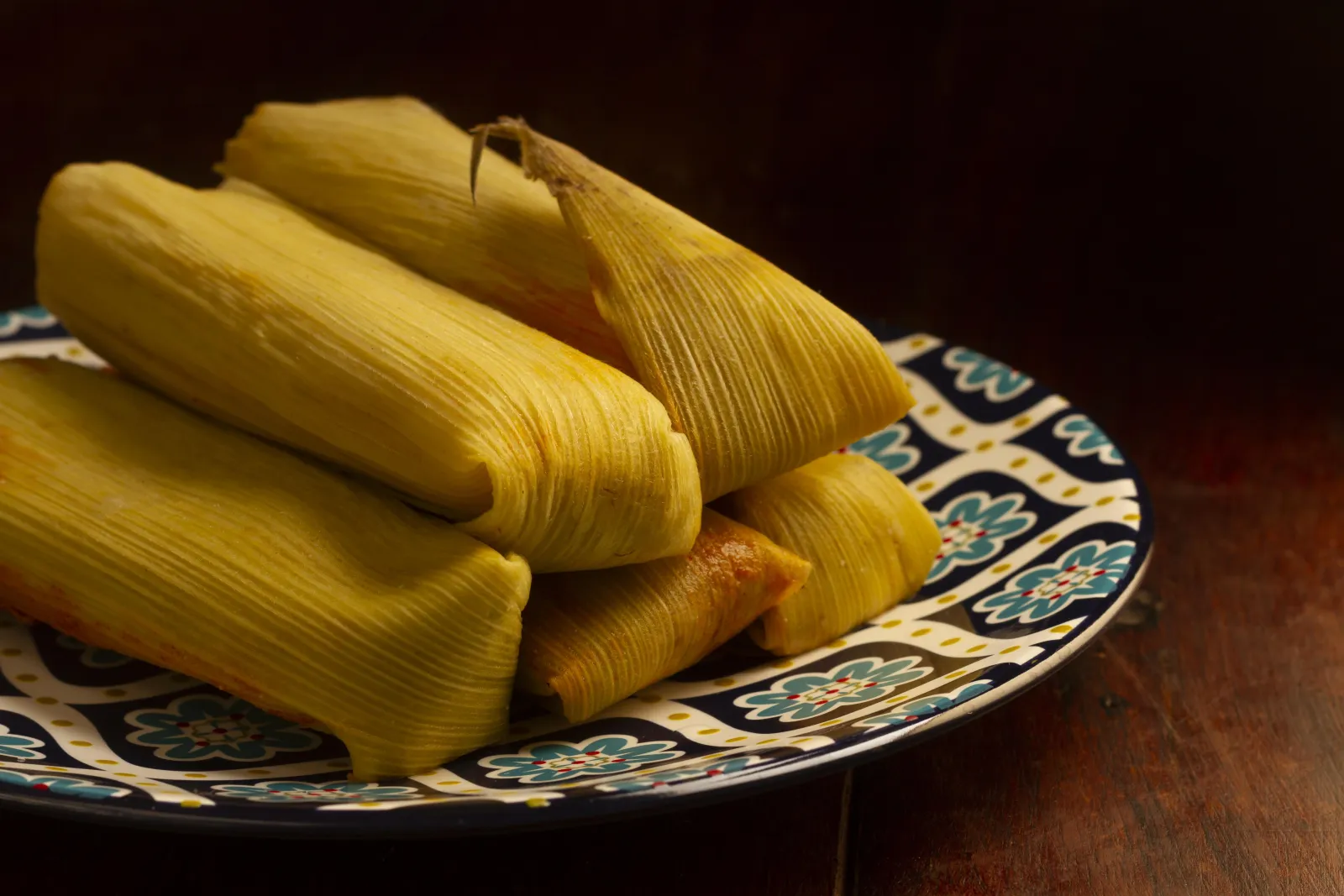

Tamales verdes (tah-MAH-lehs VEHR-dehs) are Mexico’s green tamales: a soft corn dough whipped with lard, wrapped around shredded chicken in tomatillo and serrano salsa, folded into a corn husk and steamed. If your only tamale so far came frozen from a supermarket, the homemade version is lighter and moister, and the difference comes down to one test you can do with a glass of ice water. This batch makes 24, takes 3 hours with half of it hands-off, and freezes for months, which is why Mexican families make them by the dozen for posadas, Christmas Eve and Candelaria on February 2.
What are green chicken tamales, and how are they made?
How do you make green chicken tamales? Poach and shred chicken, then fold it into a thick salsa verde of boiled tomatillos, serrano chiles, onion, garlic and cilantro. Whip masa with 300 g (1½ cups) of lard per kilo (2.2 lb), salt, baking powder and warm broth until a pinch floats in cold water, spread it on soaked corn husks, fill, fold and steam 60 to 75 minutes. 180 minutes for 12 servings of 2 tamales.
A tamal is a parcel of corn dough cooked in a wrapper, and Latin America has dozens of them. The Mexican green one is small, around 75 g (2½ oz) of masa each, with a modest spoonful of filling. The masa is nixtamalized corn, corn cooked with lime (calcium hydroxide) and ground, the same dough as a corn tortilla, so it tastes toasty and faintly mineral rather than like cornbread.
It’s a different dish from a Colombian tamale. The Colombian chicken tamales on this site go in banana leaves with a kneaded masa, bone-in chicken, potato and vegetables, and steam for two hours; a Colombian tamal tolimense even carries rice in the dough. The Mexican one is lighter, faster and eaten two or three at a time.
When it comes to the calendar, December posadas and Christmas Eve are tamale nights in Mexico, and Candelaria, February 2, is tamale day for whoever found the baby figurine in the rosca de reyes back on January 6.
Is it worth it? For a crowd, yes. 180 minutes total, 90 of them hands-on, and 24 cost barely more effort than 12. For a quick dinner for two, no. Difficulty is medium: nothing is technically hard, but three things decide the result, the float test, a thick salsa and patience at the end.
Shopping for a US or UK kitchen
The exact quantities are in the recipe card: 1 kg (2.2 lb) of fresh masa, 300 g (10.5 oz) of lard, 700 g (1.5 lb) of chicken, 750 g (1⅔ lb) of tomatillos and 40 husks for 24 tamales.
| Ingredient | What it is | US | UK | If you can’t find it |
|---|---|---|---|---|
| Masa harina for tamales | dried, ground nixtamalized corn, coarser than tortilla masa harina | Hispanic aisle of most large supermarkets | Mexican online grocers | tortilla masa harina works, slightly denser |
| Corn husks (hojas) | dried husks, sold in bags | Hispanic aisle | Mexican online grocers | squares of parchment and foil, though the flavor is flatter |
| Tomatillos | small green fruit in a papery husk, tart | fresh in most supermarkets | canned, from Mexican online grocers | canned tomatillos, drained, skip the boiling |
| Serrano chiles | small, hot green chile | most supermarkets | some supermarkets, Mexican grocers | jalapeños, milder |
| Lard | rendered pork fat | supermarket baking or meat aisle | supermarket baking aisle | vegetable shortening, same amount |
Two traps. Cornmeal, polenta and masarepa (the precooked corn flour for arepas) are not masa harina: the corn isn’t nixtamalized, and the tamale comes out tasting of arepa or cornbread. And unripe red tomatoes are not tomatillos; nothing else gives that clean, sharp acidity (the salsa verde guide compares canned tomatillos, green tomatoes and physalis side by side).
Fresh masa, masa harina or prepared masa?
Fresh masa from a tortillería has the deepest corn flavor. Masa harina is what most people outside Mexico will use, and the conversion follows the bag’s own ratio of 2 cups flour to 1½ cups water: 400 g (3½ cups) of masa harina plus 600 ml (2½ cups) of hot water replaces 1 kg (2.2 lb) of fresh masa. Rick Bayless uses a bit more flour, 8½ oz for each pound of fresh masa, for a firmer dough; add 50 g (½ cup) more if yours feels loose. Prepared masa for tamales already has lard and salt in it, so it only needs whipping with broth and a taste.
Lard, shortening, butter or oil?
Lard is solid at room temperature, and beating it traps air. That air is what floats the test ball and puffs the tamale in the steam. Vegetable shortening does the same job with no pork flavor. Butter is 81 % fat by USDA figures and most of the rest is water; it whips, but softens fast in a warm kitchen, so I use it half and half with lard when I want the dairy note. Oil can’t be whipped at all: you get a dense, compact tamale, and the float test stops meaning anything.
The float test, and why ice water
Half a teaspoon of masa floats when it holds enough air to be lighter than water. Bayless specifies ice-cold water, and the reason is practical: in warm water the lard in the ball starts to melt and the test lies to you.
If it still sinks after 10 minutes of beating, the masa is usually short of fat or too dry. Add 50 ml (3 tbsp) of broth, beat 2 minutes and test again. With oil, or with a very lean prepared masa, it won’t float at all; then I go by feel, a thick cake-batter texture that pulls cleanly off the spatula.
Steaming without a tamale pot
A tamalera is just a tall pot with a raised rack. An 8 to 10 quart (8 to 10 liter) stockpot does the same job:
- The rack → a folding steamer basket, a metal colander that fits inside, or a heatproof plate set upside down on three balls of aluminum foil.
- The water → 1½ in (4 cm) in the bottom, below the rack; Bayless asks for at least an inch. If water touches the tamales they boil instead of steam and turn soggy.
- The coin → drop one in the water, as Bayless suggests. While it rattles there’s water; when it goes quiet, top up with boiling water, never cold, which kills the steam.
- The lid → husks over the tamales, a clean towel, then the lid. Weigh it down if it doesn’t seal.
My 10-quart pot holds 24 medium tamales standing up. For more, use two pots or two rounds.
How long, and how to tell they’re done. Excélsior gives 60 minutes over medium-low and a 10-minute rest; Bayless, about an hour and then a test; small batches of 6 to 8 take around 40. For a full pot of 24 I count 60 to 75 minutes from the boil. The sign is the husk: pull one tamale, wait 5 minutes, unwrap it. If the husk peels off clean, they’re done. Fresh from the steam the masa always looks raw and sticky, and that’s the moment people add another half hour they didn’t need.
A make-ahead plan for Christmas or Candelaria
- Two days ahead → shop, poach the chicken, refrigerate broth and shredded chicken separately.
- The day before → make the salsa and filling, and whip the masa. Bayless refrigerates the masa overnight and rewhips it next day with a splash more broth; I do the same and repeat the float test.
- On the day → soak the husks, fill, fold and steam: about 2½ hours to the table, 70 minutes of it unattended.
- Weeks ahead → steam the tamales, cool them and freeze. On the day they only need reheating.
Hosting a tamalada for 20 to 40
A tamalada is a tamale-making party, and the arithmetic is simple: 2 tamales per guest, 24 tamales per 2.2 lb (1 kg) of fresh masa. El Universal’s figure is 15 to 20 per kilo (2.2 lb); the difference is the size of each tamale.
Whip the masa in 2.2 lb (1 kg) batches, about 15 minutes each, because a home mixer can’t handle more. Then split the jobs:
- One person, the day before → chicken, salsa and filling.
- One or two on masa → whip each batch and float-test it.
- Three or four on an assembly line → one dries husks, one spreads masa, one fills and folds.
- One on the steamer → loads the pot, watches the water, does the husk test.
Mistakes that ruin tamales verdes
- Heavy, dense tamales → under-whipped masa or too little fat. Don’t fold a single one until the ball floats.
- Masa stuck to the husk → not enough steam, or opened too soon. Wait 5 minutes; if it still sticks, 10 to 15 more minutes in the pot.
- Soggy, pasty tamales → runny salsa, or water touching the tamales. Reduce the salsa and keep 1½ in (4 cm) of water below the rack.
- Masa cracks when folded → too dry. Beat in 50 ml (3 tbsp) more broth.
- Bland → nobody tasted the raw masa. It should taste a touch too salty.
- Scorched pot → it ran dry. Listen for the coin and top up with boiling water.
Heat level, 2 out of 5. Three serranos give a mild heat that arrives late; deseeded, it drops to 1. Two jalapeños are gentler still. Kids generally like them; make their salsa with one jalapeño and tell them the husk isn’t eaten. Allergens: no gluten, dairy, egg or nuts in the recipe, but check the baking powder and masa harina labels for celiac guests. The lard is pork; shortening fixes that without changing the texture.
Other ways to make them
- Short on time → shredded rotisserie chicken (about 600 g / 1⅓ lb of meat) and store-bought prepared masa. That cuts out the poaching and the lard, and the day shrinks to about 2 hours.
- No stand mixer → a hand mixer works; by hand with a wooden spoon, in 500 g (1 lb) batches, it’s a workout of 20 to 30 minutes per kilo in my kitchen.
- No pork → vegetable shortening, same 300 g (1½ cups) per kilo.
- Lighter → 200 g (1 cup) of lard per kilo instead of 300: about 75 kcal less per serving and a slightly firmer tamale.
- Green masa → stir 250 ml (1 cup) of salsa into the whipped masa and cut the broth by the same amount, so the dough itself turns green.
- Vegetarian → strips of roasted poblano with fresh cheese instead of chicken, with the same salsa: tamales de rajas.
- Pork → 700 g (1.5 lb) pork shoulder simmered 60 minutes and shredded, same salsa.
What a batch costs
At US city average prices published by the Bureau of Labor Statistics for August 2026, boneless chicken breast was $4.17 per pound, so the 1.5 lb (700 g) here cost $6.44, about 27 cents a tamale. BLS doesn’t track masa harina, lard, husks or tomatillos, so I won’t put a made-up total on them.
In Mexico the salsa is the cheap part: on October 9, 2026, Mexico City’s Central de Abasto wholesale market, as reported by the Ministry of Economy’s SNIIM, had tomatillos at 16 pesos a kilo and serranos at 17, which puts this salsa at about 17 pesos for 24 tamales.
Yield. 24 medium tamales of about 75 g (2½ oz) of masa: 12 servings of 2, or 8 hungry ones of 3. The expensive parts are the chicken and the lard. Boneless thighs instead of breast cost less in most stores and stay juicier.
Serving, storing and reheating
Taste and texture. Soft, fluffy, moist masa that comes away from the husk in one piece, tasting of toasted corn, around a tart, slightly hot filling.
How they’re served. Hot, in the husk, which each person unwraps; the husk isn’t eaten. In Mexico they go with atole or champurrado, the thick masa and chocolate drink. For a bigger holiday spread, mole poblano is the other dish you can make almost entirely ahead, and a Venezuelan family will recognize the idea from Venezuelan hallacas, boiled in banana leaves instead of steamed in husks. Salsa and shredded chicken left over from the tamale day roll straight into green chicken enchiladas in under half an hour.
Fridge. Per the USDA Food Safety and Inspection Service: no more than 2 hours out of the fridge and 3 to 4 days at 40°F (4°C) or below. Keep them in their husks in a closed container.
Freezer. The best way to keep them. Freeze them steamed and cooled, in their husks, in airtight bags with the air pressed out; according to FSIS, frozen leftovers keep their best quality for 3 to 4 months.
Reheating. Steam them again: 15 to 20 minutes from the fridge, about 30 minutes from frozen without thawing, to 165°F (74°C) in the center. In the microwave, wrap them in a damp towel and go in 1-minute bursts; overdo it and the masa hardens. On a dry skillet in the husk, turning, they get a toasty outside.
FAQ
How many tamales does 1 kg (2.2 lb) of masa make? 24 medium tamales of about 75 g (2½ oz) of whipped masa with this recipe. Bigger tamales give 15 to 20 per 2.2 lb.
How much masa harina replaces fresh masa? 400 g (3½ cups) of masa harina plus 600 ml (2½ cups) of hot water for every 1 kg (2.2 lb) of fresh masa. Then add the lard and broth as usual.
How do I know the masa is whipped enough? Drop ½ teaspoon into ice-cold water. If it floats, it’s ready; if it sinks, beat a couple of minutes more and test again.
How long do tamales steam? A full pot of 24 takes 60 to 75 minutes from the boil, then rests 15 minutes covered. They’re done when the husk peels away clean.
Can I make tamales without a steamer? Yes. A tall stockpot with 1½ in (4 cm) of water and a colander, or a plate set on foil balls, as the rack. The water must never touch the tamales.
Can I use oil instead of lard? Yes, about 1 cup (220 g) per kilo, but oil can’t be whipped, so the tamales come out denser. Vegetable shortening behaves exactly like lard.
How do I freeze and reheat tamales? Steamed, cooled, in their husks, in airtight bags for three to four months. Steam from frozen about 30 minutes, to 165°F (74°C) in the center.
Are Mexican tamales the same as Colombian tamales? No. Mexican tamales use corn husks, a whipped masa and a small filling, and steam for about an hour. Colombian tamales are wrapped in banana leaves with kneaded masa, bone-in meat and vegetables, and cook much longer.
Nutrition
Per serving of 2 tamales, calculated ingredient by ingredient from USDA FoodData Central (SR Legacy) with the quantities above, counting all the lard, 20 g of salt across masa, salsa and the share of broth used, and the fresh masa as 400 g of masa harina:
- Calories: 454 kcal
- Protein: 17 g
- Carbohydrates: 31 g
- Fat: 30 g, of which 11 g saturated
- Fiber: 4 g
- Sugars: 4 g
- Sodium: 735 mg
One tamale is about 227 kcal. More than half the calories come from the lard; at 200 g per kilo the serving drops to about 380 kcal. Nearly all the sodium is salt, with the baking powder adding about 60 mg per serving.
Hallacas were the Christmas parcels of my Venezuelan childhood, and their dough was kneaded, never whipped, so my first Mexican tamales came out like little bricks. The glass of ice water fixed that. It now sits next to the mixer every time, and nothing gets folded until the ball floats. Josnaisis.