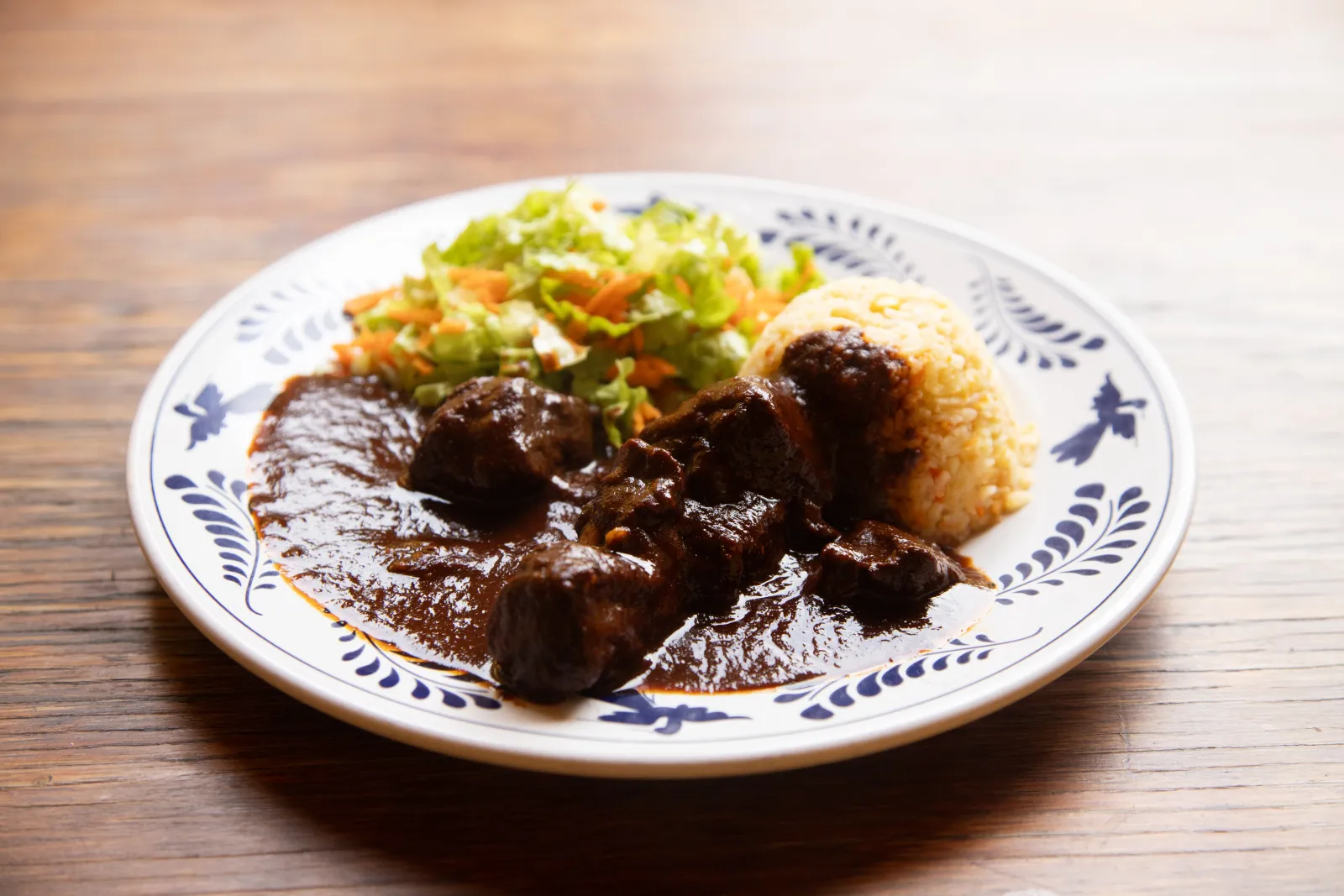

Mole poblano (MOH-leh poh-BLAH-noh) is a thick, dark brown sauce from Puebla, in central Mexico, made from four kinds of dried chile ground with nuts, seeds, bread, spices, charred tomatoes and a little chocolate, then simmered and poured over turkey or chicken. “Poblano” means “from Puebla”, not the fresh green chile, although two of the chiles in it, ancho and mulato, are dried poblanos. It is the dish Mexican families make for big celebrations, and it is the sauce that scares people off with its ingredient list. The list is long; the cooking isn’t hard. What goes wrong is 20 seconds at the skillet, and a plan fixes the rest.
What mole poblano takes, and whether it’s worth a weekend
How do you make mole poblano from scratch? Toast 218 g (7.7 oz) of dried ancho, mulato, pasilla and chipotle chiles for 10 to 20 seconds a side, soak them, and blend with chicken broth, fried almonds, peanuts, sesame, bread, tortilla, spices and charred tomatoes. Strain, fry the purée in lard, simmer 40 minutes with Mexican chocolate, then thin with broth and simmer the cooked chicken in it. 160 minutes for 8 servings.
Worth it for a holiday table, yes, if you split it over two days. One afternoon makes a paste that keeps; serving day is then 80 minutes, about 40 of them hands-on. In a single session it is 160 minutes with about 90 of active work.
Honest difficulty, hard. Not because any step needs skill, but because there are many small steps and two of them punish inattention: toasting the chiles and toasting the sesame, which goes from golden to burnt in under a minute.
Skip it if you want dinner tonight, or if someone at the table is allergic to tree nuts, peanuts or sesame and you don’t want to adapt it (the swaps are below).
How spicy is mole poblano?
Mild. It rates about 2 out of 5 with two chipotles, and closer to 1 without them. The three main chiles are gentle: on Food.com’s Scoville chart ancho sits at 1,000 units and pasilla at 2,500, both below a fresh jalapeño. The mulato isn’t listed there; a Puebla family’s recipe published by Sunset describes it as slightly hotter than the ancho.
Kids. Most children like it because it’s sweet and mild. Leave out the chipotle and serve theirs with less sauce and plenty of rice.
Allergens. This recipe contains tree nuts (almonds), peanuts, sesame and gluten from the bread. Some table chocolates add soy lecithin or carry milk traces, so check the label. Jarred mole paste is no way around it: Doña María lists peanuts, sesame, wheat and soy.
- Gluten-free → replace the bread with a second corn tortilla (30 g / 1 oz).
- Nut- and peanut-free → leave out the almonds and peanuts and add 30 g (1 oz) more pepitas. The sauce is a little thinner.
- Sesame-free → harder, since sesame is part of the flavor. Use 40 g (1.4 oz) more pepitas and skip the sesame on top.
Ingredients, grouped so the list makes sense
Nineteen lines on the recipe card, but only seven jobs:
| Group | What’s in it | What it does |
|---|---|---|
| Chiles, 218 g (7.7 oz) | ancho, mulato, pasilla, chipotle | flavor, color, the little heat there is |
| Fat, 90 g (6 tbsp) | lard or oil | fries the nuts and, above all, the purée |
| Nuts and seeds, 165 g (5.8 oz) | almonds, peanuts, pepitas, sesame, raisins | body and thickness |
| Bread, 70 g (2.5 oz) | 1 corn tortilla, a piece of bread roll | thickens |
| Spices | cinnamon, cloves, pepper, anise, thyme | background, never the lead |
| Charred produce, 565 g (1.25 lb) | tomatoes, tomatillos, onion, garlic | acidity and sweetness |
| To finish | 60 g (2.1 oz) table chocolate, salt, broth | rounds off the bitterness |
The chiles, and what to buy in the US and UK
For 8 people, 80 g (2.8 oz) ancho, 80 g (2.8 oz) mulato, 50 g (1.8 oz) pasilla and 2 chipotles, weighed after stemming and seeding. Ancho is wide and wrinkled, reddish brown. Mulato looks similar but almost black. Pasilla is long, thin and black; it’s the dried chilaca. Chipotle is a smoked, dried jalapeño. One trap in US stores: anchos are sometimes labeled “pasilla”, so go by shape, not by the bag.
In the UK, Mextrade sells pasilla by the kilo, and mulato turns up at online spice shops such as Spice Mountain and Somerset Foodie in 100 g bags. Order a week before you plan to cook.
Equipment
A cast-iron skillet or comal, a powerful blender, a fine sieve and a heavy pot of at least 5 quarts (5 liters): the purée spits and sticks. With a weaker blender, blend in smaller batches for longer and sieve twice.
Toasting the chiles without turning them bitter
A dried chile has so little water left that it goes from toasted to burnt in seconds, and burnt chile skin is bitter. In a sauce carrying 218 g (7.7 oz) of chile, one burnt pod flavors everything. Published methods give 15 to 30 seconds a side; I stay at 10 to 20 seconds a side over medium heat, because an under-toasted chile is harmless and an over-toasted one isn’t.
- Medium heat, never high. Chiles opened flat, two at a time.
- Press with a spatula so the whole surface touches the metal.
- Done → brighter red, pliable, smells toasty.
- Too far → white smoke or black spots. That chile goes in the bin.
- Discard the soaking water. It’s bitter; blend with broth instead.
- Seeds and veins out first, because they scorch before the skin does.
Frying the purée, the step that changes the flavor
The strained purée goes into hot lard and fries for 10 minutes before any broth. This is where raw chile flavor turns into mole: the sauce darkens a shade, stops spitting and starts to pull away from the pot. Skip it and the mole tastes of raw chile. Then 40 minutes at low heat with the chocolate, stirring every 5 minutes, until it looks glossy with a little fat at the edges.
Mistakes that ruin mole poblano
- Bitter sauce → burnt chiles or sesame, the soaking water in the blender, or toasted seeds and veins. A tablespoon of sugar and 20 g (0.7 oz) more chocolate soften mild bitterness; a burnt chile can’t be fully rescued.
- Gritty texture → it wasn’t sieved. A fine sieve isn’t optional.
- Scorched bottom → high heat or not enough stirring. Low heat, spoon along the bottom every 5 minutes.
- Too sweet → too much chocolate or raisins. More broth and a pinch of salt.
- Thick as paste the next day → normal; mole sets as it cools. Add broth when reheating.
A two-day plan for Christmas Eve or New Year’s Eve
The paste is the long part, and it’s better made ahead. For a dinner on the 24th or the 31st:
- Two days before → toast and soak the chiles, fry the nuts and seeds, blend, sieve, and cook the paste with the chocolate. Use store-bought chicken broth or broth made that day. Cool uncovered, then refrigerate in a sealed container.
- The day before (optional) → poach the chicken or turkey, cool it in its broth and refrigerate both. Lift off the fat that sets on top.
- The day itself → reheat the paste with 1 tbsp of lard, thin it with the meat broth, add the meat for 20 minutes, make rice alongside.
Turkey instead of chicken. Turkey is the traditional meat. A recipe from Sunset simmers two bone-in turkey breast halves, 5 to 6 lb (2.3 to 2.7 kg) in total, in salted water for 35 to 40 minutes, to 165°F (74°C) at the thickest point. Turkey thighs and drumsticks take longer; go by a thermometer, not the clock.
Scaling it for 6, 12 or 20 people
Allow about 27 g (1 oz) of dried chile and 250 g (9 oz) of bone-in meat per person, and scale everything else the same way.
| Guests | Dried chiles, all four | Bone-in meat | Paste batches |
|---|---|---|---|
| 6 | 164 g (5.8 oz) | 1.5 kg (3.3 lb) chicken | 1 |
| 8 | 218 g (7.7 oz) | 2 kg (4.4 lb) chicken | 1 |
| 12 | 327 g (11.5 oz) | 3 kg (6.6 lb) chicken or turkey | 1, large pot |
| 20 | 545 g (1.2 lb) | 5 kg (11 lb) turkey | 2 |
For 20, make the paste in two batches. A home blender can’t take 545 g of chile at once, and an overcrowded pot stews the purée instead of frying it.
Jarred mole paste or homemade?
Jarred (Doña María is the brand most US supermarkets carry) takes about an hour including the chicken. The jar label calls for roughly 4 parts broth to 1 part paste. It’s sweeter and flatter than homemade, and you can’t take the allergens out. I use two 8.25 oz (235 g) jars for 4.4 lb (2 kg) of chicken, because one leaves the sauce thin.
The upgrade that gets jarred mole close to homemade, in about 75 minutes: fry the paste in 1 tbsp of lard for 5 minutes, then blend in 2 toasted ancho chiles, 1 charred tomato and 20 g (0.7 oz) of table chocolate with some broth, and simmer 20 minutes before thinning. If it’s your first mole and you’re feeding 20, this is the safe bet.
Homemade wins when you can split it over two days and when you need to control heat, sweetness or allergens.
What mole poblano costs in the US
At the US city average prices the Bureau of Labor Statistics published for August 2026, bone-in chicken legs were $1.670 per pound, so the 4.4 lb (2 kg) here cost $7.36, about $0.92 a serving. A whole chicken at $2.012 per pound would cost $8.87 for the same weight. A Doña María jar was $2.86 at Walmart when I checked in October 2026.
The BLS doesn’t track dried chiles, nuts or Mexican chocolate, so I won’t give a total I can’t back up. The expensive part outside Mexico is usually the mulato bought online; if budget matters, use more ancho in its place.
Yield. 8 servings of 2 chicken pieces with plenty of sauce. In my kitchen the paste comes to about 1.2 liters (5 cups) before thinning and about 2.2 liters (9 cups) of finished mole.
Serving, storing and reheating
How it tastes. Chile and toastiness first, then a soft sweetness from raisins and chocolate, then the spices and a little smoky heat at the end. It doesn’t taste like chocolate; the chocolate only rounds it off.
How it’s served. Meat covered in sauce, toasted sesame on top, warm corn tortillas, and rice on the side. Red rice is the most common in Mexico; fluffy white rice works just as well for soaking up the sauce. On a Latin holiday table it sits easily next to Venezuelan hallacas and Venezuelan ham bread, with Colombian natilla for dessert and a mug of Colombian hot chocolate, made with the same kind of sweetened table chocolate that goes into the mole. For a weeknight chicken in a thick sauce that takes an hour, there’s Colombian stewed chicken. If the bag of pasillas has a couple left over, Mexican tortilla soup with pasilla chile needs just two for four bowls.
Fridge. With the meat in it, mole is a cooked poultry dish. The USDA Food Safety and Inspection Service rules: no more than 2 hours out of the fridge, then 3 to 4 days at 40°F (4°C) or below. Spread it in containers no deeper than 3 inches (7.5 cm) so it cools quickly.
Freezer. Mole with the meat freezes well for 2 to 6 months (FSIS). The concentrated paste, before any broth goes in, freezes best of all. Pati Jinich keeps hers up to a month in the fridge and a year in the freezer; I make mine with broth in the blender, so I keep it no more than a week in the fridge under a thin layer of lard, and freeze the rest in flat 300 g (10 oz) bags, enough for 2 or 3 people.
Reheating. Mole thickens as it cools. Add ½ cup of broth for every 2 cups of mole and heat gently, stirring, until it simmers and the meat reaches 165°F (74°C) in the center. High heat scorches the bottom, and scorched mole is bitter mole. Leftover sauce makes enmoladas the next day: warm corn tortillas folded around shredded meat and covered in mole. Leftover paste is enough for a pot of romeritos in mole with dried shrimp cakes.
Frequently asked questions
What chiles are in mole poblano? Ancho, mulato and pasilla are the base; chipotle adds smoke and the heat. For 8: 80 g (2.8 oz) ancho, 80 g (2.8 oz) mulato, 50 g (1.8 oz) pasilla and 2 chipotles, stemmed and seeded.
Why is my mole bitter? Almost always burnt chiles or sesame, or blending with the soaking water. Toast chiles 10 to 20 seconds a side over medium heat and discard any that smoke. A tablespoon of sugar softens mild bitterness.
Is mole poblano spicy? Not much, about 2 out of 5 with two chipotles. Ancho is rated around 1,000 Scoville units and pasilla 2,500, both milder than a fresh jalapeño.
Can I make mole ahead? Yes, and it improves. Make the paste one or two days ahead and refrigerate it. On the day, cook the meat and thin the paste with its broth; about 80 minutes, 40 hands-on.
How long does mole paste keep? I keep homemade paste up to a week in the fridge under a layer of lard, or freeze it in flat bags. Finished mole with meat keeps 3 to 4 days in the fridge and 2 to 6 months frozen, per the USDA FSIS.
Is jarred mole any good? It’s a fair shortcut: about an hour with the chicken and under $3 a jar in the US, but sweeter and flatter than homemade, and it contains peanuts, sesame, wheat and soy. Frying it and blending in 2 toasted anchos, a charred tomato and some chocolate brings it close.
Can I use turkey? Yes, it’s the traditional meat. Simmer bone-in turkey breast 35 to 40 minutes to 165°F (74°C); thighs take longer.
Can I make mole poblano without nuts or gluten? Yes. Swap the bread for a second corn tortilla to make it gluten-free, and replace the almonds and peanuts with extra pepitas for a nut-free version.
Nutrition
Per serving (2 chicken pieces with about 270 ml / 1 generous cup of mole, without rice or tortillas), calculated ingredient by ingredient from the USDA FoodData Central database (SR Legacy) with the quantities above, counting 1.4 kg (3.1 lb) of meat in 2 kg of bone-in thighs and drumsticks (my own estimate) and all of the lard:
- Calories: 577 kcal
- Protein: 43 g
- Carbohydrates: 35 g
- Fat: 31 g, of which 8 g saturated
- Fiber: 10 g
- Sodium: 946 mg
More than half the fat comes from the lard and the seeds; with 50 g (3½ tbsp) of lard instead of 90 g you save about 45 kcal a serving and the purée still fries properly. A cup of cooked rice adds about 200 kcal. There’s no sugar figure because the USDA database doesn’t give one for dried ancho and pasilla chiles.
Mole isn’t a dish I grew up with: a Venezuelan Christmas means hallacas, and chocolate was something we drank. I learned it from cookbooks and from one batch I ruined with three pasillas left too long on the skillet, which taught me more than any recipe did. The chiles decide the sauce, and the clock decides the chiles. These days the paste goes into my freezer in flat bags in early December. Josnaisis.