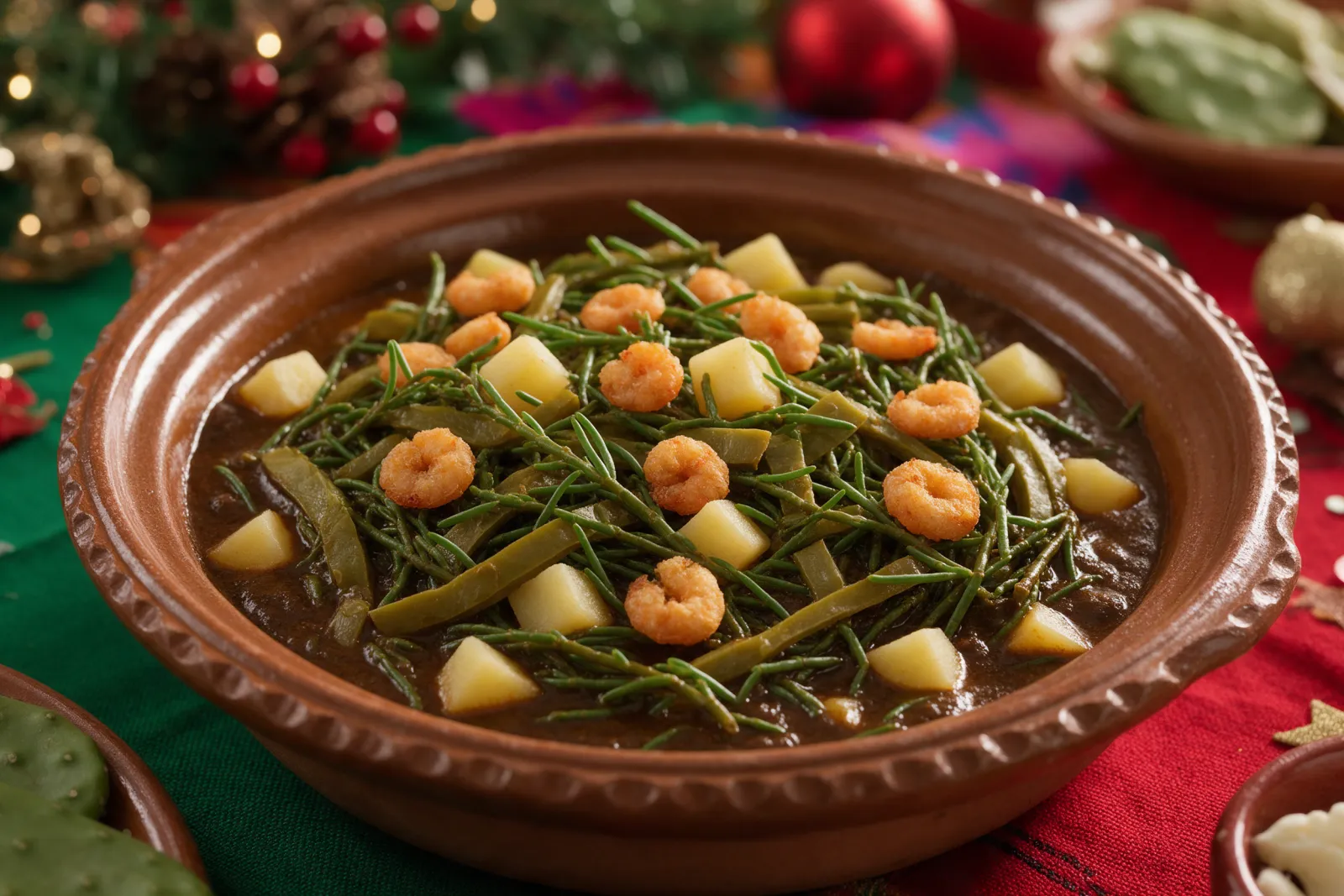

On Christmas Eve in central Mexico, a pot of dark mole often holds something green that looks like rosemary and tastes of the sea. That’s romeritos (roh-meh-REE-tohs): the tender tips of Suaeda edulis, a fleshy, naturally salty plant grown in the saline soils south of Mexico City, simmered in mole with potatoes and cactus paddles and topped with fluffy fritters of dried shrimp. Outside Mexico the greens are the hard part, and the closest stand-in is one a UK supermarket already sells: samphire.
What romeritos are, and whether the dish is worth making at home
How do you make romeritos? Trim and blanch the greens for 5 minutes, cook potatoes and nopales separately, and fry mole paste before thinning it with 1 liter (4 cups) of broth. Whip 4 egg whites stiff, fold in the yolks and 120 g (4.2 oz) of ground dried shrimp, fry spoonfuls into puffy cakes, and add them to the sauce for the last 5 minutes. 90 minutes for 8 servings.
What they are. Despite the name, romeritos have nothing to do with rosemary. The cultivated plant was described as a new species, Suaeda edulis, by Noguez-Hernández, Carballo-Carballo and Flores Olvera in the journal Botanical Sciences, from saline lakes in central Mexico; older sources call it Suaeda torreyana. In English it’s a seepweed, a cousin of samphire and lambsquarters. Because it grows in salty ground, it tastes salty before you add anything. In Mexico it’s a dish of the Christmas and New Year’s Eve dinners and of Lent.
Is it worth it? Yes, if you like mole and want a holiday main that isn’t a roast. It’s 90 minutes, about 65 of them hands-on, and most of that is trimming greens and frying shrimp cakes. With the sauce made the day before, the day itself drops to 45 minutes.
Skip it if someone at the table is allergic to shellfish or eggs, since both are in the cakes and shrimp goes into the sauce too.
How to buy and substitute romeritos in the US and UK
Fresh romeritos turn up in December at Mexican markets in US cities with large Mexican communities. Canned romeritos exist too, some already stewed with shrimp, so check the label before you add more mole. In the UK they’re essentially unavailable, and the honest answer is a swap.
| You can’t find | Use | What changes |
|---|---|---|
| Romeritos, 900 g (2 lb) trimmed | Samphire (sea beans), same weight | Crunchier and saltier; blanch 1 minute, never salt |
| Romeritos | Lambsquarters or purslane | Softer, no natural salt; purslane is tangier |
| Romeritos | Baby spinach, 500 g (1.1 lb) | Stir in raw at the end; it collapses into spinach in mole |
| Nopales, 400 g (14 oz) fresh | Jarred nopalitos, drained and rinsed | Already cooked; add them with the potatoes |
| Mexican dried shrimp | Asian dried shrimp from an Asian grocer | Same ingredient; check saltiness by tasting one |
| Mole paste | Homemade mole poblano paste | Deeper flavor, allergens under your control, one extra day |
Samphire, in practice. Waitrose has stocked British samphire year-round from glasshouse growers, and Tesco and fish counters carry it in season. In the US, look for “sea beans” at fishmongers and specialty grocers. It’s a salt-marsh plant like seepweed, so the texture and seasoning land close; just cut the blanching to a minute or it goes limp.
Dried shrimp. Small, orange and very salty: the USDA’s FoodData Central lists 2,175 mg of sodium per 100 g (3.5 oz), and some US brands declare over 3,000 mg. They’re sold at Mexican groceries and at almost every Asian grocery in the US and UK.
Mole paste. Doña María in jars is the brand most US supermarkets carry. If you’d rather make your own, the paste from my mole poblano from scratch works as is; half a batch is plenty for this pot.
A Christmas Eve plan that leaves you 45 minutes on the day
The sauce and the vegetables improve overnight; the shrimp cakes don’t. So split it:
- Two days before → buy the greens, shrimp and paste. Keep the romeritos unwashed, wrapped in paper towel inside a bag, in the crisper. Grind the shrimp and store the powder in a sealed jar.
- December 23 → trim, wash and blanch the greens, cook the potatoes and nopales, and make the mole sauce. Refrigerate the sauce and the vegetables separately.
- December 24 → reheat the sauce, add the vegetables, and fry the shrimp cakes while they simmer.
Scaling for 4, 8 and 20
| Guests | Romeritos, as bought | Mole paste | Broth | Potatoes | Nopales | Dried shrimp | Eggs |
|---|---|---|---|---|---|---|---|
| 4 | 600 g (1.3 lb) | 175 g (6.2 oz) | 500 ml (2 cups) | 250 g (9 oz) | 2 | 75 g (2.6 oz) | 2 |
| 8 | 1.2 kg (2.6 lb) | 350 g (12.3 oz) | 1 L (4 cups) | 500 g (1.1 lb) | 4 | 150 g (5.3 oz) | 4 |
| 20 | 3 kg (6.6 lb) | 875 g (1.9 lb), 4 jars | 2.5 L (10½ cups) | 1.25 kg (2.75 lb) | 10 | 375 g (13.2 oz) | 10 |
For 20, blanch the greens in 1 kg (2.2 lb) batches so the water keeps boiling, whip the whites in two lots of 5, and use a 10-quart pot or two smaller ones. You’ll fry about 40 cakes.
Shrimp cakes that hold together in the sauce
The cakes are an egg foam carrying shrimp powder, so the foam is what holds them up. Three rules, each worth 2 minutes of patience:
- Stiff whites, 4 to 5 minutes with an electric whisk. Turn the bowl over; nothing should slide. Beat in the yolks one at a time so the foam doesn’t collapse.
- 30 g (1 oz) of ground shrimp per egg. More makes a heavier, saltier cake that breaks more easily; one widely shared Mexican recipe uses 200 g for 4 eggs, which is 50 g per egg. If your shrimp tastes very salty, drop to 25 g (0.9 oz) per egg.
- Five minutes in the sauce, no stirring. Twenty minutes of simmering turns any cake into crumbs. For a buffet, serve them on a platter beside the pot.
No salt, anywhere. Not in the batter, not in the vegetable water, not in the sauce. Taste at the very end; it almost never needs any.
Mistakes that ruin romeritos
- Watery sauce → greens not squeezed, or sauce too thin to begin with. Squeeze by the handful and leave the mole thicker than looks right.
- Too salty → added salt, regular boxed broth or very salty shrimp. Regular broth instead of low-sodium adds about 430 mg of sodium per serving. To rescue it, more unsalted broth and an extra potato.
- Greasy, flat cakes → oil below 340°F (170°C). The batter should bubble the moment it lands.
- Gritty greens → fewer than three washes.
- Slimy nopales → not rinsed after boiling.
- Gray, limp greens → blanched too long. Romeritos 5 minutes, samphire 1.
Spice level, kids and allergens
Heat, 1 out of 5. Commercial mole pastes are mild; homemade mole poblano with two chipotles sits around 2.
Kids usually go straight for the shrimp cakes. Serve theirs with potato and a little sauce.
Allergens. Shellfish (dried shrimp, in the cakes and the sauce) and egg. Commercial mole paste adds peanuts, sesame and wheat per the Doña María label; the Doña María paste listed in the USDA database also declares caramel color with sulphites, and other listings add soy. Homemade mole poblano carries almonds, peanuts, sesame and gluten from bread, and the breadcrumbs in the cakes are gluten.
- Gluten-free → ground dry corn tortilla instead of breadcrumbs, and homemade mole made with tortilla instead of bread; none of the commercial pastes I checked will do.
- Shellfish-free → potato and cheese cakes in place of shrimp, and no shrimp in the sauce. A different dish, still a good one; I add 1 toasted, ground ancho chile to the broth to make up some depth.
What romeritos cost in the US
At the Bureau of Labor Statistics’ US city averages for August 2026, a dozen large eggs cost $2.272 and white potatoes $0.976 per pound: $0.76 for the 4 eggs and $1.08 for 1.1 lb. A jar of Doña María paste was $2.86 at Walmart when I checked in October 2026. The lines I can back up come to $6.13, about $0.77 a serving. Dried shrimp, the greens and nopales aren’t tracked by the BLS, and they’re what really sets the bill, so I’d rather leave them out than guess.
Yield. 8 plates, each with about 110 g (4 oz) of greens, potato, cactus and 2 shrimp cakes. As a side next to a roast it stretches to 12.
Serving, storing and reheating
How it tastes. A thick, reddish-brown sauce, sweet and mellow from the mole, with the sea saltiness of the shrimp. The greens stay juicy with a slight crunch, the potato softens everything, the cactus brings a little acidity, and the shrimp cakes are the part everyone fishes for.
How to serve it. In shallow bowls with 2 cakes on top and warm corn tortillas. On a Mexican holiday table it sits next to pozole rojo and green chicken tamales; to drink, café de olla or a cup of thick champurrado. If your Christmas is more Colombian, fluffy white rice soaks up the sauce just as well. For a taco buffet alongside, Yucatán-style cochinita pibil bakes unattended while you deal with the shrimp cakes.
Fridge. Per the USDA Food Safety and Inspection Service: refrigerate leftovers within 2 hours, and eat them within 3 to 4 days at 40°F (4°C) or below. Store the shrimp cakes in a separate container.
Freezer. The sauce with the greens and cactus freezes well, and FSIS gives cooked leftovers 2 to 6 months. Potatoes turn mealy and the cakes lose their air, so freeze the sauce without them and add fresh potato and cakes when reheating.
Reheating. Mole thickens in the fridge: add ½ cup of broth for every 2 cups and heat gently, stirring, until it simmers and reaches 165°F (74°C) in the center. Crisp the cakes separately, 3 minutes in a dry skillet or in a 350°F (180°C) oven, and lay them on top.
Frequently asked questions
What are romeritos? The tender tips of Suaeda edulis, a fleshy, salty seepweed grown in saline soils around Mexico City. They aren’t rosemary, though the thin leaves look similar.
What can I use instead of romeritos? Samphire (sea beans) is the closest: salty, crunchy and juicy. Blanch it 1 minute and add no salt. Lambsquarters or purslane work with a softer texture; spinach is a last resort.
Do romeritos taste like rosemary? No. They taste green and salty, a little like samphire or spinach cooked in seawater, with none of rosemary’s resin.
How long do you boil romeritos? I blanch them 5 minutes from when the water returns to the boil, unsalted, because they simmer another 15 minutes in the sauce. Published recipes range from 5 to 10 minutes.
Why do my shrimp cakes fall apart? Soft egg whites, too much shrimp for the egg, or too long in the sauce. Whip to stiff peaks, use 30 g (1 oz) of shrimp per egg, and add the cakes for the last 5 minutes.
Can I make romeritos ahead? Yes. The sauce and vegetables keep in the fridge overnight; fry the shrimp cakes on the day.
Are romeritos gluten-free? Not with commercial mole paste and breadcrumbs. Use homemade mole without bread and ground tortilla in the cakes.
Nutrition
Per serving (one eighth of the recipe with 2 shrimp cakes, without tortillas), calculated ingredient by ingredient from USDA FoodData Central with the quantities above: SR Legacy entries for egg, potato, nopales, breadcrumbs, low-sodium broth and oil, the FNDDS survey entry for dried shrimp, and the Doña María mole paste label listed in the database. Romeritos aren’t in the USDA data, so I used lambsquarters, a relative, for 900 g (2 lb) of trimmed greens. The 40 g (1.4 oz) of oil absorbed by 16 cakes is my own estimate.
- Calories: 531 kcal
- Protein: 25 g
- Carbohydrates: 37 g
- Fat: 32 g, of which 5 g saturated
- Fiber: 8 g
- Sugars: 11 g
- Sodium: 1122 mg
Nearly half the calories come from the mole paste, which is over 40 % fat by weight. Sodium is the number to watch: 1,122 mg a serving with no salt added, mostly from the paste (about 580 mg) and the shrimp (about 410 mg), and real romeritos probably add a little more than lambsquarters does, since they grow in salty ground.
My Christmas growing up was hallacas in Venezuela, and in Colombia it’s natilla and buñuelos, so romeritos came to me as a cook’s curiosity rather than a family dish. The first thing that surprised me was biting into a raw sprig and tasting salt, which is why nothing in this pot gets salted. The second was watching my first shrimp cakes dissolve in the sauce. Stiff whites and the last five minutes fixed both. Josnaisis.