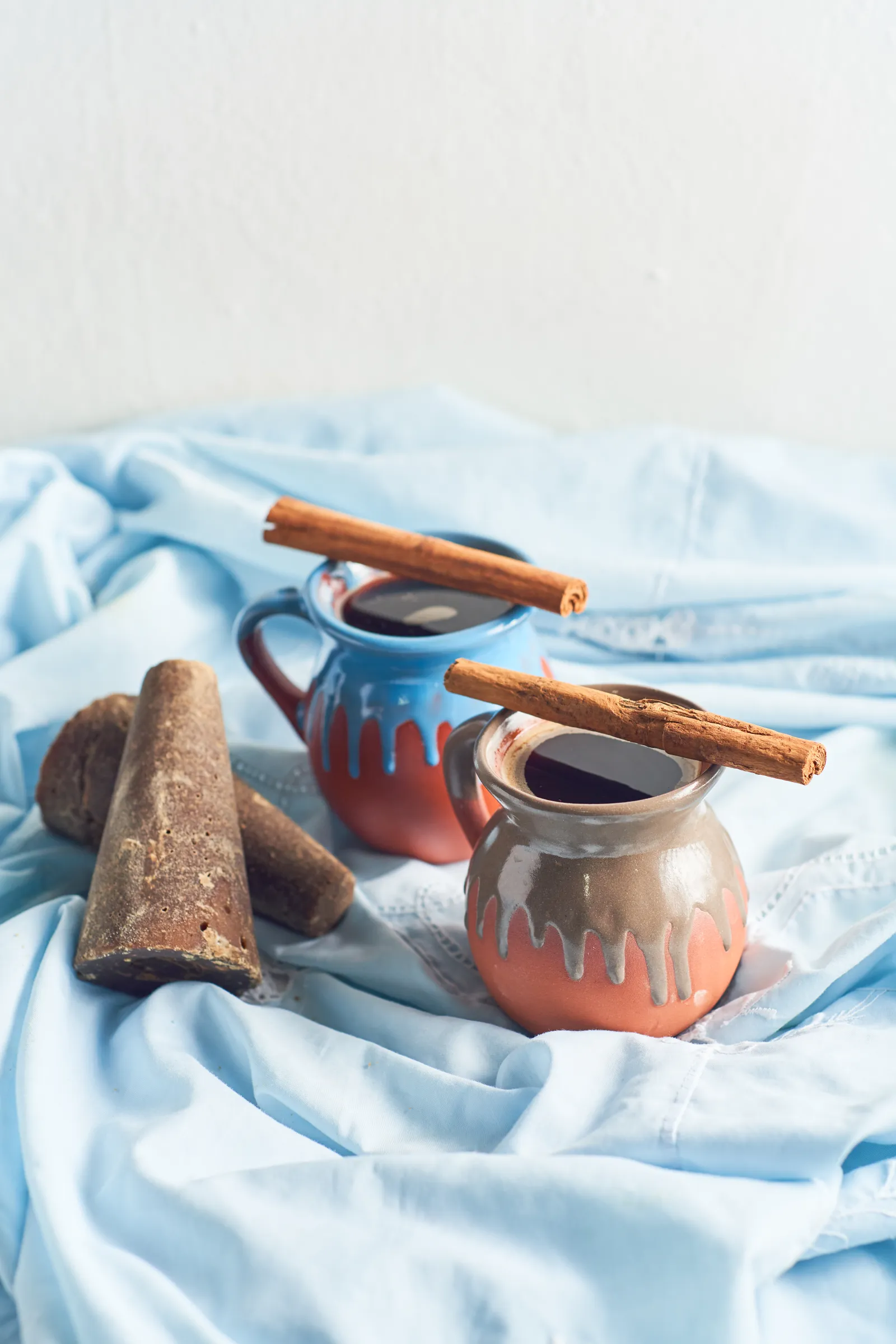

Café de olla (kah-FEH deh OH-yah) means “pot coffee”, and the pot is the giveaway: in Mexico it’s brewed in a clay olla with a stick of cinnamon and a cone of piloncillo, a raw cane sugar that tastes of molasses, then served black in little clay mugs. It’s the coffee of cold mornings and of the posadas, the neighborhood parties of the nine nights before Christmas. If you’ve only had it from a café, the homemade version is simpler than it looks, and it hinges on a single rule that most quick versions skip: the sugar and spice boil, the coffee never does.
What is café de olla, and how do you make it?
How do you make café de olla? Simmer 1.5 liters (6⅓ cups) of water with 100 g (3.5 oz) of piloncillo and a cinnamon stick for 10 minutes. Turn off the heat, wait 1 minute, stir in 90 g (3.2 oz) of medium-coarse coffee, cover for 5 minutes off the heat and strain. 30 minutes for 6 servings.
Think of it as a French press brewed in a saucepan, with the sweetener and spice already in the water. It comes out medium-bodied, cinnamon first, molasses second, with no milk. The ratio I use is 60 g of coffee per liter of water (about 2 oz per quart), a little stronger than the 55 g per liter the Specialty Coffee Association uses as its reference, because the piloncillo and cinnamon need a coffee with some backbone.
Who it’s for. Anyone hosting in December: one pot, very little hands-on time, and the method for 24 mugs is the same as for 6. It is not for anyone avoiding sugar or caffeine late at night; there are fixes for both below.
Time and effort. 30 minutes on the clock, about 5 of them hands-on. Easy, as long as you don’t boil the grounds.
Ingredients, and what to buy in a US or UK store
Exact amounts are in the recipe card. Straining costs some liquid, since the grounds hold water and a little evaporates during the simmer, so 1.5 liters (6⅓ cups) of water gives about 1.2 liters (5 cups) of coffee, six 200 ml (7 fl oz) mugs.
| Ingredient | What it is | US swap | UK swap | What changes |
|---|---|---|---|---|
| Piloncillo | unrefined cane sugar in cones | dark brown sugar, or panela from Latin aisles | dark muscovado, or panela | brown sugar is a little flatter; panela is identical |
| Ceylon cinnamon | thin, papery “true” cinnamon | ”Ceylon cinnamon” sticks, or “canela” in Mexican spice bags | Ceylon sticks from spice shops | cassia works at half the amount, sharper |
| Coffee | medium-dark roast | any medium-dark, French-press grind | the same | light filter roasts taste sour next to the sugar |
| Orange peel, cloves | optional aromatics | supermarket | supermarket | leave out for a cleaner cup |
Weighing the coffee. On my scale, a level tablespoon of medium-ground coffee weighs about 5 g, so 90 g is about 18 level tablespoons. Below 50 g per liter the sugar and cinnamon drown it; above 70 g it turns harsh for my taste.
The grind matters more than the bean. Café de olla is an immersion brew, so it wants a medium-coarse grind, about what you’d use for a French press. Pre-ground drip coffee slips through a strainer, clouds the cup and over-extracts in 5 minutes; if that’s all you have, steep 4 minutes and strain through a cloth or a paper filter.
Piloncillo is sold in cones in Latin grocery stores and the Hispanic aisle of Walmart in the US. Colombian panela and Venezuelan papelón are the same product in blocks and swap 1 to 1 by weight. Cones are hard, but there’s no need to grate them: 2-3 cm (1 in) chunks dissolve in the 10-minute simmer.
Ceylon or cassia cinnamon
Mexico cooks with Ceylon cinnamon, Cinnamomum verum, and buys more of it than anyone: $80 million of Sri Lanka’s $214 million in cinnamon exports went there in 2022, according to the Observatory of Economic Complexity. In a US or UK supermarket, a jar that just says “cinnamon” may well be cassia, so look for “Ceylon” or Cinnamomum verum on the label.
Germany’s Federal Institute for Risk Assessment (BfR) measured around 3,000 mg of coumarin per kg in cassia, against under 8 mg/kg in Ceylon, and sets a tolerable daily intake of 0.1 mg per kg of body weight. One stick in a party pot is not the issue; the BfR’s concern is large daily amounts. If you’ll drink café de olla every morning, buy Ceylon. Ground cinnamon doesn’t work here: it sinks to the bottom of the mug as sludge.
The one rule, don’t boil the grounds
Coffee extracts best between 197 and 205°F (92 and 96°C), the range the Specialty Coffee Association uses to certify home brewers. At a rolling 212°F (100°C), the water pulls out the bitter, astringent compounds that come out last, and the agitation breaks the grounds into fines that pass through any strainer. Piloncillo won’t hide it.
So the recipe runs in two stages: what needs to boil (sugar, spice) boils; what doesn’t (coffee) steeps off the heat. Re-boiling strained coffee does the same damage more slowly, which is why you hold it at 160-175°F (70-80°C), not on a simmer.
How to tell it’s going right.
| Stage | What you should see |
|---|---|
| Piloncillo, 10 min | nothing solid left in the pot, water amber |
| 1 minute off the heat | the surface is still; about 200°F (94°C) if you have a thermometer |
| Coffee in | a brown foam crust rises, then sinks after 3 stirs |
| 5 min steep | done at 4-5 minutes; bitter by 8 |
| Strained | dark but translucent in a spoon held to the light; muddy means the grind was too fine |
Clay pot or saucepan, and the lead question
A clay olla holds heat and looks the part, but a 3-quart (3-liter) stainless steel saucepan makes coffee just as good. I don’t taste enough difference to justify a pot I can’t vouch for, because some low-fired glazed pottery is glazed with lead compounds, and lead leaches into hot, acidic drinks. Coffee is mildly acidic and served very hot.
What the FDA says about lead-glazed traditional pottery, in short:
- Be most careful with pottery that looks handmade and crude, is antique, chipped or worn, was bought at a flea market or from a maker you can’t verify, or is decorated in bright orange, red or yellow.
- Curing or seasoning does not remove lead. The FDA states that no amount of washing, boiling or any other process removes it. Curing only seals the clay and helps prevent cracks.
- Home swab kits from hardware stores show leachable lead by changing color. If a piece tests positive, the FDA strongly advises against using it for food or drink; if you can’t test or verify it, consider not using it.
In Mexico, the standard NOM-231-SSA1-2016 sets limits on soluble lead and cadmium in glazed pottery, and FONART, the government crafts fund, awards a registered “Sin plomo” (lead-free) seal to workshops whose pieces pass tests at Cofepris-authorized labs. If you’re buying an olla in Mexico, look for it. Pregnant women and small children are the most vulnerable; if in doubt, brew in steel and keep the clay mug on the shelf.
If your pot is new and certified, cure it as the potter recommends. I fill mine with water, bring it up on low heat, simmer it gently for an hour, and pour that water away. Always start clay on low heat: cold clay on a high flame cracks.
Make-ahead plan and party math
For a posada, a Christmas Eve open house or a New Year’s morning, the work splits neatly across days.
- A week before → if you’re using a clay pot, test it with a swab kit and cure it.
- Two days before → buy whole beans or medium-coarse ground coffee, piloncillo and Ceylon sticks. Grind beans on the day.
- The day before → make a spiced syrup concentrate: for 24 mugs, 400 g (14 oz) piloncillo and 4 cinnamon sticks in 1 liter (1 quart) of water, 10 minutes at a simmer. Strain, cool and refrigerate.
- On the day, 1 hour before guests arrive → heat 5 liters (5.3 quarts) of water with the syrup to a boil (a big pot takes about 35 minutes on a home burner), turn off, wait 1 minute, steep 360 g (12.7 oz) coffee for 5-6 minutes and strain into thermoses.
| For | Water | Coffee | Piloncillo or brown sugar | Ceylon sticks | Pot |
|---|---|---|---|---|---|
| 6 mugs | 1.5 L (6⅓ cups) | 90 g (3.2 oz) | 100 g (3.5 oz) | 1 | 3 qt (3 L) |
| 12 mugs | 3 L (3.2 qt) | 180 g (6.3 oz) | 200 g (7 oz) | 2 | 5 qt (5 L) |
| 24 mugs | 6 L (6.3 qt) | 360 g (12.7 oz) | 400 g (14 oz) | 4 | 10 qt (10 L) |
| 30 mugs | 7.5 L (7.9 qt) | 450 g (1 lb) | 500 g (1.1 lb) | 5 | 12 qt, or two 6 qt |
Mugs are 200 ml (7 fl oz). In 8 oz (250 ml) paper cups, 24 mugs becomes about 19 cups.
Keeping it hot all evening
- Preheated thermos or airpot. Fill it with boiling water for 5 minutes first. It holds the coffee at 160-175°F (70-80°C) for 2 to 3 hours without the stewed taste.
- Brew in batches. Keep the spiced syrup water on the lowest flame and steep a fresh 1.5-liter (6-cup) batch each time the thermos runs low. It’s the reason the last mug tastes like the first.
- Slow cooker on “warm”. Only with coffee that’s already strained and hot, and check it doesn’t climb above 175°F (80°C).
- On the stove, covered, lowest flame. It works, but after about 90 minutes it tastes like office coffee to me.
Caffeine, kids and spiking it
The USDA SR Legacy database lists brewed coffee at about 40 mg of caffeine per 100 ml, so an 8 oz (237 ml) mug has about 95 mg and a 200 ml (7 fl oz) clay mug about 80 mg; at 60 g per liter, mine may run a little higher. The FDA cites 400 mg a day as an amount not generally linked to negative effects in healthy adults, and recommends talking to a doctor during pregnancy or breastfeeding.
Kids. They’ll like the flavor, but it’s coffee, and the FDA advises avoiding caffeinated drinks for children under 2. At a posada, the children’s pot is usually champurrado, a thick chocolate and corn masa drink, or Colombian hot chocolate. A plain Mexican atole with cinnamon and vanilla is the caffeine-free option made with the same piloncillo.
Spiked café de olla, adults only. Add 30 ml (1 fl oz) of spirit to each mug, not to the pot, so one pot serves everyone. I use aged rum; brandy and reposado tequila work too. It adds about 64 kcal per mug.
Allergens and spice. No gluten, dairy, egg or nuts. The cinnamon and cloves are aromatic, not hot.
Variations
- Drip coffee maker → put the grounds and a broken piece of cinnamon in the filter, and sweeten the carafe with piloncillo dissolved in 100 ml (⅓ cup + 1 tbsp) of hot water. Cleaner, less spiced.
- Less sweet → 50 g (1.75 oz) piloncillo instead of 100 g: about 32 kcal and 8 g sugar less per mug.
- Decaf → same method with medium-coarse decaf; about 2 mg caffeine per mug by USDA figures. The evening option.
- Iced → brew as written, cool, and pour over ice the next day. Leftovers from the party taste better this way than reheated.
- Extra spice → orange peel and 2 cloves, or one star anise, in the simmer. One of each at most, or they bury the coffee.
What it costs
At the US city average prices the Bureau of Labor Statistics published for August 2026, ground roast coffee was $9.299 per pound and sugar $1.024 per pound (I use sugar as a stand-in for piloncillo, which the BLS doesn’t track). That puts 6 mugs at about $2.07, roughly $0.35 a mug, before the cinnamon, and a 24-mug party pot at about $8.30. The coffee is almost 90 % of the cost; piloncillo usually costs a little more than sugar in Latin stores, but it’s still pennies per mug.
What to serve with it
Café de olla wants something sweet and bready. In January it goes with a slice of rosca de reyes; at a mixed Latin Christmas table like mine, with Colombian buñuelos, cheese fritters that are crisp outside and soft in the middle; and for breakfast, with pork tamales. For someone who skips caffeine, hot aguapanela has the same cane-sugar note, and a bowl of cinnamon-scented Colombian rice pudding ends the night on the same flavor.
Storing leftovers. I keep strained leftovers covered in the fridge for up to 2 days and drink them iced. Frozen in ice cube trays, they cool iced coffee without watering it down. Reheat gently to 160-175°F (70-80°C), never to a boil; for guests, a fresh 5-minute batch beats reheated every time.
Frequently asked questions
What is the coffee-to-water ratio for café de olla? 60 g of medium-coarse coffee per liter of water, about 2 oz per quart, with 65-70 g (2.3 oz) of piloncillo per liter.
Do you boil the coffee in café de olla? No. Boil the water with the piloncillo and cinnamon, take it off the heat, and let the coffee steep covered for 5 minutes after a 1-minute pause. Boiled grounds turn it bitter.
What can I use instead of piloncillo? Panela or papelón at the same weight, with no difference. Dark brown sugar or dark muscovado at the same weight, slightly flatter. White sugar sweetens but loses the molasses note.
Should I use Ceylon or cassia cinnamon? Ceylon, the thin papery sticks, is what’s used in Mexico. Cassia works at half the amount and tastes sharper.
Is it safe to make café de olla in a Mexican clay pot? Only if the glaze is lead-free. Look for the “Sin plomo” seal or a maker you can verify, test with a swab kit, and remember curing doesn’t remove lead. If in doubt, use a steel pot.
How much café de olla do I make for 20 to 30 people? For 24 mugs of 200 ml (7 fl oz): 6 liters (6.3 quarts) water, 360 g (12.7 oz) coffee, 400 g (14 oz) piloncillo and 4 sticks. For 30, scale to 7.5 liters, 450 g (1 lb) coffee and 500 g (1.1 lb) piloncillo.
How much caffeine is in café de olla? About 95 mg per 8 oz (237 ml) mug, the same as drip coffee, by USDA figures. Cinnamon and piloncillo add none.
Nutrition
Per 200 ml (7 fl oz) mug, without spirits, calculated from the USDA FoodData Central (SR Legacy) database with this recipe’s amounts, using brown sugar for piloncillo and brewed coffee for the drink:
- Calories: 65 kcal
- Protein: 0 g
- Carbohydrates: 16 g
- Fat: 0 g
- Sugars: 16 g
- Sodium: 9 mg
- Caffeine: about 80 mg
Nearly all the calories are the 17 g of piloncillo in each mug; the coffee itself brings 2 kcal. With 30 ml (1 fl oz) of rum, a mug comes to about 129 kcal.
I grew up in Venezuela drinking guayoyo, a long, light coffee strained through a cloth sock and sweetened with papelón, so the sweetener was never the strange part. The hard lesson was the opposite one: the cone and the cinnamon can bubble away all afternoon, the coffee gets five quiet minutes off the flame. Josnaisis.