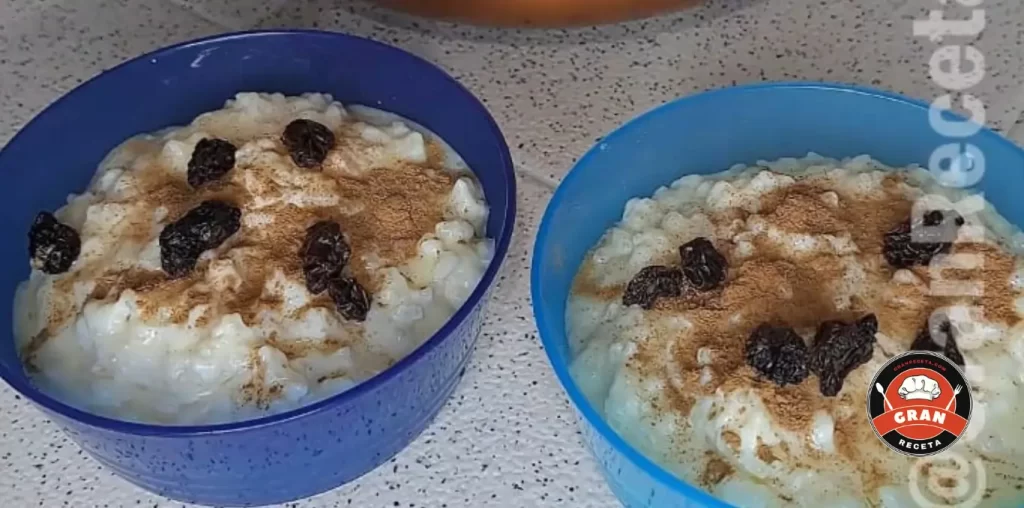
Creamy rice pudding doesn’t come from cream, it comes from starch, which is why 7 oz of short-grain rice gives a completely different dessert than the same weight of long-grain. The other half of the job is the ratio, six parts liquid to one of rice, and the order, because the milk goes in twice and never at the start. That gives eight servings of 400 calories in under an hour, and a pudding that goes on thickening well after the heat is off.
How do you make Colombian rice pudding? Simmer water with a cinnamon stick and cloves, cook 7 oz of unrinsed short-grain rice in it for 10 minutes until absorbed, add half the milk and cook 15 minutes stirring, then the rest of the milk with a can of condensed milk for 25 minutes more. Rest 20 minutes. About 55 minutes for eight servings.
Which rice to use, which is half the result
The creaminess of rice pudding is dissolved starch. Short-grain rice is high in amylopectin, the starch that breaks down and thickens; long-grain is higher in amylose, which keeps the grains separate, and that’s what you want in a pot of white rice and not here. In a US supermarket the easiest short-grain to find is sushi rice, and it works perfectly. Arborio also works and is creamier still, though it needs constant stirring.
And the rice isn’t rinsed, which is the opposite of what you do for any other pot of rice. That dust on the grains is loose starch and it’s what thickens the milk in the first minutes.
The ratio, 6 parts liquid to 1 of rice
For 7 oz of rice: 1 cup of water, 4 cups of milk and a 14-oz can of condensed milk, which comes to roughly 6 parts liquid to 1 of rice. Any thinner on liquid and the pudding dries out as soon as it cools; much wetter and it never really thickens.
Here’s the mistake I see most: taking it off the heat when it looks perfect in the pot. As it cools, the starch retrogrades, its chains reorganize and trap more water, and the pudding sets up considerably. Pull it while it still looks a bit loose.
The order of the milks
The rice starts in water, not milk. A grain that starts in milk seals on the outside: fat coats it and sugar competes for water, and you get rice that stays hard in the middle however long you cook it. Ten minutes in the cinnamon water is enough to open it up.
Then the milk goes in twice. The first half does the slow work of hydrating and releasing starch. The second goes in with the condensed milk, which besides sweetening adds lactose and protein that thicken the pudding and deepen its color; that’s also why it goes in late, since the longer it cooks the more it browns and the more it wants to catch on the bottom.
Cinnamon and cloves go in whole at the start and come out at the end. Ground cinnamon from the start clouds the pudding and leaves a gritty deposit; it belongs on top at serving.
Where the calories are
A serving with cream is 400 kcal, and the rice is the least of it: the can of condensed milk and the ¾ cup of cream account for 1,858 of the 3,184 kcal in the pot. Without the cream it’s 325 a serving and still creamy, because the creaminess is starch. I make it without cream on a weekday and with cream when there’s company.
Step by step
Stirring, but not constantly
You stir so the starch distributes and the bottom doesn’t catch, but you don’t need to stand there for 40 minutes. A pass every couple of minutes, scraping the bottom with a wooden spoon and reaching the corners of the pot, is enough. Once it catches, the pudding tastes scorched and there’s no rescuing it.
The pot matters more than you’d think: heavy-bottomed, low heat. In a thin pot the milk at the bottom boils before the rest and grabs.
Who this recipe is for
- If you want it lighter → skip the cream; 325 kcal a serving and the same texture
- If you can only find long-grain → use it, but raise the milk to 5 cups and add 10 minutes
- If you need it lactose-free → lactose-free milk and condensed milk; it thickens the same because the starch doesn’t change
- If you like raisins → 2 oz soaked 10 minutes in warm water, stirred in for the last 5 minutes
- If you’re cooking for 16 → double it but use two pots; in one, the bottom scorches before it thickens
What goes wrong
Rinsing the rice. The thickening starch goes down the drain and the pudding stays thin. This is the one rice you don’t rinse.
Starting in milk. The grain seals and stays hard inside. Water with cinnamon first, 10 minutes.
Medium or high heat. The milk catches on the bottom and the whole pot tastes scorched. Low heat and a wooden spoon.
Taking it off when it’s already thick. It sets as it cools. Pull it while it still looks loose.
Ground cinnamon from the start. It clouds the pudding and leaves grit. Sticks in the pot, powder on top.
Storage
Covered in the fridge it keeps up to 4 days, and like any milk preparation it should be chilled within a couple of hours of coming off the heat. It thickens every day: by day two you can cut it with a spoon. To bring it back, stir in a splash of cold milk, either cold or over gentle heat, never high heat, which makes it catch.
It doesn’t freeze well: the starch separates from the liquid on thawing and the texture turns grainy. This is a dessert to make and eat within the week.
What to serve it with
Cold from the fridge or warm from the pot, in a glass or a 5-oz mug. On a paisa table it competes for the same slot as mazamorra, which is also grain and milk but cooked separately and sweetened at the table. In December it sits beside natilla and buñuelos, and after a plate as big as a bandeja paisa it’s one of the few desserts anyone will still accept. With a cup of Colombian hot chocolate it’s an afternoon in itself.
Questions people ask
Why is my rice pudding thin? Either you rinsed the rice or you used long-grain. Starch is what thickens it: rinse it away or use a grain that doesn’t release it, and there’s no creaminess to be had.
How much milk per cup of rice? About 6 parts liquid to 1 of rice. For 1 cup of rice: 1 cup water, 4 cups milk and a 14-oz can of condensed milk.
Can I make it without condensed milk? Yes: ¾ cup of sugar and one extra cup of whole milk. It’s less dense and less caramel-colored, with a cleaner rice-and-cinnamon flavor.
Why does it set hard in the fridge? The starch retrogrades: as it cools, the chains reorganize and trap water. A splash of milk and a stir brings it back.
Can I use Arborio? Yes, and it’s the creamiest of the three, but it needs near-constant stirring and 5 minutes less time.
Can I freeze it? Better not. Thawed, the starch weeps and the texture turns grainy. Four days in the fridge is the window.
Nutrition
Per serving, one eighth of the pot with cream, from the USDA database: about 400 kcal, 60 g carbohydrate, 14 g fat of which 9 g saturated, 9 g protein, 0 g fiber, 38 g sugar and 130 mg sodium.
Nearly all the sugar arrives with the condensed milk, which per USDA is 54 % sugar by weight; the rest is the milk’s own lactose. Without the cream, a serving drops to about 325 kcal and roughly half the fat.
Rice pudding is what my kids asked for most when they were small, and the first thing I let them stir, which was the part they liked. In Venezuela we make it almost the same way, with more cinnamon and sometimes a strip of lemon peel; in Colombia I picked up the condensed milk, which we didn’t use at home and which changes both the color and the body. The argument is the same in both countries: whether it takes raisins. In my kitchen they go on the side, so everyone decides for themselves. Josnaisis.