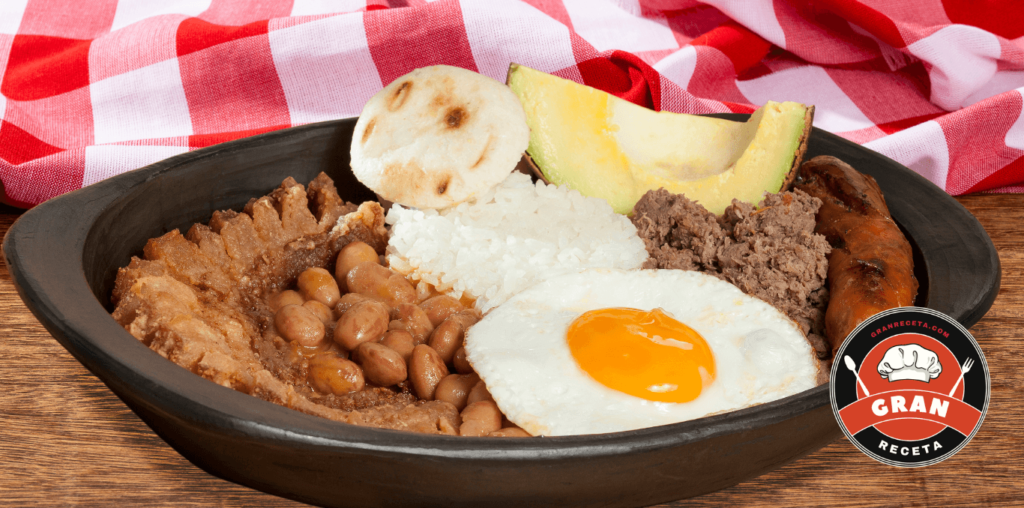
Bandeja paisa (bahn-DEH-hah PIE-sah) is Colombia’s biggest plate: twelve separate preparations on one platter, from the mountain region around Medellín, adding up to about 2,470 calories by USDA figures. The hard part isn’t any single component; a fried egg is a fried egg. It’s getting beans, rice, ground beef, chicharrón, chorizo, morcilla, plantain, arepa and egg to the table hot at the same time. This version maps every Colombian ingredient to what a US supermarket sells, gives the calorie count part by part, and lays out the cooking order on two burners.
What bandeja paisa is, and what’s on the platter
How do you make bandeja paisa? Cook the parts separately and plate them together: cargamanto beans with pork ribs and hogao, white rice, ground beef finished with hogao, chicharrón fried at 350°F (180°C), fresh chorizo, morcilla, a fried egg, fried ripe plantain and an arepa, with avocado, hogao and lime on the side. On two burners, with the beans soaked overnight, 140 minutes for 4 servings.
“Paisa” is what Colombians call the people of Antioquia and the coffee departments of Caldas, Risaralda and Quindío; “bandeja” is the platter it comes on. The full version has twelve components: red beans, white rice, ground beef, chicharrón, chorizo, morcilla, fried egg, fried ripe plantain, arepa, avocado, hogao and lime. By the Spanish Wikipedia’s account it doesn’t appear in Colombian cookbooks before 1950, and in 2005 the national government proposed it as the country’s national dish under the name “bandeja montañera”, a proposal that went nowhere because it represents one region. What is certain is that it’s on the lunch menu every day in Medellín, and that anything with fewer than ten parts is sold as a “típico” or “montañero”, not a bandeja.
The ingredients, and what to buy in a US supermarket
Six of the twelve have Colombian names that don’t map directly to a US shelf. None needs a specialty trip if you know what to ask for.
Beans. Cargamanto is a large speckled bean from Antioquia; cranberry (borlotti) beans are the closest, red kidney beans work. Soaked overnight and cooked with pork ribs, 45 minutes under pressure.
Chorizo. Colombian chorizo is a fresh, uncured pork sausage. Fresh Mexican-style chorizo from the meat counter is the right family; Spanish cured chorizo is not. The reference is the chorizo of Santa Rosa de Cabal, in the coffee region.
Morcilla. A blood sausage with rice inside. Black pudding or boudin noir from a European or Latin deli stands in; it’s also the one part you can drop without losing the dish.
Chicharrón. Fried pork belly with the skin on. The skin is what puffs; skinless belly gives you fried bacon, not chicharrón. Ask a butcher or an Asian market for skin-on belly.
Arepa. The Antioquian arepa is thin, white and unsalted, made from precooked cornmeal (masarepa, sold as P.A.N. or Goya Masarepa): 1 cup meal to 1¼ cups warm water, rested 5 minutes, patted thin and griddled. Not cornmeal, not masa harina.
Plantain. The slices are from a ripe plantain with a nearly black skin, which takes 5 to 7 days on the counter from green. A yellow plantain fries starchy, not sweet.
How many calories are in a bandeja paisa
About 2,470 kcal for the full platter, calculated part by part from USDA FoodData Central for the portions actually served: 3.5 oz (100 g) of pork belly for the chicharrón, 3.5 oz of ground beef, a 2 oz chorizo and a 2 oz morcilla, a cup of beans with 1.8 oz of rib meat, a cup of rice, two plantain slices, one arepa, half a small avocado, one egg and two tablespoons of hogao. The nutrition center of Colombia’s Universidad Javeriana puts it at 2,200, as reported by El Tiempo in April 2023; the difference fits inside the size of the chicharrón.
The four meats are 1,180 kcal, nearly half. If you want the platter under 2,000 without dropping a component, the lever is the chicharrón: a 1.8 oz (50 g) piece instead of 3.5 oz brings it to about 2,200, and leaving out the morcilla to 1,970. Beans, rice, arepa and plantain together are 850 kcal that don’t move much.
How long it takes, and the order that keeps it hot
140 minutes on two burners, not counting the overnight soak. The order isn’t fussiness: what holds heat (beans, rice, ground beef) goes first, and what dies waiting (chicharrón, plantain, egg) goes in the last 15 minutes. On a single burner the same platter takes three hours.
Three timings to respect: 45 minutes under pressure for soaked beans, 15 minutes for the chorizo over medium heat, turning, until it passes 160°F (71°C) inside, and 12-15 minutes for the chicharrón in 350°F (180°C) oil. Make the beans and hogao a day ahead and the day-of schedule drops to 95 minutes.
How to make bandeja paisa, step by step
The six timed steps are in the recipe card above. These two decide the platter.
Beans that “trabar”, not soup
Soaked beans go into the pressure cooker with the ribs and water to cover by 2 inches, 45 minutes. Then the lid comes off, the hogao goes in, and they simmer 15 minutes uncovered over low heat. The liquid reduces, starch comes out, and the beans “trabar”, the Antioquian word for a bean liquid thick enough to coat the spoon. Still thin after 15 minutes? Crush a ladle of beans against the side of the pot and give it 5 more.
Chicharrón at 350°F, skin side down
Pat the belly dry, salt it, and score it every ¾ inch (2 cm) down to the skin without cutting through. Oil at 350°F (180°C), skin side down 8 minutes until it puffs, then 5 more on the other sides. Inside, whole pork is safe at 145°F (63°C) with a 3-minute rest per the USDA FSIS, and at these oil temperatures it’s well past that. Oil that’s too cool gives you rubbery chicharrón that soaks up fat.
Who this recipe is for
- If you have 2 hours or less → beans made the day before or canned (15 minutes with hogao), ground beef, egg, arepa and avocado. That’s a típico montañero, not a bandeja, and it’s fine to call it that.
- If it’s your first time → make the beans and hogao the day before. On the day you only have meats and frying, 95 minutes.
- If you’re cooking for 8 → double the beans and meats, but fry the chicharrón and plantain in two batches; a crowded pot drops the oil temperature and the belly turns rubbery.
- If you can’t find morcilla → skip it. The platter loses a component, not its identity. Chicharrón and chorizo are the two you can’t replace.
- If you have an Instant Pot → soaked beans with the ribs, 25 minutes on high pressure with a 15-minute natural release, then finish with the hogao on sauté.
- If you’re gluten-free → the dish has none; check the labels on commercial chorizo and morcilla, which sometimes carry flour.
Mistakes that ruin a bandeja paisa
Soupy beans. They never thickened. Fifteen minutes uncovered with the hogao and a ladle of beans crushed against the pot.
Hard or mealy beans. No soak, or very hard water. Eight hours minimum; with old beans, 10 more minutes under pressure.
Rubbery chicharrón. Oil under 350°F or too many pieces at once. Two at a time, and let the oil come back up between batches.
The morcilla burst. Sudden heat with no water. Medium heat, 3 tablespoons of water, lid on for the first 5 minutes.
Dry ground beef. Browned too long or without hogao. Eight minutes until no pink remains, then the 2 tablespoons of hogao.
Everything arrived lukewarm. It was cooked in sequence and plated at the end. Follow the timeline, fry and cook the eggs in the last 15 minutes, and keep the plates in a 175°F (80°C) oven.
When each meat is done, and how to store the leftovers
With four different meats on one plate it helps to know which one needs the thermometer. The figures are the USDA FSIS minimum internal temperatures and leftover rules.
Out of the fridge, 2 hours at most (USDA FSIS), and less for the rice and beans, which should be cooled fast in containers under 3 inches deep. In the fridge, 3 to 4 days for beans, beef, chorizo and morcilla, stored separately. Chicharrón keeps 2 days and loses its crunch; an air fryer at 400°F (200°C) for 4 minutes brings most of it back. Plantain and egg, same day only. Freezing: beans and ground beef, 2 to 6 months; raw chorizo and morcilla, yes; chicharrón, no. Reheat to 165°F (74°C).
Variations
With carne en polvo. The old-school and restaurant version: beef simmered, dried and ground to a powder instead of browned ground beef. More work, and a dry texture that soaks up the hogao.
Típico montañero. Beans, rice, beef, egg, arepa and avocado, without chorizo, morcilla or chicharrón. It’s what most people in Medellín order on a weekday, at about 1,100 kcal.
With kidney beans. Outside the paisa region, where cargamanto isn’t sold, the platter is made with smaller beans: 10 minutes less under pressure and a thinner liquid.
With green plantain. Twice-fried patacones instead of sweet ripe slices. A household choice more than a tradition, and a less sweet plate.
What to serve with bandeja paisa
Whatever is left of the beans and rice becomes Colombian calentado the next morning, which is half the reason the pot is made so big. For the Venezuelan version of the same legume, faintly sweet with panela, see Venezuelan black beans. Nothing else on the plate. On the table: extra hogao (about 2 tablespoons a person), lime wedges for the chicharrón, a fresh ají if you like heat, and cold aguapanela with lime to drink. Dessert, if anyone can, is a cold bowl of mazamorra with milk and panela. For a Venezuelan take on the same loaded-plate idea at a third of the calories, pabellón criollo keeps to four components and plates them apart. The cheese arepas are a different, thicker arepa; the one on the platter is thin and plain. For the other two Colombian dishes that feed a whole family on a Sunday, look at Colombian sancocho and lechona. If the fire is lit instead of the stove, the salt-crusted tenderloin cooks straight on the coals in 14 minutes. The paisa soup that fills the same Sunday slot is Colombian mondongo, 8 bowls of tripe, pork ribs and chorizo.
Frequently asked questions
What is bandeja paisa? Colombia’s largest traditional plate, from Antioquia and the coffee region: twelve components including beans, rice, ground beef, chicharrón, chorizo, morcilla, a fried egg, ripe plantain, arepa and avocado, served together on a platter.
How many calories are in a bandeja paisa? About 2,470 kcal calculated part by part from USDA data, or 2,200 by the Universidad Javeriana’s nutrition center. The four meats are almost half; the chicharrón alone is 518.
What can I use instead of chorizo and morcilla? Fresh Mexican-style chorizo or bratwurst for the chorizo, black pudding or boudin noir for the morcilla. Skip the morcilla if you can’t find it; don’t skip the chorizo.
What cut is chicharrón? Skin-on pork belly, scored and deep-fried at 350°F (180°C) until the skin puffs. Skinless belly won’t puff.
Can I use canned beans? Yes, for a quick version: 15 minutes over low heat with hogao and a little of their liquid so they thicken. Not the same as soaked cargamanto, but it works.
How long does it take? 140 minutes on two burners with the beans soaked overnight; 95 minutes if the beans and hogao are made a day ahead; about 3 hours on one burner.
Nutrition
Per full platter as served, about 950 g (2.1 lb), calculated component by component from the USDA FoodData Central database (SR Legacy) with one teaspoon of salt spread across the parts:
- Calories: 2,470 kcal
- Protein: 92 g
- Carbohydrates: 166 g
- Fat: 159 g, of which 54 g saturated
- Fiber: 24 g
- Sugars: 22 g
- Sodium: 3,730 mg
That is more saturated fat than an adult needs in a day, which is why in Antioquia it’s a lunch dish and not a weekly habit. A típico montañero without the three pork items lands around 1,100 kcal with the same table.
The first bandeja I ever finished was in Medellín, at a place near the Plaza Minorista where the beans came to the table still bubbling. I grew up in Venezuela thinking pabellón was a big plate; it has four parts. Twelve seemed like showing off until I understood that every one of them does something the others can’t. Josnaisis.