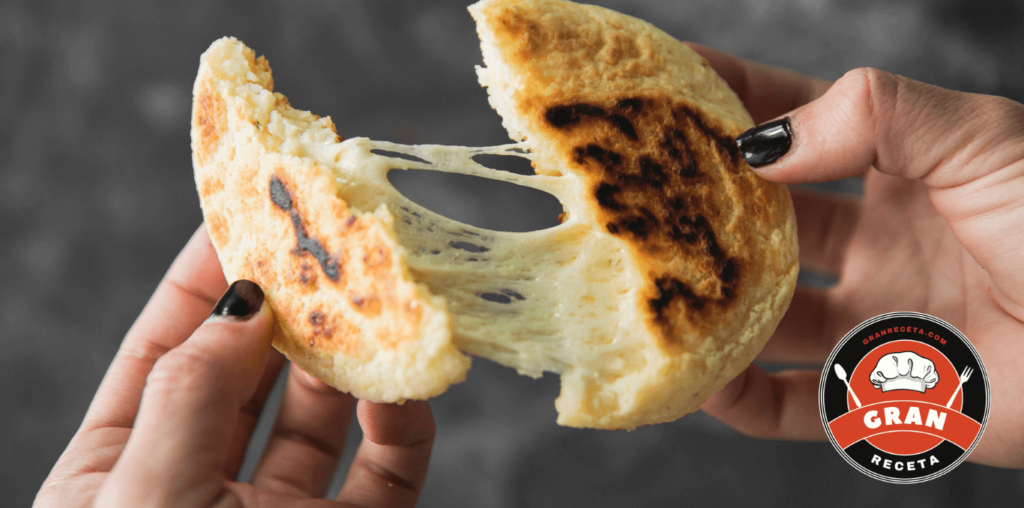
A Colombian cheese arepa is a corn cake with cheese in two places: 100 g of queso fresco worked into the dough for flavor, and 150 g of mozzarella tucked inside at the end because it’s the one that melts. Made with masarepa, the precooked cornmeal sold as P.A.N., four large arepas take 30 minutes and no special equipment beyond a skillet. Below: which of the three corn flours on a US shelf actually works, which supermarket cheeses do each job, why the dough cracks and how to freeze a batch.
What arepas are, and how the Colombian ones differ from Venezuelan
How do you make Colombian cheese arepas? Mix 2 cups of masarepa with 1¼ cups of warm water, a teaspoon of salt and a tablespoon of butter, knead 3 minutes, work in a cup of crumbled queso fresco and rest the dough 5 minutes. Shape four 5-inch discs, ⅝ inch thick, griddle them 6 minutes per side in a dry skillet, then split, fill with mozzarella and cover 2 minutes to melt. 30 minutes for 4 arepas.
An arepa (ah-REH-pah) is the daily corn bread of Colombia and Venezuela, a round griddled cake of ground corn that plays the role bread plays elsewhere. The cheese version is the one both countries share most naturally. The modern shortcut is precooked cornmeal: corn that’s been cooked, dried and finely ground, so the dough only needs water. Empresas Polar launched the first brand, Harina P.A.N., in Venezuela in 1960, building on a process patented in the 1950s by engineer Luis Caballero Mejías, per the English Wikipedia; before that, arepas meant pounding and grinding boiled corn by hand.
The two countries differ on thickness and where the cheese goes. The Colombian arepa is thinner, ⅜ to ⅝ inch (1 to 1.5 cm), with cheese in the dough and often inside too, griddled dry. The Venezuelan one is thicker, about ¾ inch (2 cm), griddled and sometimes finished in the oven, then split and stuffed after cooking with queso de mano, shredded beef or whatever’s around. This recipe is the Colombian one with a filling: the arepa I make at home since moving from Venezuela to Colombia.
The flour, and why masa harina and cornmeal don’t work
This is where most first attempts outside Latin America go wrong, because three different products sit near each other on the shelf.
Masarepa (P.A.N., Goya Masarepa, Areparina) is corn that was cooked, dried and ground fine. It’s the only one that makes arepa dough, and the bag says “precooked” or “precocida”. Masa harina (Maseca) is corn treated with lime, for tortillas and tamales; it gives a crumbly disc that tastes of tortilla. Cornmeal and polenta are raw ground corn and won’t hold together. White masarepa is the classic; yellow gives a deeper color and a little more corn flavor. A 2.2 lb (1 kg) bag makes about 16 arepas of this size.
Which cheese goes where
Colombian cheese arepas use two cheeses because no single cheese does both jobs: one in the dough for flavor, one inside that melts in strings. In Colombia that’s queso campesino in the dough and queso doble crema inside; here’s what stands in for them in a US supermarket.
In the dough, queso fresco (100 g / 1 cup). Mild, moist and crumbly, it seasons the dough and adds fat without melting, exactly what Colombian queso campesino does. Cotija works too and is saltier: halve the salt if you use it.
Inside, low-moisture mozzarella (150 g / 5 oz). The block kind, not fresh mozzarella in water, which is too wet and leaks. Monterey Jack melts just as well. Colombian queso doble crema, if you find it at a Latin grocery, is the original.
How long they take
30 minutes on the clock, about 15 of them hands-on. Most of the time is the skillet, 6 minutes a side, and it doesn’t speed up with more heat: on high they scorch outside and stay raw inside.
Two timings matter: the 5-minute rest of the dough, which stops the cracking, and 6 minutes per side over medium heat without touching them for the first 4. A ⅝-inch arepa needs those 12 minutes to cook through; a ⅜-inch one, 8 in total.
How to make cheese arepas, step by step
The five timed steps are in the recipe card above. These are the two that decide whether they crack or not.
The dough, warm water and the rest
Water first, with the salt and butter, then the masarepa a little at a time. The other way around, dry flour makes lumps that never smooth out. The ratio is 1¼ cups of water per 2 cups of masarepa, 300 ml per 250 g, and the water about 120°F (50°C): warm to the touch, not boiling, which would cook the surface of the flour and make the dough gummy. Knead 3 minutes and rest 5, covered: precooked corn keeps absorbing water after kneading, so dough that feels slightly wet before the rest is right afterward.
The right dough feels like firm play dough: it doesn’t stick to your hands and a ball doesn’t crack when you squeeze it. Cracks mean water, a tablespoon at a time; sticking means flour.
The skillet, dry and unhurried
Nonstick skillet or cast-iron griddle over medium heat, no oil: the butter and the cheese in the dough carry enough fat. Six minutes a side, untouched for the first 4; they release on their own when the side is done. They’re cooked through when they sound hollow tapped with a fingernail and show golden spots, not black ones.
Who this recipe is for
- If it’s your first time → make them ⅜ inch (1 cm) thick instead of ⅝: they cook evenly in 8 minutes and forgive more.
- If the dough cracks when you shape it → it needs water; a tablespoon at a time, kneading between additions.
- If you saw them in Encanto → those are these, minus the filling. The arepa tela of Medellín is thin, unsalted and eaten with butter and a slab of queso fresco on top.
- If you want the Venezuelan version → ¾ inch (2 cm) thick, 8 minutes a side, then split and fill after cooking with shredded beef, avocado or black beans and white cheese.
- If you’re cooking for 8 or more → double everything and shape all the arepas at once; the dough keeps 2 days refrigerated under plastic wrap, and shaped raw arepas freeze.
Mistakes that ruin cheese arepas
They crack when you shape them. Dry dough, or no rest. Water a tablespoon at a time and 5 minutes under a cover.
They stick and tear when you flip. Flipped too early. Four minutes untouched; they release themselves when ready.
Black outside, raw inside. Heat too high. Medium heat, 6 minutes a side.
Hard and dry. Too little water or too long in the pan. Ratio 1¼ cups to 2 cups; ⅝-inch arepas take 12 minutes total.
The filling doesn’t melt. It’s queso fresco or cotija. Inside goes low-moisture mozzarella or Jack.
The filling leaks. Fresh mozzarella in water. Use the low-moisture block.
Make ahead, storing and freezing
The raw dough keeps 2 days in the fridge with plastic wrap pressed onto the surface; knead in a tablespoon of water before shaping. Shaped raw arepas freeze up to 3 months between sheets of wax paper and go straight into the skillet from frozen, 8 minutes per side. Cooked, unfilled arepas keep 3 to 4 days refrigerated under the USDA FSIS leftover rule and reheat in a dry skillet 3 minutes a side or in a toaster; the microwave turns them gummy. Once the cheese is inside, eat them.
Variations
Antioquian, no filling. The arepa tela: thin, no cheese in the dough, served with butter and queso fresco on top. It’s the one on the bandeja paisa.
Coastal, with condensed milk. In Barranquilla and Cartagena, crumbled salty costeño cheese and a drizzle of sweetened condensed milk on top. Sweet and salty at once.
Venezuelan, split and stuffed. ¾ inch thick, opened after cooking, filled with queso de mano, shredded beef or avocado. The reina pepiada, with chicken and avocado, is the famous one.
Yellow masarepa. Same recipe with yellow precooked cornmeal, same 1¼ cups of water per 2 cups: deeper color, a little more corn flavor.
What to serve with cheese arepas
In Colombia they come with hot chocolate, a mug of aguapanela or a glass of cold oat drink at breakfast, one 6.7 oz (190 g) arepa a person, and next to Colombian changua, the milk-and-egg soup, on cold Bogotá mornings. On the same breakfast tray you’ll often find a couple of pandebonos, which carry the cheese inside the dough instead of on top. As a side they go with Colombian ajiaco and with shredded beef in hogao. For the fried coastal cousin with a whole egg inside, see the Colombian egg arepa; for the sweet fresh-corn one, the sweet corn arepa.
Frequently asked questions
What flour do you use for arepas? Masarepa, precooked cornmeal sold as P.A.N., Goya Masarepa or Areparina, in the Latin aisle or online. Not masa harina (that’s for tortillas) and not cornmeal or polenta.
How much water per cup of masarepa? 1¼ cups of warm water per 2 cups (250 g) of masarepa, then a 5-minute rest before shaping.
What cheese melts best inside arepas? Low-moisture mozzarella or Monterey Jack. Queso fresco and cotija season the dough but don’t melt; fresh mozzarella in water leaks.
Can I make arepas in an air fryer? Yes: 8 minutes at 400°F (200°C) per side in a greased basket. They come out drier outside than in a skillet; brush with butter when they’re done.
Can I freeze arepas? Shaped and raw, up to 3 months between sheets of wax paper, cooked from frozen 8 minutes a side. Cooked and unfilled, 3 to 4 days in the fridge.
Are arepas gluten-free? Yes. Masarepa is only corn, though P.A.N.’s label notes possible traces from the production line.
Nutrition
Per arepa, about 6.7 oz (190 g) with the filling, calculated from the Harina P.A.N. label (360 kcal, 79 g carbohydrate and 8 g protein per 100 g) and USDA FoodData Central for the cheeses and butter, with the teaspoon of salt:
- Calories: 437 kcal
- Protein: 18 g
- Carbohydrates: 51 g
- Fat: 18 g, of which 10 g saturated
- Fiber: 3 g
- Sugars: 1 g
- Sodium: 990 mg
The sodium splits about evenly between the salt and the two cheeses. A plain 3.5 oz (100 g) arepa with no filling runs about 219 kcal in the USDA’s restaurant data.
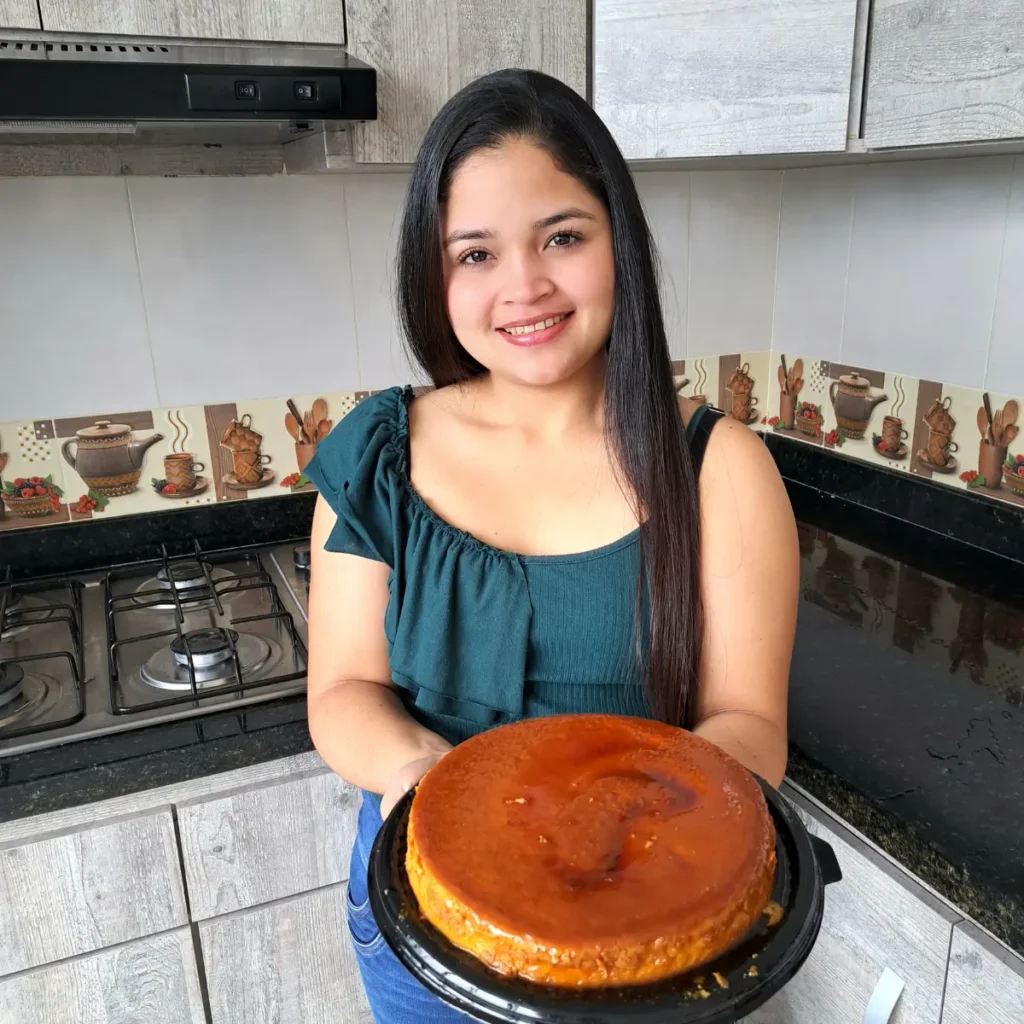
In my grandmother’s kitchen in Venezuela the arepa came off a clay budare every morning, and the cheese went on top, never inside. It took moving to Colombia to learn that you could split one open and let the cheese melt in there, and now I can’t go back. Josnaisis.