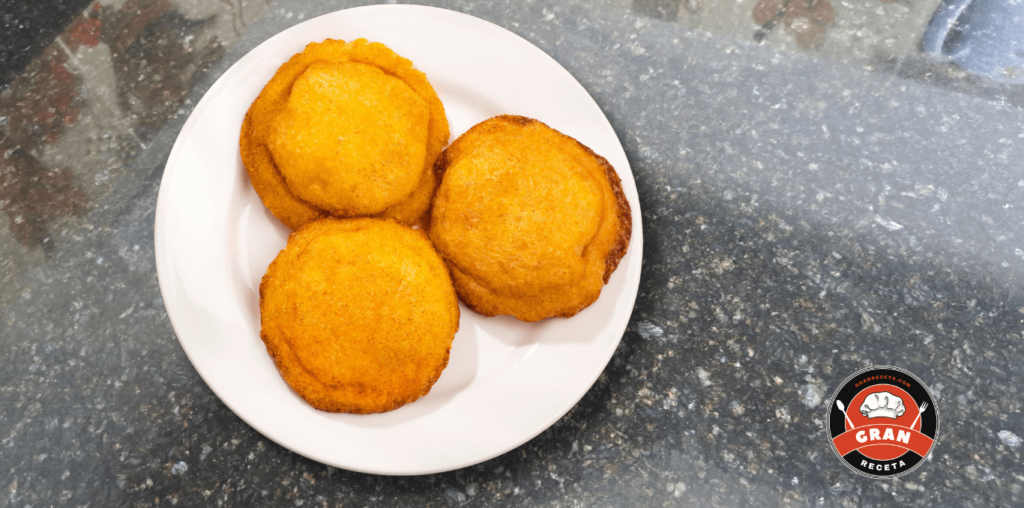
The arepa de huevo of Luruaco has a whole egg cooked inside it, and the trick isn’t the filling, it’s the hollow. The arepa inflates by itself in the first fry: the water in the dough turns to steam, the sealed disc gives it nowhere to go, and it forces the two faces apart into a pocket. Then you cut the rim, slide a raw egg in, patch the cut with dough and fry it again. Four arepas of 430 calories in 52 minutes, and two numbers decide all of it: ½ inch thick and 350-360 °F.
How do you make arepa de huevo? Knead yellow precooked corn flour with warm water, salt and sugar, shape 5-inch discs ½ inch thick, and fry at 350-360 °F for 3 minutes a side until they puff. Cool 5 minutes, cut a 1½-inch slit in the rim, slide in a raw egg, seal with dough and fry 4 minutes more. About 52 minutes for 4 arepas.
What it is, and where it’s from
The arepa de huevo is “a fried dish typical of the Caribbean Region of Colombia, made of a corn arepa with a hen’s egg inside”, according to the Spanish Wikipedia, and the method is exactly 2 fries: fry the dough, take it out, open it, pour in a raw egg, finish frying. The same entry notes that the town of Luruaco, in Atlántico, holds its Festival de la Arepa de Huevo every year in mid-June, and that in Cartagena it’s the star of the fried-food festival during the Candelaria feasts.
On the coast it’s a street food: bought from a cart, eaten standing, usually with a little bag of suero costeño, a tangy cultured cream. It travels badly and is best within minutes, which is why it’s rarely on restaurant menus and always on carts.
What to buy
Everything is standard except the flour, and the flour is the whole recipe. It has to be precooked corn flour, the kind sold as masarepa for arepas (P.A.N., Goya, Areparina). Cornmeal won’t hydrate into a dough at all, and masa harina, the nixtamalized flour for Mexican tortillas, makes a dough that tears instead of stretching, so it won’t hold the steam. The yellow version is the coastal standard; white works identically and just looks different.
Depth of oil matters as much as temperature: you want at least 2 inches so the disc floats rather than sits. And a thermometer is worth more here than in almost any other recipe, because the whole thing hangs on a 20-degree window.
Why it inflates, which is where the pocket comes from
The dough is roughly 45 % water. Dropped into oil at 350-360 °F, the surface dries and stiffens within seconds while the water inside flashes to steam with nowhere to escape, so it pushes. That push separates the two faces and leaves the pocket, and you can watch it happen at around the 40-second mark: the disc swells like a cushion.
Three things have to be right. Half an inch of thickness: thinner and the steam bursts through instead of lifting, thicker and the center never gets hot enough in time. A rim with no cracks, since a crack is a vent. And 350-360 °F: below 320 the surface never seals and the dough drinks oil, above 375 the outside browns before the steam does its work.
The cut, the egg and the seal
There’s a 4-to-5-minute window between fries. Straight out of the oil the arepa is scalding and still pressurized inside; cut it there and it deflates and the pocket closes. Fully cold, the dough stiffens and cracks around the knife.
Cut about an inch and a half in the rim, parallel to the faces, without going through. Crack the egg into a cup first: straight from the shell it’s easy to break the yolk or drop in a piece of shell, and there’s no getting it out. The seal is a small piece of dough pressed onto both lips of the cut; loose, and the egg pours out the moment it hits the oil.
Four minutes at 350 °F is plenty for the second fry: egg white sets at about 144 °F and yolk thickens at 154 °F, so the egg is done long before the crust can burn. For a runny yolk, take it out at 3.
What goes wrong, and how to fix it
The most common failure by far is the first one, a disc that comes out flat. When it happens it’s almost always the oil rather than the dough: every disc you drop in pulls the temperature down several degrees, so let it climb back between pieces.
How long it takes
About 20 of the 52 minutes are hands-on. Because the arepas go in one at a time to keep the oil hot, crack all four eggs into cups before you start the second round; the pocket closes up if it waits.
Who this recipe is for
- If it’s your first time → make five discs and treat one as a test; 40 seconds tells you whether the oil is right
- If you have no thermometer → drop in a pea of dough: if it rises quickly ringed with fine bubbles, the oil is ready; if it sinks, it’s cold; if it browns in 10 seconds, it’s too hot
- If you want it with meat → in Luruaco they add a spoonful of seasoned ground beef beside the egg, in before the egg and sealed the same way
- If you’re cooking for 8 → double the dough but fry in batches or two pots; four discs at once drops the oil 35 °F and none of them puff
- If you want to get ahead → do the first fry a day early; the puffed discs keep 2 days refrigerated and get filled and fried from there
Not a gordita, not an empanada
The 3 look like close relatives and work differently. A Mexican gordita is griddled and then split with a knife, the pocket cut rather than blown. An empanada is folded around its filling before it ever meets the oil. The arepa de huevo is the only one of the three where the hollow is made by steam and the filling goes in mid-cook, which is also why it can’t be made in an air fryer: without hot oil all around it, the surface never seals fast enough to trap the steam.
Storage
Fried and filled, this is a five-minute food: by 20 minutes the steam from the egg has softened the crust from inside. What you can get ahead is the first fry. Puffed discs keep 2 days in a sealed container in the fridge and go straight into filling and the second fry, a minute longer since they start cold.
Raw dough keeps 24 hours covered in the fridge, though it dries a little; knead in a spoonful of warm water before shaping. Leftover filled arepas keep 2 days, within the USDA window for cooked dishes, and come back with 5 minutes in a 400 °F oven or air fryer. Never a microwave: it turns the crust to leather.
Questions people ask
Why didn’t my arepa puff? Oil temperature or a cracked rim. Below 340 °F the surface doesn’t seal and the steam leaks out; a crack in the rim is a vent. An even ½-inch disc at 350-360 °F inflates in about 40 seconds.
When do I cut it open? Four to five minutes after it comes out. Sooner and it deflates; later and the dough cracks.
Can I use masa harina? No. Masa harina is nixtamalized corn for tortillas and tamales; it behaves differently with water and won’t hold the steam. Look for “precooked corn flour” or masarepa.
Can I make it in an air fryer? Not this recipe. Without oil surrounding it, the surface doesn’t seal fast enough to form the pocket, and the pocket is the whole point. An air fryer is good for reheating.
How many calories is one? About 430, from the corn flour label and the USDA database for the egg and the absorbed oil. That’s a full breakfast: 12 g of protein and 56 g of carbohydrate.
What do I serve with it? On the coast, suero costeño or a homemade ají. Sour cream loosened with a pinch of salt is the closest easy substitute.
Nutrition
Per arepa, egg included, from the precooked corn flour label and the USDA database for the egg and oil: about 430 kcal, 56 g carbohydrate, 17 g fat of which 3 g saturated, 12 g protein, 3 g fiber, 1 g sugar and 370 mg sodium.
About 12 g of that fat is oil absorbed across the two fries; the rest comes from the egg. Against a bowl of Colombian changua, the poached-egg milk soup they drink in Bogotá, this is a different kind of morning altogether. Against a breakfast of two griddled Colombian cheese arepas, this one carries nearly twice the fat, which is the difference between a griddle and a pot of oil. For the rest of a coastal spread, patacones fry in the same oil and a cold aguapanela is what you drink with them.
The first time I ate one was from a cart in Barranquilla at six in the morning, and what surprised me wasn’t the egg but the crunch, which we don’t have in Venezuela; our arepas go on a griddle and are a different thing entirely. At home I make them on Sundays and we always fry one extra, the test one, eaten standing in the kitchen by whoever is closest. Josnaisis.