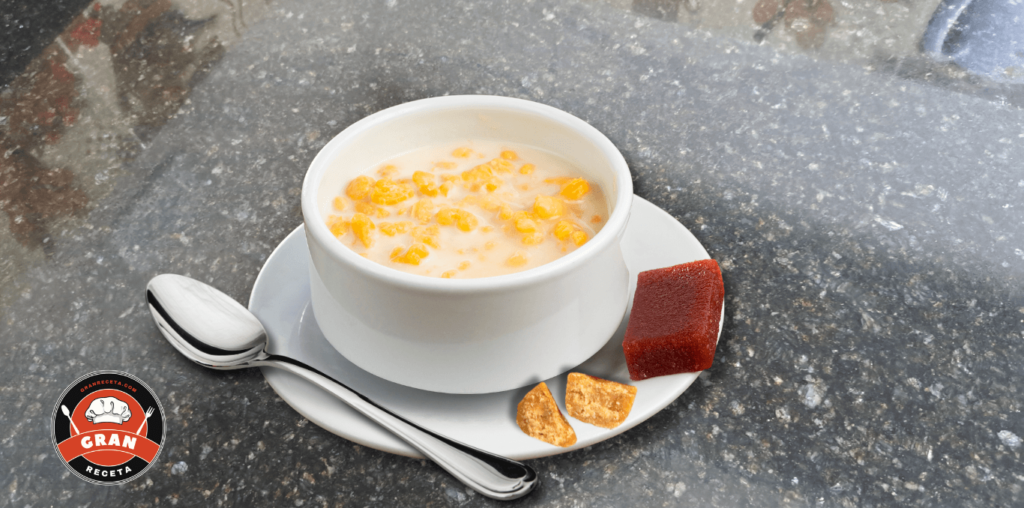
Mazamorra paisa, from Antioquia, is two things in the same mug: a pound of cracked corn simmered until it crushes between your fingers, and the claro, the thick milky water it cooked in. It’s served cold, the milk poured over at the table and the sweetener set beside the bowl, never stirred into the pot. That last part is what separates it from peto, its highland cousin, which is cooked in milk and served hot and already sweet. Ten hours from start to finish, only 20 minutes of them hands-on, and 210 calories a serving before the milk goes on.
How do you make mazamorra paisa? Wash and soak 1 lb of dried white cracked corn for 8 hours. Simmer it in 10 cups of water over medium-low heat for 2 hours with ¼ tsp of baking soda, until a grain crushes between your fingers, and keep the cooking liquid. Chill it, then serve with cold milk and panela on the side. About 600 minutes for 6 servings.
What it is, and what the claro is
Colombian mazamorra, according to the Spanish Wikipedia, “consists of corn boiled in unsalted water, served with milk, and accompanied by a small dry sweet (panela, blanqueado, or bocadillo)”, and the cooking liquid, called the claro, is served as a drink during meals.
That claro is the part most people outside Colombia pour down the drain. Over 2 hours the grain releases starch and the water turns thick and white; a good share of the flavor and all of the body live there. In Antioquia the mazamorra is served with its claro and, if there’s some left over, it gets drunk cold with a little panela stirred in.
What to buy
The corn is the only thing you might have to hunt for, and the substitution most likely to disappoint is the obvious one. Canned hominy is not a shortcut: it’s already cooked, packed in brine, and it produces no claro, so you end up with corn in milk rather than mazamorra. What you want is dried white cracked corn, sold as maíz trillado or maíz peto in Latin groceries and easy to find online. It’s the same grain that becomes hominy once it’s cooked, but raw and dry.
The soak, which is what saves you hours
Dried cracked corn takes about 4 hours to soften from scratch, and it cooks unevenly: some grains blown out, some still hard. An overnight soak brings it down to 2 hours with an even grain. The soaking water gets discarded; it carries loose starch and dust from the grain.
About the baking soda, it’s worth being precise, because plenty of recipes present it as if it were nixtamalization. Alkaline water does soften the grain’s cell walls, but baking soda is a far weaker base than the lime used to nixtamalize corn, which works several pH points higher. It shortens the simmer by roughly half an hour and leaves a softer grain, but it doesn’t hull the corn and it doesn’t replace that process. A quarter teaspoon for a pound is the limit; past that there’s a metallic aftertaste that never leaves.
Mazamorra, peto and pozole
Peto is the one Colombians themselves mix up with it, and the distinction is simple: peto is cooked in milk with cinnamon, sweetened in the pot and drunk hot; mazamorra is cooked in plain water, keeps its claro, is eaten cold and is sweetened in the bowl. If it’s hot and already sweet, it’s peto.
Mexican pozole shares the grain and nothing else: that corn is nixtamalized, the pot is broth with pork or chicken, and it’s a savory main course. The name travels too. Per the Spanish Wikipedia, Peruvian mazamorra morada is made from purple corn thickened with starch and is one of Lima’s best-loved desserts; the Venezuelan version is made like majarete but with tender corn, mostly in Sucre and Monagas; and in Panama it’s cornstarch cooked with fruit and cinnamon. Same word, unrelated dishes.
What you put on it
The corn on its own is 210 kcal a serving, and everything else is what you add: a cup of cold whole milk brings 152, an ounce and a half of guava paste 118, two tablespoons of grated panela 76. A full bowl with milk and panela lands near 440.
That’s the reason the milk goes on at the table and the sweet sits beside the bowl. It isn’t only tradition; it’s what lets one person take it almost plain and the next bury it in guava paste.
How long it keeps
Stored properly, mazamorra holds up to 5 days. Cooked corn is moist and not acidic, so the margin depends almost entirely on chilling it fast: into the fridge within 2 hours of coming off the heat, covered, below 40 °F. Always store it with its claro, which keeps the grain hydrated; without it the corn dries and compacts within a day.
Three signs mean it’s done, and one is enough: a sour or fermented smell, a slimy grain, or bubbles in the claro. It also freezes well for 2 months, always without the milk, and thaws overnight in the fridge.
How it’s eaten in Antioquia
Cold, in an 8-oz mug, usually mid-afternoon, with the milk poured over and panela or a slice of guava roll on the side; the contrast between the sweet and the unsweetened corn is the whole idea. On a paisa table it turns up after a bandeja paisa, when nobody can face a real dessert, and it competes with Colombian rice pudding for the same slot. In December, next to natilla and buñuelos, it’s what you offer someone who wants something less sweet. And leftover claro gets drunk cold with panela, like a thick aguapanela. The other paisa way with corn is the fresh-kernel sweet corn arepa, griddled in 8 minutes and eaten with a slab of cheese.
Questions people ask
How long does mazamorra keep in the fridge? Three to five days, if it goes in within 2 hours and is stored covered with its claro. A sour smell, slimy grains or bubbles in the claro mean it’s finished.
What is the claro? The cooking water, thick and milky from the starch the corn releases. Per the Spanish Wikipedia it’s also served as a drink with meals. Never throw it out.
What’s the difference between mazamorra and peto? Peto is cooked in milk with cinnamon, sweetened in the pot and served hot. Mazamorra is cooked in plain water, keeps its claro, is served cold, and is sweetened in the bowl.
Can I use canned hominy? In a pinch, but it’s a different dish: it comes cooked and brined, needs a thorough rinse, and produces no claro, which is half of what mazamorra is.
Can I use a pressure cooker? Yes: with soaked corn, a little under 40 minutes once it comes to pressure. It works, though the claro is thinner because less water evaporates.
What does the baking soda do? It raises the pH of the water and softens the grain walls, cutting roughly half an hour off the simmer. It isn’t nixtamalization, which uses a much stronger base. A quarter teaspoon per pound; more tastes metallic.
Nutrition
Per serving, one sixth of the pot and without the milk, from the USDA database for the corn: about 210 kcal, 44 g carbohydrate, 3 g fat of which 1 g saturated, 6 g protein, 4 g fiber, 1 g sugar and 30 mg sodium.
With a cup of whole milk and a tablespoon of panela, a full bowl comes to about 440 kcal. The sugar in the mazamorra itself is close to zero: all the sweetness arrives afterward, which is exactly the logic of the dish.
Mazamorra was the first thing I understood about paisa cooking: that some dishes aren’t trying to impress anyone. The first time I was handed a mug with the claro floating on top I thought they’d watered it down; later I learned that liquid is half the dish and that throwing it out is the mistake of those of us who come from elsewhere. The closest thing we have in Venezuela is majarete, which is thicker and made with coconut. Now I make mazamorra on Sunday mornings and let it get cold while the house gets on with other things. Josnaisis.