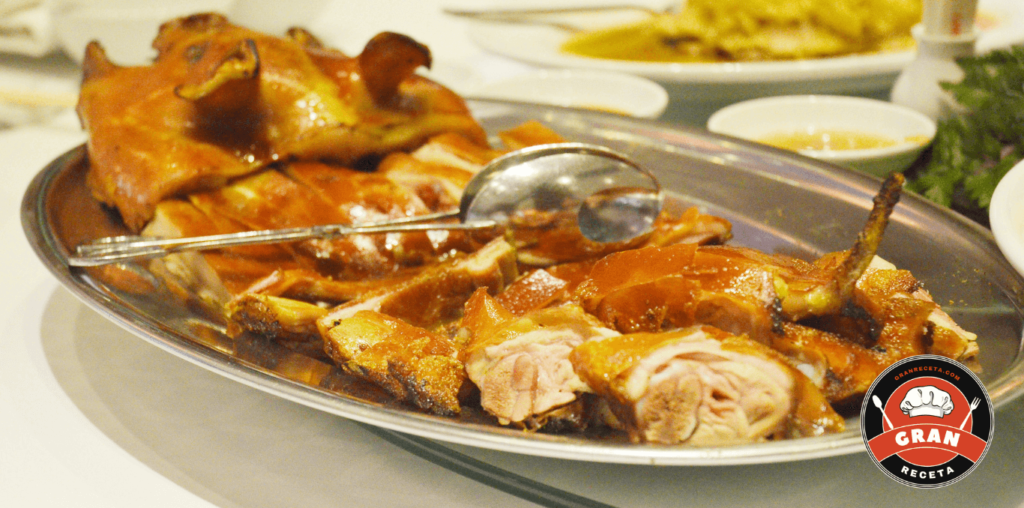
Lechona is judged by its skin: it has to puff, brown and sound hollow when you tap it, which in Tolima is described as the skin thundering. That takes two oven temperatures, not one: three hours at 320 °F so the filling of marinated pork and yellow split peas cooks without drying, and a final 40 minutes at 390 °F so the water trapped under the skin turns to steam and lifts it. It feeds 20 at about 420 calories a portion, and of the seven hours it takes, only 45 minutes are work.
How do you make Colombian lechona? Soak yellow split peas overnight and cook them 20 minutes, marinate 3¼ lb of cubed pork with onion, garlic and cumin for 2 hours, mix the two and stuff a large piece of pork skin, then sew it and rub it with salt and sour orange. Roast 3 hours at 320 °F and 40 minutes at 390 °F until the skin puffs. About 425 minutes for 20 servings.
What a lechona is
Lechona is a whole pig, or a large piece of its skin, stuffed and slow-roasted. What makes it tolimense is the filling: dried yellow split peas with cubed pork, and no rice. In Valle del Cauca they use rice, and that’s the standing argument between the two versions. The peas bring what rice doesn’t: 23 g of protein and 22 g of fiber per 100 g dry per USDA, and a texture that doesn’t turn to paste as it soaks up the pork fat.
The other half of the dish is the skin with its fat layer. It isn’t a wrapper: as it roasts, that fat renders inward and is what keeps the filling moist across seven hours.
What to order from a butcher
This is the recipe’s one real obstacle outside Colombia, and it’s solvable with a phone call. What you want is a single large sheet of pork skin with its fat still attached, which a butcher will cut from a fresh ham or a whole belly if you order two or three days ahead. Skin-on pork belly, about 4½ lb in one piece, is the easiest thing to ask for in the US and works well.
Everything else is standard. Pork shoulder rather than loin, because loin dries out over seven hours. Yellow split peas, which are the same product sold for split pea soup. And sour orange, which is in the Latin aisle; two parts orange juice to one part lime is a fair substitute.
The two oven temperatures
This is the technical heart of it. At 320 °F for three hours the filling cooks slowly: the pork comes to temperature, the peas absorb fat, and the whole mass settles. The skin in that stretch doesn’t puff, it just dehydrates gradually, which is exactly what it needs to do.
The last 40 minutes at 390 °F are a different process. The water left between skin and fat flashes to steam and pushes outward: the skin separates, inflates and turns brittle. Start at that temperature and the skin burns while the filling is still raw; never go up, and you get leathery skin you chew instead of snap.
One safety note: per USDA FSIS, whole cuts of pork are safe at 145 °F with a 3-minute rest. The filling here goes to 165 °F, not for safety but because that’s where cubed pork and split peas finish softening.
How long it really takes
Seven hours sounds worse than it is: the actual work is 45 minutes. Everything else is soaking, marinating and roasting.
The 30-minute rest at the end isn’t optional. Straight from the oven the fat is liquid and the filling has no structure, so it collapses when you cut it. Half an hour later the filling holds and the skin is still crisp; after that, serve it promptly, because steam from the filling softens the skin over time.
Tolima, Valle and Spanish cochinillo
Tolima means split peas; Valle means rice. That’s the real difference, and the skin is handled identically in both. Spanish cochinillo looks related but is another dish entirely: a three-week-old animal, no filling, two hours in the oven, and a thin skin traditionally carved with the edge of a plate rather than puffed.
Step by step
The skin, which is the whole job
Ask for it whole, cleaned and with its fat. Before stuffing, rub the outside with coarse salt and sour orange juice: the salt pulls moisture from the surface, which is what later lets it puff, and the acid helps it brown evenly.
Prick it with a fork every 2 inches, skin only, not into the meat. Those holes vent steam over the first three hours; without them the steam builds and tears the skin in the final stretch.
And stuff it loosely. The filling expands as it heats, and a tightly packed lechona splits its seams by the second hour.
Who this recipe is for
- If it’s your first time → make half, with 2¼ lb of skin and 1½ lb of pork; a home oven handles it better and the technique is identical
- If you can’t get a whole sheet of skin → bake the filling in a dish and roast strips of skin separately at 390 °F to crackle on top; not the same, but it works
- If your oven stops at 350 °F → stretch the final stretch to 60 minutes and move it to the top rack; it still puffs, more slowly
- If you want the Valle version → swap the peas for 1 lb of rice cooked al dente and add diced carrot
- If you’re feeding 40 → two medium lechonas rather than one large: in a single big piece the center takes two hours longer and the skin overcooks
What goes wrong
Not pricking the skin. Steam builds and tears it in the last stretch. Holes every 2 inches, before roasting.
Packing the filling tight. It expands with heat and splits the seams. Stuff it loosely.
Roasting hot from the start. The skin burns over a raw filling. Three hours at 320 °F, then 40 minutes at 390 °F.
Basting at the end. Baste over the first three hours; in the 390 °F stretch the skin needs to dry to puff. Basting there leaves it leathery.
Carving it straight from the oven. The filling collapses. Thirty minutes of rest.
What to serve it with
When the fire is outdoors rather than in an oven, the equivalent Sunday roast is llanero beef. In Tolima, lechona comes with insulso, a corn-and-panela custard, and a white corn arepa, and nothing else: a 7-oz portion already carries meat, fat and legume. On a celebration table it sits beside the Colombian tamal, the other Tolima signature, and in December it shares the table with Venezuelan hallacas in households that cook both cuisines. To drink, cold aguapanela with lime cuts the fat better than any soda. At the opposite end of the oven scale, homemade pizza is done in 12 minutes. For dessert, if anyone can, natilla or very cold mazamorra.
Storage
Carved lechona keeps 4 days in the fridge in a sealed container, within the USDA window for cooked dishes, and should be chilled within 2 hours. The filling freezes well for 3 months; the skin doesn’t, because it loses its crackle and turns rubbery on thawing.
To reheat, 10 minutes in a 390 °F oven: the skin recovers much of its snap and the filling warms without drying. A microwave softens the whole thing and is what I’d avoid.
Questions people ask
Why didn’t my skin puff? Temperature or moisture. If you never went up to 390 °F there was no sudden evaporation; if you basted in the final stretch, the skin was wet. Salting it before roasting helps too.
How much pork per person? About 2½ oz of meat and 1 oz of dry split peas per serving; 3¼ lb of pork and 1 lb of peas make 20 portions of about 7 oz.
Can I make it in a home oven? Yes, half a lechona fits a domestic oven. The limit is size, not technique: same temperatures, same timings.
What’s the difference from the Valle version? The filling: Tolima uses yellow split peas, Valle uses rice. Skin and roasting are the same.
How many calories in a portion? About 420 per 7-oz portion, from the USDA database for pork and split peas. Most of the fat comes from the skin and the lard in the filling.
Do I have to sew the skin? Yes, with butcher’s twine, stitching every inch. Unsewn, the filling escapes within the first hour.
Nutrition
Per portion, one twentieth of the lechona (about 7 oz with skin and filling), from the USDA database: about 420 kcal, 20 g carbohydrate, 23 g fat of which 8 g saturated, 32 g protein, 5 g fiber, 2 g sugar and 580 mg sodium.
The split peas carry nearly all the fiber: 22 g per 100 g dry per USDA, leaving about 5 g per portion. It’s a fatty dish, yes, but also the most complete one in Tolima’s cooking: pork protein, legume and starch in the same bite.
Lechona isn’t a dish you improvise: it’s ordered, it’s for a party, and it’s for sharing. The first time I saw a whole one on a table in Ibagué it struck me as excessive, until I understood that it was lunch for thirty people and nobody was cooking anything else that day. The closest thing we had in Venezuela was the Christmas pernil, which is another matter entirely: here the pig arrives with the meal inside it. Josnaisis.