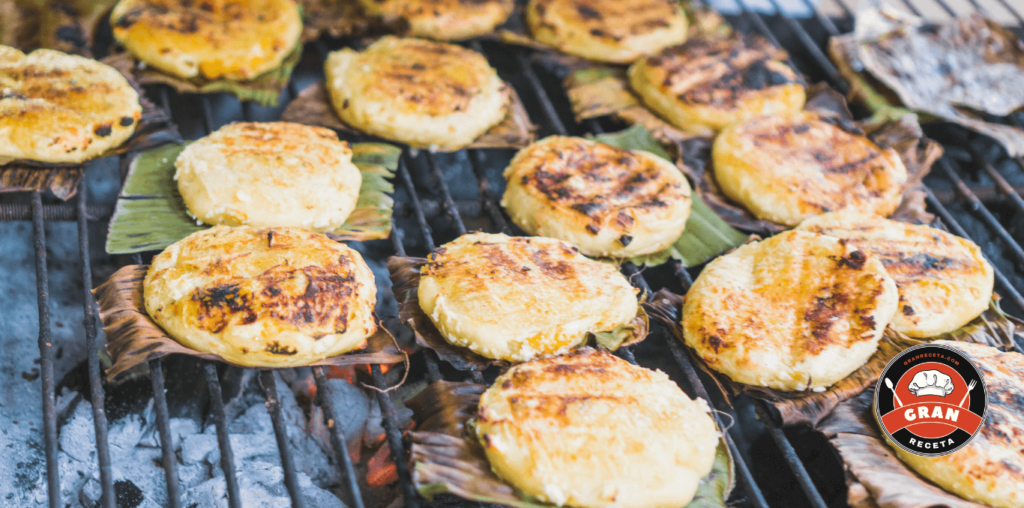
Arepas de chócolo, from Colombia’s Valle del Cauca, sweeten themselves. Fresh sweet corn carries 6.26 g of sugar per 100 g per USDA, and that sugar is what caramelizes in the pan and gives the golden edge; the three tablespoons you add only underline it. Which is why an older ear won’t do: its sugar has already turned to starch, and the arepa comes out dry. The rest is 2 oz of precooked corn flour for body, a 10-minute rest, and medium-low heat, because sugar burns long before the center sets. Four arepas of just under 300 calories, ready in three quarters of an hour.
How do you make arepas de chócolo? Blend 1 lb of fresh corn kernels with butter, sugar and salt without taking it fully smooth, stir in 2 oz of precooked corn flour and rest 10 minutes. Cook 5-inch discs in a buttered skillet over medium-low heat, 5 minutes a side, then top with cheese and cover the pan 2 minutes. About 44 minutes for four arepas.
What to buy
Chócolo is corn in the milk stage, and the test is your thumbnail: press a kernel and it should burst with white juice. In a US supermarket, ordinary fresh sweet corn in season is exactly right, and frozen kernels work well out of season, thawed and drained.
The other item is masarepa, precooked corn flour, sold in the Latin aisle for arepas. It isn’t cornmeal and it isn’t masa harina: it hydrates instantly and acts as the binder that turns blended corn into something you can flip. Two ounces is all it takes.
Why tender corn matters
The corn’s sugar turns to starch as the ear matures. Per USDA, raw sweet corn is 6.26 g of sugar and 18.7 g of carbohydrate per 100 g; dried corn reaches 74 g of carbohydrate with virtually no free sugar. Between those two points lies the difference between a juicy, sweet arepa and a dry one.
That’s also why canned corn disappoints: packed in brine it turns the arepa savory and slightly metallic, and packed in syrup it goes cloying. If it’s all you have, rinse and drain it thoroughly.
How long it takes, and the rest that matters
Half of the 44 minutes is pan time. What you can’t skip is the 10-minute rest: the precooked flour needs it to absorb the water the corn released in the blender. Before the rest the batter looks too loose and it’s tempting to add more flour, which is the classic error; after it, the batter has body and holds a disc.
If it’s still running once the rest is up, then add a tablespoon of flour and give it a few minutes more.
Pan temperature, the thing that most often goes wrong
This batter has sugar in it, and sugar scorches sooner than you expect. Over high heat the arepa browns in two minutes and stays raw inside, tasting of starch. Over medium-low, around 320-340 °F, it takes 5 minutes a side and cooks evenly while the surface caramelizes slowly.
And don’t move it. Pour the disc, leave it alone, and flip once, when the edges look matte and dry. Moving it earlier tears it, because until it sets it has no structure.
The cheese, and when it goes on
The 7 oz of cheese goes on top, at the end, never into the batter. Lay it on the arepa once one side is golden, cover the pan for two minutes, and the steam softens it without letting it run. Mixed into the batter it releases water and the arepa never sets.
In Colombia it’s queso doble crema, which softens and stretches without fully melting. Queso fresco is the natural US match, and a mild feta gives the sharper salty contrast against the sweet corn. What doesn’t work is anything that melts completely, like cream cheese, which soaks the batter.
Chócolo, plain arepa and cachapa
If you know Venezuelan cachapas, this is their Colombian cousin: same blended fresh corn, different binder. The chócolo arepa carries 2 oz of precooked flour, making it thicker and grainier; the cachapa has little or none, so it’s thin and elastic enough to fold over a slab of cheese. A plain Colombian arepa is a different thing altogether: flour and water, unsweetened, griddled rather than pan-fried in butter.
Who this recipe is for
- If you only have frozen corn → it works; thaw, drain well and use one tablespoon less milk
- If the batter runs → give it 5 more minutes of rest before adding flour; it’s usually time, not proportion
- If you want them less sweet → one tablespoon of sugar instead of three; the corn brings its own
- If you have no nonstick pan → a well-greased griddle and even lower heat
- If you’re cooking for 8 → double it but cook two at a time; a crowded pan drops the temperature and nothing browns
What goes wrong
Corn past its prime. No sugar, no juice, dry bland arepas. Test a kernel with your thumbnail.
Skipping the rest. The batter runs and won’t hold a disc. Ten minutes.
High heat. The sugar burns outside while the center stays raw. Medium-low, 5 minutes a side.
Flipping too soon. It tears. Wait for matte edges.
Cheese in the batter. It releases water and the arepa never sets. Cheese on top, at the end.
What to serve it with
With 2 oz of cheese on top it’s already breakfast, and that’s how it’s sold at roadside stands in Valle del Cauca and the coffee region, with a mug of Colombian hot chocolate. At home we have it with aguapanela, or with a santandereana arepa on the same griddle when there are more of us, and sometimes a fried egg on top, which turns it into lunch. On a table of Colombian breads, beside pandebono and cheese arepas, this is the sweet one.
Storage
Raw batter keeps 2 days in a sealed container in the fridge and needs a stir before use, since the corn releases water. Cooked arepas keep three days and come back in a buttered pan, a couple of minutes a side; a microwave makes them gummy.
They also freeze well, cooked and without cheese, for up to two months: separate them with parchment so they don’t stick and cook them straight from frozen over low heat, a little longer than fresh.
Questions people ask
What is chócolo? Corn in the milk stage, tender enough that a kernel bursts and releases white juice when pressed.
Can I use frozen or canned corn? Frozen, yes, and it works well. Canned comes in brine or syrup and changes the flavor; if it’s all you have, rinse and drain thoroughly.
Why is my batter runny? It needed the rest. Precooked corn flour takes 10 minutes to absorb the corn’s water. Adding more flour up front gives a heavy arepa.
Can I make it without the corn flour? Yes, and then it’s closer to a cachapa: thinner, more fragile and harder to flip. The flour is what gives it arepa body.
How many calories in one? About 295 with its cheese, from the USDA database for sweet corn, butter and cheese. Without cheese, about 180.
Is it sweet or savory? Both: there’s sugar and salt in the batter and salty cheese on top. That contrast is the recipe.
Nutrition
Per arepa with 2 oz of cheese, from the USDA database: about 295 kcal, 34 g carbohydrate, 13 g fat of which 7 g saturated, 11 g protein, 2 g fiber, 9 g sugar and 260 mg sodium.
Most of that sugar is the corn’s own; only about a third comes from what you add. The fat is split between the butter in the batter and the cheese; without cheese an arepa drops to about 180 kcal.
In Venezuela we make cachapas, the same idea with less flour, folded over a slab of fresh cheese, and for years I argued with Colombian friends about which was better. I’ve stopped: they’re two ways of using the same ear of corn, and in season I make both. What I do hold to is that the cheese goes on top, at the end, in either country. Josnaisis.