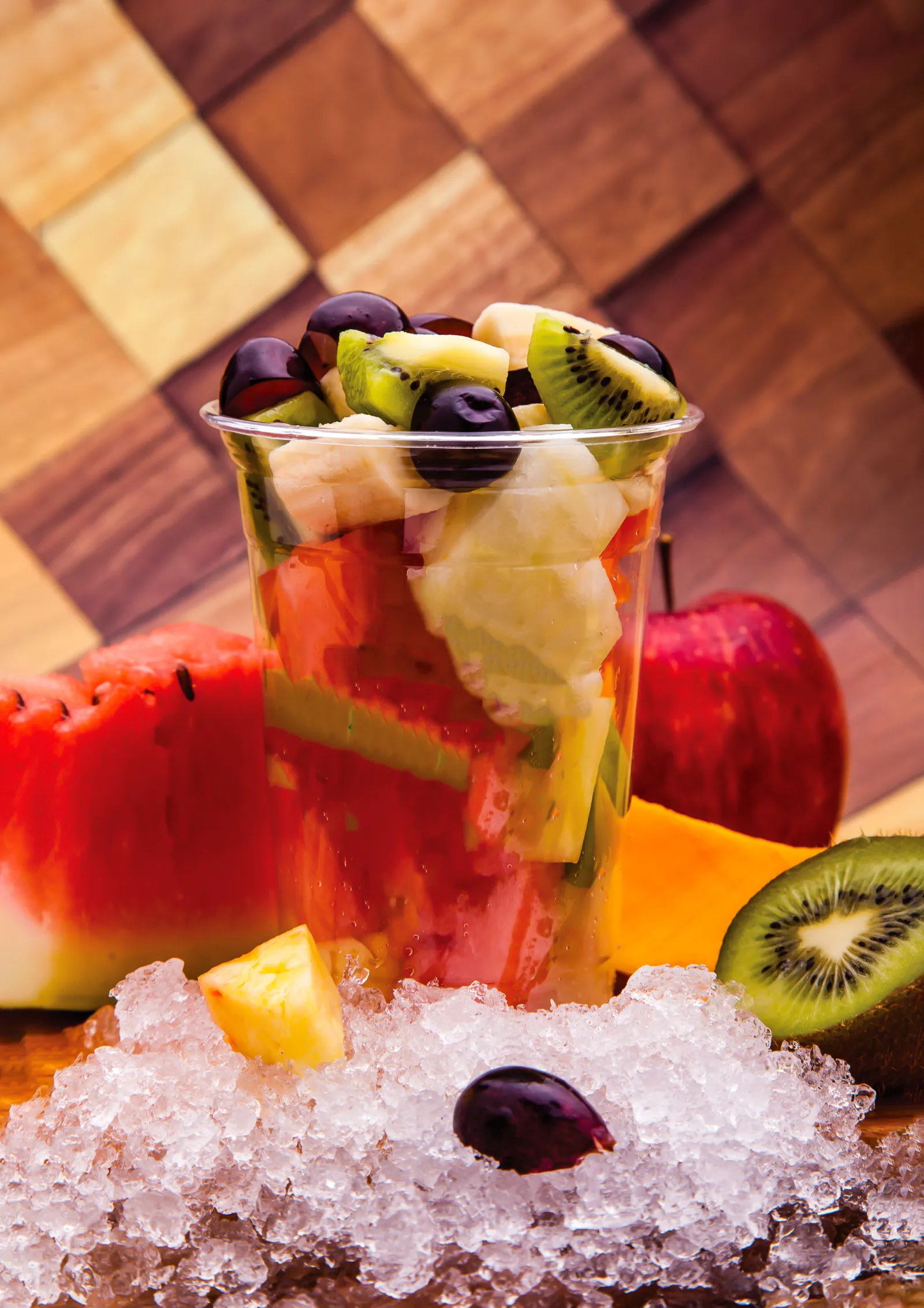

In Spain and Mexico a salpicón is a cold salad of shredded beef or seafood; in Colombia the same word means a tall glass of diced fresh fruit floating in watermelon juice, which you drink through a wide straw and finish with a spoon. Think of it as a fruit cocktail you can drink. Fruit stands across the country sell it plain, topped with a scoop of vanilla ice cream, or with grated white cheese on top, which surprises most people the first time. Made at home it takes 30 minutes, needs no stove, and the only real technique is cutting the fruit in the right order.
What is Colombian salpicon, and is it worth making at home?
How do you make Colombian salpicon? Blend watermelon with no water, strain it and chill the juice. Dice papaya, pineapple, mango and strawberries into ½ inch (1 cm) cubes, then dice apple and banana last and toss them in orange and lime juice so they don’t brown. Combine everything, cover with the watermelon juice and serve in tall glasses, with a scoop of vanilla ice cream if you like. Ready in 30 minutes for 6 servings.
It’s worth it if you want something cold for a hot afternoon, a kids’ party or a drinks table, and it scales to 20 glasses without much extra work. It’s a poor choice if you want a make-ahead drink that holds for days: once assembled it’s at its best the same day.
Time and effort. 30 minutes, all hands-on, no cooking. If your fruit isn’t already cold, give the juice and the cut fruit 30 minutes in the fridge before serving.
Difficulty. Easy. Two things go wrong, and both are covered below: blending the watermelon too hard, and cutting the apple and banana too early.
The ratio per glass, the fruit, and US and UK swaps
One glass of 400 ml (14 fl oz) holds 1 cup of diced fruit, about 160 g (5½ oz), and 190 ml (¾ cup) of liquid. Less juice and you have a wet fruit salad; more, and the fruit floats and the glass runs dry before you reach it.
For 6 glasses that’s 970 g (2 lb 2 oz) of fruit in six kinds. Each does a job. Papaya and mango bring body and sweetness, pineapple brings acid and crunch, strawberries color, apple a crisp bite and banana the creamy note. Papaya is the largest share, 250 g (9 oz), because it’s the backbone of almost every fruit-stand salpicon. If you dislike papaya, split its weight between pineapple and mango.
Good additions are halved grapes, cantaloupe and a few spoonfuls of passion fruit pulp for sharpness. Soursop and kiwi break down and cloud the juice.
Where to shop. In the US, Maradol papaya (the large orange-fleshed kind) is in Latin grocers and most big supermarkets; the small Hawaiian papayas work but are pricier per ounce. Colombiana soda by Postobón, if you want the fruit-stand version, turns up in Latin grocers and at Costco in 24-bottle cases. In the UK, large papayas are in Asian and Latin grocers and some larger supermarkets; outside summer, when watermelon is poor, switch the base to orange juice.
Ice cream and grated cheese on top
A scoop of vanilla ice cream turns the drink into dessert. Add it right before serving: in the cold juice it melts over 5 to 10 minutes and turns the liquid milky, which is the point.
Grated cheese is the part that sounds odd. It’s best documented on Colombian ensalada de frutas, the fruit salad with cream, ice cream and cheese, but plenty of fruit stands offer it on salpicon too, and the stand near my house always asks. A mild, slightly salty white cheese plays against the sweet fruit. Use 15 g (½ oz) per glass, finely grated: queso blanco, queso fresco or fresh mozzarella. A hard, salty cheese like feta overwhelms the fruit.
Which liquid base to use, and how much sugar each adds
All three bases are authentic. They differ in sugar, color and how long they hold.
Watermelon juice is the lightest and gives salpicon its red color. Orange juice alone is tangier and protects cut fruit better, so it suits a batch made hours ahead. Colombiana soda, a sweet kola champaña, is the fruit-stand choice and the sweetest; USDA has no entry for it, so the chart uses cream soda, its closest match. If you use soda, pour it into each glass at serving time, because it goes flat in the bowl within 20 minutes. My base, the one in this recipe, is watermelon with a splash of orange and lime: red, fresh and acidic enough for the apple, at 12 g of sugar per glass of liquid.
Make-ahead and party plan for 10 to 20 people
For a crowd, split the work over two days. Everything except the apples and bananas can be done the night before.
The night before. Strain the watermelon juice into a covered pitcher; it separates overnight, so just stir it. Dice the papaya, pineapple, mango and strawberries into an airtight container. On the day, dice the apples and bananas into the citrus, combine and serve.
| Ingredient | 6 glasses | 12 glasses | 20 glasses |
|---|---|---|---|
| Watermelon flesh | 1.2 kg (2⅔ lb) | 2.4 kg (5¼ lb) | 4 kg (8¾ lb), one 8 kg (17 lb) melon |
| Diced fruit, all six | 970 g (2 lb 2 oz) | 1.95 kg (4¼ lb) | 3.25 kg (7 lb) |
| Orange juice | 120 ml (½ cup) | 240 ml (1 cup) | 400 ml (1⅔ cups) |
| Lime juice | 30 ml (2 tbsp) | 60 ml (¼ cup) | 100 ml (7 tbsp) |
| Total liquid | 1.15 L (4¾ cups) | 2.3 L (9¾ cups) | 3.8 L (1 US gallon) |
| Ice cream scoops (60 g) | 6 | 12, about 1.3 L (1⅓ quarts) | 20, about 2.1 L (2¼ quarts) |
For 20, use a 4 L (1 gallon) drink dispenser or two bowls set on a tray of ice. I spoon fruit into each glass first with a ladle and top up with juice from a pitcher; that way nobody ends up with a glass of only liquid.
How to tell it’s going right. The juice is deep red after straining; pale pink with black specks means the blender cracked seeds. The cubes keep sharp edges; papaya that squashes under the knife is too ripe and belongs in a smoothie. Apple and banana are still pale after 30 minutes. The juice tastes of watermelon and the fruit of fruit; if it all tastes equally sweet, there’s too much sugar.
Mistakes that ruin salpicon
- Brown apple and banana → cut first or left in the air. Cut them last, into 2 tablespoons (30 ml) of lime and ½ cup (120 ml) of orange juice, and keep them submerged. An enzyme in the cut fruit reacts with oxygen; acid slows it and the liquid keeps the air out.
- Watery salpicon → ice in the bowl or water in the blender. The cold should come from the fridge. If you want ice, freeze watermelon juice in an ice-cube tray.
- Mushy fruit → overripe papaya or banana, or stirring with a whisk. Ripe-but-firm fruit and a big spoon, folding from the bottom.
- Bitter juice → crushed seeds. Low speed, 30 to 45 seconds, then a fine sieve.
- Cloying → soda plus condensed milk plus ice cream in one glass. Pick one.
Spice level is zero. Kids love it; for under-fours, dice the fruit to ¼ inch (5 mm) and quarter any grapes, since whole grapes are a choking risk. Allergens: the base has no gluten, dairy, egg or nuts; dairy comes with the ice cream and cheese, and some ice creams contain egg. People with latex allergy can react to banana, papaya and kiwi (latex-fruit syndrome); swap in more pineapple and watermelon.
Which version should you make?
First, what salpicon is and isn’t. Several drinks and desserts share diced fruit.
- Short on time → unsweetened bottled orange juice instead of watermelon, and supermarket pre-cut fruit without apple or banana. 10 minutes.
- No blender → mash the watermelon with a potato masher and strain it, or use orange juice only.
- Party of 20 → the table above, with juice and firm fruit made the night before.
- Lighter → watermelon juice, no sugar, no ice cream or cheese: 158 kcal per glass, the base of this recipe.
- Dessert → a scoop of ice cream plus grated cheese, about 329 kcal.
- Fruit-stand style → 190 ml (¾ cup) of Colombiana soda or cream soda instead of juice, poured at the table. Twice the sugar in the liquid.
- Vegan → the base already is; use coconut ice cream on top.
If you want the same fruit-stand world in a spoonable dessert, try the Colombian cholado, shaved ice with fruit, syrups and condensed milk.
What it costs to make
Colombian wholesale prices from the DANE SIPSA bulletin for Bogotá’s Corabastos market, the week of September 12 to 18, 2026, put the six glasses at 14,417 pesos, about 2,403 pesos per glass; the watermelon alone is 39% because you buy it with the rind.
For US shoppers, the BLS average price survey for August 2026 covers only part of the list: bananas at $0.652/lb make the banana about $0.27; strawberries at $2.578 per 12 oz pint come to about $0.83 for 3½ oz; navel oranges at $1.709/lb about $1.13 for two; lemons, standing in for limes, which the BLS doesn’t track, at $2.114/lb about $0.61. Six scoops of ice cream from a $5.854 half-gallon run about $2. The BLS publishes no current series for watermelon, papaya, pineapple, mango or apples, so I can’t give a verified US total. In practice the papaya and mango are the costly fruit outside Latin America, and watermelon, in season, is the cheap one.
Serving and storage
Serve ice-cold, in tall glasses with a wide straw, about ⅓ inch (1 cm) across, because thin straws clog with fruit, and a long spoon. Salpicon is an afternoon drink or a dessert after something savory, like Colombian empanadas or cheese arepas. On a drinks table it pairs well with Colombian coconut lemonade and the tart lulo juice or creamy soursop juice.
Out of the fridge. Perishable food can sit out for 2 hours at most, or 1 hour above 90°F (32°C), according to USDA FSIS. On a buffet, set the bowl on ice.
In the fridge. Assembled salpicon is best the same day; after 24 hours the banana goes soft and the apple loses its crunch, though it stays safe at 40°F (4°C) or below. Diced firm fruit without the apple or banana keeps 3 to 4 days covered, the window the University of Maryland Extension gives for cut melon. Strained watermelon juice keeps until the next day.
Freezing. Don’t freeze the assembled drink; thawed fruit is limp and weepy. Do freeze leftover watermelon juice in ice-cube trays, and use the cubes to chill tomorrow’s glass without diluting it.
Frequently asked questions
What is the difference between salpicon and fruit cocktail? Canned fruit cocktail is cooked fruit in heavy syrup. Colombian salpicon is fresh, raw fruit in watermelon or orange juice, served as a drink with a straw and spoon.
What fruit goes in Colombian salpicon? Papaya, pineapple, mango, banana and apple are the core, with watermelon blended into the juice. Strawberries, grapes and cantaloupe are common extras. This recipe uses 970 g (2 lb 2 oz) of fruit for 6 glasses.
What can I use instead of Colombiana soda? Cream soda is the closest supermarket match, a little sweeter and more vanilla-forward. Fresh watermelon juice, the base here, has about half the sugar.
Why do Colombians put cheese on salpicon? For contrast: a mild, slightly salty white cheese against sweet fruit and ice cream. It’s most typical on Colombian fruit salad, and many fruit stands offer it on salpicon too.
How do I keep the bananas and apples from browning? Cut them last, toss them straight into orange and lime juice, and keep them under the liquid. Papaya, pineapple and mango don’t brown.
Can I make salpicon the day before? Make the juice and dice the firm fruit the day before, stored separately. Cut the apples and bananas and combine on the day.
How long does salpicon last in the fridge? Assembled, it’s best within the day. Cut firm fruit on its own keeps 3 to 4 days at 40°F (4°C) or below.
Is salpicon alcoholic? No. Colombian salpicon is a non-alcoholic drink, which makes it a standard at children’s parties.
Nutrition
Per glass (about 390 g / 14 oz, without sugar, ice cream or cheese), calculated ingredient by ingredient from USDA FoodData Central (SR Legacy) using this recipe’s quantities:
- Calories: 158 kcal
- Protein: 2 g
- Carbohydrates: 40 g
- Fat: 1 g, 0 g saturated
- Fiber: 4 g
- Sugars: 30 g, all from fruit
- Sodium: 7 mg
About 16 g of the sugar comes from the diced fruit and 14 g from the juice. A 60 g scoop of vanilla ice cream adds 124 kcal, 7 g fat and 13 g sugar; 15 g of queso blanco adds 47 kcal and 106 mg sodium.
Back in Venezuela the drink I knew was tizana, fruit in orange juice with a splash of grenadine, so the first salpicon I bought in Colombia felt familiar until the vendor asked whether I wanted cheese on top. I laughed, said yes, and still order it that way. At home I keep the apple for last and let Dylan scoop the ice cream. Josnaisis.