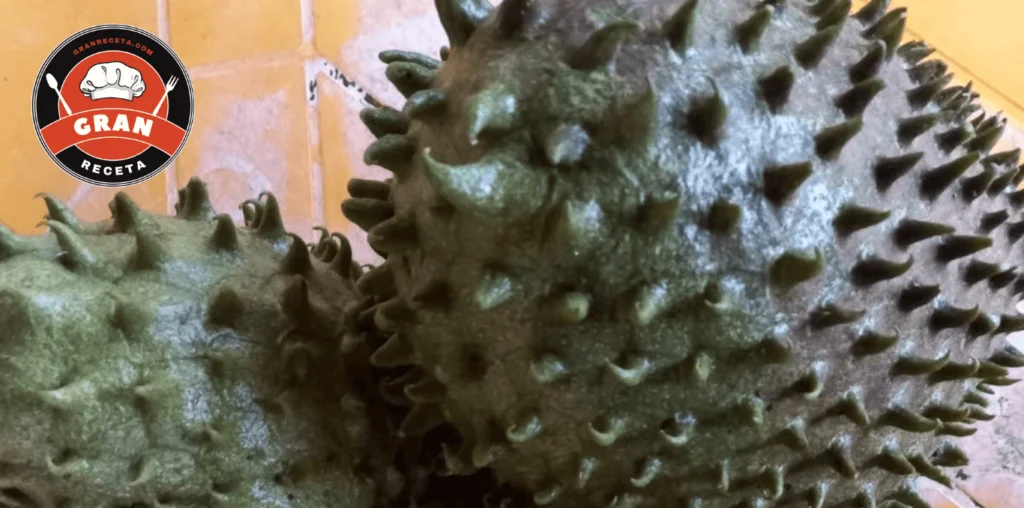

A soursop the size of a rugby ball, about 3.3 lb, gives roughly 2 lb of pulp; the skin, core and seeds are the other 40 %. From 14 oz of that pulp, cold water and a squeeze of lime you get 2 glasses in 10 minutes with no sugar added, because ripe fruit already brings 27 g of its own per glass. The only step with no shortcut is the seeds: they come out whole, by hand, before anything goes in the blender.
How do you make soursop juice? Open a ripe soursop, scoop out the pulp and pull out every black seed by hand. Blend 14 oz of pulp with 1½ cups of cold water and a tablespoon of lime for 45 seconds and serve at once over ice. 10 minutes for 2 glasses.
Telling when it is ripe
Soursop is picked green and ripens off the tree, so it is almost always sold firm. It is ready when it gives under your thumb like a ripe avocado and when the spines on the skin bend instead of pricking. The color moves from bright green to a duller green with patches.
That takes the best part of a week at room temperature and cannot be hurried in the fridge, where cold stops the process and leaves the pulp sour and firm. Once ripe, refrigeration does make sense, but then it has to be used within a couple of days.
It also goes over quickly. A fruit with dark, sunken skin has already fermented inside, and the juice comes out with an alcoholic edge.
Buying it in the US
Fresh soursop turns up seasonally in Latin, Caribbean and Asian markets, usually sold by the pound and not cheap. The reliable option is frozen pulp, sold in 14 oz packets in the same markets: same fruit, no added sugar, available all year, and it needs nothing but blending.
Frozen whole fruit also exists and works. What is worth avoiding for a juice you can make in 10 minutes is boxed nectar, where water and added sugar do most of the work.
The seeds come out whole
A 3.3 lb soursop holds more than 50 large, glossy black seeds scattered through the pulp. They are not eaten and they are not blended: you pull them out as you scoop, which is the slow part of this recipe and the only one that asks for patience.
Blending them is the thing to avoid. Broken open they release bitter compounds that spoil the whole jug, which is why it is worth checking the bowl before the pulp goes anywhere near the blender. The fibrous core running down the fruit is discarded the same way.
What soursop actually delivers
This fruit is often described as loaded with vitamin C, and the numbers do not support it. According to the USDA, soursop carries 20.6 mg of vitamin C in every 100 g: a tenth of guava, at 228.3 mg, and under half of orange juice.
What it does bring is fiber: 3.3 g per 100 g of pulp, which works out to about 7 g in a glass made with 7 oz of pulp, roughly a quarter of a day’s recommendation. It also carries 278 mg of potassium in the same 100 g.
On what circulates online about cancer: the studies on soursop acetogenins were done in cell cultures and in animals, not in people. There is no evidence in humans, and this is a juice, not a treatment.
Why only 45 seconds of blending
Soursop pulp is fibrous and breaks down fast. Forty-five seconds is enough to bring it together with the water; beyond that all you incorporate is air, and the glass fills with a foam that separates into two layers within minutes.
If you prefer it smooth, strain it after blending. But straining is expensive here: it takes out much of the 7 g of fiber per glass, which is precisely what makes this fruit interesting.
Fresh, frozen or boxed
Frozen pulp is a genuinely good solution and it is available year-round: same fruit, no added sugar, just blend. It comes out slightly looser than fresh because freezing breaks some of the fiber.
Boxed nectar is a different product. It carries water, sugar and a fruit percentage that rarely exceeds 20 %, so the sugar stops being the soursop’s and becomes added sugar.
Who this recipe is for
- If the fruit is green → 2 to 4 days out of the fridge, never in it
- If you want it with milk → swap the water for 1½ cups of cold milk; it rises to about 230 calories a glass
- If you have leftover pulp → freeze it flat for up to 3 months, in 7 oz portions
- If the fruit is not sweet enough → 1 tbsp of grated panela per glass rather than white sugar
- If you want it thicker → drop the water to 1 cup and add 3 ice cubes to the blender
What goes wrong
Blending the seeds. They release bitterness that cannot be removed afterwards.
Ripening the fruit in the fridge. Cold halts ripening and the pulp stays sour.
Blending over a minute. It only adds air and foam that separates the juice into layers.
Sweetening before tasting. Fruit at its peak does not need it; it already carries 13.54 g of sugar per 100 g.
Letting it sit. Within 30 minutes the color turns from white to beige through oxidation.
Variations
With milk. 1½ cups of cold milk instead of water, which is the most common version in Colombia.
With mint. Four leaves added in the last 5 seconds of blending, which lift it without covering the fruit.
As a sorbet. Frozen pulp blended with ½ cup of water and served in a glass, halfway between juice and ice cream.
With lime and ginger. Half a teaspoon of grated ginger for a sharp counterpoint to the sweetness.
What to serve it with
This is a lunch drink, one 13 oz glass per person, and it suits a heavy savory plate such as Colombian chicken rice or a Colombian bandeja paisa, because it clears the palate without being acidic.
For other homemade drinks, Colombian aguapanela takes 12 minutes and works hot or cold, and Colombian hot chocolate is the other drink that belongs on a Colombian table.
Frequently asked questions
Can the seeds be blended? No. They are pulled out whole by hand before blending, because broken seeds turn the whole jug bitter.
How do I know a soursop is ripe? It gives under your thumb and the spines bend without snapping. If it is firm, give it a few more days on the counter.
How much pulp does one fruit give? A 3.3 lb soursop gives about 2 lb of pulp; the other 40 % is skin, core and seeds.
Water or milk? Water lets the fruit come through; milk makes it creamier and takes it to about 230 calories a glass.
Does soursop cure cancer? There is no evidence in humans. The acetogenin studies were done in cells and animals.
Nutrition
Per glass of about 13 oz, half the recipe, calculated with the USDA database:
- Calories: 135 kcal
- Protein: 2 g
- Carbohydrates: 28 g
- Fat: 1 g
- Fiber: 7 g
- Sodium: 30 mg
- Sugars: 27 g, all from the fruit
According to the USDA, soursop pulp carries 66 calories, 13.54 g of sugar and 3.3 g of fiber per 100 g. The 27 g of sugar in a glass are therefore the fruit’s own, with nothing added, and the fiber is the reason not to strain it.
In Venezuela soursop was a backyard fruit and the juice was always made with milk. When I got to Colombia they served it to me with water and I thought something was missing, until I understood that with water you taste the fruit and with milk you taste the milk. Now I use water when the fruit is at its peak and milk when it is not quite there. Josnaisis.