
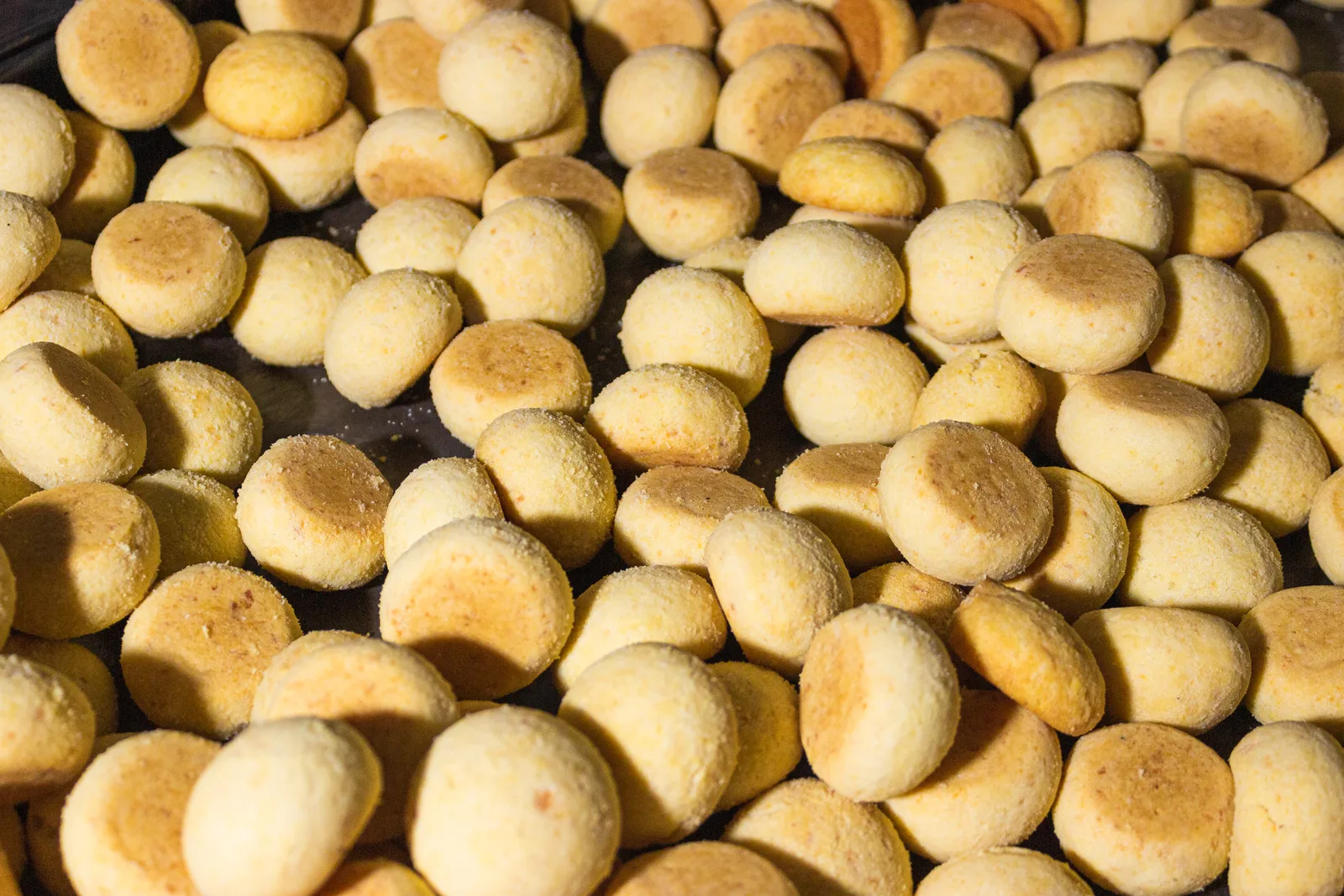

Achiras are Colombia’s answer to a cheese cracker: thumb-sized sticks of achira starch and fresh curd cheese, salty and buttery, crisp from end to end and sandy enough to melt on your tongue. They come from Huila, in the south of the country, where shops in the village of Fortalecillas, just north of the capital, Neiva, sell them by the bag. There’s no wheat, yeast or baking powder in them. At home the whole trick is a two-stage bake, hot to set and color them, then low to dry them out, and that is also why they keep for days in a jar when most cheese breads go stale by evening.
What achiras are, and how long they take
How do you make Colombian achiras? Knead 500 g (1 lb 2 oz) of well-drained curd cheese with 60 g (2 oz) of butter, an egg yolk, salt and 250 g (8¾ oz) of achira starch into a smooth dough. Chill it 30 minutes, roll it into ⅜-inch ropes, cut 2-inch sticks and bake at 400°F (200°C) for 15 minutes, then at 320°F (160°C) for 15 to 20 more, until dry inside. Ready in 105 minutes for 12 servings.
Time. 105 minutes, of which only about 40 are hands-on: 15 to make the dough and 25 to shape it. The rest is chilling and baking, plus 10 minutes of cooling. Difficulty, easy. Shaping 160 little sticks sounds slow, but cutting them from ropes makes it quick.
Who it suits. Anyone who wants a gluten-free savory snack that doesn’t taste like a substitute, a lunchbox treat, or something crunchy to go with coffee. Not spicy. Kids tend to love them, but they’re too hard for babies who can’t chew well yet.
Achiras next to other Latin American cheese breads
All of these are wheat-free cheese breads, and they’re easy to mix up in a Latin bakery case. What separates them is the starch and the oven.
Colombian pandeyuca and Colombian pandebono use cassava starch and are eaten hot from the oven; the Brazilian cheese bread is their hollow, stretchy cousin. Colombian almojábanas are soft corn-and-curd buns, and Paraguayan chipa is a dense anise-scented ring. Achiras are the only ones dried in the oven until crisp all the way through.
Ingredients, and what to buy in the US or UK
Each achira weighs about 5 g (⅙ oz), so one batch gives around 160: a dozen people get roughly 13 apiece as a snack. The ratio that matters is 2 parts cheese to 1 part starch by weight. To scale up or down, keep that ratio and adjust the butter, yolk and salt to match.
Achira starch is not arrowroot
Achira (Canna indica, long listed as Canna edulis) is a tropical plant grown for its starchy rhizome, mostly in Huila, Nariño, Cundinamarca and Cauca in Colombia. Its starch is a fine, white powder that squeaks between your fingers. Three things to know before you shop:
- It isn’t the arrowroot powder in your supermarket. That comes from a different plant (Maranta). I haven’t baked achiras with it, so I can’t promise how they turn out.
- It isn’t English “sago” either. Sago is a palm starch. In Colombia achira starch is sold as almidón de achira or sagú, which is where the confusion comes from. Make sure the bag says achira.
- Where to find it. Colombian grocery stores and online Latin American food shops in the US, and Latin or online specialty shops in the UK. It isn’t always in stock, so buy two bags when you see it.
The tested swap, tapioca starch
If you can’t get achira starch, use the same weight of tapioca starch (also sold as tapioca flour). The achiras still work, but they’re a different snack: they puff a little more, they’re less sandy inside and they bite harder, with a slight chew. The flavor is more neutral. Two cassava products that don’t work: sour cassava starch (almidón agrio, polvilho azedo), which makes the sticks balloon and go hollow, and cassava flour, which is the whole dried root and makes a heavy, gritty dough.
The cheese
Colombian cuajada is fresh, soft, unsalted curd cheese; queso campesino behaves the same. What matters more than the name is draining it well, because every bit of whey has to be soaked up with more starch, and extra starch is what makes achiras hard.
- In the US, use cuajada or queso campesino if a Latin grocery has it. Otherwise Mexican queso fresco, crumbled, is the closest match; it’s salted, so use half the salt.
- In the UK, a workable stand-in is half feta and half full-fat cream cheese. The dough is softer and saltier and the flavor tangier than with curd, so add no salt.
- Salty Colombian queso costeño works too, with half the salt.
Equipment. A large bowl, a kitchen scale (the ratio is what makes them work), two large baking sheets and, if you have one, a food processor to crumble the cheese. Without a scale, 250 g of achira starch is about 2 level cups and 500 g of crumbled cheese about 4 cups, but weight is more reliable.
How to make achiras
Cheese, butter and yolk first, then starch, then a short chill while the oven heats. The two baking sheets go in together.
Get the dough right
Knead with the heel of your hand and don’t stop early: it takes 5 to 8 minutes, about the time it takes the cheese lumps to disappear. At first it looks like damp sand with flecks of cheese, then it turns smooth and compact. It’s ready when it is:
- Soft and smooth, like modeling clay, with no visible lumps of cheese.
- Not sticky on clean hands.
- Crack-free: a small ball pressed flat between your palms keeps a smooth edge.
If it sticks, the cheese was wet: add starch 1 tablespoon at a time, only until it stops sticking. If it cracks, it needs a little more soft butter. The 30-minute chill firms the butter so the ropes roll without breaking.
Rope, cut, taper
Roll each quarter of dough into a ⅜-inch (1 cm) rope, cut it every 2 inches (5 cm) and give each piece a quick roll between your fingertips to taper the ends. Thicker sticks stay hard in the middle; much thinner ones scorch before they dry. They barely spread, so ⅜ inch (1 cm) between them is plenty.
Hot, then low
The first 15 minutes at 400°F (200°C) set and color the achiras. The next 15 to 20 minutes at 320°F (160°C) dry them without darkening them, the way a wood oven does as its fire dies down. Swap the sheets between racks when you turn the heat down so both batches brown evenly.
Judge them by the inside, not the color. Pull one, wait 2 minutes and snap it. A clean break and a dry, sandy center mean they’re done; if it bends or the middle is damp, give them 5 more minutes and test again. Straight out of the oven they feel slightly soft; the 10 minutes of cooling on the sheet makes them crisp.
Troubleshooting hard or soft achiras
| What happened | Why | Fix |
|---|---|---|
| Hard as a rock | Extra starch added to a wet cheese, or sticks too thick | Drain the cheese well; ropes no thicker than ⅜ in (1 cm) |
| Crisp outside, pasty inside | Low-oven stage skipped or cut short | Back in at 320°F (160°C) for 5 to 10 minutes |
| Dark before they’re dry | Oven too hot or sticks too thin | Turn down to 320°F (160°C) as soon as the bottoms are light gold |
| Sticky dough | Undrained cheese | Drain and squeeze it, or add starch by the spoonful |
| Cracks when rolling | Dough cold and dry, or too little butter | Knead a minute to warm it, then add a little soft butter |
| Soft the next day | Jarred while warm, or a jar that doesn’t seal | Re-crisp, see below |
Allergens. Milk (cheese and butter) and egg. No wheat, barley or rye, so they’re naturally gluten-free; for anyone with celiac disease, buy a starch labeled gluten-free, since it can be cross-contaminated at the mill.
Make ahead, half batch and storage
- The night before. Wrapped dough keeps up to 24 hours in the fridge. Take it out 15 minutes before shaping and knead it for a minute.
- Half batch. 250 g (9 oz) cheese, 125 g (4½ oz) achira starch, 30 g (1 oz, 2 tbsp) butter, 1 yolk and 2.5 g (a scant ½ tsp) salt make about 80, enough for one sheet.
- For a party or gifts. Double the recipe and bake two sheets at a time; shape the next round while the first is in the oven.
- Storage. Completely cold, in a glass jar or airtight tin at room temperature, somewhere dry: crisp for up to 1 week. Because they are dried right through, they don’t need the fridge, which would actually soften them.
- Re-crisping. Spread soft achiras on a sheet and give them 5 minutes at 320°F (160°C). Let them cool before jarring them again.
The pricey part outside Colombia is imported achira starch; the cheese is next.
How to serve achiras
Straight from the jar as a snack, in a lunchbox, or with black coffee. In Colombia they’re also lovely with a mug of Colombian hot chocolate with cheese. If you’d like to make the curd cheese yourself, it’s the same fresh cheese as in Colombian cuajada with melao, and if you want something warm and cheesy for breakfast without turning on the oven, Colombian cheese arepas take 30 minutes in a skillet.
Achira questions
Are achiras gluten-free? Yes, by ingredients: achira starch, cheese, butter, egg yolk and salt. Check the starch label if you’re cooking for someone with celiac disease.
Can I use cornstarch? I wouldn’t. It’s a different starch and I haven’t tested it in achiras; tapioca starch is the swap that works.
Why are my achiras hollow? They shouldn’t be: with no leavening and sticks only ⅜ inch (1 cm) thick, they bake up solid and sandy. Hollow achiras usually mean sour cassava starch or baking powder got into the dough.
How do you pronounce achira? Ah-CHEE-rah. In Colombia the biscuits are also called bizcochos de achira.
Nutrition per serving
Per serving, which is a twelfth of the batch or about 13 achiras, worked out ingredient by ingredient from the amounts above:
- Calories: 239 kcal
- Protein: 8 g
- Carbohydrates: 20 g
- Fat: 14 g, including 8 g saturated
- Fiber: 1 g
- Sugar: 1 g
- Sodium: 476 mg
The curd cheese was counted as salted queso fresco, so with unsalted cuajada the real sodium is noticeably lower. Almost all the carbohydrate comes from the starch and almost all the fat from the cheese and butter.
For me, achiras are won or lost at the draining stage. I drain the cheese in the fridge from the morning, squeeze it hard, and that way I never have to add a spoonful of extra starch. The other habit I never skip is snapping one before I turn off the oven, because the color can fool you and the center can’t. Josnaisis.