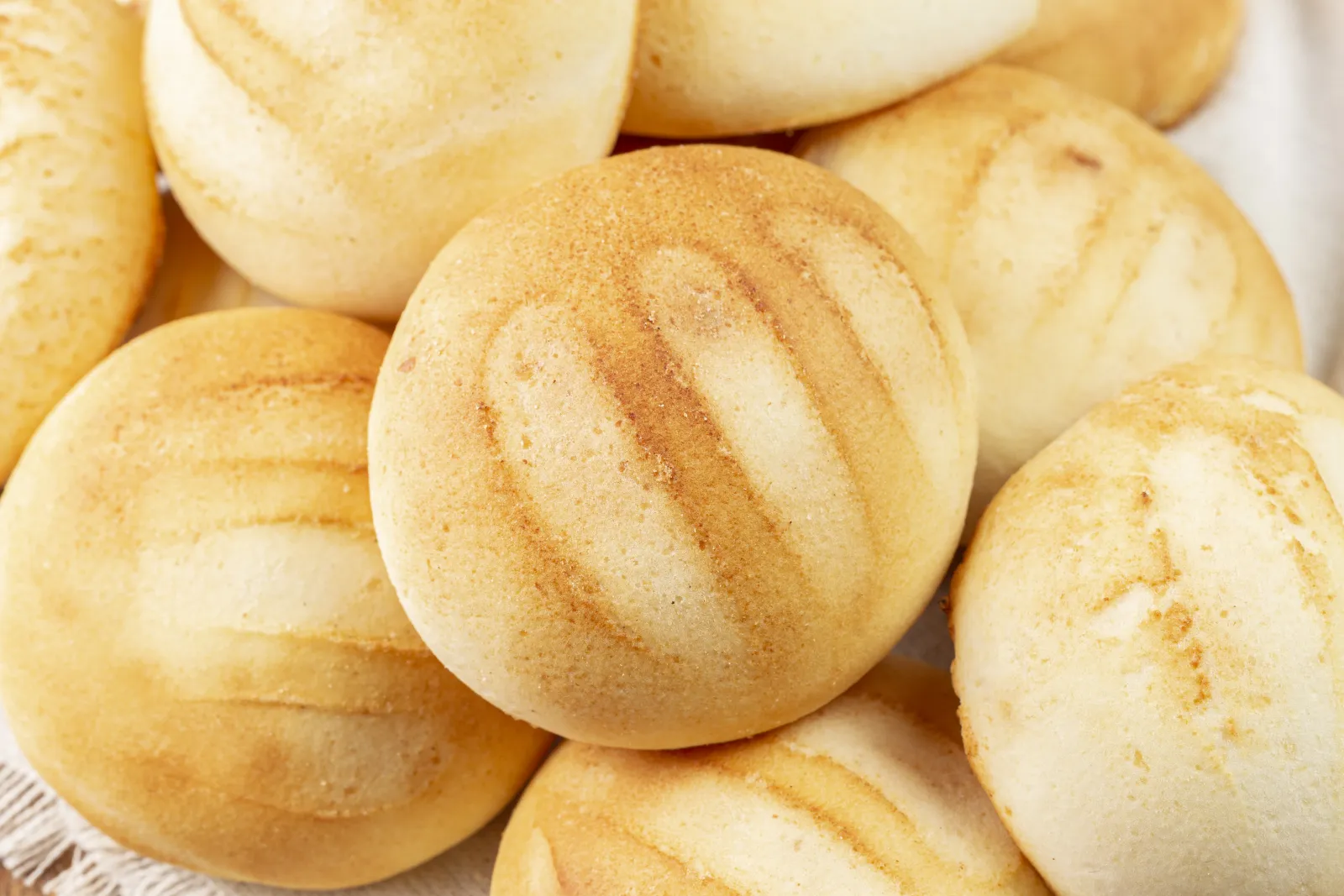

Picture a dinner roll made almost entirely of fresh cheese, held together with corn instead of wheat: that’s an almojábana (al-mo-HAH-bah-nah), the cheese bun Colombians eat warm with hot chocolate at breakfast. It’s Bogotá and Boyacá’s everyday bakery bread, and at home it takes 20 minutes of work and one bowl. The catch for anyone outside Colombia is the cheese. Cuajada, the soft fresh curd it’s built on, rarely turns up in a US or UK supermarket, so most of this page is about what to buy instead, how to handle it, and how to tell when the dough is right.
What are almojábanas, and how do they differ from pandebono?
How do you make Colombian almojábanas? Knead 250 g (9 oz) of crumbled fresh curd cheese and 150 g (5½ oz) of a saltier white cheese with 175 g (1¼ cups) of masarepa, an egg, 2 tablespoons of melted butter, sugar, baking powder and a splash of milk, until the dough is soft and doesn’t crack. Shape 12 slightly flattened balls and bake 18 to 22 minutes at 400°F (200°C). 40 minutes for 12 servings.
Almojábanas are small, round, golden buns with a thin crust and a soft, moist, almost cake-like crumb that pulls apart in shreds. The base ratio is a little over 2 parts cheese to 1 part precooked corn meal, lifted with baking powder. There is no wheat flour and no yeast, so there’s no rising time.
They sit in the same Colombian bakery case as two other cheese breads, and the three are easy to mix up:
| Bread | Starch | What lifts it | Crumb | Oven |
|---|---|---|---|---|
| Almojábana | masarepa (precooked corn) | baking powder | soft, moist, cake-like | 400°F (200°C), 20 min |
| Pandebono | sour (fermented) cassava starch | steam | stretchy, chewy | 425-445°F (220-230°C), 15-18 min |
| Pandeyuca | sweet cassava starch | baking powder | crisp shell, dry inside | 445°F (230°C), 13 min |
If you want the chewy pull of Brazilian pão de queijo, you want pandebono. If you want something soft to dunk in a mug of Colombian hot chocolate, you want these.
Wikipedia traces the word to Andalusian Arabic for “made with cheese”, and notes that it means different things elsewhere: in Puerto Rico almojábanas are fried rice-flour balls, and in Spain they’re a cheese-free pastry. This recipe is the Colombian baked bun.
The cheese, and what to buy if you can’t find cuajada
The recipe card asks for 250 g (9 oz) of fresh curd cheese plus 150 g (5½ oz) of a saltier one. Cuajada is milk set with rennet and drained, never pressed or aged: white, wet, mild and barely salted. Its moisture gives the soft crumb; its mildness is why the recipe adds a second, saltier cheese (queso campesino in Colombia) for seasoning.
My ranking for a US or UK kitchen:
- Farmer’s cheese (US dairy aisle, often next to the cottage cheese) → dry, crumbly and mild, the closest texture to cuajada. Use as is with ¼ teaspoon of salt.
- Whole-milk ricotta → drain it in a cloth-lined sieve in the fridge for 2 hours, or the dough turns to paste. It needs ½ teaspoon of salt and gives a slightly more tender crumb. In the UK, curd cheese or crumbled paneer works the same way, with ¼ teaspoon.
- Queso fresco (Latin-style, sold in blocks) → good as both the fresh and the salty cheese if it’s all you have. Add no salt.
- Cottage cheese → only drained and blended smooth, and the buns still spread more.
Feta is the one to be careful with. It’s useful as part of the salty cheese, never as all of it.
For the second, saltier cheese, queso fresco is the easiest find in the US. In the UK, I’d reach for a crumbly white cheese such as Wensleydale or Caerphilly, or mix two-thirds mild mozzarella with one-third feta.
Masarepa, and the flours that won’t work
Use white masarepa: precooked corn meal, sold as P.A.N., Goya Masarepa or Areparina in the Latin aisle in the US and online in the UK. Because it’s already cooked, it soaks up the cheese’s moisture in 3 minutes and the dough holds its shape raw. Yellow masarepa works too and gives yellower buns.
Three look-alikes that won’t work: masa harina (nixtamalized corn for tortillas; it tastes of lime and behaves differently), cornmeal and polenta, which stay gritty because they aren’t precooked.
How to make almojábanas, and what to look for at each stage
40 minutes on the clock, 20 of them hands-on. Turn the oven on first and make the dough while it heats.
What you should see and feel.
| Stage | What’s right |
|---|---|
| Fresh cheese | crumbled to chickpea-size; no liquid when you squeeze a handful |
| Dough | soft as play dough, doesn’t stick; a rolled ball has smooth edges |
| Shaping | 60 g (2 oz) balls, flattened to 2.5 cm (1 in) |
| Oven, 10 min | slightly risen, starting to color |
| Oven, 18-22 min | golden top and bottom; base sounds hollow; top springs back |
The dough’s moisture is the whole recipe
With 175 g of masarepa to 400 g of cheese (6 oz to 14 oz), the cheese supplies most of the liquid. That’s why the milk goes in last, a tablespoon at a time: a wet cuajada may need half of it, a dry farmer’s cheese all of it plus one more. Too dry, and the dough cracks and the buns bake hard. Too wet, and they spread into discs. The 3-minute rest often fixes cracking on its own.
Why almojábanas come out flat or hard
- Flat → the cheese was too wet (undrained ricotta or cottage cheese), or the oven wasn’t fully hot. Baking powder releases most of its gas in the first minutes; in an oven still climbing to temperature, it escapes before the dough sets.
- Hard → too much masarepa, too long in the oven, or simply cold. Each spoonful of extra corn meal firms them up as they cool. Wet your hands instead of flouring them, and stop at 22 minutes for 2 oz buns.
- Cracked when shaping → dry dough. One more tablespoon of milk and a 3-minute rest.
- Brown outside, raw inside → oven too hot or buns too thick. Stick to 400°F (200°C) and 1 inch high.
- Taste like cornbread → not enough cheese, or mild ricotta with no salt added.
- White lumps in the crumb → the fresh cheese wasn’t crumbled finely. Press it against the bowl as you knead.
Make-ahead plan, freezing and batch sizes
This is where almojábanas earn their place in a weekday kitchen.
- The night before → shape the balls, cover and refrigerate. Bake straight from the fridge with 2 extra minutes.
- Freeze raw → shape and flatten, freeze on a sheet for 2 hours until hard, then bag. I use them within 2 months. Bake from frozen, no thawing, 25 minutes at 400°F (200°C). Thawed first, they weep and spread.
- Freeze baked → cooled and bagged, about 1 month. Reheat from frozen at 350°F (180°C) for 8 to 10 minutes.
How many to make. The recipe gives 12 buns, enough for 4 to 6 people at breakfast. Double it for 12 people (24 buns) and triple it for 18 to 20 (36). The ratios don’t change. With two sheets in the oven at once, use the upper and lower thirds, swap them at 12 minutes and add 2 to 3 minutes.
Which version should you make?
- Short on time → frozen raw buns: 25 minutes in the oven, nothing to wash up.
- No oven → in my air fryer they work at 350°F (180°C) for 12 to 14 minutes, 4 at a time with space between them. A skillet doesn’t work; the bottoms burn before the middle cooks.
- For a party → 30 g (1 oz) minis, 24 from one batch, 14 minutes at 400°F (200°C).
- Chewier → swap 50 g (⅓ cup) of the masarepa for sour cassava starch (polvilho azedo). They land halfway to pandebono.
- Filled → push a cube of guava paste or a teaspoon of Colombian dulce de leche into each ball and seal it well before baking.
- Lighter → 400 g (14 oz) of fresh cheese only, no salty cheese, and 1 tablespoon of butter; add ¼ teaspoon of salt.
What almojábanas cost
At US city average prices from the Bureau of Labor Statistics for August 2026, the egg ($2.272 a dozen), 2 tablespoons of butter ($4.021 a pound), ¼ cup of whole milk ($4.229 a gallon) and the sugar come to about $0.56 for the batch. The BLS doesn’t track farmer’s cheese, ricotta, queso fresco or masarepa, and that’s where the money goes: as in Colombia, the cheese is most of the cost. In Bogotá, the cheeses were 85 % of the ingredient bill at wholesale prices that same season.
Yield. 12 buns of about 60 g (2 oz) of dough, around 55 g (2 oz) once baked. Two each with a hot drink is breakfast.
How to serve and store them
Taste and texture. A thin golden crust, a white, moist crumb that tears in soft shreds, the flavor of fresh milk with a sweet corn background and a salty edge from the second cheese. Warm, they’re fluffy; cold, they settle and turn denser.
Serving. Warm, in a cloth-lined basket, with hot chocolate, coffee, or a glass of aguapanela. For a bigger Colombian breakfast, put them out with boyacense arepas, the sweet stuffed corn cakes from the same region, and their crumbly cousins, garullas.
Storage. They’re best the day they’re baked. Because they’re made with fresh cheese, treat them as perishable: according to the USDA Food Safety and Inspection Service, perishable food shouldn’t sit out more than 2 hours. Leftovers go in a sealed container in the fridge for up to 3 to 4 days.
Reheating. 5 to 6 minutes at 350°F (180°C) in the oven or toaster oven revives the crust and softens the crumb. In the microwave, 15 seconds at most; longer makes them rubbery and then hard.
Almojábana questions
What is an almojábana made of? Fresh curd cheese (cuajada), a saltier white cheese, precooked corn meal (masarepa), egg, butter, sugar, baking powder and a little milk.
What can I use instead of cuajada? Farmer’s cheese as is, or whole-milk ricotta drained for 2 hours with ½ teaspoon of salt added. Queso fresco works too and needs no salt.
Is an almojábana the same as pandebono? No. Pandebono uses sour cassava starch and comes out chewy; almojábanas use masarepa and fresh curd and come out soft and cake-like.
Are almojábanas gluten-free? There’s no wheat in them, but P.A.N. masarepa carries a “may contain gluten” warning on its label. For celiac guests, use a certified gluten-free corn meal and check the baking powder.
Can I use regular cornmeal or masa harina? No. Neither is precooked the same way; cornmeal stays gritty and masa harina changes the flavor and texture.
Can you freeze almojábanas? Yes, ideally raw. Freeze the shaped balls for up to 2 months and bake from frozen for 25 minutes at 400°F (200°C).
Why did my almojábanas turn out flat? Wet cheese or an oven that wasn’t hot yet. Drain ricotta or cottage cheese well and preheat a full 20 minutes.
Nutrition per almojábana
Per bun (about 60 g / 2 oz of dough), calculated ingredient by ingredient from the USDA SR Legacy database with the quantities above. Cuajada and queso campesino aren’t in the database, so both were calculated as queso fresco (299 kcal and 751 mg of sodium per 100 g), and the masarepa as enriched white corn flour:
- Calories: 185 kcal
- Protein: 8 g
- Carbohydrates: 14 g
- Fat: 11 g, of which 6 g saturated
- Fiber: 1 g
- Sugars: 3 g
- Sodium: 306 mg
Made with drained whole-milk ricotta (150 kcal per 100 g) instead of curd cheese, each bun drops to about 155 kcal and 8 g of fat; sodium falls even after the ½ teaspoon of added salt.
Back in Venezuela, a bag of P.A.N. meant arepas and nothing else, so baking corn flour into a cheese bun felt almost like breaking a rule. Now a bag of raw almojábanas lives in my freezer, and on Sunday mornings they bake while the chocolate heats. A good almojábana is mostly cheese, barely held together by corn. Josnaisis.