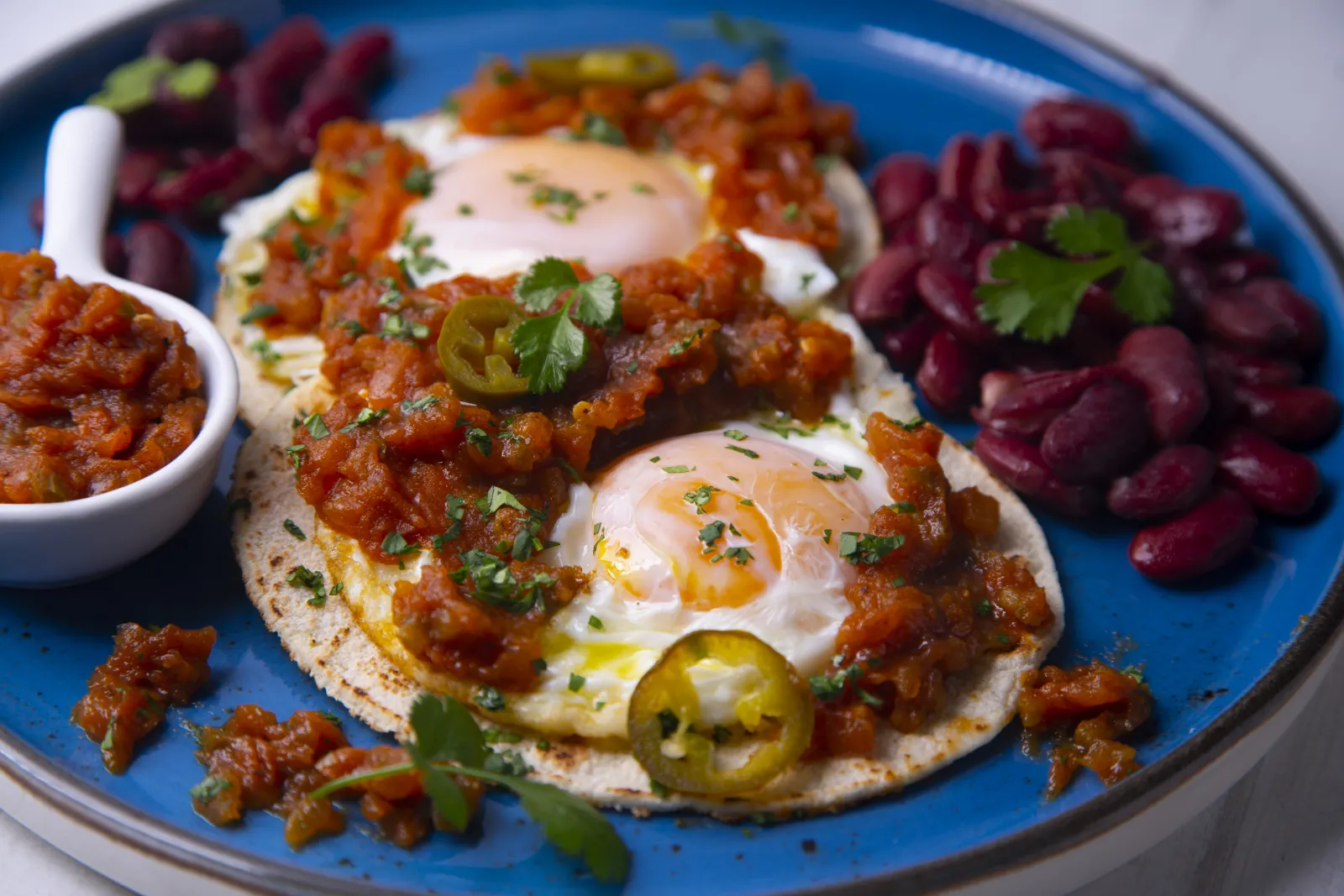

Ranch-style eggs, which is all huevos rancheros (WAY-vohs rahn-CHEH-rohs) means, are one of Mexico’s best-known breakfasts: fried eggs on corn tortillas under a cooked tomato and chile sauce, with crumbled fresh cheese and often refried beans. Two details make or break them, and neither is the egg itself. The tortilla needs a few seconds in hot oil so it bends without tearing, and the egg pan needs a lid so the whites set while the yolk stays runny. Get those right and you have a plate that takes 30 minutes for four people, or 13 if the sauce is already in the fridge.
How do you make huevos rancheros, and is it worth it?
How do you make huevos rancheros from scratch? Simmer 600 g (1⅓ lb) of tomatoes with 2 serrano chiles and a garlic clove for 10 minutes, blend with onion and fry the sauce in 1 tbsp of oil for 8 minutes until brick red. Dip 8 corn tortillas in hot oil for 5 to 10 seconds a side, fry 8 eggs covered for 3 minutes for runny yolks, and spoon the sauce around them. Ready in 30 minutes for 4 servings.
It’s worth it if you like a breakfast with some heat and a lot of contrast: hot yolk running into a spicy sauce, soft tortilla, salty cheese. It costs very little, and the sauce is better made a day ahead, which makes it one of the easiest egg dishes to serve to guests.
When it fits. A slow weekend breakfast for 2 to 4, or a brunch for 8 if the sauce is done the night before.
When it doesn’t. A 10-minute weekday breakfast with no sauce ready. Anyone who can’t eat a runny yolk and won’t enjoy it firm. And anyone who wants zero heat, unless the chiles are seeded or swapped for a jalapeño.
Real time. 30 minutes on the clock, about 20 of them hands-on. Difficulty, easy.
Ingredients, with US and UK swaps
The recipe card has everything for 4: 2 eggs and 2 tortillas per person, and about 125 ml (½ cup) of sauce each. Most of it is in any supermarket. The table covers the four things that might not be.
Ranchero sauce, cooked twice
The sauce is simmered, blended and then fried in oil for 8 minutes. That last step is the one people skip, and it’s what makes it ranchero sauce rather than blended tomatoes: the frying drives off water, darkens the color, rounds out the acidity and gives a sauce that clings to the tortilla instead of running across the plate. For a smoky version, char the tomatoes, chiles and garlic in a dry cast-iron pan for about 12 minutes (10 if the tomatoes are small), turning until the skins blister and blacken in spots, then blend and fry as usual.
Canned tomatoes are the better choice from late autumn to spring. One 400 g (14 oz) can of whole plum tomatoes replaces 600 g of fresh ones: blend straight from the can, skip the simmer and fry for 10 minutes instead of 8. Pale winter tomatoes give a thin, sour sauce; the can doesn’t.
Chiles, serrano or jalapeño
Two serranos give what I’d call medium heat, 2 out of 5. One jalapeño in their place is milder and a bit grassier, 1 out of 5 once seeded. In the UK, where serranos are rare, a fresh red chilli works, but start with half: the small bird’s eye kind is hotter than a serrano.
Corn tortillas, dipped rather than fried
A corn tortilla warmed dry cracks when it folds and goes to mush under sauce. Five to ten seconds a side in hot oil seals the surface and softens it, and it then holds up under the eggs and sauce. Leave it 30 seconds and it browns into a crisp tostada that shatters when you cut it. Each one absorbs only about 3 g of oil. Flour tortillas need no oil but turn soggy under the sauce; corn is the version served in Mexico and the better one here.
In the US, corn tortillas sit in the bread aisle or the chilled Latin section. In the UK, look for Mission corn tortillas or a Mexican grocer online; supermarket “soft taco” packs are usually wheat.
Queso fresco, and what to use in the UK
Queso fresco is a mild, salty, crumbly fresh cow’s-milk cheese, sold in most US supermarkets. UK shops rarely have it, so use mild feta, soaked 10 minutes in cold water to pull out some salt. Ricotta salata or a young Lancashire crumble similarly.
Equipment
A saucepan, a blender, a small skillet for the tortilla oil and a 26 cm (10 in) nonstick skillet with a lid. No lid? A flat plate or baking sheet over the pan does the job. An immersion blender in the saucepan replaces a countertop one.
Yolk timing by the minute, and who should eat it firm
In my kitchen, a large egg in a nonstick pan over medium heat with ½ tbsp of oil and the lid on goes like this: 3 minutes gives set whites and a runny yolk, 4 minutes a jammy one, and 5 to 6 minutes a firm one. The lid matters more than the heat. Steam sets the white around the yolk; without it, the bottom browns and the edges go lacy before that last bit of white is cooked.
On runny yolks. The FDA advises cooking eggs until both the yolk and the white are firm, and names children, older adults, pregnant women and people with weakened immune systems as the groups at greater risk of serious illness. For them, cook to 5 or 6 minutes or use pasteurized shell eggs, which US stores sell labeled as such. Keep eggs in their carton in a fridge at 40°F (4°C) or below and use them within 3 weeks, which is the FDA’s guide for best quality.
How to plan it, from 2 people to a brunch for 8
The 30 minutes work because the tortillas and eggs fit inside the 8 minutes the sauce spends reducing. The sauce is the only part worth making ahead.
| People | Eggs | Tortillas | Tomatoes | Serranos | Onion | Refried beans | Queso fresco |
|---|---|---|---|---|---|---|---|
| 2 | 4 | 4 | 300 g (⅔ lb) | 1 | 30 g (1 oz) | 120 g (½ cup) | 30 g (1 oz) |
| 4 | 8 | 8 | 600 g (1⅓ lb) | 2 | 60 g (2 oz) | 240 g (1 cup) | 60 g (2 oz) |
| 8 | 16 | 16 | 1.2 kg (2⅔ lb) | 4 | 120 g (4 oz) | 480 g (2 cups) | 120 g (4 oz) |
| 12 | 24 | 24 | 1.8 kg (4 lb) | 6 | 180 g (6 oz) | 720 g (3 cups) | 180 g (6 oz) |
Everything scales in proportion except the tortilla oil: it’s the same 80 ml (⅓ cup) bath, topped up when it drops below about 5 mm (¼ in).
Make-ahead and freezer
Cool the sauce and get it into the fridge within 2 hours. USDA FSIS figures for leftovers: up to 4 days in a fridge at 40°F (4°C), and 3 to 4 months frozen for best quality. I freeze it in 500 ml (2 cup) tubs, one tub per four people. Reheat until it bubbles, which takes it past the 165°F (74°C) FSIS asks for reheated leftovers, and loosen with 2 or 3 tablespoons of water if it has thickened.
A brunch for 8 without frying 16 eggs one by one
- The night before, make sauce for 8, about 1 liter (4 cups).
- 20 minutes before guests sit down, dip all 16 tortillas, wrap them in foil and hold them in the oven on its lowest setting; they stay warm and soft for half an hour.
- Cook the eggs in the sauce. Bring the sauce to a simmer in a 30 cm (12 in) deep skillet or braiser, make 8 wells, crack an egg into each, cover and cook over medium-low for about 6 minutes for runny yolks, 9 for firm. This is the version called huevos ahogados, “drowned eggs”. Serve each egg with its sauce over 2 tortillas, then do the second batch.
- If you’d rather fry them, run two 26 cm (10 in) pans side by side: four batches of 4 eggs take about 15 minutes.
Mistakes, heat level, kids and allergens
- The tortilla tears → it was heated dry or left to brown. 5 to 10 seconds a side in oil, out while it’s still floppy.
- The tortilla goes soggy → the sauce was thin or the plates were assembled too early. Reduce the full 8 minutes and plate at the last moment.
- The sauce tastes raw and sharp → it wasn’t fried. Those 8 minutes in oil are the recipe.
- Slimy white around the yolk → no lid. Cover from the start.
- Burnt, lacy edges → heat too high. Medium, with just enough oil.
- Sauce poured over the yolks → you lose sight of the doneness and the contrast. Around the eggs, never on top.
Heat level, 2 out of 5 with two serranos; 1 out of 5 with a seeded jalapeño. Kids usually like it with a single seeded jalapeño, and per the FDA guidance above, with firm yolks for the little ones. Allergens: egg and milk (the cheese). Corn tortillas contain no wheat; for a coeliac guest, check the pack says corn only and use fresh oil that hasn’t fried anything breaded.
Which version should you make?
- Short on time → canned tomatoes, blended and fried for 10 minutes. 13 minutes start to finish with the sauce ready.
- With or without beans → without is the basic plate and the lighter one. With 60 g (¼ cup) of refried beans spread on each tortilla, it’s more filling and the tortilla holds the sauce better; canned beans add about 54 kcal and 222 mg sodium per plate.
- Huevos divorciados → “divorced eggs”: one egg with red ranchero sauce, the other with tomatillo salsa verde, beans down the middle. With both sauces made, no extra work.
- Huevos motuleños → the breakfast of Motul, in Yucatán: a fried tortilla with black refried beans, a fried egg and a tomato sauce with ham and peas, served with fried plantain and cheese.
- For a crowd → drowned eggs in the sauce, as in the brunch plan.
- Scrambled instead of fried → that’s a different everyday dish, huevos a la mexicana, with the tomato, onion and serrano diced and cooked into the eggs.
- Lighter → warm the tortillas on a dry pan instead of oil and skip the cheese: about 100 kcal less per plate, though the tortillas tear more easily.
- Leftover tortillas and green salsa → that’s a different breakfast, chilaquiles verdes.
- No tortillas at all → split Colombian cheese arepas make a sturdier base with the same yolk-and-salsa contrast. Not traditional, but it works.
What it costs
At US average prices from the Bureau of Labor Statistics for August, 8 large eggs cost $1.51 (at $2.272 a dozen) and 600 g (1.32 lb) of tomatoes $2.61 (at $1.977 a pound), so the two ingredients that make up most of the dish come to about $4.12 for 4 plates, just over a dollar each. BLS doesn’t track tortillas, chiles or queso fresco, so I haven’t guessed at those. In Mexico, eggs and tomatoes are also about 80 % of the cost at wholesale market prices; the chile barely registers anywhere.
Serving and storing
Serve 2 tortillas and 2 eggs per plate with the sauce pooled around, cheese and cilantro on top, beans on the side (refried, or for a long weekend brunch, a cup of Mexican charro beans in their broth), and avocado or a spoonful of guacamole if you have it. A mug of café de olla, coffee simmered with cinnamon and piloncillo, is the drink I’d pour.
Only the sauce keeps. Fried eggs reheated turn rubbery with chalky yolks, and dipped tortillas harden in the fridge or freezer. The FDA’s rule for cooked egg dishes is no more than 2 hours out of the fridge, or 1 hour above 90°F (32°C).
Frequently asked questions
What are huevos rancheros? A Mexican breakfast of fried eggs on oil-dipped corn tortillas with a cooked tomato and chile sauce, queso fresco and often refried beans. About 30 minutes for 4.
What is ranchero sauce made of? Tomatoes, serrano or jalapeño chiles, onion, garlic and salt, simmered, blended and fried in oil until reduced. For 4: 600 g (1⅓ lb) tomatoes, 2 serranos, 60 g (2 oz) onion, 1 garlic clove.
How long do you fry an egg for a runny yolk? 3 minutes over medium heat with a lid on; give it 4 for jammy and 5 to 6 for firm.
Is a runny yolk safe? The FDA advises firm yolks and whites, especially for children, older adults, pregnant women and people with weakened immunity. They should have firm yolks or pasteurized eggs.
Why do my corn tortillas break? They were warmed dry or browned. Give each one 10 seconds or less per side in hot oil and pull it out while still pliable, before it colors.
Can I use flour tortillas? Yes, without oil, but they go soft under the sauce. Corn holds up better.
What can I use instead of queso fresco in the UK? Mild feta soaked in cold water for 10 minutes, or ricotta salata. Both are saltier, so go easy on the salt in the sauce.
Can I make ranchero sauce ahead? Yes. It keeps 4 days in the fridge, or 3 to 4 months frozen; reheat until bubbling.
Nutrition
Per plate of 2 tortillas, 2 eggs, 15 g (½ oz) queso fresco and about 125 ml (½ cup) of sauce, with no beans or avocado, calculated from USDA FoodData Central (SR Legacy) for the quantities in this recipe, counting 3 g of absorbed oil per tortilla:
- Calories: 450 kcal
- Protein: 20 g
- Carbohydrates: 31 g
- Fat: 28 g, of which 6 g saturated
- Fiber: 5 g
- Sugars: 6 g
- Sodium: 670 mg
Almost half the fat comes from the oil and about a third from the eggs. A quarter of an avocado adds about 57 kcal.
Back home in Venezuela, breakfast eggs were perico, scrambled with tomato and onion, and Colombia gave me almost the same dish under the name pericos. Huevos rancheros taught me to leave the egg whole and put the sauce beside it, so the yolk does half the work. These days there’s nearly always a tub of ranchero sauce in my fridge, and Sunday breakfast takes 13 minutes. A good sauce and an intact yolk are the whole dish. Josnaisis.