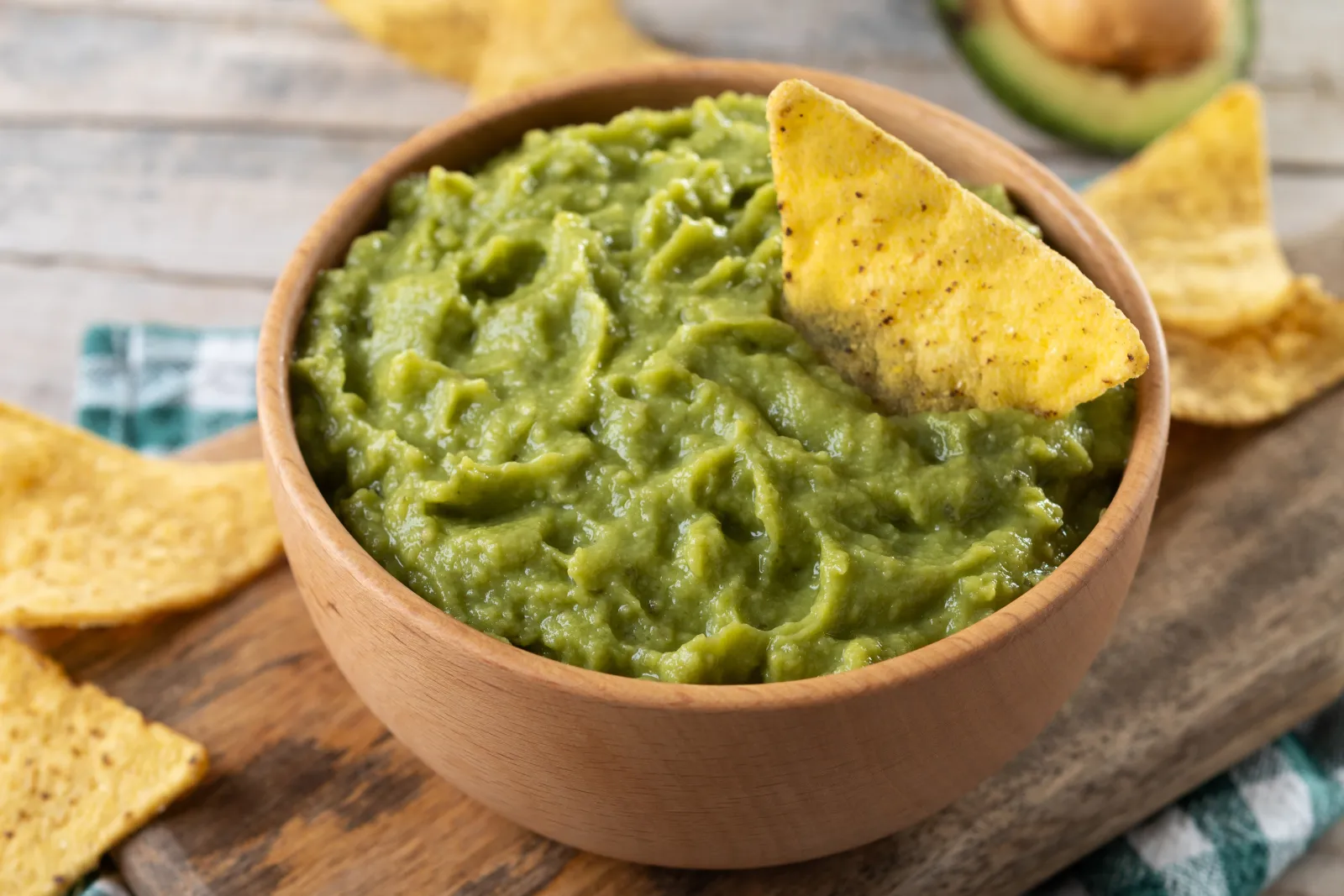

Guacamole is Mexico’s mashed avocado dip: ripe avocado crushed with white onion, fresh green chile, cilantro, lime and salt, and nothing creamy added, because the avocado is the cream. The recipe below runs on a ratio per avocado rather than a fixed batch, so it works the same for two people or twenty. Most of what goes wrong with guacamole happens before you pick up a knife (an avocado that’s three days from ready) or after you’ve made it (a bowl that turns brown on the party table), so those get as much space as the mashing.
What makes guacamole authentic, and is homemade worth it?
How do you make authentic guacamole? Grind white onion, serrano chile, cilantro and salt into a paste in a molcajete or bowl, then mash in 3 ripe Hass avocados with 1 tablespoon of lime juice, leaving ½-inch (1 cm) pieces. Fold in the remaining onion and cilantro and serve right away, or press plastic wrap onto the surface. 15 minutes for 6 servings.
In Mexico, guacamole is avocado, onion, chile, cilantro, lime and salt; tomato is a common extra, and some central Mexican cooks skip the lime entirely. What it doesn’t contain is sour cream, mayonnaise, garlic powder or cumin. Those make an avocado dip, and a fine one, but not this.
Is it worth it? Yes, with one condition: ripe avocados on the day. It takes 15 minutes, all of them hands-on, with no cooking. Fresh guacamole has crisp onion, bright cilantro and real chunks; tubs from the store are usually acidified and puréed smooth so they last.
When it’s the right call. Taco night, a barbecue, a game-day spread, or alongside fried plantains and grilled meat. When it isn’t. If you need to make it a day ahead: guacamole is at its best in the first hour and only holds a day or two.
The ratio per avocado, in grams and spoons
Scale by avocado and it never drifts. This is the recipe card above, broken down:
| Ingredient | Per 1 avocado | ×3 (6 servings) | ×10 (20 guests) |
|---|---|---|---|
| Hass avocado | 1 (136 g / 4.8 oz flesh) | 3 | 10 |
| White onion, chopped | 13 g (1⅓ tbsp) | 40 g (¼ cup) | 130 g (about ¾ cup) |
| Serrano chile | ⅓ | 1 | 3 to 4 |
| Cilantro, chopped | 3 g (2½ tbsp) | 8 g (½ cup) | 25 g (1½ cups) |
| Lime juice | 5 ml (1 tsp) | 15 ml (1 tbsp) | 50 ml (3⅓ tbsp) |
| Fine salt | 1.5 g (¼ tsp) | 4.5 g (¾ tsp) | 15 g (2½ tsp) |
The 136 g of flesh per avocado is the USDA’s figure for a Hass without skin or pit. If yours are small, weigh the flesh and scale from that.
Supermarket swaps, US and UK.
| Called for | US | UK | What changes |
|---|---|---|---|
| Serrano chile | serrano, or jalapeño | green finger chilli, or jalapeño | jalapeño is milder and thicker-walled |
| White onion | white onion | white or brown onion, rinsed | brown onion is sharper; rinse it |
| Mexican lime | Persian lime, or Key lime | lime | Persian limes are a bit less sharp |
| Cilantro | cilantro | coriander | same herb, different name |
| Roma tomato | Roma | plum tomato | none |
Buying avocados so they’re ready on the right day
Avocados don’t ripen on the tree; they start after harvest. UC Davis postharvest research puts Hass avocados treated with ethylene at 3 to 6 days to ripen at 68°F (20°C), and that is roughly what a hard supermarket avocado does on a kitchen counter. Shop backwards from the day you need them.
How to check. The California Avocado Commission says to press with the palm of your hand, not your fingertips, which bruise the fruit. A ripe Hass gives slightly and its skin has turned from green to nearly black. Flick off the little stem cap: green underneath is good, brown can mean spots inside.
To speed it up, close the avocados in a paper bag with an apple or a kiwi at room temperature. The apple releases ethylene, the gas that drives ripening, and the bag holds it in; the Commission singles out Red and Golden Delicious. Don’t refrigerate hard avocados, which ripen unevenly afterwards. Once ripe, the fridge at 36-40°F (2-4°C) buys you a couple of days.
Hass or the big smooth one? US stores also sell large, smooth, bright green avocados, mostly Florida-grown, sometimes labelled greenskin. By the USDA’s numbers, a Florida avocado has 10.1 g of fat per 100 g against the Hass’s 15.4 g, a third less, and one fruit holds 304 g (10.7 oz) of flesh, more than twice a Hass. For guacamole that fat is the creaminess, so they make a paler, sweeter, wetter bowl. If that’s all there is, count 1 Florida avocado per 2 Hass, drain the mashed flesh briefly in a sieve and add a little extra lime and salt.
How to make it, and which tool to use
The method is in the recipe card: grind a paste, mash the avocado into it, fold in the rest. The tool matters more than people expect.
A molcajete (mol-kah-HEH-teh) is a Mexican mortar of volcanic stone. Its advantage is simple: grinding the onion, chile and salt breaks them open, and the juice and aroma coat every piece of avocado. You get most of that in a plain bowl by mincing the aromatics very fine and crushing them with the salt before the avocado goes in. A food processor gives you a smooth purée and whips in air, so it browns faster. For a big batch, use a potato masher in a wide bowl.
Signs it’s right.
- The paste → onion and chile reduce to a wet paste in 1 to 2 minutes, no large pieces.
- The mash → mostly creamy, with ½-inch (1 cm) chunks. All smooth means you’ve gone too far.
- The salt → taste on a chip, not a spoon; chips are salted and change the balance.
- The color → light, glossy green. Gray or dull flesh when you cut the avocado is the avocado’s fault, not yours.
How to keep guacamole from turning brown
Browning is the avocado’s own enzyme, polyphenol oxidase, reacting with oxygen at the surface. Remove the air and it stops; lime juice slows the enzyme but doesn’t block it.
The pit is a myth. Harold McGee tested it: the pit protects only the patch it sits on, as a stone would. Plastic wrap works if it touches the guacamole, so flatten the top with a spoon and press the wrap down with no air pockets. A ½-inch (1 cm) water layer also blocks air and is poured off before serving; the FDA advises against storing avocados submerged in water because bacteria on the skin can grow, and I prefer wrap anyway because water leaves the top layer wet.
If the surface does darken, it’s oxidation, not spoilage. Scrape off that thin layer and the guacamole underneath is green.
Guacamole for a crowd, with a make-ahead plan
Avocados From Mexico’s rule is half an avocado per guest, and that’s what I use when there are other snacks on the table. When guacamole is the main event, with tacos for example, I count three quarters.
| Guests | With other snacks (½ each) | Guacamole as the main dip (¾ each) |
|---|---|---|
| 4-6 | 2-3 avocados | 3-5 avocados |
| 10 | 5 | 8 |
| 20 | 10 | 15 |
For chips, I figure one large 14 oz (400 g) bag per 6 people.
What you can do ahead. Chop the onion, chile and cilantro up to about 4 hours before and keep them covered in the fridge, the cilantro separately. Buy the avocados on the schedule in the chart above. Cut and mash them last; for 20 guests, about 30 minutes in two batches, starting the second when the first bowl is half gone.
At the party. The USDA Food Safety and Inspection Service’s limit for perishable food is 2 hours at room temperature, 1 hour above 90°F (32°C). Put out half, keep the rest wrapped in the fridge, and swap the bowl rather than topping it up.
Mistakes, heat level, kids and allergens
- Watery → the tomato wasn’t seeded, or you used Florida avocados. Seed the tomato and drain greenskin flesh.
- Flat → not enough salt, the most common problem: ¼ teaspoon per avocado.
- Grassy or bitter → the avocado wasn’t ripe. There’s no fix; wait for the next one.
- Onion takes over → rinse chopped onion in cold water for 5 minutes and drain well.
- Gray purée → too long in a blender or processor. Mash by hand.
Heat, 2 out of 5 with one serrano for 3 avocados. No chile is 0; two serranos with their ribs is about 4. The heat sits in the white ribs and seeds, so remove them to tame it without switching chiles.
Kids. Without chile, most children eat it happily. Scoop out their portion before the chile goes in; the chile can go in the paste for the adults’ bowl only.
Allergens. No gluten, dairy, egg or nuts. Tortilla chips can contain gluten or traces, so check the bag. People with a latex allergy can react to avocado too, which is known as latex-fruit syndrome.
Which version should you make?
- Fastest → fork and bowl, aromatics minced fine and crushed with the salt. 5 minutes for 3 avocados.
- Mild → no chile, or half a seeded jalapeño.
- With tomato → 100 g (3.5 oz) seeded Roma per 3 avocados, folded in at the end. The most common version in Mexican homes and restaurants.
- Central Mexican, no lime → avocado, onion, serrano, cilantro and salt, as Milk Street documented. Without acid it browns faster, so make it to eat immediately.
- Taquería guacamole → the pourable sauce many Mexican taquerías serve: avocado blended with tomatillo, chile and cilantro until it runs off a spoon. A salsa, not a dip.
- Venezuelan guasacaca → not guacamole. It uses vinegar instead of lime, plus oil, garlic, parsley and bell pepper, blended smooth and spooned over grilled meat and arepas. The full method is in my Venezuelan guasacaca recipe.
What a batch costs, and what drives it
At the national average advertised grocery prices in the USDA Agricultural Marketing Service retail report for the week of October 9, 2026, a 6-serving batch costs about $4.39, or 73 cents a serving. Three Hass avocados at $1.09 each are 74 % of it.
Yield. About 480 g (17 oz), six 80 g (2.8 oz) servings as a dip with chips; as a taco topping or a side for grilled meat, it serves 4.
What drives the price. Avocados, and nothing else comes close. These are flyer prices, so regular shelf prices run higher. The Bureau of Labor Statistics, the usual source for US food prices, doesn’t track avocados, limes or cilantro, which is why this chart uses the USDA’s retail report. Hard avocados bought a few days early are usually cheaper than ripe-today ones.
Serving it, and how long it keeps
Taste and texture. Creamy with chunks, rich from the avocado, fresh from lime and cilantro, with crunch from the onion and heat that lands at the end. Straight from the fridge it tastes muted; give it 10 minutes out.
What to serve it with. Tortilla chips, tacos and tostadas, or grilled meat. It’s very good on Colombian patacones and Caribbean tostones, which are sturdy enough to scoop with, and next to Colombian beef skewers or a Colombian fritanga platter, where something cold and fresh cuts the richness. On a Mexican seafood spread, it sits well beside a shrimp aguachile in green chile-lime sauce, and the avocado softens the serrano heat. For a Mexican dinner, follow it with a bowl of pozole rojo, or in late summer, chiles en nogada with their cold walnut sauce.
Fridge. Wrap pressed onto the surface, at 40°F (4°C) or below. There’s no official figure for homemade guacamole; I eat it within 1 day, 2 at most, because the onion and cilantro fade before the avocado spoils.
Freezer. Possible without the onion, cilantro and tomato, which go limp; thawed, it’s looser, and I only use it as a spread. What I do freeze is plain mashed avocado with lime.
Don’t heat it. From the fridge, scrape off any dark layer, stir, check the salt and serve.
Frequently asked questions
What’s in authentic Mexican guacamole? Avocado, white onion, serrano chile, cilantro, lime and salt. Tomato is optional, and some central Mexican versions leave out the lime.
Does the avocado pit keep guacamole from turning brown? No. It only protects the spot it touches. Plastic wrap pressed onto the surface is what works.
How many avocados do I need for 20 people? 10 if there are other snacks, half an avocado per guest. About 15 if guacamole is the main dip.
How do I ripen an avocado fast? Close it in a paper bag with an apple or kiwi at room temperature. A hard Hass takes 3 to 6 days at 68°F (20°C); in the fridge it won’t ripen properly.
How long does homemade guacamole last? I eat it within 1 day, 2 at most, wrapped and refrigerated. At room temperature, no more than 2 hours.
Should guacamole have garlic? Not in the Mexican version. Raw garlic belongs to Venezuelan guasacaca, which also uses vinegar and oil.
Can I make guacamole without a molcajete? Yes. Mince the onion and chile very fine and crush them with the salt in a bowl before adding the avocado; a fork or potato masher does the rest.
What’s the difference between guacamole and guasacaca? Guasacaca is Venezuelan: avocado blended smooth with vinegar, oil, garlic, parsley and bell pepper, used as a sauce for grilled meat. Guacamole is mashed, with lime and chile, and eaten as a dip.
Nutrition
Per serving, about 80 g (2.8 oz) without chips or tomato, calculated ingredient by ingredient from the USDA FoodData Central database (SR Legacy) using the quantities above:
- Calories: 118 kcal
- Protein: 2 g
- Carbohydrates: 7 g
- Fat: 11 g, of which 1 g saturated and 7 g monounsaturated
- Fiber: 5 g
- Sugars: 1 g
- Sodium: 297 mg
- Potassium: 367 mg
Nearly all of it comes from the avocado: per 100 g (3.5 oz), a Hass has 167 kcal, 15.4 g of fat, mostly monounsaturated, 6.8 g of fiber and 507 mg of potassium, per the USDA. The sodium is the salt you add; with ½ teaspoon instead of ¾ it drops to about 200 mg. Chips change the math: 1 oz (28 g) of salted corn tortilla chips adds about 130 kcal and 90 mg of sodium.
I grew up in Venezuela with guasacaca, vinegary and garlicky and blended for Sunday barbecues, so my first real guacamole came out runny because I used the big smooth avocados from my mother’s kitchen. Now I buy Hass, ripen them in a bag with an apple and measure the lime by the teaspoon. Josnaisis.