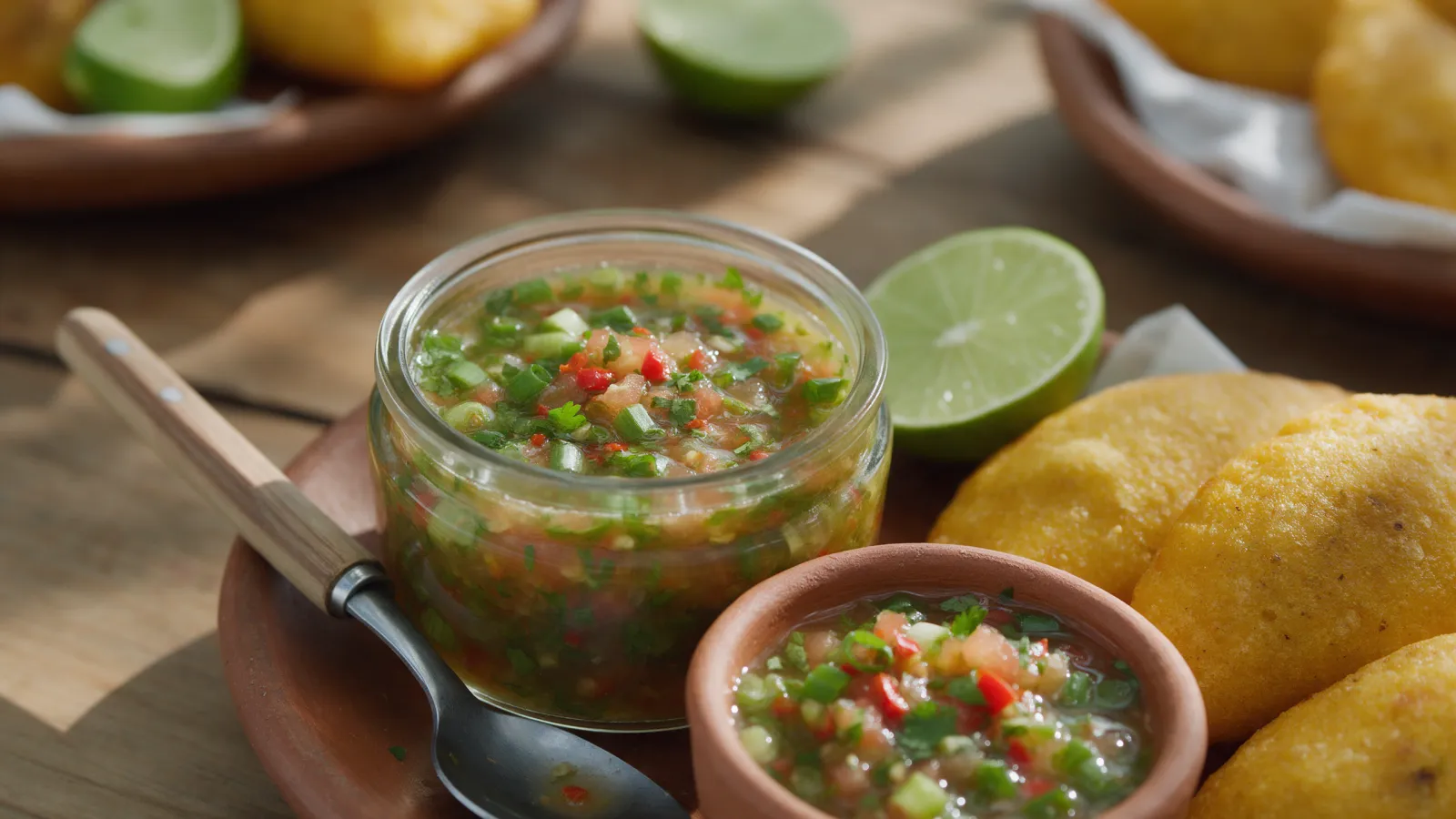

Order empanadas anywhere in Colombia and they come with a jar on the side: chopped green onion, tomato and cilantro floating in a pale pink liquid of water, vinegar and lime, with crushed hot chile running through it. That jar is ají (ah-HEE), short for ají picante, and it’s the everyday table hot sauce of the country. It’s thin enough to spoon into soup, sharp enough to cut through fried dough, and nothing like a bottled hot sauce.
What is Colombian ají picante, and how hot is it?
How do you make Colombian ají picante? Blend 2 hot chiles with 4 tablespoons (60 ml) of white vinegar, salt and half the water. Stir that base into 100 g (3½ oz) of finely sliced green onion, a seeded diced tomato and 20 g of chopped cilantro, then add the juice of a lime and the rest of the water. Chill 30 minutes and serve with its liquid. Ready in 15 minutes for 12 servings.
Think of it as a cross between a thin pico de gallo and a vinegar hot sauce. The vegetables stay raw and crunchy, while the liquid soaks into whatever you spoon it on. One 2-cup (500 ml) batch covers about 30 empanadas or several bowls of soup.
How hot. With 2 serranos, about 3 out of 5: the heat arrives at the end of the bite and fades fast. With half a habanero it’s a solid 4. The heat is entirely down to the chile you buy, and since Colombian ají peppers are hard to find outside Colombia, the chart below shows what the supermarket options measure.
Which chile to use outside Colombia
At home in Colombia this sauce is made with small, fiery red peppers sold under local names like ají pajarito. I haven’t found a published Scoville measurement for them that I’d stand behind, so I won’t give you one. The chiles you’ll find in a US or UK store do have measured ranges, according to the Scoville scale table on English Wikipedia.
My rule of thumb for one 2-cup (500 ml) batch:
- 3 jalapeños, ribs left in — mild, a 2 out of 5. Good for a crowd with kids.
- 2 serranos — medium, the closest match to the ají served with street empanadas in Colombia.
- ½ habanero or Scotch bonnet, seeded — hot, a 4 out of 5, with a fruity aroma Colombian ají doesn’t have. Wear gloves or wash your hands well afterwards.
Most of the burn sits in the white ribs inside the chile, so trimming them lowers the heat without changing how much chile flavor you get.
Ingredients, with US and UK swaps
The full list is in the recipe card: 100 g (3½ oz) green onion, 150 g (5 oz) tomato, 20 g (¾ oz) cilantro, 10 g (⅓ oz) chile, 105 ml (7 tbsp) acid split between vinegar and lime, 120 ml (½ cup) water and 6 g (1 tsp) salt. It makes about 2 cups.
The onion. Colombia’s cebolla larga is a thick, sharp green onion. Scallions in the US or spring onions in the UK are milder, so use 120 g, about 1 cup sliced, instead of 100 g. Only have a white onion? Use 80 g (½ cup) diced very small and rinsed in cold water to take the edge off. It turns out sweeter and less green.
The acid. What Colombians call limón is the green lime, so use limes, not yellow lemons. Plain distilled white vinegar is the standard; cider vinegar works but adds a fruity note.
The tomato. Any firm round or plum tomato. The only rule is to seed it.
Equipment. A sharp knife, a board, a small blender or a mortar, and a 500 ml (2-cup) glass jar with a lid. Glass matters: plastic tubs hold on to the onion smell for weeks.
Lime or vinegar, and the other versions worth making
This is the decision that changes the sauce most. Lime makes it fragrant; vinegar makes it last.
- Eating it today → lime only, about 105 ml (7 tbsp), from 2 or 3 limes.
- Want a jar for the whole week → vinegar only, 105 ml (7 tbsp). Sharper, but the cilantro stays green for days.
- Ají de aguacate (avocado ají) → fold 1 diced Hass avocado (about 136 g / 4¾ oz of flesh, in 1 cm / ½ in cubes) into half a batch just before serving. Creamier and gentler; eat it the same day because the avocado browns.
- Ají pique → a name many people use for this same sauce. The most liquid version I’ve been served used twice the blended base and half the vegetables, spooned by the teaspoon into soup.
- Peanut ají → a different sauce altogether, from Popayán, made with toasted ground peanuts. It’s the one that goes with Colombian peanut empanadas.
- Mild for kids → set aside 100 ml (scant ½ cup) of the vegetables, lime and water before adding the hot base.
If you know Venezuelan food, don’t confuse the two words: in Venezuela, plain ají means the sweet ají dulce, which has no heat at all. The closest Venezuelan table sauce in spirit is guasacaca, and it tastes nothing like this.
How to plan it, and how much to make
Make ahead. The blended base (chile, vinegar, salt and water) keeps in a covered jar in the fridge for up to a week in my kitchen. Slice the onion and dice the tomato on the day; chop the cilantro last. I make the jar in the morning for afternoon empanadas, and it tastes best after 2 to 6 hours in the fridge.
How much. I allow 1 tablespoon per empanada and 2 or 3 empanadas each, roughly 40 g (1½ oz) per person.
| Guests | Batch | Roughly |
|---|---|---|
| 4 to 6 | half recipe | 250 ml (1 cup) |
| 12 | full recipe | 500 ml (2 cups) |
| 20 | double recipe, two jars | 1 liter (4 cups) |
To scale, multiply everything by the same number. The ratio is what holds the sauce together.
Signs it’s right. The blended base has no chile skin bigger than a grain of rice and has turned pink or orange. The onion pieces don’t stick together. The liquid barely covers the vegetables in the jar; if they stick out a lot, add 2 tablespoons of water. Taste it on something fried, not off a spoon: acid first, heat last, salt in the background.
Mistakes that ruin ají, and allergens
- Watery after an hour → the tomato went in with its seeds and jelly, and that liquid dilutes the acid. Scoop them out of the 150 g (5 oz) tomato with a teaspoon.
- Black, limp cilantro → it was blended or chopped with a dull knife. Sharp knife, chopped last.
- Too hot → stir in another half batch with no chile. More lime doesn’t tame heat; it makes it harsher.
- Tastes like straight vinegar → not enough water. Keep acid and water roughly equal.
- Bitter → the lime was squeezed down to the pith, or a thick-skinned lemon was used.
Allergens. None of the major ones: no gluten, dairy, egg, nuts, fish, soy or sesame. If you’re coeliac, check the vinegar is distilled spirit or wine vinegar rather than malt vinegar, which is common in the UK.
Cost in the US and in Colombia
At US prices, the tomato, cilantro, lime and chiles (priced as 3 jalapeños) come to about $2.25 a batch, under 20 cents a serving. That uses the BLS average for field-grown tomatoes in August 2026 ($1.977/lb), and USDA AMS retail advertised prices from early October 2026 for cilantro ($0.97 a bunch), limes ($0.50 each) and jalapeños ($1.45/lb). Scallions, vinegar and salt aren’t in either series, so they’re not included. In Colombia, the vegetables, lime and vinegar cost about 1,427 pesos at Bogotá wholesale prices per the SIPSA bulletin of DANE for mid-September 2026, under 120 pesos a serving.
The cilantro bunch is the biggest single cost in the US and you only use half; the rest goes into the next batch or into Colombian ajiaco.
What to serve it with, and how to store it
What to spoon it on. Colombian empanadas above all, bitten open and filled with a spoonful. Then soups: a ladle of Colombian sancocho or three-meat sancocho with a spoon of ají stirred in. It also goes on patacones, carimañolas, rice and fried eggs.
Fridge. USDA FSIS sets the general rule: no more than 2 hours out of the fridge (1 hour above 90°F / 32°C), and a fridge at 40°F (4°C) or below. FSIS has no specific entry for homemade fresh salsa, so the times that follow are my own practice, in a covered glass jar: 2 days with lime only, 3 to 4 days for this mixed version, up to 5 days with vinegar only. If it smells fermented or fizzes, throw it out.
Freezer. Don’t freeze the finished sauce; the tomato and onion thaw soft and watery. Keep the blended base in the fridge instead and make a fresh jar in 10 minutes.
Serving leftovers. Never heat it. Take it out 10 minutes before serving, stir because the vegetables sink, and add a spoonful of freshly chopped cilantro if it looks tired.
Frequently asked questions
What is Colombian ají made of? Green onion, tomato, cilantro, hot chile, white vinegar, lime juice, water and salt. For 2 cups: 100 g onion, 150 g tomato, 20 g cilantro, 10 g chile, 4 tbsp vinegar, 3 tbsp lime juice, ½ cup water and 1 tsp salt.
How long does homemade ají last in the fridge? In my experience 2 days with lime only, 3 to 4 days with lime and vinegar, up to 5 days with vinegar only, in a glass jar at 40°F (4°C) or below.
Is ají the same as pico de gallo? No. Ají is thin and spoonable, with water and vinegar; pico de gallo is chopped vegetables dressed with lime and barely any liquid.
What chile can I use instead of Colombian ají peppers? 2 serranos for medium heat, 3 jalapeños for mild, or half a seeded habanero for hot. Habanero measures 100,000 to 350,000 Scoville units; jalapeño 2,500 to 10,000.
Can I make it in a food processor? Only the chile base. Pulse the vegetables and they turn to mush and darken; chop them by hand.
Can I freeze ají? Not once it’s finished. The blended chile and vinegar base keeps a week in the fridge, ready for a fresh batch.
Nutrition
Per serving of 3 tablespoons (about 42 g / 1½ oz), calculated from USDA FoodData Central (SR Legacy) values for this recipe’s quantities:
- Calories: 7 kcal
- Protein: 0 g
- Carbohydrates: 2 g
- Fat: 0 g
- Sodium: 196 mg
Nearly all the sodium comes from the teaspoon of salt, 2,325 mg of the batch’s 2,350 mg. Halve the salt and it drops to about 100 mg a serving; the acid covers for it. The avocado version, with one Hass avocado in half a batch, comes to about 45 kcal and 3.5 g of fat per serving.
I grew up in Venezuela, where ají meant a sweet little pepper, so the first time someone in Colombia passed me “the ají” for my empanada I put on far too much. These days a jar of the blended base lives in my fridge, and a fresh batch takes me less time than frying the empanadas. Josnaisis.