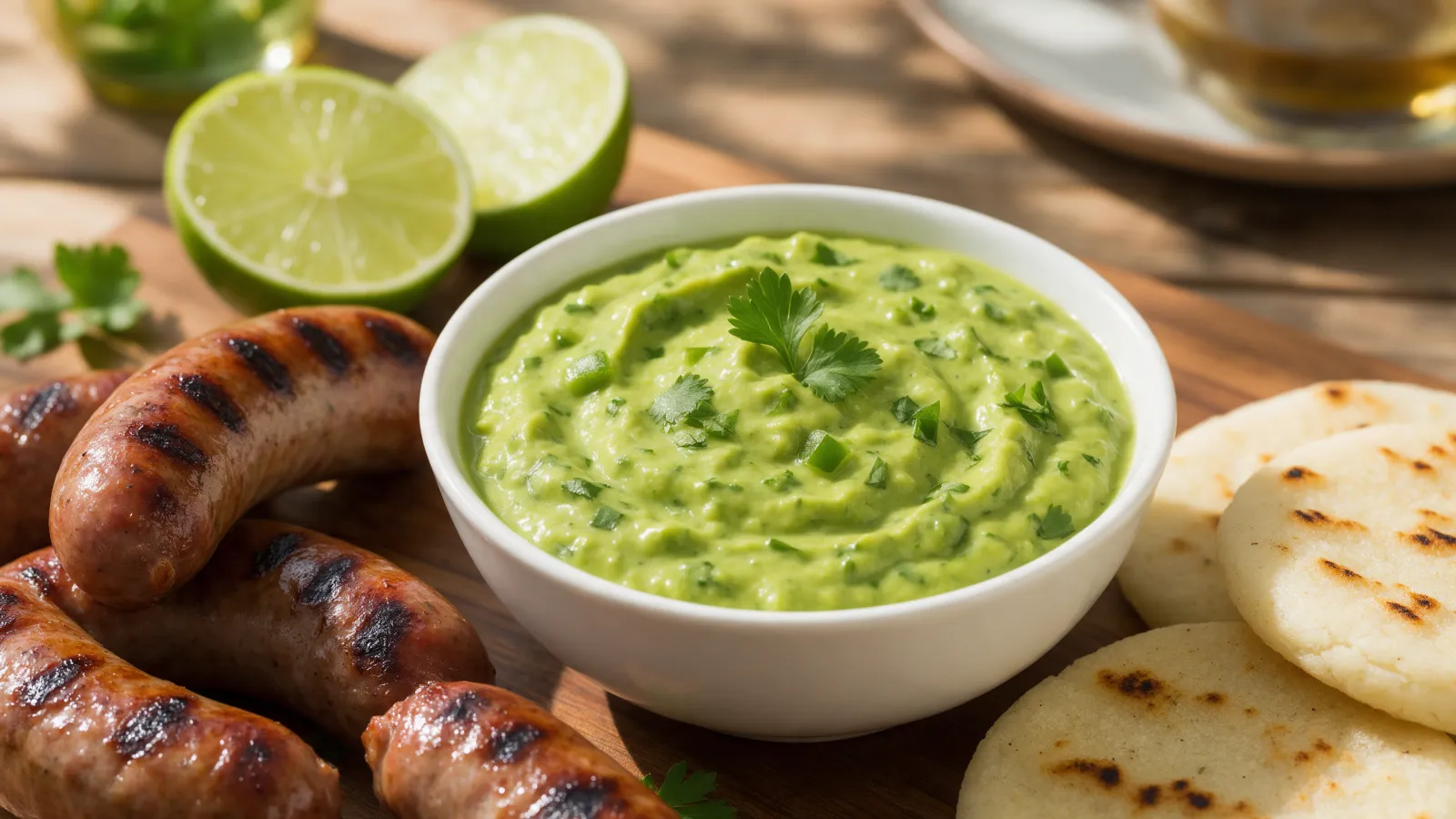

Picture guacamole that went to Argentina and picked up chimichurri’s habits. Guasacaca (wah-sah-KAH-kah) is Venezuela’s table sauce: avocado blended with vinegar, oil, garlic, parsley, cilantro, green pepper and a small, fragrant pepper called ají dulce, loose enough to spoon over a steak straight off the grill. Venezuelans put it on grilled meat, tuck it into arepas and dip fried cheese sticks in it. It takes 15 minutes, needs no stove, and the only real trick is the order in which things go into the blender.
What is guasacaca?
How do you make Venezuelan guasacaca? Blend green bell pepper, onion, sweet ají peppers, garlic, white vinegar and salt for 30 seconds, add cilantro, parsley and oil, then pulse in ripe avocado 5 or 6 times until the sauce pours. The ratio is 3 tablespoons each of vinegar and oil per 150 g (5 oz) of avocado flesh. Ready in 15 minutes for 10 servings.
It’s a sauce, not a dip. Where guacamole is mashed, chunky and built on lime, guasacaca is blended smooth, sharpened with vinegar and enriched with oil, so it clings to hot meat and soaks into it. One batch makes about 780 g (3 cups), enough for a grill session for 10 or snacks for 15.
Is it worth making? If you grill, yes. It costs about $6 a batch, keeps a day in the fridge, and turns plain grilled chicken or sausages into something with a point of view. If what you want is a thick dip for chips, make guacamole instead.
Outside Venezuela it has a following too: the food-ranking site TasteAtlas placed it 26th in its list of 50 world dressings, rated 4.3 out of 5.
Guasacaca vs guacamole, and where chimichurri fits
The quickest way to understand guasacaca is to put it between two sauces you probably know.
Three differences matter in the kitchen:
- Vinegar instead of lime. About 3 tablespoons per 150 g (5 oz) of avocado, far more acid than guacamole carries, which is why guasacaca tastes bright against fatty meat.
- Oil. The same 3 tablespoons per 150 g. It makes the sauce pourable and, usefully, means it works with the big, watery Florida avocados that make a runny guacamole.
- No heat. The classic version is 0 out of 5 on the spice scale. Ají dulce smells like a habanero and barely tastes hot. Most English-language recipes swap in jalapeño, which gives you a different sauce.
Ingredients, and what to buy in the US and UK
Exact amounts are in the recipe card. Here is what each one does and what to use when you can’t find it.
Sweet ají peppers (ají dulce)
Small, wrinkled peppers, green, red or yellow, about 10 g (⅓ oz) each, with the fruity smell of a hot pepper and almost none of the burn. They give guasacaca its perfume. In the US, look for ajicitos or ajíes dulces in Latin and Caribbean grocery stores, fresh or frozen. In the UK they’re hard to find; a sweet pointed Romano pepper or a bag of mini sweet peppers gives the sweetness without the aroma.
Avocados, Hass or Florida
US and UK supermarkets mostly sell Hass: small, pebbly-skinned, rich. In Venezuela the everyday avocado is the large, smooth-skinned kind the USDA files as Florida avocado, sold in the US as greenskin. According to USDA data, Hass carries 15.4 g of fat per 100 g and Florida 10.1 g, and one Florida avocado yields 304 g (10½ oz) of flesh against 136 g (4.8 oz) for a Hass.
For guacamole that lower fat is a problem. Here it isn’t, because the oil supplies what the fruit lacks. One large Florida avocado equals two large Hass. Florida gives a paler, lighter, slightly sweeter sauce; Hass, a thicker, darker one. Either way, it must be ripe: an underripe avocado tastes grassy and no amount of blending fixes it.
The rest
- Green bell pepper (green pepper in the UK): body and color.
- Vinegar: distilled white in the US, white wine vinegar in the UK, which is a little softer.
- Oil: neutral, such as canola, vegetable, sunflower or rapeseed. Extra-virgin olive oil can turn bitter in a blender; if you love it, stir a spoonful in by hand at the end.
- Parsley: flat-leaf. Curly parsley leaves a bitter edge.
- Cilantro: called coriander in the UK. Leaves and tender stems.
Equipment
A blender or food processor. A processor leaves more texture, which some people prefer. No blender? Chop everything very finely, mash the avocado with a fork, then beat in the vinegar, oil and salt for 1 minute. You get a rustic, chunky guasacaca that holds its color just as well.
How to make guasacaca, step by step
Total time is 15 minutes, all hands-on: 10 to wash and chop, 2 in the blender, 3 to taste and adjust.
Why the avocado goes in last
Avocado is the ingredient that browns. An enzyme in the flesh, polyphenol oxidase, darkens it on contact with oxygen, and a spinning blade both whips in air and warms the jar. So the vegetables get their 30 seconds with the vinegar first, the herbs and oil get 15 to 20 seconds, and the avocado gets only 5 or 6 one-second pulses in a base that’s already acidic. Blend the avocado for a full minute with everything else and the sauce comes out a dull olive color before it even reaches the table.
How to tell it’s right
| Stage | What you should see |
|---|---|
| Vegetable base, 30 sec | coarse purée, no pepper pieces bigger than ¼ in (5 mm) |
| Herbs and oil, 15-20 sec | bright green, slightly thick, no whole leaves |
| Avocado, 5-6 pulses | pale green with dark green flecks; falls in a ribbon that flattens in 2-3 seconds |
| Taste | vinegar first, then garlic and avocado. Avocado drowning everything means too little vinegar; vinegar catching your throat means too little avocado |
Who this recipe is for
- If you’re grilling for a crowd → double it and blend in two batches so the avocado doesn’t heat up in a full jar.
- If you’ve only had guacamole → make it as written once before you change anything; the vinegar is the point.
- If you can’t find ají dulce → mini sweet peppers, never jalapeño, unless you want heat.
- If you’re feeding kids → set some aside before the garlic goes in, or use 1 clove instead of 2.
Keeping it green, and how long it lasts
Vinegar slows browning; it doesn’t stop it. Air is the enemy. Store guasacaca in a small container with little headspace and plastic wrap pressed onto the surface, with no bubbles.
Food safety. The USDA Food Safety and Inspection Service rule for perishable food applies: no more than 2 hours at room temperature, 1 hour above 90°F (32°C), and refrigerate at 40°F (4°C) or below. In my fridge, wrapped, it stays green about 24 hours. By 48 hours the top layer darkens; scrape it off and what’s underneath is green and tastes the same. Stirring the dark layer in only spreads the color. I don’t keep it past 3 days.
Freezer. The California Avocado Commission gives mashed frozen avocado two weeks to a month. Frozen guasacaca thaws watery and the herbs go limp, so I freeze only the avocado flesh with 1 tablespoon of vinegar, in a bag with the air pressed out, and blend it with fresh herbs after thawing.
Reheating. Don’t. It’s served cold or at room temperature. If it comes out of the fridge too thick, stir in a tablespoon of cold water.
Make-ahead plan for a cookout
- The day before → blend the base without avocado (pepper, onion, ají, garlic, herbs, vinegar, oil, salt) and keep it in a sealed jar in the fridge. In my kitchen it holds 2 days; the cilantro loses some color, not flavor.
- When you light the grill → blend in the avocado. 3 minutes.
- How much → I count 50 to 60 g (about 3 heaping tablespoons) per person at a cookout. For 4 to 6, make half the recipe with 150 g (5 oz) of flesh; for 12 to 20, double it with 600 g (1 lb 5 oz) of flesh, 180 ml (¾ cup) of vinegar and 180 ml (¾ cup) of oil.
- On the table → two small bowls instead of one big one. The second stays wrapped in the fridge and arrives green at the end of the afternoon.
Mistakes that ruin guasacaca
- Grey or dull sauce → the avocado was blended too long or went in first. Last, and in pulses.
- Thick as a purée → too little vinegar and oil for the amount of flesh, or very large Hass avocados. Loosen with 2 or 3 tablespoons of cold water or 1 of vinegar.
- Tastes of raw vinegar → not enough avocado or salt. Half a teaspoon more salt usually balances it.
- Bitter → extra-virgin olive oil in the blender, curly parsley or thick parsley stems. Neutral oil, leaves only.
- Unexpectedly hot → jalapeño instead of sweet peppers, or seeds left in.
- Garlic takes over → 2 cloves per 300 g (10½ oz) of flesh is plenty; raw blended garlic hits twice as hard as chopped.
Allergens. No gluten, dairy, egg or nuts in the classic version. The mayonnaise version below contains egg. People with a latex allergy can also react to avocado (latex-fruit syndrome).
Variations
- Spicy → ½ jalapeño or 1 small hot chile, blended with the base. About 2 out of 5.
- Lighter → half the oil, 45 ml (3 tbsp). It drops from 134 to about 98 kcal per serving and tastes sharper; add 1 tablespoon of water.
- Street-cart style → for each 150 g (5 oz) of flesh, 2 tablespoons of mayonnaise and 1 less of oil. Smoother and creamier; it’s the version Venezuelan hot dog and burger carts squeeze onto everything.
- With lime → replace 2 tablespoons of vinegar with lime juice. Fresher, and a step closer to guacamole.
- No avocado → peppers, onion, herbs, garlic, vinegar and oil only, closer to a green chimichurri. Excellent on steak, and it keeps longer.
- Vegan → the classic recipe already is.
What it costs
Using the national average advertised supermarket prices that the USDA Agricultural Marketing Service collected for October 3 to 15, 2026, a batch costs about $6.29, or 63 cents a serving, before the vinegar and oil, which the report doesn’t track.
What drives the price. The avocados, at 41 %. The surprise is the herbs: you buy two whole bunches for 30 g (1 oz), so they’re a third of the bill. Use the leftovers in salsa or rice. Greenskin Florida avocados were advertised at $0.99 a pound that week, though in only 34 ads nationwide; when you find them, one fruit costs well under a dollar and replaces two Hass.
Yield. About 780 g (3 cups): 10 servings of a little under 80 g (⅓ cup), or 15 if it’s a dip for fried snacks.
What to serve it with
In Venezuela guasacaca sits in the middle of the table at every barbecue: over grilled beef, sausages and blood sausage, with boiled cassava, and next to anything fried. Count on 3 heaping tablespoons, about 50 g (1¾ oz), per person. Try it with:
- Venezuelan tequeños, the cheese sticks it’s most often paired with.
- Venezuelan empanadas, crisp corn turnovers from every birthday party.
- A reina pepiada arepa: avocado on avocado, and Venezuelans do it anyway.
- Colombian beef skewers straight off the grill.
- Leftover Venezuelan pernil in a sandwich the day after Christmas.
- Caribbean tostones, smashed and fried plantains that need a sharp sauce.
If you’re curious about the cousin, my authentic Mexican guacamole works on a per-avocado ratio too, built on lime and chile instead.
Frequently asked questions
What is guasacaca made of? Avocado, green bell pepper, onion, sweet ají peppers, garlic, cilantro, parsley, white vinegar, neutral oil and salt, blended until it pours.
What’s the difference between guasacaca and guacamole? Guasacaca is Venezuelan, blended smooth with vinegar, oil, garlic and parsley, and used as a sauce for grilled meat. Guacamole is Mexican, mashed with lime, onion and chile, and eaten as a dip.
Is guasacaca spicy? Not the classic version. Ají dulce is aromatic, not hot. Add ½ jalapeño if you want heat.
What can I use instead of ají dulce? Mini sweet peppers in the US or a Romano pepper in the UK, 40 g (1.4 oz) for this batch. You keep the sweetness and lose some aroma. Avoid jalapeño unless you want heat.
How do I keep guasacaca from turning brown? Pulse the avocado in last and briefly, store it in a small container with plastic wrap pressed on the surface, and keep it cold. Scrape off any darkened top layer before serving.
How long does guasacaca last? About 24 hours green, wrapped, at 40°F (4°C) or below. I don’t keep it more than 3 days. At room temperature, 2 hours at most per the USDA FSIS.
Can you freeze guasacaca? It loses texture. Freeze the avocado flesh with a tablespoon of vinegar for up to a month, then blend it with a fresh herb base.
Is guasacaca the same as chimichurri? No. Chimichurri is an Argentine herb, garlic, vinegar and oil sauce with no avocado. Guasacaca shares the vinegar, oil, parsley and garlic, then adds avocado and sweet peppers.
Nutrition
Per serving, about 79 g (⅓ cup), one tenth of the batch, calculated ingredient by ingredient from USDA FoodData Central (SR Legacy) using Hass avocado, soybean oil, and sweet red pepper as a stand-in for ají dulce:
- Calories: 134 kcal
- Protein: 1 g
- Carbohydrates: 5 g
- Fat: 13 g, of which 2 g saturated
- Fiber: 3 g
- Sugars: 1 g
- Sodium: 238 mg
The oil supplies 54 % of the calories; halve it and a serving drops to about 98 kcal. A Florida avocado instead of Hass takes off another 14 kcal or so. Nearly all the sodium comes from the teaspoon of salt.
At home in Venezuela we made guasacaca with the big avocados from the yard, and when I moved to Colombia and tried to make guacamole with that same fruit, it came out runny. It took me a while to see the avocado wasn’t wrong, the recipe was: the big ones are for guasacaca. These days I blend the base on Saturday and add the avocado on Sunday while the charcoal catches, and the last arepa still gets green sauce. Josnaisis.