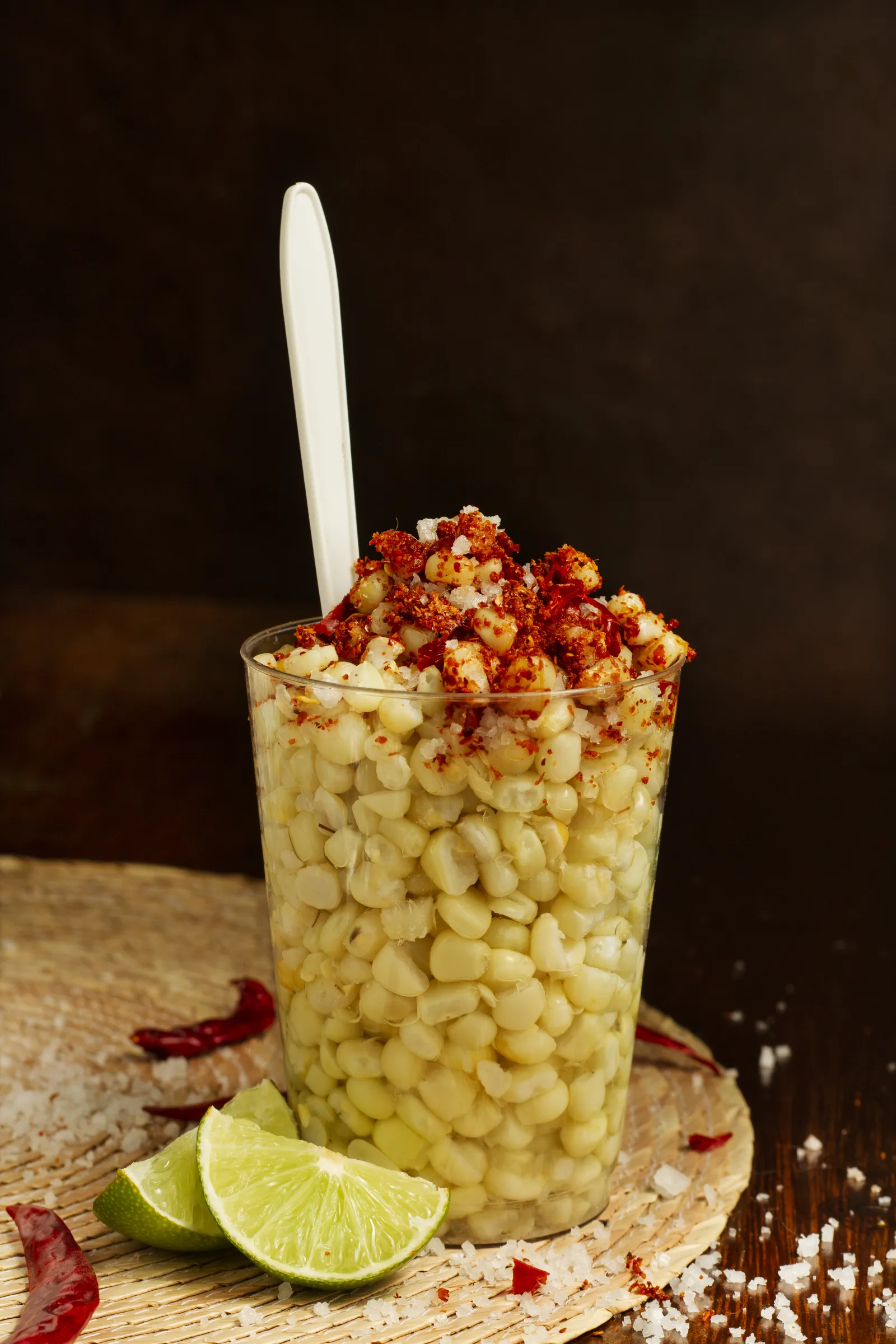

On a Mexican street corner, the corn in your cup was never grilled. It was simmered for 15 minutes in a pot of buttery broth with onion, a serrano and a few sprigs of epazote, and it is served with some of that broth still hot in the cup. That broth is what melts the mayonnaise and softens the cotija into the kernels. Esquites (ess-KEE-tess) are the off-the-cob, eat-with-a-spoon cousin of elote, and they are among the easiest Mexican snacks to make at home.
What esquites are, and how they differ from elote and corn salad
How do you make esquites? Cook a chopped onion and a serrano in 2 tablespoons (30 g) of butter, add 600 g (4 cups) of corn kernels, 500 ml (2 cups) of water or stock, salt and three sprigs of epazote, and simmer uncovered for 15 minutes until the corn is tender and the liquid has reduced by two thirds. Serve in cups with the broth, mayo, cotija, lime and chile powder. Ready in 35 minutes for 4 servings.
Elote is the whole cob, boiled or grilled, on a stick, slathered with mayo, cheese and chile. Esquites are the same flavors with the kernels cut off and cooked in their own broth, served in a cup. The Diccionario del español de México from El Colegio de México defines them as a snack of fresh corn kernels boiled with salt and epazote and served “with its broth,” topped with salt and chile powder and sometimes cream or mayonnaise and cheese.
What many English-language recipes call Mexican street corn salad is a third thing: kernels charred in a hot skillet, tossed with mayo, cheese, cilantro and lime, and eaten warm or cold. It is very good. It is just not what the cart sells. You will find both methods below.
Across Mexico the name changes, too. A round-up by the Mexican news outlet N+ lists elote en vaso (“corn in a cup”) in the north and the Bajío, vasolote in Michoacán, trolelote in Tamaulipas and chasca in Aguascalientes.
Ingredients, and what to buy in a US or UK supermarket
The base is short: 600 g (4 cups) of corn, 30 g (2 tbsp) of butter, onion, one serrano, salt and epazote. The toppings are where your shopping changes depending on where you live.
| Ingredient | What it does | US swap | UK swap |
|---|---|---|---|
| White Mexican corn | firm, less sweet kernels | any fresh sweet corn, or frozen | frozen sweetcorn |
| Epazote | resinous, anise-like herb | Mexican grocers, some summer markets | online Mexican shops, often dried |
| Cotija | dry, salty, crumbly cheese | Latin dairy case | feta |
| Mexican crema | rich, slightly tangy cream | sour cream | soured cream or crème fraîche |
| Chile piquín powder | dry, bright heat | Tajín or chili powder | mild chilli powder plus a pinch of cayenne |
| Serrano | clean green heat | jalapeño (milder) | green finger chilli |
Corn. Mexican street carts use white corn. It has about half the sugar of yellow sweet corn, 3.2 g per 100 g against 6.3 g in USDA data, so yellow corn gives sweeter esquites. Both work.
Epazote. It is the herb that makes esquites taste like the cart. Dried epazote adds little, and nothing in a US or UK store replaces it. I would rather leave it out than force a substitute: the corn comes out sweeter and plainer, still good.
Cotija and its stand-ins. Cotija is aged, salty and dry. It does not melt; it crumbles over the top and seasons every spoonful.
Mayo, crema or yogurt. Mayonnaise is what the cart uses and melts best into the hot broth, at about 100 kcal per tablespoon. Sour cream or crema is lighter and tangier, and half mayo, half sour cream is how I order mine. Plain Greek yogurt is the lightest option.
Tajín is a chile-lime seasoning with salt in it. If you use it instead of plain chile powder, skip the final pinch of salt.
Fresh, frozen or canned corn, and how long to cook each
Fresh corn takes 15 minutes, frozen 10, canned 5. Fresh corn gives the firmest, juiciest kernels, and scraping the cob adds pulp that thickens the broth. Frozen is the best shortcut, already cut and needing half the liquid. Canned corn is already cooked and salted, at 205 mg of sodium per 100 g against 15 mg for fresh, so it only needs 5 minutes to take on the epazote.
If you shop at a Latin grocer, the big-kernelled choclo from Peru, Ecuador or Colombia is a starchier corn than sweet corn. It works, but it needs more liquid and more time, and the kernels come out mealy. Save it for something like Colombian sweet corn arepas, where that starch helps. And if you have an extra ear of sweet corn, cut the kernels into a skillet of calabacitas with zucchini and tomato.
How to make esquites step by step
35 minutes, 15 of them hands-on. Cut the kernels and chop while the butter melts; 5 minutes of sweating the onion and corn; then 15 minutes of simmering you don’t need to watch.
Keep the broth in the cup
The single thing that separates street esquites from corn salad is the broth. After 15 minutes uncovered, the liquid should sit about a third of the way up the kernels, cloudy and pale yellow from the corn starch. Spoon 2 to 3 tablespoons of it into every cup before the toppings. The heat melts the mayo, softens the cotija and carries the lime down to the bottom of the cup.
Signs you are on track:
- The onion is translucent after 3 minutes, with no browned edges.
- The broth turns cloudy within 10 minutes.
- The corn is tender at 15 minutes and still pops when bitten. If it is chewy, keep going in 5-minute steps with a splash of water.
- The salt is checked last, remembering the cotija will add more.
The charred version, Mexican street corn salad
If you want the skillet version, the Serious Eats method heats 2 tablespoons of oil in a nonstick skillet or wok over high heat, leaves the corn alone for about 2 minutes per side, 6 minutes in all, and has you thaw and pat frozen corn completely dry first, because wet kernels steam instead of browning. I work in batches of about 300 g (2 cups) so the pan stays hot. Then toss with the same mayo, cheese, lime and chile, plus cilantro and scallions if you like.
Charred is the one I take to a barbecue because it is good at room temperature. For anything served hot, I make the broth version.
Who this recipe is for
- If you have 20 minutes → frozen corn, 250 ml (1 cup) of liquid, 10 minutes of simmering.
- If all you have is canned → two drained 15-oz (425 g) cans, 5 minutes with the epazote, salt only after tasting.
- If you are cooking for kids → leave the serrano out of the pot and put the chile on the table.
- If you want it lighter → Greek yogurt instead of mayo brings a cup from 351 to about 264 kcal.
- If you can’t eat dairy or egg → oil instead of butter, vegan mayo, no cheese, and extra lime and chile.
- If you want elote on the cob instead → simmer whole ears in the same broth for 15 minutes and brush on the same toppings; the per-ear amounts match one cup.
Scaling esquites for a party of 12 to 20
One 10-oz (300 ml) cup takes 150 g (1 cup) of corn plus the broth and toppings. A large ear gives a little under a cup.
| Cups | Corn | Butter | Mayo | Cotija | Epazote |
|---|---|---|---|---|---|
| 4 | 600 g (1 lb 5 oz) | 30 g (2 tbsp) | 60 g (¼ cup) | 60 g (2 oz) | 3 sprigs |
| 8 | 1.2 kg (2 lb 10 oz) | 60 g (4 tbsp) | 120 g (½ cup) | 120 g (4 oz) | 6 sprigs |
| 12 | 1.8 kg (4 lb) | 90 g (6 tbsp) | 180 g (¾ cup) | 180 g (6 oz) | 8 sprigs |
| 20 | 3 kg (6.6 lb) | 150 g (10 tbsp) | 300 g (1¼ cups) | 300 g (10 oz) | 12 sprigs |
For 20 cups, use an 8-quart (8-litre) pot with 2.5 litres (10 cups) of water and 5 teaspoons of salt; at that volume the simmer takes about 25 minutes. Epazote doesn’t scale one to one, and 12 sprigs is plenty.
USDA FSIS asks for hot food held at 140°F (60°C) or above, which a slow cooker on warm handles. Keep the mayo in a small bowl you refill from the fridge, since cold dishes shouldn’t sit out longer than 2 hours.
Mistakes that ruin esquites
- Draining the corn. You end up with a lukewarm salad. Keep 2 to 3 tablespoons of broth per cup.
- Too much epazote, or for too long. It tastes medicinal. Three sprigs per 600 g (4 cups), out when the heat goes off.
- Simmering canned corn like fresh. It turns soft and bland. Five minutes is enough.
- Salting at the start with canned corn, cotija and Tajín. All three bring salt. Taste with the cheese on before adding more.
- A crowded skillet for the charred version. The corn steams. Batches of 300 g (2 cups), kernels dry.
Heat level. 1 out of 5 with a seeded serrano in the pot; 2 out of 5 with chile piquín on top.
Allergens. Milk (butter, cotija) and egg (mayonnaise). Esquites are naturally gluten-free, but check the chile powder and mayo labels if you cook for someone with celiac disease. In pregnancy, the FDA advises avoiding Latin-style soft cheeses unless the label says they are made with pasteurized milk; I apply the same rule to cotija.
What esquites cost
The toppings cost more than the corn. At Mexico City’s Central de Abasto on 9 October 2026, Mexico’s SNIIM market service quoted large ears of corn at 7.50 pesos per kilo, so the vegetables for 4 cups come to about 17 pesos, before butter, mayo and cheese. In the US, the Bureau of Labor Statistics put butter at $4.02 per pound in August 2026, so the 2 tablespoons in this recipe cost about 27 cents. The BLS doesn’t track fresh corn, mayonnaise or cotija, so I can’t give you an honest US total.
Make ahead, storage and reheating
The day before, cut the kernels and refrigerate them in a sealed container, or cook the whole batch with its broth; it reheats perfectly.
Fridge. USDA FSIS says cooked food should go in the fridge within 2 hours (1 hour above 90°F / 32°C) and keeps 3 to 4 days at 40°F (4°C) or below. Store the corn with its broth and without toppings.
Freezer. The cooked corn and broth freeze well; FSIS gives 3 to 4 months for best quality. Toppings don’t freeze.
Reheating. On low heat with a splash of water, stirring, until it reaches 165°F (74°C), or in the microwave in 1-minute bursts. Add the toppings after.
What to serve with esquites
Esquites belong on a table of Mexican snacks: next to tacos al pastor, a plate of Mexican quesadillas from the skillet, or authentic Mexican guacamole with chips. A cold 12-oz (350 ml) glass of agua de jamaica, the hibiscus water, cuts through the mayo, and for adults a salty, lime-sharp michelada made with Mexican lager does the same job. For a Venezuelan-Mexican spread, Venezuelan cachapas share the same sweet fresh-corn flavor.
Esquites FAQ
What is the difference between esquites and elote? Elote is a whole cob on a stick with mayo, cheese and chile. Esquites are the kernels, simmered in broth with epazote and served in a cup with the same toppings.
Is Mexican street corn salad the same as esquites? Not quite. Street-cart esquites are simmered and served hot with their broth. Most “street corn salad” recipes char the kernels in a skillet and serve them warm or cold, with no broth.
Can I make esquites with frozen corn? Yes, and it is the best shortcut: 600 g (1 lb 5 oz) frozen, 250 ml (1 cup) of liquid and 10 minutes. For the charred version, thaw and pat it dry first.
Can I use canned corn? Yes. Drain it and simmer just 5 minutes with the epazote, since it is already cooked. It is salted, so taste before adding any salt.
What can I use instead of cotija cheese? Feta is the closest in the US and the UK. Grated Parmesan works at half the amount. Queso fresco is milder, so add a pinch of salt.
What is epazote and is there a substitute? A Mexican herb with a resinous, anise-like flavor. There is no real substitute; without it, esquites are sweeter and plainer but still good.
How much do I need for a crowd? One 10-oz (300 ml) cup per person, 150 g (1 cup) of corn each. For 20 people, 3 kg (6.6 lb) of corn, about 21 large ears.
How long do esquites keep? 3 to 4 days in the fridge without toppings, per USDA FSIS. Reheat to 165°F (74°C) and add the toppings when serving.
Nutrition per cup
Per cup (150 g of corn with broth, 1 tablespoon of mayo, 15 g of cotija, 1 tablespoon of lime juice and chile powder), calculated from USDA SR Legacy data for raw white corn, salted butter, regular mayonnaise and cotija:
- Calories: 351 kcal
- Protein: 8 g
- Carbohydrates: 32 g
- Fat: 24 g, of which 9 g saturated
- Fiber: 5 g
- Sugars: 6 g
- Sodium: 880 mg
Without mayo and cheese, a cup drops to about 194 kcal and 570 mg of sodium. The mayo adds about 100 kcal, the cotija about 55 kcal and 210 mg of sodium.
Where I grew up in Venezuela, fresh corn went into cachapas or got boiled on the cob and rubbed with butter, and nobody served it in a cup. The first time I made esquites here in Colombia I drained the corn, and they tasted like warm salad with mayo on it. Leaving the broth in fixed everything. The broth is the dish; the rest is topping. Josnaisis.