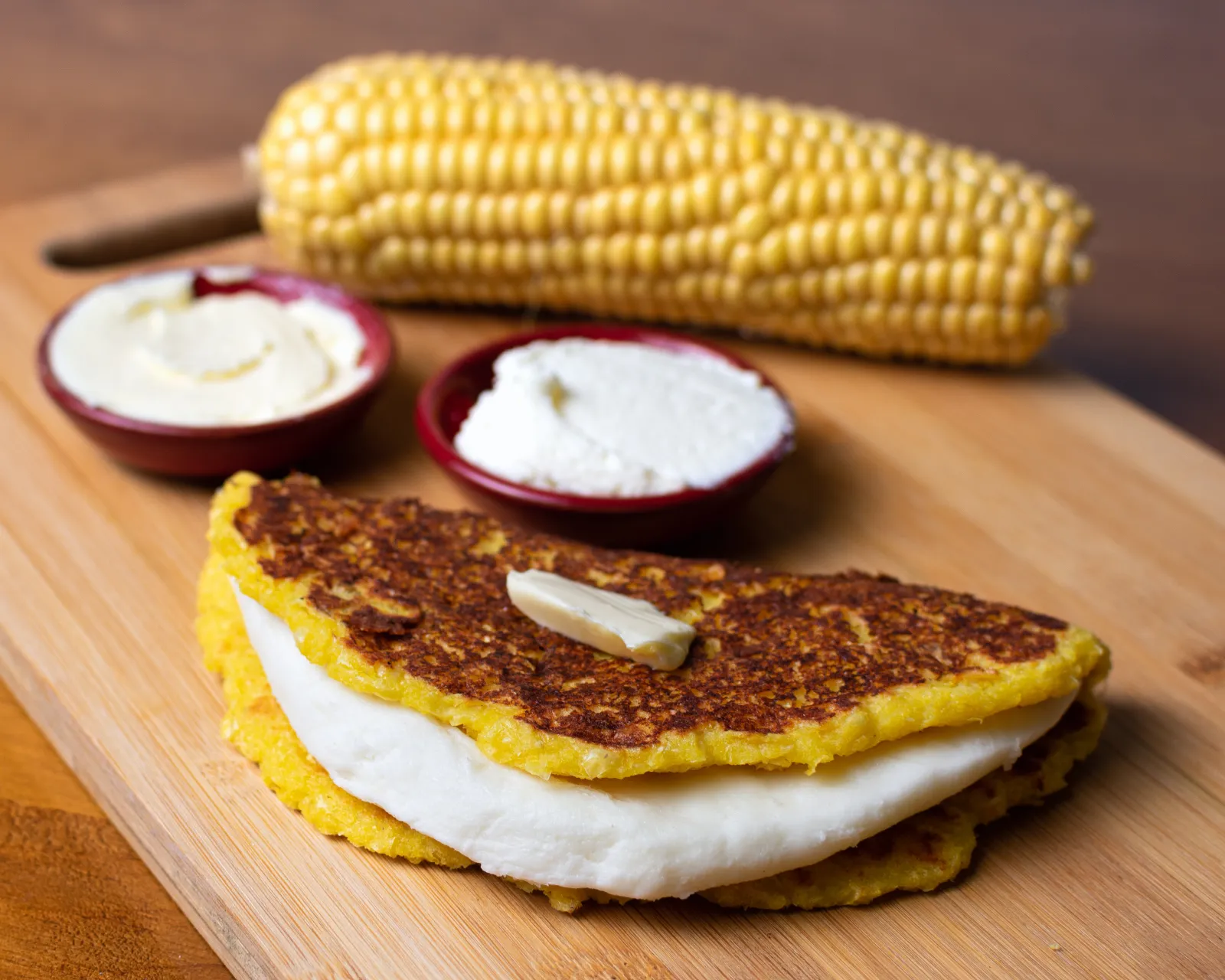

Cachapas (kah-CHAH-pahs) are what Venezuelans do with sweet corn at its peak: the kernels are blended into a loose, lumpy batter, cooked on a griddle like a thick pancake and folded over a slab of soft, stretchy white cheese called queso de mano. The flavor is closer to fresh corn on the cob than to cornbread, sweet and a little caramelized at the edges, with salty cheese pulling in strings when you cut it. They’re breakfast, lunch or a late-night plate, and the whole recipe hinges on one adjustment most home cooks never make: how much cornmeal your particular corn needs.
What is a cachapa, and how is it different from an arepa?
How do you make Venezuelan cachapas? Blend 1.75 lb (800 g) of sweet corn kernels with milk, sugar, salt and melted butter, leaving small bits of kernel, then stir in ¼ cup (30 g) of masarepa and rest 10 minutes. Cook 8-inch (20 cm) rounds on a griddle over medium heat for 5-6 minutes, flip, top with queso de mano and fold. 60 minutes for 4 servings.
A cachapa is a fresh-corn pancake, about 8 inches (20 cm) across, folded in half around cheese. An arepa is a different thing entirely: a thick patty of precooked cornmeal and water, with no fresh corn, split and stuffed like a pita (the reina pepiada arepa is the famous one). Colombia has a cousin, the sweet corn arepa, made from the same tender corn but with about three times the cornmeal per pound of kernels, so it holds a thick disc and gets cheese on top instead of folded inside.
The cachapa is the loosest of the three. It barely holds together until it has cooked through, which is why the flip is the only part that takes nerve.
Is it worth making? Yes, especially in late summer when sweet corn is cheap and good. One cachapa with 3½ oz (100 g) of cheese is a full meal for an adult. It’s not a light breakfast, at around 590 kcal, and it’s not a five-minute job: about 60 minutes from whole ears, 50 with frozen kernels.
The corn, fresh, frozen or canned
Fresh sweet corn gives the best cachapa, frozen is a very good second, and canned works if you adjust for it. The difference is water, sugar and starch, so the amount of masarepa changes with each.
Fresh sweet corn. Pick ears where a kernel pressed with a fingernail squirts milky juice. USDA data puts raw sweet corn at 6.26 g of sugar per 100 g (about 3.5 oz), and that sugar is what browns on the griddle. ¼ cup (30 g) of masarepa is all it needs. An older ear with hard, deep-yellow kernels has turned some of its sugar to starch: give it double the milk, a spoonful more sugar and little or no masarepa.
Frozen corn. What I use out of season. Thaw it, drain it in a sieve for 10 minutes and pat it dry. USDA lists frozen sweet corn at 2.5 g of sugar per 100 g, under half of fresh, so it takes 2 tablespoons of sugar, and ⅓ cup (45 g) of masarepa because the thawed kernels release water.
Canned corn. It’s already cooked and packed in brine; drained, it has 205 mg of sodium per 100 g by USDA figures. Rinse it, pat it dry, skip the milk entirely and use ½ cup (60 g) of masarepa so the cachapa survives the flip.
What masarepa is, and what it isn’t. Masarepa is precooked corn flour, sold as Harina P.A.N. or Goya Masarepa in the international aisle of US supermarkets and in Latin shops and online in the UK. It is not masa harina (the Mexican nixtamalized flour for tortillas), which tastes of lime and won’t absorb liquid the same way, and it is not cornmeal, which stays gritty. In a pinch, 2 tablespoons of fine cornmeal plus 1 tablespoon of cornstarch per 30 g of masarepa will thicken the batter; the texture is grainier.
The cheese, and what to buy instead of queso de mano
Queso de mano is a fresh, soft white cheese made by stretching hot curd by hand into layered discs, mildly salty. In a cachapa it softens and pulls without turning to liquid, and that’s the test for any substitute.
| Cheese | US | UK | What changes |
|---|---|---|---|
| Queso de mano | Venezuelan and some Latin grocers | Venezuelan shops online | nothing, it’s the original |
| Fresh mozzarella (ball in brine) | every supermarket | every supermarket | weeps whey; slice, rest 15 min on paper towels, add a pinch of salt |
| Oaxaca cheese | Latin grocers, many large supermarkets | hard to find | pulls into long strings, slightly drier; excellent |
| Low-moisture mozzarella | every supermarket | every supermarket | melts and runs out of the fold, saltier |
| Halloumi, paneer, feta | widely sold | widely sold | won’t stretch; skip them here |
My first choice outside Venezuela is fresh mozzarella, sliced and patted dry, with a pinch of salt over it. Living in Colombia, I use queso doble crema, which is stretched the same way and behaves almost identically.
How to cook cachapas without tearing them
The batter has almost no flour holding it together, so the structure comes from the corn cooking through. A clean fold comes down to two things, griddle temperature and patience.
Heat. Medium, around 340-355°F (170-180°C) on the surface. Below 300°F (150°C) the batter dries without browning and sticks; at 375°F (190°C) and above the corn sugar burns while the middle is still liquid. Without an infrared thermometer, use the water test: a drop should hiss and disappear in 2-3 seconds. Grease with just enough butter to make the surface shine; a pool of butter fries the edge hard.
When to flip
Flip once, and only when you see all three signs together: the top has gone from glossy to matte, small holes open and stay open, and the edge lifts from the pan on its own. That’s usually 5-6 minutes. I slide a wide spatula to the center, lift in one movement and lay it back down. If the edge still droops when you lift it, give it another minute; that’s nearly always the problem.
The cheese goes on the cooked side
Lay the cheese on the browned side right after flipping, over one half, and give it 3-4 minutes so the heat from below softens it. Then fold. Cheese added to raw batter leaks water into it and the cachapa never sets.
Equipment, and what to use instead
A blender or food processor, a sharp knife, a ladle and a cast-iron griddle or 10-11 inch (26-28 cm) nonstick skillet with a wide spatula. Stainless steel sticks. No blender? Grate the whole ears on the coarse side of a box grater; the batter is more rustic and very good, and takes about 20 extra minutes.
Make-ahead plan and cooking for a crowd
The day before. Cut the kernels and refrigerate them covered, or make the whole batter: it keeps up to 24 hours, covered, in the fridge. It separates a little; stir it back together, and if it has thinned out, add a tablespoon of masarepa and wait 5 minutes.
On the day. With batter ready, 4 cachapas take about 40 minutes on one griddle, 20 on two. Keep finished ones under a clean towel on a plate.
For 8 to 10 people. Multiply by 2½: 2 kg (4.4 lb) of kernels, about 14 large ears or four to five 1-lb (454 g) bags of frozen corn, 150 ml (⅔ cup) milk, 75 g (⅔ cup) masarepa and 1 kg (2.2 lb) of cheese for 10 cachapas. Blend in three batches, make the batter the night before and run two pans.
Yield per pound. About 1.17 kg of batter per kilo of kernels, so roughly 2 cachapas of 8 inches (20 cm) per pound of kernels, or 4-5 smaller 5-inch (12 cm) ones, which are easier on a brunch table.
Mistakes that ruin cachapas
- Tears in half when flipped → flipped too early, or too little masarepa for the corn. Wait for the holes; add 10 g (1 tbsp) more masarepa if it keeps happening.
- Sticks to the pan → cold griddle or stainless steel. Preheat 6 minutes on cast iron or nonstick.
- Raw in the middle → poured thicker than ½ inch (1 cm), or heat too high. Spread to ¼ inch (7 mm) and turn the heat down.
- Dry and floury → older, starchy corn with the full amount of masarepa. Skip the masarepa and add milk.
- Soggy inside → wet mozzarella straight from the brine. Pat it dry for 15 minutes.
- Tastes canned → canned corn not rinsed. Rinse and dry it before blending.
Spice level, 0 out of 5. Nothing in a cachapa is hot. Kids usually love them: sweet, soft, stretchy cheese. Let the cheese cool for 2 minutes before cutting a child’s portion. Allergens: dairy (milk, butter, cheese). There’s no egg, and with masarepa there’s no gluten; check the flour label if you cook for someone with celiac disease.
Variations
- With fried pork → in Venezuela the classic roadside order is a cachapa with queso de mano and a side of cochino frito, chunks of pork fried until the fat crisps. Salty pork against sweet corn is the point.
- With ham and cheese → two slices of cooked ham over the cheese before folding. The weekday version in my house.
- Leftover kernels → blend 600 g (4 cups) with 4 eggs and melted butter and bake them in a 9-inch pan for a Venezuelan corn cake, the dessert made from the same corn.
- Pabellón-style → cheese inside, shredded beef and a spoonful of Venezuelan black beans on the side, borrowing from the pabellón criollo plate.
- Lighter → 50 g (1¾ oz) of cheese instead of 100 g brings a cachapa down to about 440 kcal.
- No masarepa → only with very young, milky corn. Thinner and more fragile; spread it to 5 mm (⅕ in) and flip with two spatulas.
For a Venezuelan spread, set out a tray of tequeños as a starter; cachapas then come out one by one from the griddle as the main event. If you cut more kernels than the batter needs, simmer the rest for 15 minutes with butter and epazote for Mexican esquites served in a cup.
What cachapas cost
At the US city average prices the Bureau of Labor Statistics published for August 2026, the dairy in this recipe runs about $5.73 for 4 cachapas. Cheese is nearly all of it: the BLS doesn’t track mozzarella or queso de mano, so I used its cheddar price, $5.983 per pound, as a floor, which makes the 14 oz (400 g) of cheese $5.28. Butter at $4.021 per pound adds $0.35, a quarter cup of whole milk at $4.229 a gallon $0.07, and the sugar $0.03.
The BLS doesn’t publish a price for sweet corn, fresh or frozen, so it isn’t in that number; in season, six ears are cheap, and a bag of frozen kernels is a budget staple on both sides of the Atlantic. Queso de mano from a Venezuelan shop costs noticeably more than supermarket mozzarella. For Venezuela itself I have no reliable price source to quote.
Storing and reheating
Fridge. USDA Food Safety and Inspection Service guidance for leftovers: no more than 2 hours at room temperature, then 3 to 4 days in the fridge at 40°F (4°C) or below. Store them without cheese if you can, with parchment between them; the cheese releases water and softens the cachapa.
Freezer. Cooked and without cheese, interleaved with parchment in a freezer bag. At 0°F (−18°C) they’re safe indefinitely per FSIS; for quality, I use them within 2 months, before the edges dry out.
Reheating. In a skillet over low heat with a little butter, 2-3 minutes per side (4 from frozen), adding the cheese for the second side and covering the pan so it softens, until the center reaches 165°F (74°C). The microwave makes them rubbery.
Frequently asked questions
What does a cachapa taste like? Like sweet corn on the cob in pancake form: sweet, a little caramelized, moist in the middle, with salty, stretchy cheese.
Can I make cachapas with frozen corn? Yes. Thaw, drain and pat dry, then use ⅓ cup (45 g) masarepa, 2 tablespoons milk and 2 tablespoons sugar per 1.75 lb (800 g).
Can I use canned corn? Yes. Rinse and dry it, leave out the milk and use ½ cup (60 g) masarepa. It comes out softer and less sweet.
What’s the best substitute for queso de mano? Fresh mozzarella, sliced and patted dry, with a pinch of salt. Oaxaca cheese is just as good if you find it.
Can I use masa harina instead of masarepa? Not as a straight swap. Masa harina tastes of lime and thickens differently; use fine cornmeal plus a little cornstarch instead.
Are cachapas gluten-free? Yes, made with corn, masarepa, dairy and no wheat. Check the masarepa label for cross-contamination warnings.
Why does my cachapa fall apart? It was flipped before the top went matte and full of holes, or the batter needed more masarepa for the corn you used.
Nutrition
Per cachapa with 100 g (3½ oz) of cheese, about 330 g (11½ oz), calculated ingredient by ingredient from USDA FoodData Central (SR Legacy), with whole-milk mozzarella standing in for queso de mano and counting all 40 g of salted butter:
- Calories: 592 kcal
- Protein: 30 g
- Carbohydrates: 50 g
- Fat: 34 g, of which 20 g saturated
- Fiber: 4 g
- Sugars: 16 g
- Sodium: 878 mg
Half the calories, about 300 kcal, and most of the protein come from the cheese; the cachapa on its own is about 293 kcal. Of the 16 g of sugars, roughly 12.5 g are the corn’s own.
Back home in Venezuela, cachapas meant corn season and Sunday mornings, and every cook in the family argued about the flour. When I moved to Colombia and tried the market corn there, I added flour from memory and got thick little arepas instead. Now I test a kernel with my fingernail before I measure anything, and the cachapa folds over the cheese by itself. Josnaisis.