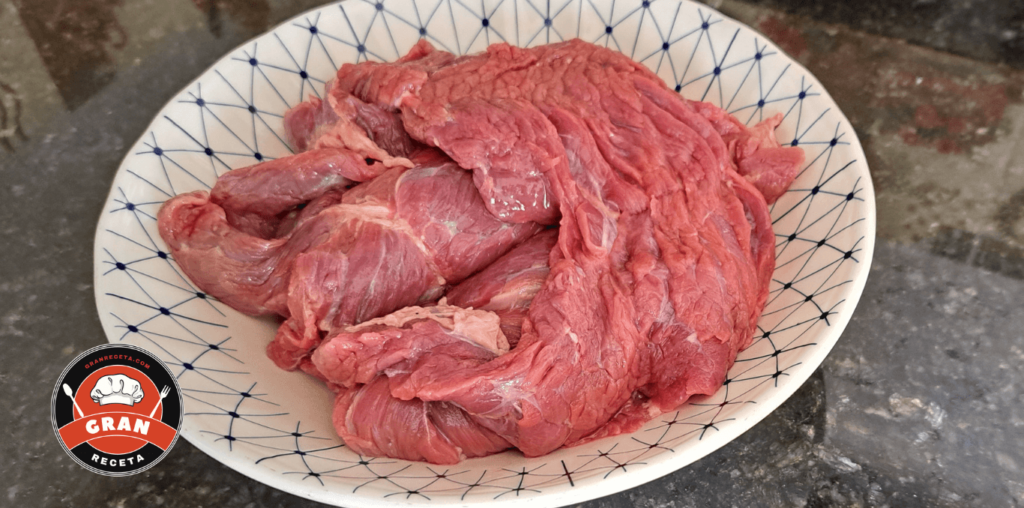
Colombian carne desmechada either falls into long strands or breaks into chunks, and after 2 hours in the pot that isn’t down to technique, it’s down to the cut. Flank, brisket and chuck are loaded with collagen and open on their own after 2 hours in the pot; a lean eye of round, which costs more, never will. A 2¼-lb flank steak leaves about a pound of shredded beef, enough for 10 stuffed arepas or 26 empanadas, and the rest of the recipe is an onion-and-tomato hogao plus a ladle of the cooking broth.
How do you make Colombian shredded beef? Simmer a whole 2¼-lb flank steak in water with onion, garlic and salt for 2 hours, or 45 minutes in a pressure cooker. Rest it 10 minutes and shred with two forks along the grain. Stew it 15 minutes with a sofrito of onion, tomato, garlic and cumin plus a ladle of the broth. About 165 minutes for 6 servings.
Which cut to buy
The rule runs opposite to what the meat case suggests: here the expensive cut is the wrong one. What makes beef shred is collagen, the connective tissue that holds the muscle together and that long, wet cooking turns into gelatin, releasing the fibers. The cuts that work hardest on the animal are the ones that have it: flank, brisket, chuck. Eye of round is lean and nearly collagen-free, so no amount of simmering will open it into strands; it breaks into short chunks and dries out along the way.
Among the three good ones there are differences. Flank gives the finest, longest strands, and it’s what I want for arepas and empanadas. Brisket gives thicker strands and needs another half hour; it’s the one that looks best served whole under hogao. Chuck sits in between and is what I use when the beef is one component of a bigger plate, like pabellón criollo.
Two hours, and why not 90 minutes
Collagen doesn’t start converting to gelatin in any hurry: it needs both time and moist heat. At 90 minutes the beef is cooked and perfectly edible, but the fibers are still bound and forking it gives you chunks. At 2 hours the same piece falls apart under almost no pressure. Past 3 hours it goes too far, into a mush where the strands vanish into the stew.
A pressure cooker gets there in about 45 minutes once it’s at pressure, with the same texture. The only real difference is the broth, which comes out less concentrated because nothing evaporates.
The two mistakes that dry it out
Cubing the beef before cooking. The most common one. In cubes the meat loses juice from every surface and the fibers get cut: short, dry shreds. The piece goes into the water whole and gets shredded afterward.
Throwing out the broth. The cooking liquid holds the gelatin from the collagen and much of the flavor. A ladle back into the stew is what keeps the beef juicy; without it, no amount of hogao saves it. What’s left over freezes and becomes soup.
A third, less obvious one: shredding it cold. Warm meat, about 10 minutes out of the pot, gives and opens; cold, it stiffens and the fibers break into pieces rather than pulling free.
How long it takes
Of the 2 hours 45 minutes, only about 25 are hands-on: starting the pot, shredding, and making the sofrito, which happens while the beef rests. Test with a fork rather than a clock: pierce and twist, and if the meat opens, it’s done.
What it goes into, and how much each takes
This is why I cook a whole flank even for three people. That pound of shredded beef becomes 10 stuffed arepas, or 26 empanadas, or the topping for eight patacones, and whatever isn’t used the same day goes into the freezer in flat 7-oz bags, which is one batch of arepas for two.
Storage and freezing
In the fridge, in a sealed container with some of its stew over it, shredded beef keeps 4 days, within the USDA window for cooked dishes, and it should be chilled within 2 hours of coming off the heat. From day two it’s better, as the stew works its way into the fibers.
Frozen it keeps 3 months. I freeze it in flat portions with a couple of spoonfuls of broth or stew in the bag so it doesn’t dry out, and thaw it overnight in the fridge. Reheat in a covered pan with a spoonful of broth for 5 minutes; a microwave with no liquid leaves it stringy and dry.
What to serve it with
Shredded beef is a filling before it’s a dish, and 1 lb of it covers three different meals. When the beef stays whole and arrives sliced instead of shredded, the Caribbean version is Colombian posta negra, braised 150 minutes in burnt sugar, and Colombian beef tongue is the cheapest tender cut of all. It goes inside Colombian cheese arepas and Colombian empanadas, on top of patacones with hogao with crumbled salty cheese, and it’s one of the four parts of Venezuelan pabellón criollo. As a plate of its own it comes with Colombian white rice and fried sweet plantain. In my house Sunday is shredded beef with rice and Monday is arepas with what’s left.
Questions people ask
What’s the best cut for shredded beef? Flank, for the long fine strands, and it’s one of the cheaper options. Brisket and chuck also work. Eye of round doesn’t: it’s lean and breaks into chunks.
How much does a pound of beef yield? About 10 to 11 oz cooked and shredded, a loss of roughly a third between water and fat. A 2¼-lb flank gives about a pound of shredded beef, enough for 10 stuffed arepas.
Can I use a pressure cooker? Yes, and it’s what I do on a weeknight: 45 minutes at pressure instead of 2 hours. Same texture, slightly thinner broth.
Can I use a slow cooker? Yes: 8 hours on low with the beef barely covered in water, onion, garlic and salt. The broth is milder, so season the stew a little more assertively.
Why does my beef come out dry? Usually three things at once: it was cubed before cooking, the broth was thrown out, and it was shredded cold. Whole piece, keep the broth, shred it warm.
Is carne desmechada the same as carne mechada? Same dish, two names: desmechada in Colombia, mechada in Venezuela. The seasonings differ, not the technique; the Venezuelan version uses ají dulce and the Colombian one cumin and annatto.
Nutrition
Per serving, one sixth of the recipe (about 4 oz of beef with its stew), from the USDA database for flank, vegetables and oil: about 235 kcal, 6 g carbohydrate, 11 g fat of which 4 g saturated, 28 g protein, 1 g fiber, 3 g sugar and 520 mg sodium.
It has one of the best protein-to-calorie ratios on this site: 28 g of protein in 235 kcal, because trimmed flank carries 21.7 g of protein against 6.3 g of fat per 100 g per USDA. A good share of the fat in the finished dish is the 2 tablespoons of oil in the sofrito.
In Venezuela we call it carne mechada and make it with ají dulce, which is the thing I miss most from that sofrito; in Colombia I learned the cumin and the annatto, which give it a different profile and an orange cast. What doesn’t change from one country to the other is the scene: somebody shredding at the kitchen table with two forks while the sofrito goes in the pan, and whoever walks past stealing a strand. Josnaisis.