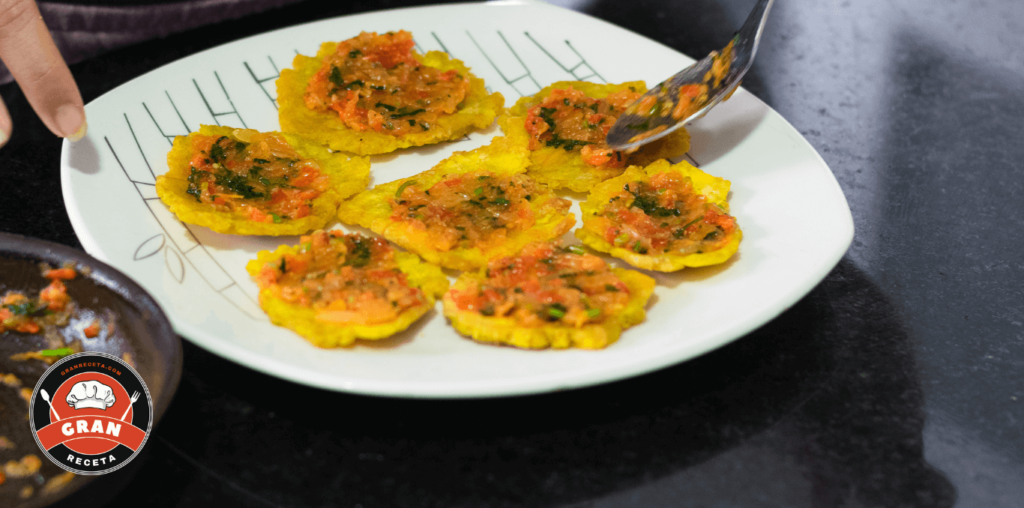

If you know tostones, you know half of this dish: 3 green plantains, 2 fries, 1 sauce. Patacones are the Colombian name for the same twice-fried green plantain, first at 330 °F to cook it through and then at 355 °F to crisp it, and in Colombia they come with hogao, a sauce of scallions and tomato cooked down for 20 minutes until it’s thick enough to sit on a patacón without softening it. Three plantains make 16 patacones for 4 people in 45 minutes, with the hogao cooking in a second pan while the plantains fry. Two things go wrong more than any other: a plantain that isn’t fully green, and a hogao pulled off the heat at 5 minutes.
How do you make patacones with hogao? Fry 1½-inch rounds of green plantain at 320-340 °F (160-170 °C) for 8-10 minutes, flatten them hot to ½ inch, and fry again at 355 °F (180 °C) for 3-4 minutes a side. Meanwhile sauté garlic and scallions, add diced tomato with cumin and cook 20 minutes until thick. About 45 minutes for 4 servings.
What hogao is, and why it’s not salsa
Hogao is the Colombian sofrito. Per the English Wikipedia, it’s traditionally made with only long green onions and tomatoes, and its cousin guiso adds round onion, garlic, cumin, salt and pepper. Most Colombian kitchens, mine included, add the garlic and a pinch of cumin anyway, but the base is those 2 ingredients and time.
Time is what separates hogao from a quick tomato sauce or a pico de gallo. A raw tomato is about 95 % water with 2.6 g of sugar per 100 g; the first 5 minutes on the heat only release that water, and between minutes 10 and 20 it evaporates, the sugar concentrates, the acidity drops and the sauce goes from bright red to a dark, thick orange. For patacones the hogao has to reach that dry point, because a wet hogao soaks the disc and undoes two fries in 5 minutes. For a pot of Colombian chicken rice it’s left looser, since there it’s a base and not a topping.
Why the plantain has to be green, in grams of sugar
Plantains and bananas are the same family, but a green plantain is a starch, not a fruit. Per USDA, 100 g of raw green plantain has 36.7 g of carbohydrate and just 2.3 g of sugar; the same plantain ripe has 17.5 g of sugar, almost 8 times more. That gap explains everything that happens in the skillet: starch cooks firm and neutral, sugar caramelizes from about 320 °F. A plantain with yellow patches darkens in the first fry before the center cooks, and when you press it, it mashes instead of flattening.
So buy plantains that are hard, green from tip to tip, and hard to peel, ideally the day you cook or the day before. In a US supermarket they’re usually next to the bananas and often sold half-ripe; a Latin or Asian market is the safer bet for truly green ones. A peeled plantain weighs about 9 oz (265 g) and gives 5 or 6 rounds of 1½ inches.
Two fries, two temperatures
The first fry cooks and the second crisps, which is why there are 2 temperatures instead of 1. At 320-340 °F the starch in the center cooks through in 8-10 minutes without the surface browning; the round comes out pale yellow and soft, and in that state it flattens without cracking. At 355 °F the flattened disc, with far more surface exposed, loses its outer moisture and crisps in 3-4 minutes a side. Do the first fry at 355 °F and the outside seals before the center cooks, leaving a patacón that’s hard outside and floury inside.
Without a thermometer, read the bubbles: in the first fry the oil bubbles gently around the plantain; in the second it fizzes hard from the first second. And stop at golden. Per the FDA, frying starchy foods to a golden yellow rather than brown lowers the acrylamide that forms in frying, and a dark patacón also tastes bitter.
How long it takes, 45 minutes on two burners
The 45 minutes assume two pans going at once. In one, the fries: two batches of eight rounds each time, roughly 18 minutes for the first fry and a little less for the second. In the other, the hogao, which starts once the first batch is in the oil and finishes before the second fry; its 25 minutes add nothing because they fit inside. The one step you can’t batch is the flattening: each round gets pressed hot as it comes out, and if you wait for all 16 the first ones will have cooled and will crack.
With a single pan, count on 70 minutes and make the hogao first. It keeps 4 days in the fridge and reheats in a few minutes, so the night before is a good time for it.
Step by step
The hogao, garlic first and patience last
Two tablespoons of oil over medium in a 9-inch (24 cm) pan. Crushed garlic for 1 minute, no browning. Chopped scallions for 5 minutes until soft and translucent. In goes the diced tomato with the cumin and annatto, down to medium-low, and 20 minutes with a stir every so often. Halfway through, the sauce is still bright red and watery; by the end it’s dark, thick and holds a furrow when you drag the spoon through it. Salt, pepper and cilantro when you turn it off; salt earlier and the tomato weeps more water and takes longer.
The double fry, cook then crisp
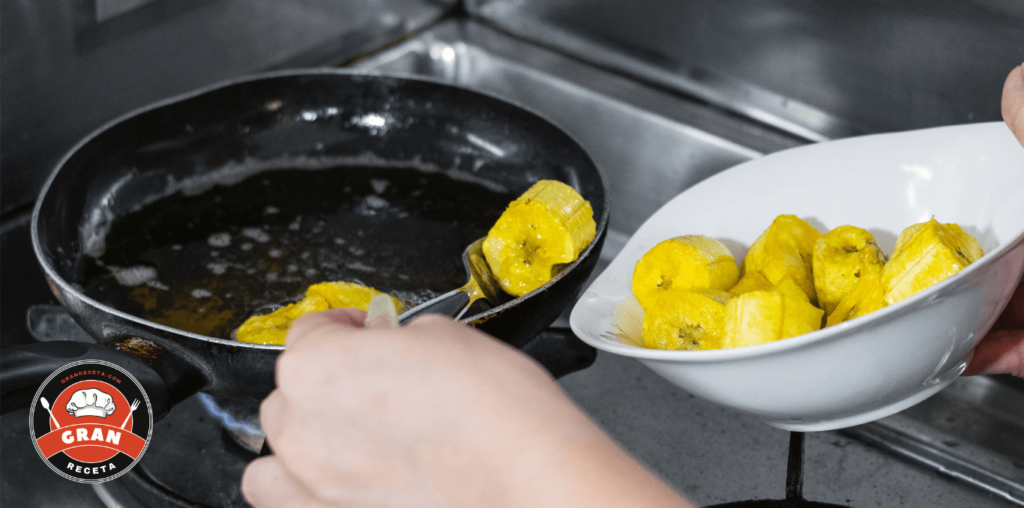
Score the plantain skin lengthwise and lift it off with your thumb. Rounds of 1½ inches; 3 plantains give 16. Oil at 320-340 °F in the 11-inch skillet, 8 rounds per batch, 8-10 minutes with a turn halfway, until yellow and yielding when pierced. Out onto paper towels.
Press each round as it comes out, between two sheets of plastic or parchment, with the flat bottom of a pot, to ½ inch. Hot, it flattens; cold, it cracks. If one cools on you, 30 seconds back in the oil and try again.
Raise the heat until the oil is around 355 °F and fry the flattened discs again in 2 batches, 3-4 minutes a side, until evenly golden. Onto paper, salt while hot so it sticks, and to the table within 10 minutes, which is about how long the crunch lasts.
Who this recipe is for
- If you’re in a hurry → make the hogao the day before (it keeps 4 days) and the dish is just the frying, a little over half an hour on one burner
- If it’s your first time → a kitchen thermometer settles the two temperatures; without one, trust the bubbling, not the color of the oil
- If ripe tomatoes are bad this week → a 14-oz (400 g) can of crushed tomatoes, already cooked, and the hogao drops to 10 minutes
- If you’re cooking for 10 → double the hogao and buy 7 plantains, about 4 lb; frying time doesn’t change, the number of batches does, so a second skillet helps
- If you want stuffed patacones → when flattening, leave the center thinner and the rim thick, like a little basket, and fill with shredded beef, salty white cheese or garlic shrimp
What goes wrong, and how to see it coming
Yellow patches on the plantain. The mistake with no fix: 17.5 g of sugar per 100 g against 2.3 in a green one. It caramelizes before the center cooks and the patacón comes out dark and limp. You can see it on the skin before you buy.
One temperature for both fries. At 355 °F from the start the outside seals and the middle stays raw; at 330 °F throughout the disc drinks oil and never crisps. Two fries because they’re two jobs.
Flattening cold. It breaks into pieces instead of pressing flat. Each round goes to the press as it leaves the oil, not once they’re all out.
A 5-minute hogao. Tastes of raw tomato, acidic, and leaks water onto the patacón. It needs 20 minutes over medium-low and has to end up thick.
A crowded skillet. With 12 rounds instead of 8 the oil temperature drops about 35 °F and the first fry turns into a simmer in oil. Two smaller batches beat one crowded batch that never colors.
Patacones, tostones, tajadas and chips
Same fruit, different fry, and the name changes by country. Patacón is the word in Colombia, Venezuela, Ecuador and Panama; tostón in Cuba, Puerto Rico and the Dominican Republic, where the flattened plantain is dipped in garlic salt water between the two fries. Colombia also makes the patacón pisao or big patacón, a whole plantain pressed into one plate-sized disc and used as the base for a loaded topping. Tajadas are the ripe plantain sliced long and fried once, the sweet side dish on the bandeja paisa; per USDA they carry 21.8 g of sugar per 100 g against 3.6 in a fried green plantain. Chips are the green plantain shaved thin and fried once, and at 531 kcal per 100 g they hold the most oil of the 3.
What to serve them with
On the Caribbean coast they’re the fixed side to whole fried fish and to Colombian fried calamari, and they share the fryer with the egg arepa at breakfast, and they stand in for bread next to a bowl of sancocho. With hogao and shredded beef on top, a patacón turns from starter into a plate; that’s the “patacón con todo” of Colombian restaurants abroad. As an appetizer, a pair of patacones per person with hogao and crumbled salty white cheese (queso fresco or feta as a stand-in) runs about 280 kcal and open a coastal table that ends with golden Colombian coconut rice under the fish.
Make ahead, storage and reheating
Patacones are a skillet-to-table food: the crunch lasts about 10 minutes and by the half-hour mark they’re leathery. Leftovers keep 3 days in the fridge and come back in a 400 °F (200 °C) oven or air fryer for 5 minutes, never in a microwave, which softens them. You can also freeze them after the first fry and the flattening, in a single layer, for up to 2 months, and fry them straight from frozen at 355 °F for 4-5 minutes a side; that’s how I keep a stash for weeknights.
The hogao keeps 4 days in a sealed container in the fridge, the USDA window for cooked dishes, and freezes well in portions for a quarter of a year. Reheat it a few minutes in a pan; if it thawed watery, an uncovered pan thickens it again.
Questions people ask
Why are my patacones soft and oily? Cold oil. Below about 300 °F the plantain absorbs oil instead of losing water. It happens when the skillet is crowded or when the second fry runs at the same temperature as the first. Fewer rounds per batch, and 355 °F for the second fry.
Can I make patacones in an air fryer? Yes, with a drier result. First cook 12 minutes at 350 °F (180 °C) with the rounds brushed with oil, flatten hot, second cook 8 minutes at 400 °F (200 °C). They crisp, but without the golden fried crust, and save about 150 kcal a serving.
Is a patacón the same as a tostón? Same technique, different name by country. Patacón in Colombia, Venezuela, Ecuador and Panama; tostón across the Spanish Caribbean.
Can I use a plantain that’s turning yellow? Not for patacones. That plantain is for tajadas, or for aborrajados once it’s fully ripe. Patacones need it green and hard, with a skin that fights you.
How much hogao per patacón? A heaping tablespoon, about 25 g. The 1 lb of tomatoes in this recipe yields about 400 g of hogao, right for 16 patacones. Leftovers go on Colombian cheese arepas the next morning, or beside a salt-crusted tenderloin if the coals are already lit. For the same fruit taken the other way, ripe and stuffed with cheese, see Colombian aborrajados. On a fritanga platter they sit next to the blood sausage and the ribs.
Nutrition
Per person, 4 patacones (150 g fried) with a quarter of the hogao, calculated from the USDA database for fried green plantain, tomato, scallions, garlic and oil: about 555 kcal, 81 g carbohydrate, 24 g fat of which 6 g saturated, 4 g protein, 7 g fiber, 9 g sugar and 500 mg sodium.
Per USDA, fried green plantain runs 309 kcal per 100 g, roughly double the raw figure; the difference is the oil it takes on across the two fries, about 12 g per 100. As an appetizer of 2 patacones a person the count halves, to about 280 kcal.
In Venezuela we make tostones with a sauce too, but our sofrito leans on ají dulce and comes out more aromatic; the Colombian one goes with cumin and tastes earthier, and it takes longer because you’re after that thick point that won’t soak the patacón. When I make patacones in Colombia I make the hogao the Colombian way, with cumin and its 20 minutes, and it’s the version that stayed in my house. Josnaisis.