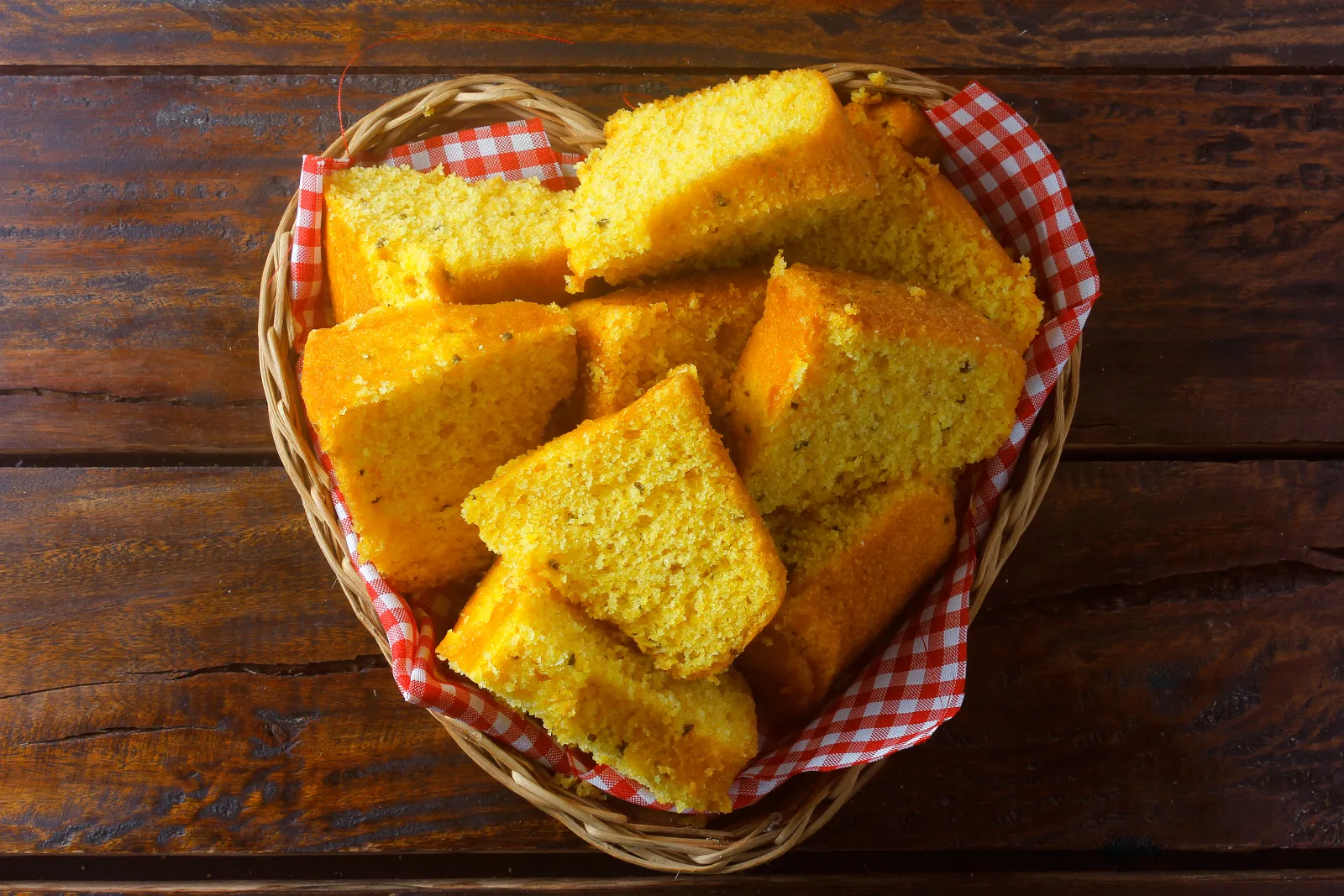

There is no cornmeal in a Venezuelan corn cake. Torta de jojoto (TOR-tah deh ho-HO-toh) is made from fresh sweet corn kernels, blitzed in a blender with milk and eggs, then baked with butter and sugar into something between a moist cake and a firm corn pudding. Jojoto is simply what Venezuelans call an ear of fresh, young corn; “torta” means cake. If you know American cornbread or Mexican pastel de elote, this sits closer to the second, but softer, and sliceable like a custard pie. This version gives you exact weights and cups, what to change for frozen or canned corn, how to tell the center is done, and why it sinks when it goes wrong.
What is torta de jojoto, and how is it made?
How do you make Venezuelan corn cake? Blend 600 g (4 cups) of sweet corn kernels with 1 cup of whole milk and 4 eggs into a thick, slightly grainy cream. Add 120 g of melted butter, ¾ cup of sugar and salt, whisk in ½ cup of flour by hand, and bake in a 9-inch pan at 350°F (175°C) for 55 to 65 minutes, until the center wobbles as one piece and reads 176°F (80°C). Cool 40 minutes before unmolding. 120 minutes for 10 servings.
It’s a home dessert and afternoon snack in Venezuela, the kind of cake that gets made when there are good ears of corn around. It uses the same blended fresh corn as cachapas, the griddled corn pancakes, but adds eggs and goes into the oven.
How it compares with cornbread, pastel de elote and cachapas
Four dishes, all built on corn, and only one of them is a bread.
Cornbread is a quick bread of dry cornmeal, crumbly and usually savory, eaten with chili or barbecue. Pastel de elote, the Mexican sweet corn cake, uses fresh kernels too, but often with condensed or evaporated milk and enough flour or leavening to make a proper cake crumb. Torta de jojoto has only 60 g (½ cup) of flour for 600 g of corn and no leavening at all: the eggs set it, so the texture is dense, moist and custardy. And Venezuelan cachapas skip both eggs and oven, cooking the corn batter thin on a griddle and folding it over fresh cheese. Colombia’s version of that idea, thicker and with more flour, is the Colombian sweet corn arepa.
Is it worth making?
Yes, especially in late summer when sweet corn is cheap and good. It’s 20 minutes of actual work: no creaming butter, no whipping egg whites, just a blender, a bowl and a pan. What comes out is a sweet, buttery, unmistakably corn-flavored slice with a slightly salty edge from the butter.
When it shines. An afternoon coffee, a potluck (it travels in the pan), a Latin dessert table, or any time you have 4 or 5 ears of corn left over. It keeps 3 to 4 days in the fridge and slices even better cold.
When to skip it. If you want a light, fluffy cake: this one is dense on purpose. If you have no oven. If you only have canned corn and expect fresh-corn flavor: it works, but it’s softer and flatter.
Honest difficulty, easy. The only judgment call is when to take it out of the oven, and an instant-read thermometer turns that into a number.
Ingredients, with US and UK swaps
The full list is in the recipe card. Per 9-inch (23 cm) cake: 600 g (4 cups) corn kernels, 4 large eggs, 120 g (8½ tbsp) salted butter, 1 cup (240 ml) whole milk, ¾ cup (150 g) sugar and ½ cup (60 g) flour.
Fresh, frozen or canned corn
All three work, but they aren’t interchangeable as-is. USDA data explains why: raw yellow sweet corn has 6.26 g of sugar per 100 g, frozen kernels only 2.5 g, and drained canned corn 4.44 g with 205 mg of sodium from the brine and more water in the kernel.
| Corn | Sugar per 100 g (USDA) | Milk | Sugar | Salt | What to do |
|---|---|---|---|---|---|
| Fresh yellow, 4-5 ears | 6.26 g | 240 ml (1 cup) | 150 g (¾ cup) | 2 g (⅓ tsp) | cut and scrape the cobs |
| Frozen kernels, 1.3 lb | 2.5 g | 240 ml (1 cup) | 175 g (¾ cup + 2 tbsp) | 2 g (⅓ tsp) | thaw, drain 10 min, pat dry |
| Canned, drained | 4.44 g | 180 ml (¾ cup) | 165 g (¾ cup + 1 tbsp) | 1 g (a pinch) | rinse, drain, pat dry |
| Fresh white corn | 3.22 g | 240 ml (1 cup) | 170 g (¾ cup + 1½ tbsp) | 2 g (⅓ tsp) | as fresh yellow |
Don’t use cream-style canned corn as the base. It’s thickened with starch and already sweetened, and the cake won’t set the same way. In the UK, frozen sweetcorn from any supermarket is the most reliable choice outside the few weeks fresh cobs are around; tinned sweetcorn works with the canned adjustments.
The dairy, the flour and the cheese
- Salted butter is the norm here, and that hint of salt against the sweet corn is the point. With unsalted butter, double the salt to 4 g (⅔ tsp).
- Whole milk sets better than skim or low-fat. Half-and-half works and makes it richer; don’t use heavy cream for all of it, or it turns greasy.
- All-purpose flour (plain flour in the UK) only gives the slice a clean cut. Cornstarch (cornflour in the UK) makes it gluten-free and a little softer.
- For the cheese version, Venezuelans use a hard, salty white cheese called queso llanero or queso duro. In the US, cotija or a firm queso fresco is the closest; in the UK, feta, which is saltier, so use 100 g (3.5 oz) instead of 150 g.
Equipment and pan sizes
A blender, a mixing bowl, a whisk and a 9-inch (23 cm) round pan, ideally springform. An 8-inch (20 cm) square pan has almost the same area and bakes in the same time. In an 8-inch round, the batter is deeper and needs 15-20 minutes more. In glass (Pyrex), I lower the oven to 325°F (165°C), because glass runs hotter at the edges. No blender? Grate the whole ears on the coarse side of a box grater; it takes about 15 minutes longer and gives a more rustic cake.
Step by step, and the part that matters
The card has the six steps. Two of them decide the result.
The blend. A medium blend, 60 to 90 seconds, leaves rice-sized flecks of kernel. Blitz it 2 minutes until perfectly smooth and you get a silky corn pudding; pulse it only and the whole kernels stay sealed, give no starch to the batter, and the slices weep when you cut them. If you like finding whole kernels, blend everything medium and stir 100 g (⅔ cup) of whole kernels, taken from the 600 g, into the bowl at the end.
The flour goes in by hand. A blender or mixer whips air into the eggs, and air is what makes a corn cake rise like a soufflé and collapse on the cooling rack.
How to tell when it’s done
The toothpick lies with this cake. Corn leaves it damp and speckled even when the center is set, so if you wait for a clean toothpick you’ll overbake it. Look for moist crumbs, no wet batter, and a center that wobbles as one block when you nudge the pan, not in ripples.
The thermometer is the honest test: 176°F (80°C) in the center. USDA’s Food Safety and Inspection Service puts the minimum for egg dishes at 160°F (71°C), so never stop below that. The 40-minute rest in the pan does the rest of the setting.
Who this recipe is for
- First time baking it → buy a thermometer, or use the wobble test, and don’t open the door before minute 40.
- Only frozen corn in the house → it’s what I use most of the year; just add 25 g (2 tbsp) of sugar.
- Gluten-free guests → cornstarch instead of flour, nothing else changes.
- Cooking with kids → they can tap the pan on the counter and watch the bubbles rise; the blender and oven stay with you.
- A crowd of 20 → see the make-ahead section below.
Why it sinks, and why the middle stays raw
It sank.
- Baking powder. It isn’t in this recipe on purpose. It makes the cake puff, then fall.
- An electric mixer. Same effect as baking powder: beaten-in air.
- The oven door opened before minute 40. The liquid center drops with the rush of cool air.
- Underbaked. An unset center collapses as it rests. Check for 176°F (80°C).
- A 3-5 mm (⅛-inch) dip as it cools is normal. It’s an egg-set cake and settles like a flan.
It’s raw in the middle.
- Pan too small or too deep. Batter deeper than 1½ inches (4 cm) needs 15-20 minutes more.
- Oven too hot. At 400°F (200°C) the edges set and brown long before the center reaches 176°F (80°C).
- Frozen or canned corn not drained. Extra water means a longer bake and a soggy middle.
- No preheat. Those 15 minutes count.
- To rescue it, cover with foil, drop to 325°F (160°C) and give it 10-15 minutes more, until the center reads 176°F (80°C).
Allergens. Egg, milk and, with flour, gluten. Not spicy, and children usually love it cold from the fridge.
Make ahead, timeline and baking for a crowd
Two hours on the clock, 20 minutes of work. Cut the corn while the oven heats; everything after the pan goes in is waiting.
The day before. Cut the kernels and keep them covered in the fridge, or bake the whole cake: chilled overnight, it slices cleaner and the corn flavor settles in. I don’t leave the raw batter sitting for hours, though; the corn sinks and you get a layer of kernels under a layer of flan.
For 12. Make 1½ times the recipe (900 g / 6 cups corn, 6 eggs) in a 9x13-inch (22x33 cm) pan, 60-70 minutes at 350°F (175°C).
For 20. Double it (1.2 kg / 8 cups corn, 8 eggs, 240 g butter) in the same 9x13-inch pan, about 2 inches (5 cm) deep: 70-80 minutes, foil on top from minute 50, cut in 20 squares. Blend in batches of no more than 600 g (4 cups) of corn each.
Versions worth making
- With cheese → 150 g (5 oz) grated cotija or firm queso fresco stirred into the batter, salt left out. About 308 kcal a slice with a fresh white cheese.
- Gluten-free → 50 g (⅓ cup plus 1 tbsp) cornstarch instead of the flour. Softer, more pudding-like, same bake time.
- Lighter → 80 g (5½ tbsp) butter and 120 g (½ cup plus 2 tbsp) sugar. Less rich and a little drier, about 220 kcal a slice.
- Condensed milk → some cooks swap the milk and sugar for a 14-oz (397 g) can of sweetened condensed milk. It comes out sweeter, denser and darker, closer to pastel de elote. I prefer sugar, which lets the corn taste like corn.
If egg-set desserts are your thing, the Venezuelan quesillo uses the same wobble test, and the Mexican esquites are where any leftover ears of corn can go.
What it costs in the US
At the US city average prices the Bureau of Labor Statistics published for August 2026, everything except the corn costs $2.50 for the whole cake, about 25 cents a slice. Butter is the biggest line, $1.06 for 120 g (4.2 oz) at $4.021 per pound; four large eggs at $2.272 a dozen add $0.76.
Yield. The batter weighs about 1.38 kg (3 lb) and bakes down to roughly 1.25 kg (2.75 lb): 10 slices of about 125 g (4.4 oz), or 12 thinner ones on a dessert table.
What drives the price. The corn, which BLS doesn’t track, so add whatever 4-5 ears or a 1.3-lb bag of frozen kernels cost where you shop. In season, fresh ears are often the cheapest thing in the recipe; out of season, frozen is.
Serving, storing and reheating
Taste and texture. Sweet corn up front, a golden, slightly firmer edge, a dense, moist middle, and a little salt from the butter. With cheese, sweet and salty in the same bite.
How to serve it. In slices, warm or cold, with coffee. It’s a dessert in Venezuela, not a side dish for chili, so think of it next to a tres leches cake on a party table, or after a Venezuelan black cake at Christmas when you want something lighter.
Fridge. USDA FSIS guidance for leftovers: no more than 2 hours at room temperature once cooled, then 3 to 4 days in the fridge at 40°F (4°C) or below, covered. With eggs and milk in it, don’t leave it out overnight.
Freezer. Wrap slices in plastic, then a freezer bag. At 0°F (−18°C) it stays safe indefinitely by FSIS guidance; for texture, I eat it within 2 months, after which it weeps a little on thawing. Thaw in the fridge overnight.
Reheating. Cold from the fridge is how I like it. For warm, 30-40 seconds per slice in the microwave at medium power, or the whole cake under foil for 10-15 minutes at 325°F (160°C). If you’re reheating it as a hot leftover, FSIS says 165°F (74°C) in the center.
Frequently asked questions
Is Venezuelan corn cake the same as cornbread? No. Cornbread is made from dry cornmeal and is a bread. Torta de jojoto is made from blended fresh corn kernels set with eggs, closer to a sliceable corn pudding.
Can I use frozen corn? Yes. Thaw, drain 10 minutes and pat dry, then add 25 g (2 tbsp) more sugar, because frozen kernels have less than half the sugar of fresh, according to USDA data.
Can I use canned corn? Yes, rinsed and dried, with ¾ cup (180 ml) milk, a pinch of salt and 1 tbsp extra sugar. Avoid cream-style corn.
What temperature and how long do I bake it? 350°F (175°C) for 55 to 65 minutes in a 9-inch (23 cm) pan, until the center reads 176°F (80°C). Then 40 minutes of rest in the pan.
Why did my corn cake sink in the middle? Baking powder, an electric mixer, opening the oven before minute 40, or underbaking. A dip of a few millimeters as it cools is normal.
Is it gluten-free? Only if you replace the 60 g of flour with 50 g of cornstarch. Nothing else in it contains gluten.
What’s the difference between torta de jojoto and pastel de elote? Both use fresh corn. Pastel de elote is usually more cake-like, often with condensed milk and leavening; torta de jojoto has less flour, no leavening and a custardy, pudding-like set.
How long does it keep? 3 to 4 days in the fridge at 40°F (4°C) or below, per USDA FSIS. Frozen in slices, about 2 months for best texture.
Nutrition
Per slice (about 125 g / 4.4 oz, one tenth of the cake), calculated ingredient by ingredient from the USDA SR Legacy database with the quantities above (raw yellow sweet corn, whole egg, salted butter, whole milk, sugar, all-purpose flour and salt; vanilla not counted):
- Calories: 261 kcal
- Protein: 6 g
- Carbohydrates: 32 g
- Fat: 13 g, of which 7 g saturated
- Fiber: 1 g
- Sugars: 20 g
- Sodium: 203 mg
About 4 g of the sugar comes from the corn itself; the rest is added. The butter accounts for almost half the calories, about 860 kcal across the whole cake. The cheese version comes to about 308 kcal, 9 g protein and 17 g fat per slice.
The first time I baked this outside Venezuela I used a bag of frozen corn and my usual amount of sugar, and it tasted like a polite omelet. That’s when I went looking at the numbers and found the frozen kernels had less than half the sugar of fresh. Now I weigh the corn, adjust the sugar, and pull the cake when the middle shivers in one piece. Josnaisis.