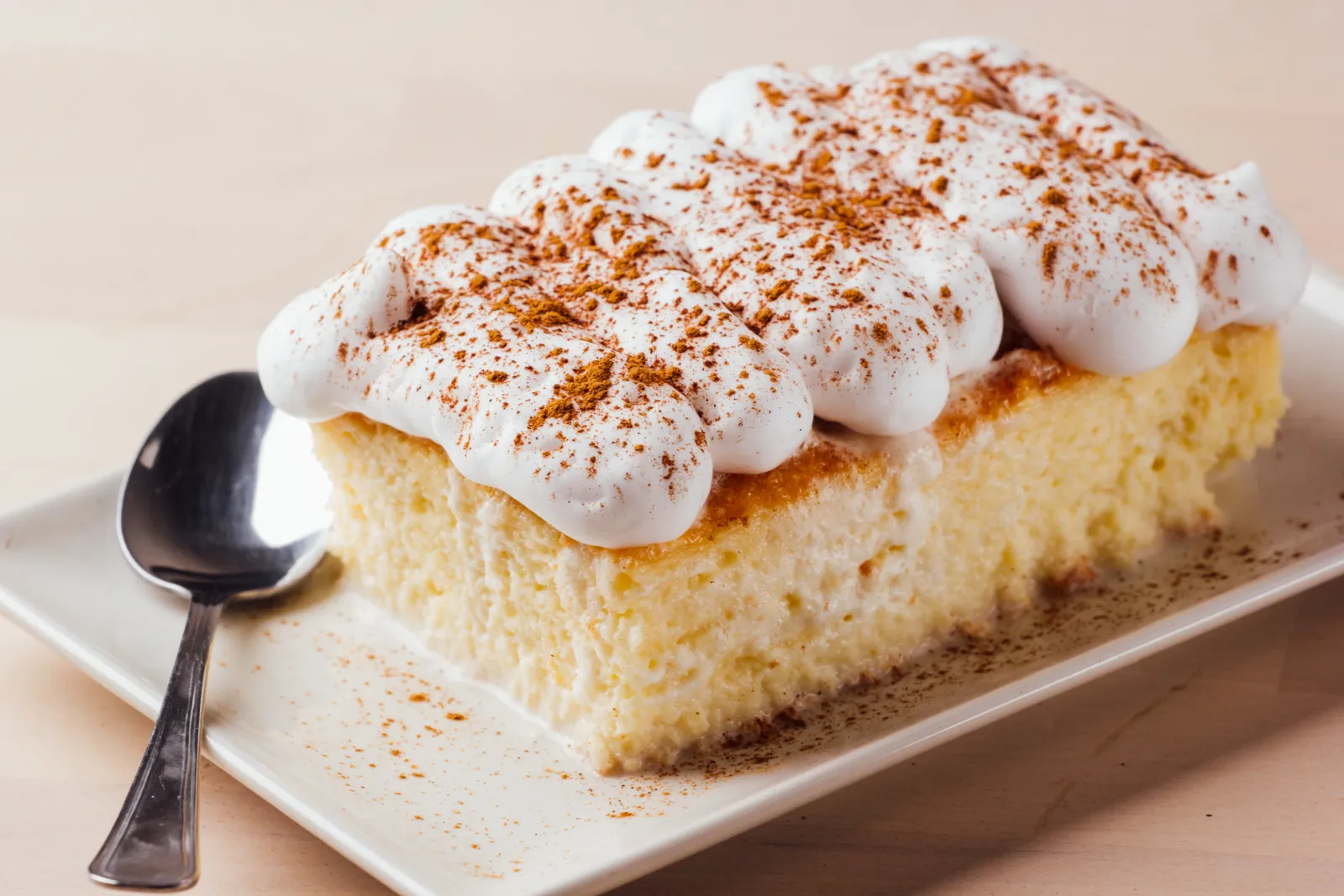

Tres leches (pronounced tres LEH-chess) means “three milks”, and the name is the whole recipe: a light sponge cake soaked with sweetened condensed milk, evaporated milk and cream until it holds nearly its own weight in liquid, then chilled and topped with meringue or whipped cream. It’s eaten from Mexico through Central America to Venezuela and Colombia, where I live, and it’s the cake I make when I’m feeding fifteen people and want dessert finished the day before. What follows is how to build a sponge that soaks without collapsing, how much milk your pan really needs, and how to time it so you’re not cutting into a puddle.
Is tres leches cake worth making at home?
How do you make tres leches cake? Bake a fat-free sponge leavened with stiffly whipped egg whites at 350°F (175°C) for 25 to 30 minutes in a 9 x 13 in pan. While it’s barely warm, poke it all over and pour on a soak of one 14 oz can of condensed milk, one 12 oz can of evaporated milk and 1 cup of heavy cream in three rounds. Chill at least 4 hours, then top with Italian meringue and cinnamon or whipped cream. 345 minutes for 15 servings.
For a crowd, yes. One pan gives 15 generous squares, the work fits in about an hour, and the cake gets better, not worse, after a night in the fridge. That makes it one of the few party desserts that’s finished before your guests arrive.
Good fit. Birthdays, potlucks, a buffet table for 12 to 20, anyone who likes a cold, very moist dessert.
Poor fit. A same-day craving: it needs 4 hours of chilling at the very least. Anyone who wants a light, barely sweet cake, since each square carries about 45 g of sugar. And if you have no electric mixer, be ready for 10 minutes of hand-whisking egg whites.
Real time. 345 minutes start to finish, roughly 60 of them hands-on. The rest is oven, cooling and fridge.
Difficulty, medium. The egg whites are the only real skill. The Italian meringue needs a thermometer; whipped cream needs nothing.
Why tres leches needs a sponge, not a butter cake
This is the decision that makes or breaks the cake. The sponge here has no butter and no oil; its whole structure comes from egg whites whipped full of air, which the oven sets into an open, springy crumb. When the milk goes in, it fills those air pockets, and the crumb holds because it’s built from egg protein.
A butter cake (pound cake, or the yellow cake from a box mix) has a tight crumb coated in fat. The soak can’t get in, so it drowns the top layer and collects at the bottom of the pan. Butter also sets firm in the fridge, so the cold cake turns dense. I’ll use a store-bought sponge or angel food cake in a pinch, but never a boxed butter cake.
The numbers, for a 9 x 13 in pan. The soak weighs about 1,013 g (2.2 lb): 397 g condensed, 378 g evaporated and 238 g cream, per USDA FoodData Central weights. The raw sponge batter weighs about 780 g (1.7 lb). In 4 hours the cake takes up nearly all of it. The thin layer of milk left at the bottom, about 5 mm (¼ in), is supposed to be there; spoon it over each slice.
Ingredients, with US and UK supermarket swaps
Everything is in the recipe card above. These are the four ingredients readers ask about.
| Ingredient | In the US | In the UK | If you can’t find it |
|---|---|---|---|
| Sweetened condensed milk | 14 oz can, baking aisle | 397 g tin, baking aisle | No real swap; it’s the sweetener and the caramel note |
| Evaporated milk | 12 fl oz can, baking aisle | tins in the baking or tinned-milk aisle | Simmer 720 ml (3 cups) whole milk down to 360 ml (1½ cups), about 30 min, then cool |
| Heavy cream | heavy cream or heavy whipping cream, 36 % fat | whipping cream; double cream works but is richer and heavier | Whole milk, for a lighter, wetter cake |
| Cake flour | not needed; all-purpose is fine | plain flour, not self-raising | Self-raising flour works if you drop the baking powder |
Equipment. A stand or hand mixer, a 9 x 13 in (23 x 33 cm) pan in glass or metal, and a candy thermometer if you’re making Italian meringue. No thermometer? The syrup is ready when a drop in a glass of cold water forms a soft ball you can squash between your fingers.
How much soak you need for your pan
Scale everything by the area of the pan, roughly 1.2 ml of soak per square centimeter (about ¼ cup per 8 square inches). The sponge scales by the same factor: 3 eggs for an 8 in square, 6 for a 9 x 13, 10 for an 11 x 15.
Cooking for 30. Two 9 x 13 in pans, baked one after the other or side by side if your oven fits them, with the oven time unchanged. That’s two cans of each milk and 2 cups of cream.
A make-ahead plan, and when to pour the milk
Bake and soak the cake the afternoon before, let it chill overnight, and on the day you only make the topping.
Warm cake or cold cake?
Pour onto a cake that is barely warm or fully cool, with the milks cold or at room temperature. What fails is hot on hot: a cake fresh from the oven is fragile, and warm milk breaks the crumb down. I pour 30 minutes after the cake comes out, when it’s just warm to the touch, using milk straight from the fridge. It soaks quickly and stays in one piece.
Poke right to the bottom every 1 to 2 cm (½ to ¾ in) and pour in three rounds, 10 minutes apart. Give the edges and corners extra on the second round; that’s where the sponge is densest.
How long to chill
At least 4 hours, ideally 8 to 12. At 2 hours the center is still dry and milk is still running loose underneath. By 4 hours it’s soaked through. The next day it slices cleanly.
Why tres leches turns soggy, dry or dense
- Soggy with a pool of milk → the sponge had no air. Soft-whipped whites, beating instead of folding, or a butter cake. It also happens when a 9 x 13 soak goes into a smaller pan; check the chart above.
- Falls apart when you slice it → hot cake met hot milk, or it was cut before 4 hours.
- Dry in the middle → the fork didn’t reach the bottom, the soak was short for the pan size, or it didn’t chill long enough.
- Tough top crust → overbaked. Start checking at 25 minutes.
- Sunken middle → the oven door was opened in the first 20 minutes, or it came out underbaked.
- Weeping meringue → the syrup never reached 245°F (118°C), or the topping went on a cake that was still warm.
Whipped cream or Italian meringue, and is the meringue safe?
Whipped cream is the usual topping in Mexico and the US: 480 ml (2 cups) of cold heavy cream with 40 g (⅓ cup) powdered sugar, whipped to soft peaks. No eggs, no thermometer. It starts to weep after a day, so I spread it the morning I serve.
Italian meringue is the Venezuelan way, with cinnamon on top, and the one in my recipe card. Hot syrup at 245-250°F (118-121°C) is poured onto whipped whites. Clemson Cooperative Extension, drawing on USDA guidance, lists seven-minute frosting, made the same way with hot syrup and beaten whites, among the egg preparations considered safe, and gives 160°F (71°C) as the point at which egg mixtures are safe.
For pregnant, elderly or very young guests I use pasteurized egg whites from a carton, which the FDA recommends for recipes with raw or lightly cooked egg, or I make Swiss meringue: whites and sugar whisked over simmering water to 160°F (71°C), then whipped until cool.
Variations worth making
- Chocolate → swap 30 g (¼ cup) of the flour for unsweetened cocoa and melt 60 g (2 oz) dark chocolate into the cream. The crumb is denser and drinks less, so I hold back 50 ml (3 tbsp) of evaporated milk.
- Coconut → coconut milk in place of the evaporated milk, toasted shredded coconut over whipped cream.
- Four milks → a thin layer of dulce de leche (cajeta in Mexico, arequipe in Colombia) over the soaked cake before the topping.
- Boozy → 60 ml (¼ cup) of dark rum in the soak, the same pairing of milks and rum as Venezuelan ponche crema. Not for the kids’ table.
- Lighter → whole milk instead of the cream saves about 44 calories and 5 g of fat per square.
- No oven → a bakery sponge or angel food cake, soak scaled to its size. For a dessert with no cake at all, the no-bake passion fruit dessert sets with condensed milk and cream.
What tres leches costs to make
For the four ingredients the US Bureau of Labor Statistics tracks, August 2026 national averages: 10 eggs $1.89, 400 g (14 oz) sugar $0.90, 190 g flour $0.23 and 80 ml whole milk $0.09, so $3.11 in all. Canned condensed and evaporated milk and heavy cream aren’t in that series, so I won’t put a total on them. By weight they’re almost half the cake, and in a Spanish supermarket (Mercadona, October 2026) they’re 57 % of the cost, so expect them to be the bulk of your bill too.
Yield. 15 squares about 6.5 x 7.5 cm (2½ x 3 in) and 140 g (5 oz) each, or 24 smaller pieces for a buffet. Four egg yolks are left over from the meringue; I stir them into the custard for a Colombian flan later that week.
Serving and storage
How it tastes. Cold, very moist and sweet, with the soft caramel note of the canned milks. The crumb is still there when you bite; it doesn’t dissolve on the spoon. Cinnamon on the meringue cuts the sweetness.
Serving. Straight from the fridge, lifted out with a spatula, with a spoonful of the milk from the pan. A cup of Mexican café de olla or plain black coffee balances it. On a dessert table it sits well next to a Venezuelan quesillo or a pineapple upside-down cake for anyone who prefers a drier slice.
Fridge. Covered, at 40°F (4°C) or below. The foodsafety.gov cold storage chart has no row for tres leches; the closest, custard and cream pies, gives 3 to 4 days. Out of the fridge, 2 hours at most, the USDA FSIS rule for perishables.
Freezer. The same chart says not to freeze custard pies, and I don’t freeze a soaked tres leches: the crumb turns watery when it thaws. The unsoaked sponge freezes well wrapped tight; thaw it in the fridge and soak it as if it were fresh.
Tres leches cake FAQ
What are the three milks in tres leches? Sweetened condensed milk, evaporated milk and heavy cream (whipping cream in the UK). Some recipes use whole milk instead of cream for a lighter cake.
Do you pour the milk on a warm or cold cake? Barely warm or cool, with cold or room-temperature milk. Never hot cake with hot milk. I pour about 30 minutes after it leaves the oven.
How long should tres leches sit before serving? At least 4 hours in the fridge, and overnight is better. At 2 hours the center is still dry.
Why is my tres leches soggy? The sponge had too little air, or it was a butter cake, or the soak was meant for a bigger pan. A 9 x 13 in pan takes about 900 ml (3¾ cups); an 8 in square takes half that.
How long does tres leches last in the fridge? 3 to 4 days covered at 40°F (4°C), going by the foodsafety.gov figure for custard and cream pies. No more than 2 hours at room temperature.
Can you freeze tres leches cake? Not once it’s soaked; the texture suffers. Freeze the plain sponge and soak it after thawing.
Can I use a boxed cake mix? You can, but a boxed yellow cake is an oil or butter cake and absorbs less. If you do, use about two-thirds of the soak and expect a denser, wetter bottom.
Is tres leches Mexican? It’s eaten all over Latin America, and both Mexico and Nicaragua are named as its birthplace. I haven’t found a source that settles it.
Nutrition per serving
Per square (1 of 15, with Italian meringue), calculated ingredient by ingredient from USDA FoodData Central (SR Legacy) using this recipe’s amounts and counting the full soak:
- Calories: 359 kcal
- Protein: 9 g
- Carbohydrates: 54 g
- Fat: 12 g, of which 7 g saturated
- Sugars: 45 g
- Sodium: 191 mg
With whipped cream instead of meringue, a square comes to about 420 calories. The 400 g (2 cups) of sugar in the sponge and meringue supply close to a third of the calories.
In my house in Venezuela, tres leches always wore meringue and a dusting of cinnamon, and that’s still the one I make, now baked the night before in my kitchen in Colombia. Every soggy cake I’ve served came from cutting it too soon. Give it the night. Josnaisis.