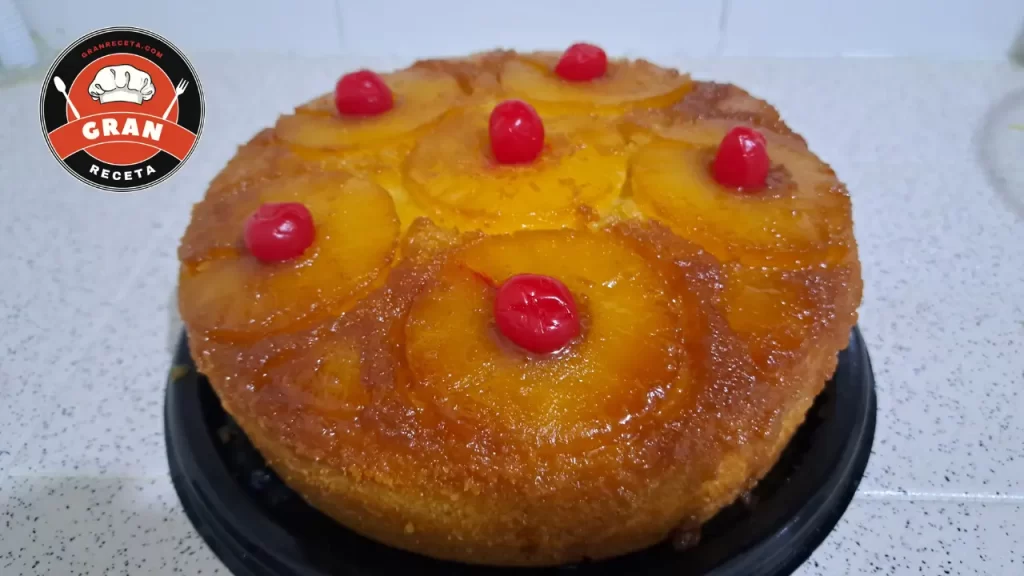
Most upside-down cakes line the pan with 4 tbsp of melted butter and brown sugar. This one cooks a real caramel instead, sugar alone taken to dark amber, and the difference is a thin glassy layer with a trace of bitterness under a cake that otherwise carries 39 g of sugar a slice. It also costs you a deadline: the caramel sets as it cools, so the cake has to be turned out within 10 minutes of leaving the oven. Ten servings, 80 minutes.
How do you make a caramel pineapple upside-down cake? Cook sugar alone in the pan to dark amber, lay dried pineapple slices on it and cover with a batter of creamed butter, sugar, eggs, flour and pineapple juice. Bake 45 minutes at 356 °F and turn it out 5 to 10 minutes after it comes out. 80 minutes for 10 servings.
The caramel, made dry
The sugar goes into the pan on its own, over medium heat, with no water at all. It melts from the edges inward, and you swirl the pan rather than stirring, because dragging a spoon through it is what makes sugar crystallize into gritty lumps.
The target is dark amber, around 356 °F. At that point the sugar has developed the bitter edge that balances the fruit and the cake; at 375 °F it smokes and turns harsh, and that harshness sits under every single slice. Wash the pan and start over if it goes; it costs 10 minutes against a whole cake.
Caramel or butter and brown sugar
The familiar American version melts butter with brown sugar in the pan, which is easier, more forgiving and sweeter. There is nothing wrong with it, and if you have only ever had that one, the difference here will be obvious on first bite: less sweetness, more depth, and a thin glassy layer instead of a sticky one.
What the caramel costs you is margin. Butter and brown sugar cannot really burn and do not set hard, so the cake can sit in the pan a while. A dry caramel burns in seconds past 375 °F and sets like glass as it cools, which brings us to the deadline.
The 10-minute window
This is the part that decides whether the cake comes out whole. Fresh from the oven the caramel underneath is still liquid and the cake releases on its own. As it cools, that caramel crystallizes and grips the pan with surprising strength.
Five minutes of rest is enough for the crumb to settle so it does not tear as you invert it, and ten is the outside limit. If you get distracted, do not write it off: set the pan over a burner for 30 seconds, the caramel re-melts, and the cake drops out.
Fresh or canned pineapple
Both work and they give different cakes. According to the USDA, canned pineapple in juice carries 14.26 g of sugar per 100 g against 9.85 g in fresh fruit, so the canned version bakes distinctly sweeter and the fresh one tastes brighter and more acidic.
The practical difference is water. Fresh pineapple sheds a lot of liquid and, laid down wet, it thins the caramel and leaves a watery base; a minute with paper towels solves it. Canned comes drained and in even ⅜-inch rings, which is the right thickness, since thicker slices sink into the batter.
One note on bromelain, the enzyme in fresh pineapple that breaks down protein: it matters if you are planning a gelatin or a cream layer, where it will stop things setting, but not here. Baking denatures it well before it can do anything to the crumb. It is the reason a no-bake passion fruit dessert can take its fruit raw and a pineapple one cannot.
Creaming the butter
It takes 8 minutes of beating soft butter with sugar, until the mixture turns from yellow to nearly white and gains volume. What happens is mechanical: sugar crystals cut air pockets into the fat, and those pockets are what the baking powder expands in the oven.
So the butter has to be soft, around 65 °F, but not melted. Cold butter will not take in air and melted butter will not hold it, and either way the crumb bakes dense no matter how long the mixer runs.
Five failures, four of them fixable
Sticking, a raw center, sunken fruit and a watery base all have a prevention and a rescue: warm the pan, tent and bake longer, slice thinner, dry the fruit.
The exception is the caramel. Once sugar starts to smoke the bitterness is already formed and nothing covers it, so the only honest move is to wash the pan and begin again.
Where the 80 minutes go
Thirty-five minutes of preparation and 45 of baking. The caramel takes about ten minutes, arranging the fruit as long again and the batter a quarter of an hour, so there is no idle time and it pays to have everything weighed before the heat goes on.
Cut it cold, even though you turn it out hot. Once inverted onto the plate, give it at least 1 hour before the first slice: warm, the crumb is still setting and the knife compresses it.
Who this recipe is for
- If your pan is 8 inches rather than 9 → it works with 55 minutes of baking, since the batter sits deeper
- If the cake stuck → warm the base of the pan for 30 seconds and invert again
- If your pineapple is very acidic → 2 extra tablespoons of sugar in the caramel, not in the batter
- If you want the easier route → melt 4 tbsp of butter with ¾ cup of brown sugar in the pan instead of the dry caramel
- If there are leftovers → they keep 3 days covered at room temperature, and the caramel loosens over time
What goes wrong
Stirring the caramel with a spoon. The sugar crystallizes and leaves hard lumps in the base.
Turning it out cold. Set caramel glues the cake to the pan and it comes out in pieces.
Wet fresh pineapple. The liquid thins the caramel and the base turns watery.
Melted butter in the creaming. It holds no air and the crumb bakes dense.
An oven above 375 °F. The top browns before the center sets.
Variations
With cherries. A maraschino cherry in the center of each ring, the classic 1950s presentation.
With coconut. ½ cup of shredded coconut in the batter, which suits the acidity of the fruit.
With panela. The caramel made from 5 oz of grated panela instead of sugar, darker with a molasses edge.
With rum. Two tablespoons in the batter, most noticeable the next day.
What to serve it with
On its own or with a scoop of vanilla ice cream, in slices of about 4 oz. It is a sweet dessert, so coffee or unsweetened Colombian aguapanela suits it better than another sweet drink.
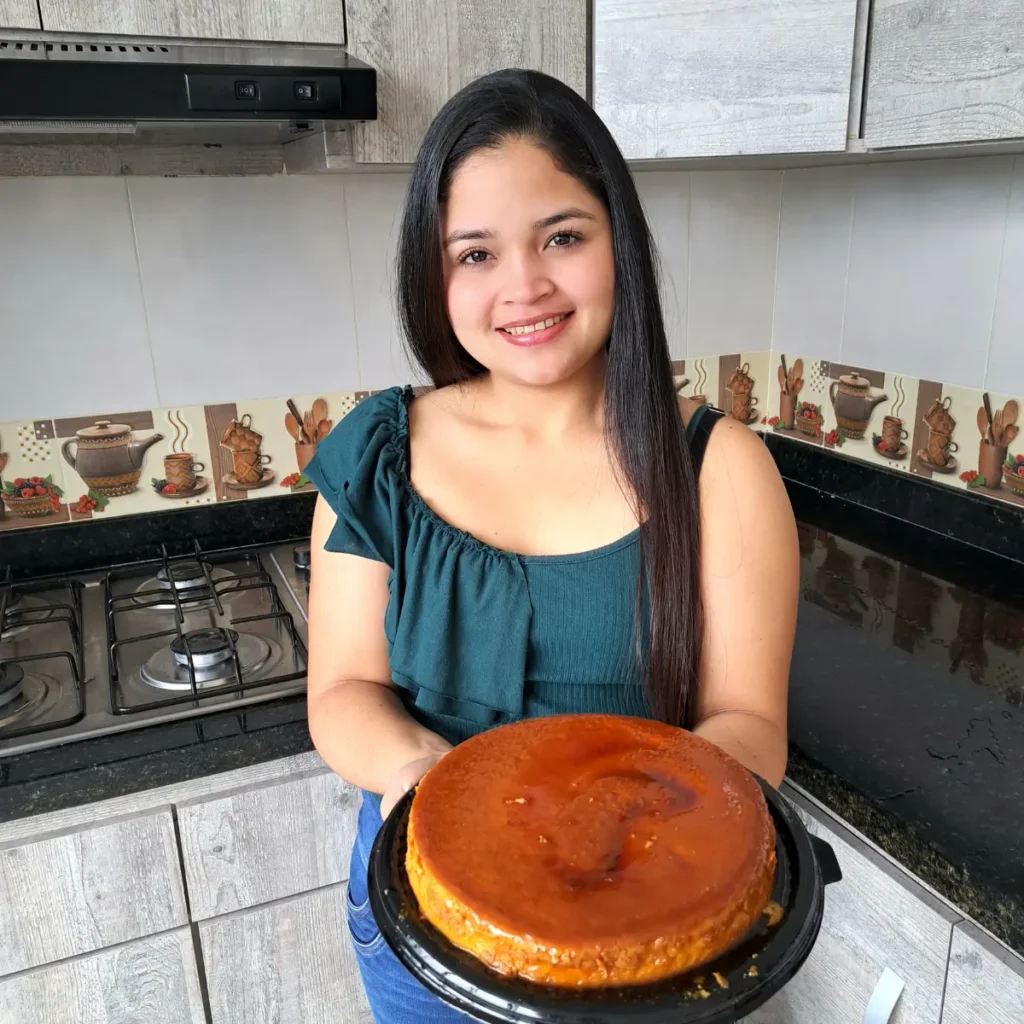
On a dessert table it sits well beside a Colombian flan, which brings the creamy part, a guava roll for the fruit end, or Colombian dulce de leche for anyone who wants more sweetness. After a heavy lunch such as a Colombian bandeja paisa, serve half slices.
Frequently asked questions
When do I turn the cake out? Within ten minutes of it leaving the oven, while the caramel is still liquid.
Can I use canned pineapple? Yes, and it is the reliable shortcut: drained and in even rings. It bakes sweeter than fresh.
Why did my caramel go lumpy? From stirring it with a spoon. Swirl the pan instead and let the sugar melt on its own.
Does fresh pineapple ruin the cake? No. Bromelain breaks down protein, but baking denatures it; it only matters in gelatin or cream desserts.
How long does it keep? It keeps 3 days covered at room temperature. Refrigerated, the caramel hardens and the crumb dries.
Nutrition
Per serving, a tenth of the cake, calculated with the USDA database for the flour, butter, sugar and pineapple:
- Calories: 360 kcal
- Protein: 4 g
- Carbohydrates: 57 g
- Fat: 14 g, of which 8 g saturated
- Fiber: 1 g
- Sodium: 180 mg
- Sugars: 39 g
Very little of that sugar is fruit: per the USDA, fresh pineapple carries 9.85 g per 100 g, so the slices in one portion add up to about 4 g. The rest is the 12 oz of sugar split between caramel and batter, which is where the room to cut it is.
This was the first dessert I made alone, at eleven, and I turned it out cold because nobody told me otherwise. It came apart in pieces with the caramel cemented to the pan. My mother served it anyway, in glasses, calling it pineapple pudding, and nobody complained. I still think about that every time I watch the clock after taking one out of the oven. Josnaisis.