
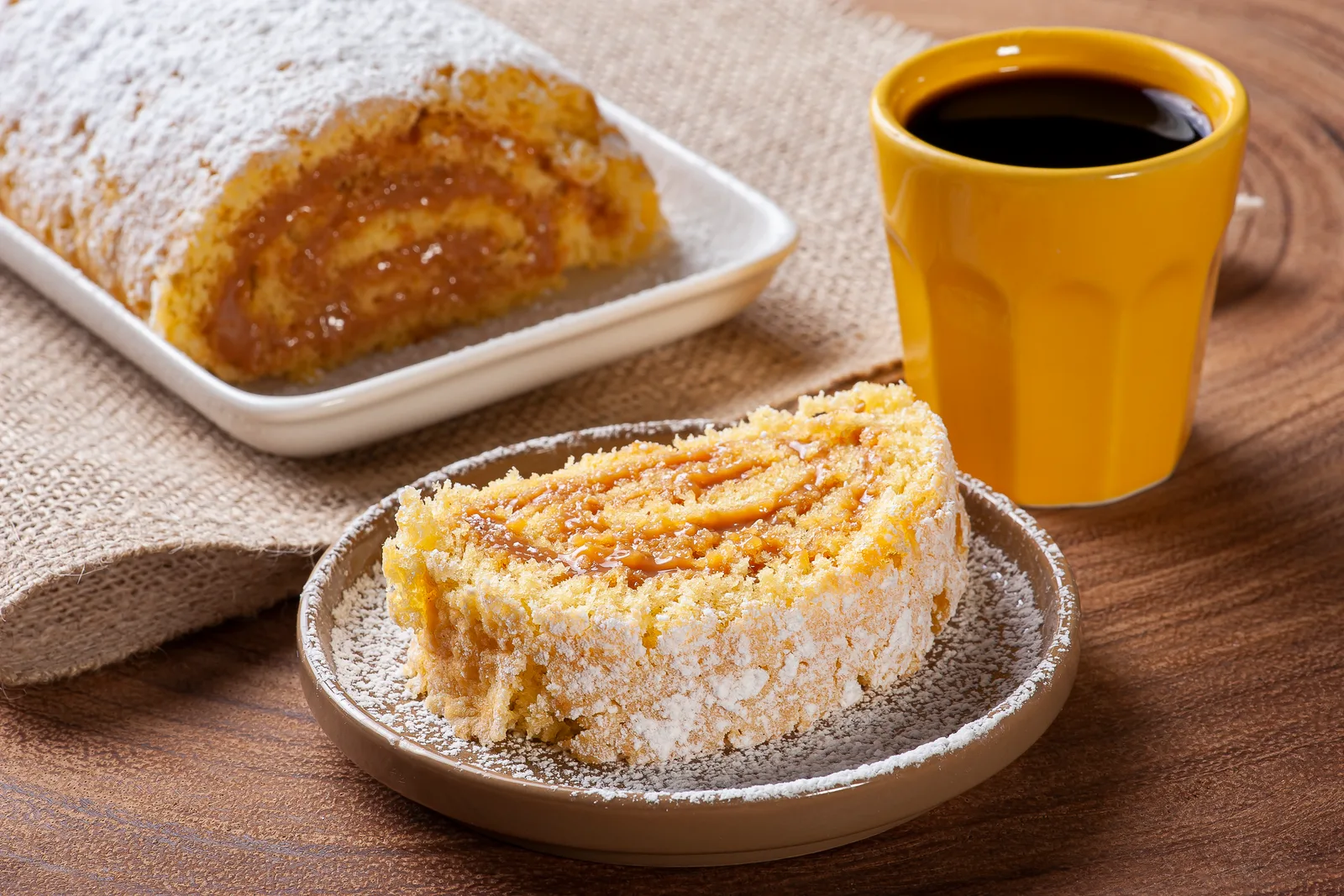

Brazo gitano (BRAH-soh hee-TAH-noh, literally “gypsy’s arm”) is what Venezuelans call a Swiss roll: a thin, butter-free sponge spread with dulce de leche or guava paste and rolled into a spiral. Colombians make the same cake and call it brazo de reina, “queen’s arm,” often with whipped cream and strawberries. If you’ve ever made a jelly roll, the method will feel familiar; the difference is the filling, which is sweeter, thicker and much more forgiving to slice. Below: the 4-egg sponge, how to read the ribbon stage, the one-minute window for rolling, and which filling can sit on a party table.
Brazo gitano at a glance
How do you make a brazo gitano? Beat 4 eggs with ½ cup (100 g) of sugar for 8 to 10 minutes to the ribbon stage, fold in ¾ cup plus 1 tbsp (100 g) of flour and spread it in a 10 x 15 in (25 x 38 cm) pan. Bake at 350°F (180°C) for 10 to 12 minutes, flip onto a sugared towel, roll it up hot and let it cool rolled. Unroll, spread with 1 cup (300 g) of dulce de leche or melted guava paste and roll it up again. 47 minutes of work and baking for 10 servings.
- What you get: a soft, springy, slightly eggy sponge that stays moist thanks to the filling. With dulce de leche it’s rich and caramel-sweet; with guava it’s fruity and a little tart.
- Time: 35 minutes hands-on and 12 in the oven, plus 45 minutes of cooling in the towel and an optional 30 in the fridge. Call it a little over 2 hours start to finish.
- Skill level: intermediate. Nothing is technically hard, but two moments need your full attention: the ribbon stage and the minute after the sponge leaves the oven.
The make-ahead plan
- The day before: bake the sponge, roll it in its towel, and once cool wrap the whole thing in plastic wrap. It keeps 1 day at room temperature. Or fill it the day before and refrigerate it; it actually slices more neatly the next day.
- On the day: unroll, fill, re-roll, chill 30 minutes and dust with sugar right before serving.
- For a crowd of 20: bake two separate sponges rather than doubling the batter. Eight eggs rarely reach a proper ribbon stage in a home mixer bowl.
Ingredients and US and UK swaps
The sponge is just eggs, sugar, flour, vanilla and salt. No butter, no milk and no baking powder: all the lift comes from the air beaten into the eggs, so they need to be at room temperature. Cold eggs whip more slowly and to less volume; 10 minutes in warm water fixes that.
Some recipes add ½ tsp of baking powder as insurance. If you hit the ribbon stage you don’t need it, and the sponge rolls more easily without it.
Picking a filling
- Dulce de leche (arequipe). The classic in both Venezuela and Colombia, where it’s often called arequipe. Use the thick kind that holds its shape on a spoon, and have it at room temperature: straight from the fridge it won’t spread and it tears the sponge. In the US, cans and jars sit in the Latin aisle or next to the sweetened condensed milk; in the UK, look in the baking aisle of larger supermarkets. Our Colombian dulce de leche takes a few hours, so make it the day before. Mexican cajeta, made with goat’s milk, works too; it’s a little runnier and tangier.
- Guava paste. Sold as a firm block, usually around 14 oz (400 g), in the Latin aisle of US supermarkets and online in the UK. Melted with water it becomes a thick, glossy spread. It’s the most heat-tolerant filling and makes the whole cake dairy-free. Quince paste (membrillo) is the closest UK deli swap; it works, but it tastes of quince, milder and without guava’s tropical perfume.
- Whipped cream and strawberries. The Colombian party version: cream whipped with powdered sugar, plus 7 oz (200 g) of diced strawberries if you like. Lightest of the three, but it must be refrigerated from the moment it’s assembled.
- Half and half. A thin layer of dulce de leche topped with guava: 150 g (½ cup) dulce de leche and 125 g (4½ oz) guava paste melted with 25 ml (5 tsp) water.
This isn’t the same thing as a Colombian guava roll, which is a candy made of pure cooked guava rolled in sugar, no cake involved. Here guava is only one filling option.
Equipment
A 10 x 15 in (25 x 38 cm) jelly roll pan, the standard US rimmed sheet for this kind of cake, or a 25 x 35 cm tray in the UK and Europe; parchment; a hand or stand mixer; a large spatula; a sieve; and a clean cotton tea towel that doesn’t smell of fabric softener. In a smaller pan the sponge comes out thicker and harder to roll.
Step by step
Beat to the ribbon stage
This is what makes the sponge light instead of rubbery. Put the eggs, sugar, vanilla and salt in the bowl and beat on high: a stand mixer gets there in 6 to 8 minutes, a hand mixer needs 8 to 10. You’re there when:
- The mixture has tripled in volume and turned from yellow to almost white.
- Lifted beaters leave a thick ribbon that sits on the surface for 3 to 5 seconds before sinking.
- You can trace a figure 8 with the ribbon and see it whole before it disappears.
If the ribbon sinks straight away, keep going. Whole eggs and sugar won’t over-whip at this stage.
Fold and spread
Sift the flour over the foam in three additions. With a spatula, cut down through the middle, sweep along the bottom and come up the side while turning the bowl. Stop as soon as the flour disappears; stirring in circles knocks the air out and you get a flat, dense sheet. Spread it evenly, about ⅜ in (1 cm) thick, right into the corners, which otherwise bake thin and brittle.
Bake until barely golden, not brown
At 350°F (180°C) the sponge takes 10 to 12 minutes; in a 10 x 15 in pan the sheet is a touch thinner, so start checking at 9. Keep the door shut for the first 8 minutes. It’s ready when the top is a pale, creamy gold, the center springs back under your finger without feeling tacky, and the edges just begin to pull away. If the edges brown while the middle is still wet, your oven runs hot: try 340°F (170°C) next time. A minute early beats a minute late.
Roll it hot
Within the first minute out of the oven, run a knife around the edges and flip the sponge onto the towel dusted with about 1 tbsp (10 g) of powdered sugar. Peel the parchment back low and flat rather than pulling it upward. Trim any dry, crisp edge, about ¼ in (5 mm): that’s where cracks start.
Roll the sponge up with the towel inside, starting from a long side, and leave it seam side down on a rack until cool to the touch, about 45 minutes. Cooling in a curl holds in steam and “trains” the sponge, so it rolls again later without splitting. Some bakers use a slightly damp towel; I prefer dry with powdered sugar, because nothing sticks.
Fill and re-roll
Unroll slowly; it will want to curl back, which is fine. Spread the filling in an even layer about ⅛ in (3 mm) thick, leaving ¾ in (2 cm) bare along the far edge, where the roll closes. Roll it back up without the towel, snug but not squeezed, and set it seam side down. Thirty minutes in the fridge firms the dulce de leche so the knife doesn’t drag it.
Finishing touches
Dust with the rest of the powdered sugar just before serving; on a humid day it melts within an hour. For a birthday or holiday look, spread about 3½ oz (100 g) more dulce de leche over the outside and drag a fork through it so it looks like bark, which also hides any cracks. Cover with whipped cream only if the filling is cream too.
Why it cracked, and other fixes
- Cracked while rolling. Almost always overbaking or rolling too late. Fill it anyway: the crack ends up underneath with the seam, and sugar or a coat of dulce de leche covers the rest.
- Flat and rubbery, with a damp layer at the bottom. The eggs never reached the ribbon stage, or the flour was beaten in. Give the eggs the full 8 to 10 minutes and fold by hand.
- Stuck to the towel. No sugar on the towel, or a synthetic one. Use cotton.
- Filling squeezed out of the ends. Too much filling, runny dulce de leche or soft cream. Stick to 300 g (about 1 cup) and keep the bare border.
- Split as it was unrolled. Opened too quickly or pressed flat. Go slowly; a small tear gets glued back by the filling.
Allergens. Eggs and wheat in the sponge; milk in dulce de leche and cream fillings. The guava version is dairy-free. Not spicy, and very kid-friendly.
Fillings by country
Every country rolls the same 4-egg style sponge; what changes is the filling.
- Venezuela: brazo gitano with dulce de leche or guava, finished with powdered sugar.
- Colombia: brazo de reina with arequipe, or whipped cream and strawberries for celebrations.
- Spain: whipped cream, pastry cream or jam, often covered in chocolate.
- Cuba and Puerto Rico: almost always guava. If you love guava with pastry, Cuban guava pastries are the puff-pastry cousin from the same bakeries.
- Argentina, Uruguay and Peru: the sponge sheet is called pionono, and it’s usually filled with dulce de leche.
For Christmas, a dulce de leche-coated brazo gitano looks like a yule log and comes together in an afternoon, unlike the Venezuelan black cake, which is baked about 3 weeks ahead. If you’d rather not roll anything, the Colombian Maria Luisa cake puts the same fillings between two flat layers, and Venezuelan quesillo is the make-ahead custard that often shares the table.
Serving and storage
- Serving: slices about 1⅓ in (3.5 cm) thick, cut with a serrated knife and no pressure. Dulce de leche and guava rolls taste best at room temperature, so take them out of the fridge 15 minutes before serving; cream rolls are served cold.
- At room temperature: dulce de leche or guava, covered, in a cool room: 1 day. Whipped cream: 2 hours at most.
- Fridge: wrapped in plastic, up to 4 days with dulce de leche or guava, up to 3 with cream. The ends dry out first, so slice only what you’ll serve.
- Freezer: dulce de leche and guava rolls freeze well, whole or sliced, wrapped in plastic and then in a freezer bag. I use them within 2 months. Thaw overnight in the fridge, still wrapped. I don’t freeze cream-filled rolls: the cream weeps when it thaws.
Brazo gitano FAQ
Is brazo gitano the same as a Swiss roll or jelly roll? Yes, it’s the same type of cake: a thin sponge, filled and rolled. What makes it Venezuelan or Colombian is the filling, dulce de leche or guava instead of jam, and the name.
Can I use sweetened condensed milk as the filling? Not straight from the can: it’s liquid and soaks the sponge. It needs to be cooked into thick dulce de leche first, or buy dulce de leche ready-made.
Can I make it without an electric mixer? Yes, with a balloon whisk, but reaching the ribbon stage takes much longer than the 8 to 10 minutes with a mixer. Whisking over a pan of hot water (bowl not touching the water) speeds it up; take it off once the mixture is lukewarm and keep whisking.
Can I make a chocolate version? The most reliable way is to keep this sponge and change the outside: cover the roll with a thin layer of melted chocolate or chocolate ganache instead of powdered sugar. I don’t swap flour for cocoa here without testing, because cocoa dries the sheet and makes it more likely to crack.
Nutrition per serving
Per slice, with the roll cut into ten and filled with dulce de leche, calculated ingredient by ingredient from the recipe amounts:
- Calories: 206 kcal
- Protein: 6 g
- Carbohydrates: 36 g
- Fat: 4 g, of which 2 g saturated
- Fiber: 0 g
- Sugars: 27 g
- Sodium: 87 mg
The sponge alone, without filling, is about 112 kcal per slice.
What I like about this cake is that it asks for almost nothing from the pantry and everything from your timing. Hurry when the sponge comes out of the oven, be patient while it cools in the towel, and it will roll without a fight. If your first one cracks, fill it, cover it with dulce de leche and serve it anyway; nobody at the table will know. Josnaisis.