
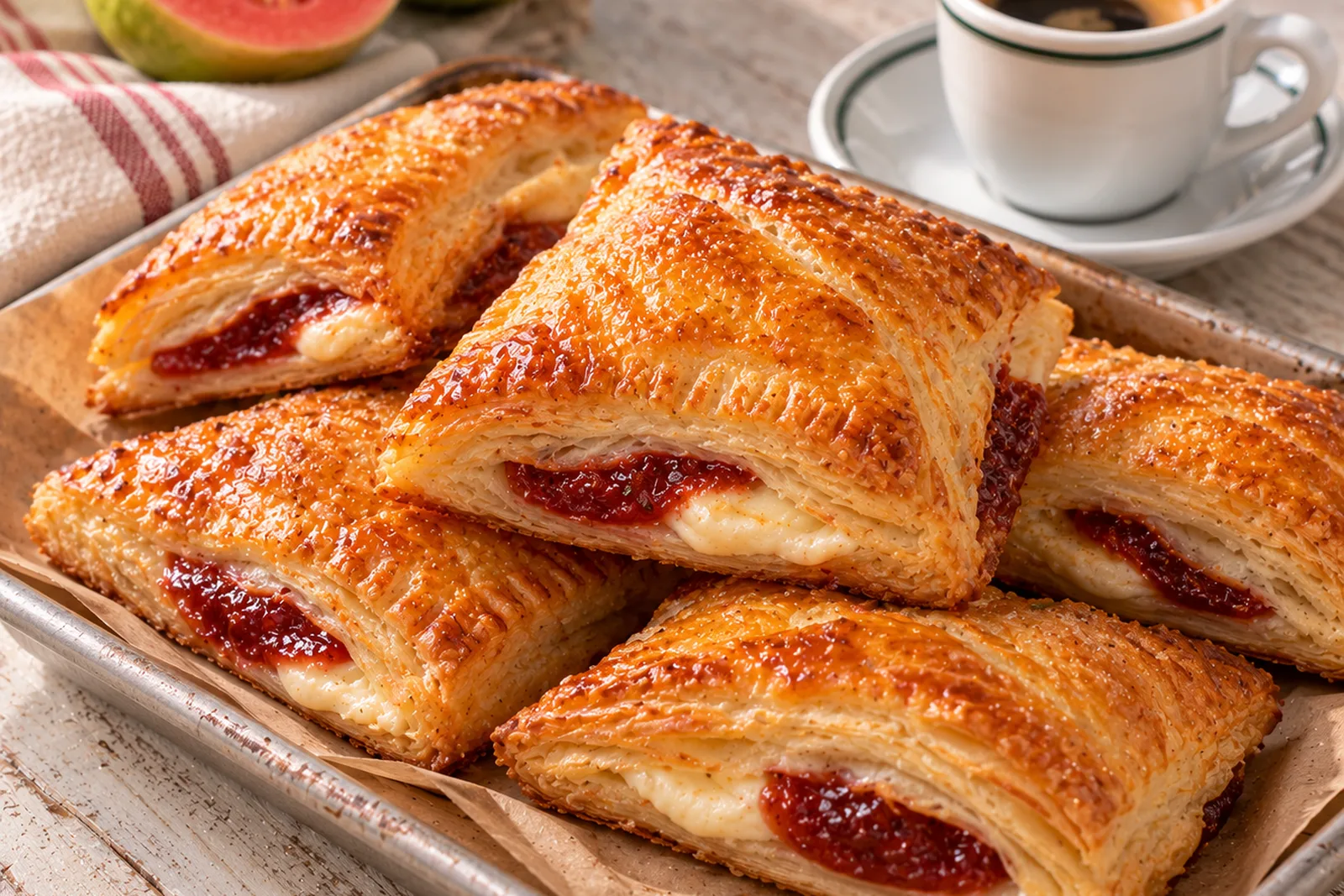

Pastelitos de guayaba (pah-steh-LEE-tohs deh gwah-YAH-bah) are the square, glossy puff pastries filled with guava paste, sometimes with cream cheese, that you find in the front case of Cuban bakeries in Miami, next to the coffee window. At home they take one box of frozen puff pastry, one block of guava paste and 25 minutes in a 400°F oven, and the only real skill is knowing when they’re actually done: the sides have to be as golden as the tops.
What you’re making, and how long it takes
How do you make Cuban guava pastries? Cut 2 thawed puff pastry sheets into 9 squares each. Top 9 squares with a slice of guava paste and a piece of cream cheese, cover with the other 9 and crimp with a fork. Brush with egg wash, bake at 400°F (200°C) for 20 to 25 minutes until golden on the sides as well as the top, and glaze with simple syrup straight from the oven. 55 minutes for 9 servings.
Picture a flaky square that shatters when you bite it, then a soft, jammy middle. Guava paste is tropical and floral, quite sweet with a slight tang, and the cream cheese takes the edge off the sugar. Cuban bakeries also sell them with guava only, and with cheese only.
Time. 30 minutes hands-on, including a 15-minute chill, and 25 in the oven, plus thawing the pastry. Easy, if you’ve ever unfolded a sheet of puff pastry.
Shopping list for a US or UK supermarket
| You need | US | UK | Swap and what changes |
|---|---|---|---|
| Puff pastry, 2 sheets | Pepperidge Farm, freezer aisle: 17.3 oz (490 g) box with 2 folded sheets | Jus-Rol ready-rolled, chiller cabinet: 320 g (11 oz) sheet, buy 2 | All-butter brands taste richer and cost much more; vegetable-fat pastry puffs well too |
| Guava paste, 8 oz (225 g) | Goya 21 oz (595 g) block in the Hispanic aisle, or a Latin market | Latin grocers or online | Quince paste (membrillo), next to the cheeses: same texture, tarter and less floral |
| Cream cheese, 6 oz (170 g) | Full-fat block (the 8 oz brick) | Full-fat soft cheese in a tub, very cold | Whipped or light cream cheese runs in the oven |
| Egg, sugar, water | Pantry | Pantry | Coarse sugar on the egg wash instead of syrup |
Guava paste vs guava jam. Paste is guava cooked with sugar until it sets into a sliceable block. Jam is loose, boils in the oven and pours out of the seams. If jam is all you have, use 1 teaspoon per pastry and a wider border. Canned guava shells in syrup are too wet to use as they come.
Rectangle sheets. The UK sheets are about 35 × 23 cm (14 × 9 in), so cutting each one 3 by 3 gives rectangles of roughly 12 × 8 cm (4½ × 3 in) rather than squares. You still get 9 pastries, just a little bigger: two UK sheets weigh 640 g against 490 g in the US box, so there’s more pastry around the same filling and the nutrition figures below run a bit higher. Bake them the same way, to golden sides.
Tools. A large baking sheet, parchment, a pastry brush, a fork and a sharp knife or pizza wheel.
Cutting guava paste without a sticky mess
Straight from the fridge, guava paste slices cleanly; at room temperature it drags and clings. Dip a sharp knife in hot water between cuts and slice on a sheet of parchment or plastic wrap rather than the board, which it sticks to. Aim for ¼ to ⅜ in (6 mm to 1 cm): thinner gets lost in the pastry, thicker squeezes out the sides.
Hard, dried-out paste (an opened block that sat for a while): cube it, put it in a small pan with 1 tbsp lime juice, orange juice or water, cover and leave over low heat for 5 minutes until it mashes with a fork. Mash, cool completely, then spoon a heaped tablespoon onto each base.
Assembly that doesn’t leak
The pastry should be cold enough to cut cleanly. If it goes floppy while you work, slide it into the fridge for 5 minutes.
- Filling in the middle, guava first and cheese on top, with a clean ⅜ in (1 cm) border. Any smear of guava or cheese on that border stops it sealing.
- Egg wash on the border only. It’s the glue.
- Lid on, air out. Press around the filling with your fingertips, then crimp all four sides with a fork.
- Two slits in each top let steam out so it doesn’t force the seams.
- Chill 15 minutes. Cold pastry seals better and rises higher.
- Egg wash on top only. If it runs down the cut edges it glues the layers together and that side won’t rise.
Bake until the sides are golden
Bake at 400°F (200°C), or 350°F (180°C) in a fan oven, on the lower-middle rack so the bottoms brown. Start checking after 20 minutes; most batches need 25. Look for three things:
- The tops are deep golden, not yellow.
- The sides are golden too, with the layers visibly separated and dry. White, damp sides need more time.
- Lift one with a spatula: the bottom is browned and the pastry feels light and sounds hollow.
If the tops get dark before the sides are done, lay a sheet of foil loosely over them and keep baking.
The syrup glaze
In many Cuban bakeries that shine is simple syrup; others finish them with coarse sugar. Simmer equal volumes of sugar and water, ¼ cup each (50 g sugar, 60 ml water), just until the syrup turns clear, a couple of minutes, and brush it on the moment the tray comes out, while the pastry is hot enough to soak it up instead of going soggy. You won’t need all of it. No syrup? Sprinkle coarse sugar over the egg wash before baking for a crunchy top, or dust with powdered (icing) sugar once cool.
Wait at least 10 minutes before biting in. The guava comes out far hotter than the pastry around it.
Troubleshooting
- Guava oozed out. Too much filling, too narrow a border, or a dirty border. A little caramelized guava on the tray is normal; trim it while it’s warm.
- Seams split open. No egg on the border, no fork crimp, or no steam slits.
- Flat, not puffy. Warm pastry going into the oven, a rolling pin on the sheets, or egg wash on the cut edges.
- Collapsed and doughy inside. Pulled with pale sides. If they’re still hot, put them back for 5 minutes.
- Soggy bottoms. The tray sat too high or the oven wasn’t fully heated.
- Cheese all over the tray. Whipped or tub cheese, or cheese that was warm. Use block cream cheese straight from the fridge.
Allergens. Wheat (gluten), egg and milk, plus butter if your pastry is all-butter. No heat at all, and kids tend to love them.
Make ahead and freeze unbaked
This is the best way to have them on a Sunday morning without the work.
- Night before. Assemble, skip the top egg wash, cover the tray with plastic wrap and refrigerate. Brush and bake straight from the fridge the next day.
- Freezer. Assemble without egg wash and freeze on the tray for 2 to 3 hours, until hard, then bag them. Bake from frozen, no thawing: brush with egg and give them about 5 minutes longer at 400°F (200°C). I use them within a month.
- For a crowd of 18 or more. Double everything and bake one tray at a time, or two at once in a fan oven at 350°F (180°C), swapping racks halfway. Assembled trays wait happily in the fridge.
Storing and reheating baked pastries
They’re best the day they’re baked. Guava-only pastries keep at room temperature, loosely wrapped in foil, for up to 2 days; a sealed plastic box softens the layers. Pastries with cream cheese go in the fridge within 2 hours, and I eat them within 3 days. Baked and cooled, both freeze for 1 month in a sealed bag.
Reheat in the oven or a toaster oven at 350°F (175°C) for 5 to 8 minutes until hot and crisp again, a few minutes more from frozen. The microwave heats them but leaves the pastry limp.
What to serve them with
In a Cuban bakery they come with a cafecito, a small and very sweet Cuban espresso, or a café con leche. They’re best within 1 hour or so of baking, still slightly warm. A glass of cold guava juice doubles down on the fruit. For a bigger spread, put out a Cuban sandwich cut into strips.
If you like guava and pastry, Colombia has its own version in bread form: the Colombian guava roscón wraps the same paste in a soft, sweet dough rather than flaky layers. And if you want to make the paste itself, the Colombian guava roll explains how guava paste, a guava roll and guava jam differ.
FAQ
Can I use homemade puff pastry? Yes, but it’s an afternoon of folding and chilling. Store-bought gives you nearly the same pastelito in under an hour, which is why most home cooks use it.
How many pastries does a 21 oz (595 g) block of guava paste make? At about 1 oz (25 g) each, around 23, so two boxes of pastry (18 pastries) leave you a piece to eat with cheese.
Do guava pastries need to be refrigerated? Guava-only ones don’t, for a day or two. Once there’s cream cheese inside, refrigerate them within 2 hours.
Why didn’t my puff pastry rise? It was too warm going in, or it was rolled. It needs to go cold into a fully heated 400°F (200°C) oven.
Nutrition per pastry
Per pastry with cream cheese (1 of 9), worked out ingredient by ingredient from the amounts above, counting half the egg wash and half the syrup, which is roughly what stays on the pastries:
- Calories: 450 kcal
- Protein: 6 g
- Carbohydrates: 47 g
- Fat: 28 g, of which 9 g saturated
- Fiber: 1 g
- Sugars: 20 g
- Sodium: 200 mg
The puff pastry is about 300 kcal of that, the guava about 72 and the cream cheese about 66. Guava-only pastries come to roughly 385 kcal.
Guava with cheese is my favorite sweet-and-salty pairing, and puff pastry is the laziest good way to serve it. My habit is a double batch: one tray for today, and one frozen raw, waiting for a weekend morning when I want something warm with breakfast and no mess. Josnaisis.