
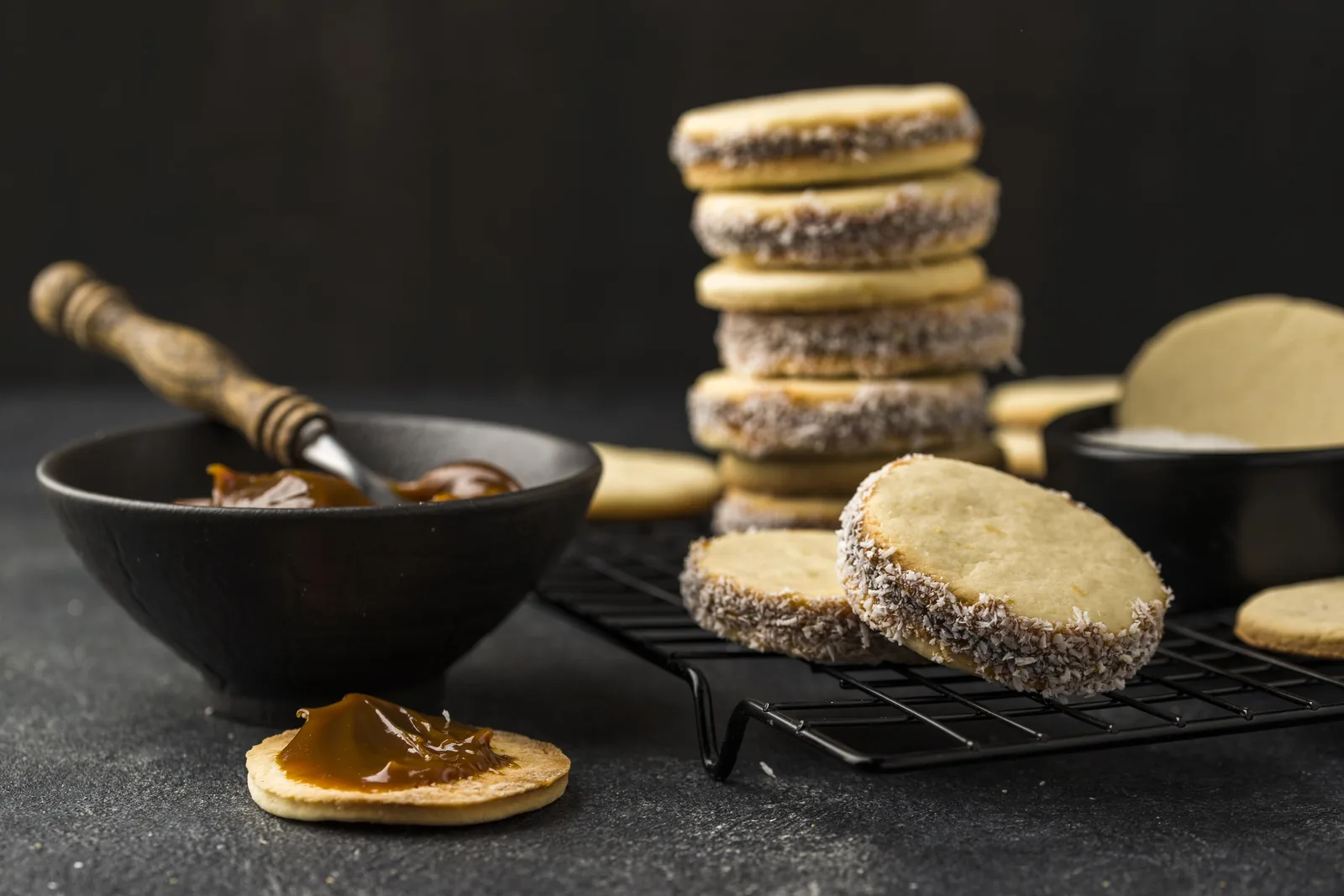

Alfajores (al-fah-HOH-res) are two pale, crumbly cookies about 2⅜ in (6 cm) across, sandwiched with dulce de leche, a thick caramel-colored jam made by slowly cooking milk with sugar, with the sides rolled in coconut. This is the Argentinian kind, alfajores de maicena, and the word that matters is maicena: cornstarch. The dough has 300 g of cornstarch to 200 g of flour, so there’s very little gluten, and the cookies break the moment you bite them and dissolve instead of chewing. Below is the recipe for about 25, how pale to bake them, which dulce de leche holds up in a sandwich and what to buy in a US or UK supermarket.
What alfajores are, and how long they take
How do you make alfajores? Cream 7 oz (200 g) butter with ¾ cup (150 g) sugar and 3 egg yolks, then press in 2⅓ cups (300 g) cornstarch, 1⅔ cups (200 g) flour, baking soda and baking powder without kneading, and chill 30 minutes. Roll to 5 mm, cut 6 cm rounds and bake at 350°F (180°C) for 10 to 12 minutes, without browning. Once cold, sandwich with thick dulce de leche and roll the edges in coconut. 135 minutes for 25 servings.
Total time 2¼ hours, of which about 1 hour is hands-on: 15 minutes for the dough, 20 to roll and cut, 25 to fill. The rest is chilling, baking and cooling. Easy, as long as you pull the cookies while they still look underdone.
Alfajores de maicena are the everyday homemade alfajor in Argentina and Uruguay. In Peru they’re filled with manjar blanco, which is the same milk jam, and are often dusted with powdered sugar instead of coconut.
If you know shortbread, these are softer and more fragile, closer to a Mexican wedding cookie in the way they melt, but plain, without nuts, and made to be filled. They’re far too delicate for cutting and icing like Christmas butter cookies.
Ingredients, with US and UK swaps
The dough weighs about 2 lb (900 g) and gives roughly 50 cookies, 25 sandwiches, depending on how much you get from the scraps.
| Ingredient | Metric | US | UK and notes |
|---|---|---|---|
| Cornstarch | 300 g | 2⅓ cups | Cornflour |
| All-purpose flour | 200 g | 1⅔ cups | Plain flour |
| Unsalted butter | 200 g | 1¾ sticks | Salted works; see FAQ |
| Granulated sugar | 150 g | ¾ cup | Caster sugar, or powdered for a finer crumb |
| Egg yolks | 3 large | 3 large | Freeze the whites for meringue |
| Dulce de leche | 475 g | about 1½ cups | Must be thick; see below |
| Shredded coconut | 80 g | about 1 cup | Desiccated, unsweetened |
Why so much cornstarch
Cornstarch is pure starch, with none of the proteins that form gluten. The flour supplies just enough to keep a cookie in one piece. Swap the ratio, with more flour than cornstarch, and you get a sturdier, cakier cookie; go all cornstarch and it truly melts but is hard to handle (see the gluten-free version).
Butter coats the starch and gives the melt-in-the-mouth feel. Yolks bind without the water of the whites, which would toughen the dough. Baking soda and baking powder, ½ tsp and 2 tsp, lift the cookies slightly so the inside is airy rather than dense. The brandy is for aroma; milk does the same binding job.
Finding thick dulce de leche, and what to use instead
The filling has to stay on a spoon when cold. In Argentina, bakers buy dulce de leche repostero, a pastry-grade version that’s denser and more matte than the spreading kind and doesn’t ooze when you press the cookies together. Regular dulce de leche works, but it squeezes out and the sandwiches slide apart.
- US. Cans of dulce de leche sit in the Hispanic aisle or next to the sweetened condensed milk. They’re softer than repostero, so chill the can for a few hours before filling. Latin shops and online stores sell Argentinian repostero in tubs.
- UK. Jars of dulce de leche are in larger supermarkets and online. The tinned caramel sold for banoffee pie is the nearest supermarket swap, but it’s softer and sweeter, so use it straight from the fridge.
- Homemade. Colombian arequipe is the same thing made from milk and sugar. Cold from the fridge it firms up; if you’re making it for alfajores, stop when the track on the bottom of the pan takes a little longer than 2 seconds to close, short of 234°F (112°C), where it sets hard.
- From a can of condensed milk. Pour a 14 oz (397 g) can into a glass pie dish, cover tightly with foil and set it in a roasting pan with hot water halfway up the sides. Bake at 425°F (220°C) for 1 to 1¼ hours, topping up with hot water if it runs low, until caramel-colored. Cool, then whisk smooth. It fills about 20 sandwiches and comes out softer than repostero. Don’t heat an unopened can: it can burst.
- Cajeta, the Mexican goat’s milk version, works but tastes tangier and is usually runnier.
Caramel sauce and ice cream toppings don’t work. They’re too thin and soak into the cookies.
Equipment
A rolling pin, a 2⅜ in (6 cm) round cutter (a 2½ in cutter or a small glass is fine), parchment, two baking sheets and a wire rack. Two ¼ in rulers or strips of wood on either side of the dough keep the thickness even.
How to make alfajores, step by step
The dough. Cream the butter and sugar for 3 minutes. After the dry ingredients go in, stop beating: press the dough together with a spatula, then your hand, until no loose flour is left. It feels soft, slightly sandy, and cracks a little at the edges when flattened. If a squeezed handful falls apart, add 1 tbsp milk.
Chill 30 minutes. That firms the butter. Skip it and the dough sticks to the pin and the cookies spread.
Roll and cut. Between two sheets of parchment you don’t need extra flour, which would toughen the cookies. Cut straight down without twisting the cutter. If the dough softens while you work, back in the fridge for 10 minutes. At 5 mm the cookies take the filling; at 3 mm they break when pressed, and at 8 mm they’re more biscuit than sandwich.
How pale to bake them
At 350°F (180°C), one sheet at a time, middle rack. Start checking at 10 minutes:
- Done. Tops dry, matte and white; lift one with a spatula and the bottom is barely cream-gold. The center doesn’t dent when touched.
- Overbaked. Golden edges or color on top. They’ll be dry and hard rather than tender.
- Not yet. The tops look shiny or damp and your finger leaves a mark.
They come out soft and firm up as they cool, so don’t wait for them to feel crisp in the oven.
Cool, then fill
5 minutes on the sheet, because hot cookies break when moved, then on a rack until fully cold, 20 to 30 minutes. Fill them warm and the dulce de leche melts and slides.
Pair the cookies by size. Put 1 tbsp (19 g) of filling in the center of the flat side, top, and press with a quarter turn until the filling reaches the edge and just peeks out. That ring is what holds the coconut when you roll the edge through it. If it doesn’t show, smear a little on the side with a knife.
Why alfajores crumble, turn hard or slide apart
- Hard, dry cookies. Overbaked or too hot an oven. Pull them white on top at 10 to 12 minutes.
- Dough crumbles when rolling. Not enough liquid, or the butter was cold. Add a tablespoon of milk and press.
- Cookies break while filling. Still warm, rolled too thin, or the filling is too stiff. If the dulce de leche is very firm from the fridge, give it 10 minutes out and stir.
- Cookies spread or lose their shape. Warm dough, or it was kneaded. Chill the cut cookies on the sheet for 10 minutes before baking.
- Raw flour taste. Underbaked: the tops should look dry and matte, not glossy.
- Filling oozes and sandwiches slide. Thin dulce de leche or warm cookies. Use a thick one, well chilled.
- Too soft after a few days. The cookies absorb moisture from the filling from day 3 or 4. Keep them sealed, and not in the fridge.
Allergens. Contains wheat (gluten), egg, milk and coconut. Kids generally love them; the brandy can be left out.
Variations
- Gluten-free. Replace the flour with cornstarch, 500 g (about 4 cups) in total, and check that the cornstarch, baking powder and dulce de leche are labeled gluten-free. The cookies are even more fragile: roll them to ¼ in (6 mm) and only move them cold.
- Peruvian style. Fill with manjar blanco and dust with powdered sugar instead of rolling in coconut.
- Chocolate-dipped. Skip the coconut and dip the filled sandwiches in dark chocolate, then set on a rack. A different alfajor, sweeter and firmer.
- Minis. A 1½ in (4 cm) cutter and 8 to 10 minutes in the oven, giving a little over twice as many. Good for a dessert table.
- For 50. Double everything and chill the dough as two disks. Allow 950 g (2 lb 2 oz) dulce de leche and 160 g (5½ oz) coconut.
Serving. With coffee or tea, 1 or 2 per person on a dessert table. They’re the natural sweet after baked Argentinian beef empanadas, and on a Peruvian table they share the milk jam with suspiro a la limeña, so one of the two is plenty for anyone who doesn’t want that much sugar. At Christmas they sit well next to spiced gingerbread cookies and soft Venezuelan catalinas, which balance all that butter and milk. For a birthday spread, add a plate of Brazilian brigadeiros, the condensed milk and cocoa fudge balls, for a chocolate bite that needs no oven.
Make ahead, storing, freezing and gifting
- Make ahead. Unfilled cookies keep in a sealed tin for up to 3 days, and the wrapped dough for 2 days in the fridge. Fill them the day before serving: by day two the cookies have absorbed a little moisture from the filling and are softer.
- Room temperature. In an airtight container in a cool spot, in one layer or with parchment between layers, they keep about 5 days, getting softer from the third.
- Fridge. Not needed, and it makes the cookies damp. Only in a very hot kitchen, sealed, and take them out 20 minutes before eating.
- Freezer. Unfilled cookies freeze well for up to 2 months, with parchment between layers. Thaw them sealed at room temperature, then fill.
- Gifting. Wrap each filled alfajor in plastic wrap or wax paper once the filling has set, and pack them in a single row in a box or tin. Make them 1 or 2 days ahead and keep them away from heat, which softens the filling. For posting or a long trip, a rigid tin beats a bag.
Frequently asked questions
Are alfajores Argentinian or Peruvian? Both. Cornstarch alfajores with coconut are the classic homemade version in Argentina and Uruguay; in Peru they’re filled with manjar blanco and usually dusted with powdered sugar. The cookie is similar, and so is the filling.
Can I use salted butter? Yes. Skip any extra salt; a little saltiness against the dulce de leche is no bad thing.
Can I make them without baking soda? Yes, with the 2 tsp baking powder alone the cookies rise slightly less. Without either leavener they bake flat and dense, more like plain shortbread.
Why did my cookies dome? They were rolled thicker than 5 mm or had too much leavening. Fill them anyway with the flat underside facing the filling.
Nutrition
Per alfajor (two 6 cm cookies, 19 g dulce de leche and its share of coconut), worked out ingredient by ingredient from the quantities above, without the brandy:
- Calories: 244 kcal
- Protein: 3 g
- Carbohydrates: 35 g
- Fat: 11 g, of which 7 g saturated
- Fiber: 1 g
- Sugars: 16 g
- Sodium: 83 mg
Butter and dulce de leche account for about half the calories between them, roughly 57 and 60 kcal per sandwich; the cornstarch adds about 46 and the coconut about 21.
In Colombia, where I live, dulce de leche is called arequipe and I make it at home, so that’s what goes into my alfajores, cooked a shade past the spreading point and left in the fridge overnight. The cookies are the part people get wrong the first time, and I understand why: pulling something out of the oven when it’s still white feels like a mistake. Trust the dry, matte top and the barely colored base, let them cool all the way, and the texture takes care of itself. Josnaisis.