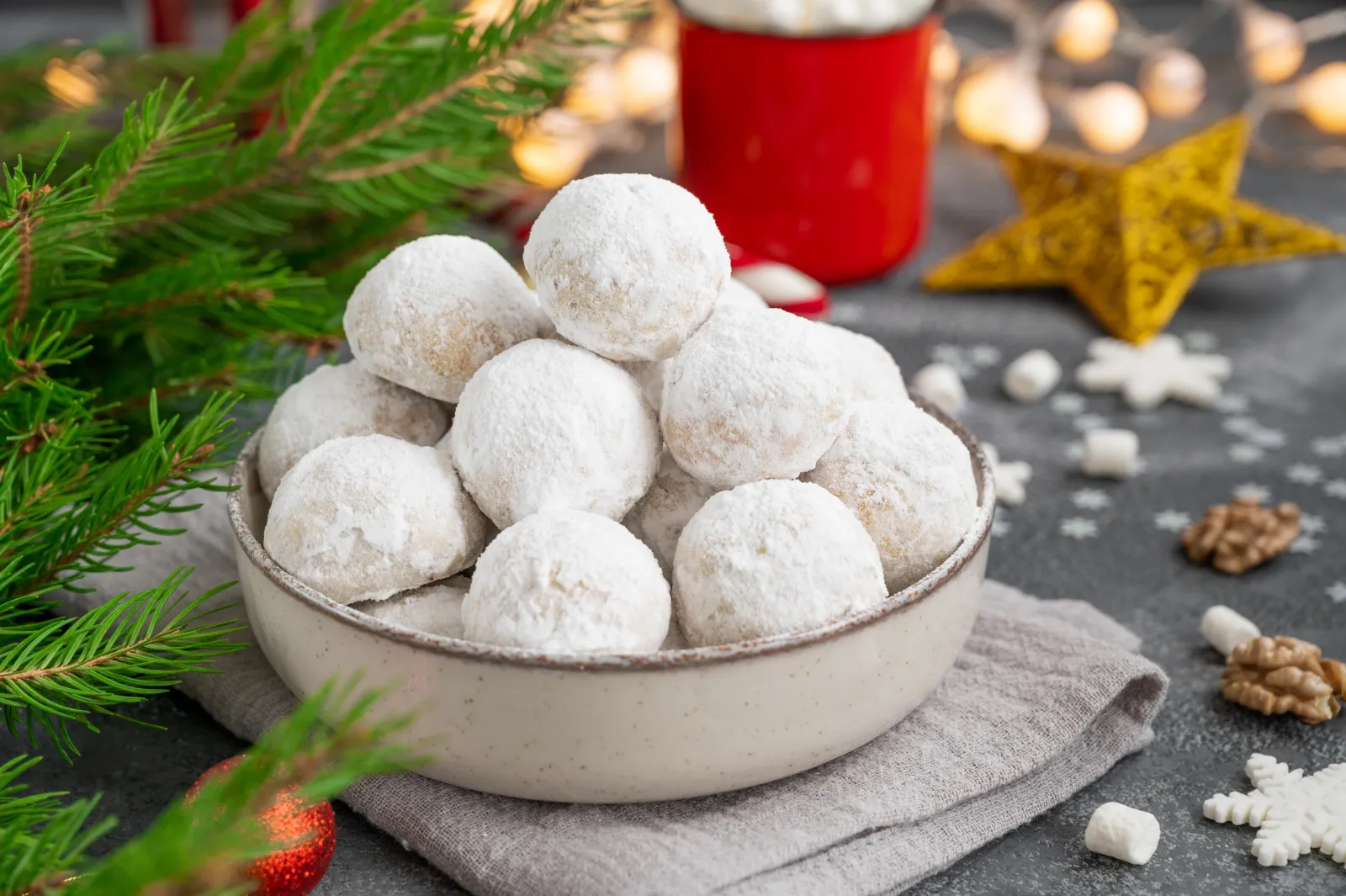

Mexican wedding cookies are 1-inch (2.5 cm) balls of butter, flour and toasted pecans, baked until just set and rolled in powdered sugar until they look like snowballs. In Mexico they’re called polvorones (pol-vo-ROH-nes), from polvo, dust, because that’s what they turn into when you bite them, and they’re baked for weddings, christenings and Christmas. In the US you’ll see the same cookie sold as Russian tea cakes or snowball cookies. The dough is nearly equal parts butter and flour, 225 g (1 cup) of butter to 250 g (2 cups) of flour, which is why the most common complaint is cookies that melt into flat discs. The fix is temperature, and this recipe gives you the numbers for 36 cookies, plus how to box them as gifts and how long they keep.
What are Mexican wedding cookies, and are they worth making?
How do you make Mexican wedding cookies? Toast and grind pecans, beat butter briefly with a little powdered sugar, vanilla and salt, then mix in the flour and nuts without overworking. Roll 18 g (1 inch) balls, chill them 30 minutes, bake at 350°F (175°C) for 14-16 minutes until the bottoms are barely golden, and roll them in powdered sugar twice, warm and then cold. 130 minutes for 36 servings.
Yes, if you want a holiday cookie with seven ingredients, no eggs, no rolling pin and no cookie cutters. They’re also one of the easiest cookies to make ahead: the dough balls freeze raw and the baked cookies keep for weeks.
When they shine. Cookie swaps, holiday gift boxes and dessert tables at weddings or showers. One batch of 36 fills 3 boxes of 12.
When to skip them. In a nut-allergic household, unless you make the nut-free version below. And if powdered sugar on a dark sweater bothers you: these are one-bite cookies for a reason.
Real time. 130 minutes start to finish, about 55 of them hands-on. The rest is cooling nuts, chilling dough and baking.
Honest difficulty, easy. Two things go wrong, and both are covered below: butter that’s too warm and cookies that bake too long.
Mexican polvorones, Spanish polvorones and Russian tea cakes
Three cookies share a family resemblance, and recipes online mix them up.
- Mexican polvorones (this recipe). Butter is 35 % of the dough, pecans 17 %, plus vanilla. Small balls of about 18 g (0.6 oz).
- Spanish polvorones. The protected Polvorones de Estepa from Seville province are made with pork lard (20-25 % of the dough), toasted almonds (at least 8 %), cinnamon and dried flour, shaped into an oval piece of up to 50 g (1.8 oz), according to the official specification of their Protected Geographical Indication. They’re denser, taste of cinnamon and come individually wrapped in paper.
- Russian tea cakes and snowball cookies. In American cookbooks these are essentially the same butter-nut-powdered sugar ball, often with walnuts. Some versions use more nuts and less flour, which makes a denser, richer cookie.
If you grew up with the tea cakes, this recipe will feel familiar, just a little sandier and more buttery.
Ingredients and US and UK swaps
The recipe card has every amount. Weigh the flour if you can: a cup scooped straight from the bag can hold noticeably more than a spooned and leveled one, and extra flour gives you dry cookies that crack.
Butter. Unsalted, so you control the salt; with salted butter, skip the ¼ tsp of salt. It should be about 65°F (18°C): a finger presses in with some effort and the surface isn’t shiny. Greasy butter means flat cookies.
Powdered sugar. Only 50 g (½ cup) goes into the dough; the sweetness comes from the coating. Granulated sugar doesn’t dissolve in a dough with no liquid and leaves the cookies gritty.
Pecans. The classic Mexican nut, sweet and buttery, with 72 g of fat per 100 g according to USDA data. Walnuts (65 g fat) work 1 to 1 and taste a touch more bitter unless toasted. Almonds (50 g fat) make a drier, sandier cookie, closer to the Spanish one.
Equipment, and what to use without it
A food processor for the nuts, a hand or stand mixer, two baking sheets with parchment and a kitchen scale. No processor? Chop the pecans by hand as fine as you can, about 5 minutes of work; the cookies get more texture. No mixer? A sturdy spatula and a few minutes of elbow grease will cream soft butter just fine. No scale? Each ball is a level tablespoon of dough.
Why Mexican wedding cookies spread, and the temperatures that stop it
Butter melts at body temperature, and a dough that’s a third butter starts to slump the moment it hits a hot oven if the fat is already soft. Three temperatures keep the shape.
- Butter at about 65°F (18°C), not left on the counter all day. In a warm kitchen, 20 minutes out of the fridge is often enough.
- A short beat, 2-3 minutes. Creaming until pale and fluffy, as you would for a cake, whips in air that expands in the oven.
- Cold dough balls, around 40°F (4°C). 30 minutes in the fridge or 15 in the freezer, and the second sheet waits in the fridge while the first bakes.
Two smaller causes: a greased pan, which lets the cookies slide outward, and a sheet still hot from the previous batch. Use parchment on a cool pan every time.
How to tell they’re done
At 14 minutes, lift one cookie with a spatula and look underneath. White bottom, give it another minute or two. Pale golden bottom, take them out even if the tops look raw. The tops barely color, so waiting for them to brown means overbaked cookies with bitter nuts. Fresh from the oven they’re soft; they firm up as they cool.
The double roll in powdered sugar
This is the question behind most searches about these cookies: how do you keep the sugar on?
- First roll, warm. 5 minutes after the cookies leave the oven, roll them in the sugar. The heat melts a thin layer that sticks like glue.
- Second roll, cold. Once they’re completely cool, roll them again. This layer doesn’t melt and gives the snowy look.
Roll them only once while hot and the sugar turns into a translucent paste. Roll them only once cold and it falls off when you pick them up. For gift boxes, I dust a little extra sugar over the top right before closing, because travel knocks some off.
Make-ahead and holiday gift plan
These are an ideal make-ahead cookie. Choose the stage that suits your week.
- Raw dough balls, up to 2 days in the fridge or 3 months in the freezer in a zip-top bag, in my experience. Bake them straight from cold; frozen ones need 17-18 minutes.
- Baked cookies, up to 2 weeks ahead of gifting, with the first roll only, in a tin. Second roll the day you pack them.
Scaling. Half a batch makes 18 cookies, one sheet. For a dessert table, plan on 3 cookies per guest: one batch serves 12, a double batch (72) serves 20 or more. For gifting, every batch fills 3 boxes of 12.
For 9 gift boxes, make a triple batch, 108 cookies. With a home stand mixer, mix each batch separately rather than cramming 675 g (1½ lb) of butter into one bowl. Plan on about 4 hours, with six sheets baked one after another.
Boxing them. I put 12 per box in a single layer, each one in a paper candy cup so they don’t knock against each other. In a tin with two layers, separate them with wax paper.
What do Mexican wedding cookies cost?
In the US a batch costs about $5.30, around 15 cents a cookie or $1.77 per gift box of 12. Butter, flour and sugar use the BLS US city average prices for August 2026; pecans use Walmart’s store-brand 16 oz bag of halves at $10.86, checked in October 2026.
What drives the price. Pecans are half the cost while being less than a fifth of the dough. Walnuts or almonds can be cheaper depending on the season; leaving the nuts out brings a batch down to about $2.70. Vanilla and salt aren’t counted. I don’t have an official price source for the UK, so I’m not giving a pound figure.
Allergens, kids and the nut-free version
Allergens. Tree nuts (pecans, or whichever nut you use), wheat (gluten) and milk (butter). There are no eggs in this recipe; some versions, like Pati Jinich’s, add one.
Nut-free. Leave out the pecans and add 30 g (¼ cup) of flour. You get a plain butter snowball, more compact and without the crunch. It’s only safe for a nut allergy if your flour, sugar and equipment haven’t been near nuts.
Gluten-free. A 1-to-1 gluten-free baking flour works in my kitchen, but the cookies are more fragile: roll them gently.
Vegan. Use plant-based butter in sticks, not a tub spread, which contains more water. Mexican Made Meatless publishes a vegan version that chills the dough 30 minutes and bakes at 350°F (175°C) for 12-15 minutes.
Kids. Good helpers for rolling balls and coating. Spice level, 0 out of 5.
What to serve with them
Something hot and not too sweet, since each cookie already carries about 2 g of powdered sugar on the outside. Mexican café de olla, coffee simmered with piloncillo and cinnamon, is my first choice. In December, a mug of thick champurrado or a ladle of Mexican Christmas punch with guava and tejocotes turns 3 cookies per person into a proper merienda. On a holiday dessert table they sit well next to crisp Mexican buñuelos with piloncillo syrup, and in January, next to a three kings bread. If you’d rather bake a yeasted sweet bread for the same coffee, Mexican conchas use the same powdered sugar in their topping.
How to store and freeze them
Room temperature. In an airtight tin, away from the stove. Kansas State University’s food storage guide gives homemade cookies 2-3 weeks in an airtight container; I find they taste best within the first week, before the nuts fade.
Fridge. Not needed, and the humidity dissolves the sugar coating.
Freezer. Baked and rolled once, in an airtight container. The USDA FSIS notes that food kept at 0°F (-18°C) stays safe indefinitely, and only quality changes; I use them within 3 months. Thaw for 1 hour without opening the container so condensation doesn’t form on the cookies, then give them the second roll.
Reviving soft cookies. If they’ve softened in humid weather, 4-5 minutes at 300°F (150°C), cool completely and re-roll.
FAQ
Why did my Mexican wedding cookies go flat? Warm fat. Butter that was too soft, a long beat, dough balls that weren’t chilled or a hot baking sheet. Fix all four and they keep their shape.
What temperature do you bake Mexican wedding cookies at? 350°F (175°C), or 325°F (160°C) in a fan oven, for 14-16 minutes, one sheet at a time.
Are polvorones and Mexican wedding cookies the same thing? Yes, in Mexico. Spanish polvorones are a different cookie made with lard, almonds and cinnamon.
What’s the difference between Mexican wedding cookies and Russian tea cakes? Very little. Both are butter and nut balls rolled in powdered sugar; tea cakes often use walnuts and sometimes a higher share of nuts.
How do I keep the powdered sugar from melting? Roll twice: once warm, so a base layer sticks, and once completely cool, for the white finish. Store them only once fully cool.
Can I use walnuts instead of pecans? Yes, 1 to 1. Toast them for 8 minutes to soften their bitterness.
How long do Mexican wedding cookies last? Two to three weeks in an airtight tin, best in the first week. Up to 3 months frozen.
How many calories are in a Mexican wedding cookie? About 105 kcal each with this recipe.
Nutrition per cookie
Per cookie (1/36 of the batch, about 19 g / 0.7 oz rolled), calculated ingredient by ingredient from USDA FoodData Central (SR Legacy) with the amounts in this recipe. For the coating I count only what actually sticks in my batches, about 70 g, a little over half the sugar in the bowl:
- Calories: 105 kcal
- Protein: 1 g
- Carbohydrates: 9 g
- Fat: 7 g, of which 3 g saturated
- Sugars: 3 g
- Sodium: 17 mg
Butter accounts for about 45 kcal of each cookie and pecans for about 21. Swap in walnuts or almonds and the total drops by only a few calories.
These aren’t part of my Venezuelan upbringing; I learned them in my own kitchen, one flat tray at a time. What finally worked wasn’t more flour, it was the fridge: half an hour cold for the dough balls, and the second sheet waiting in there for its turn. Now I mix the dough on one Sunday in December, bake on the next and pack boxes of 12. Josnaisis.