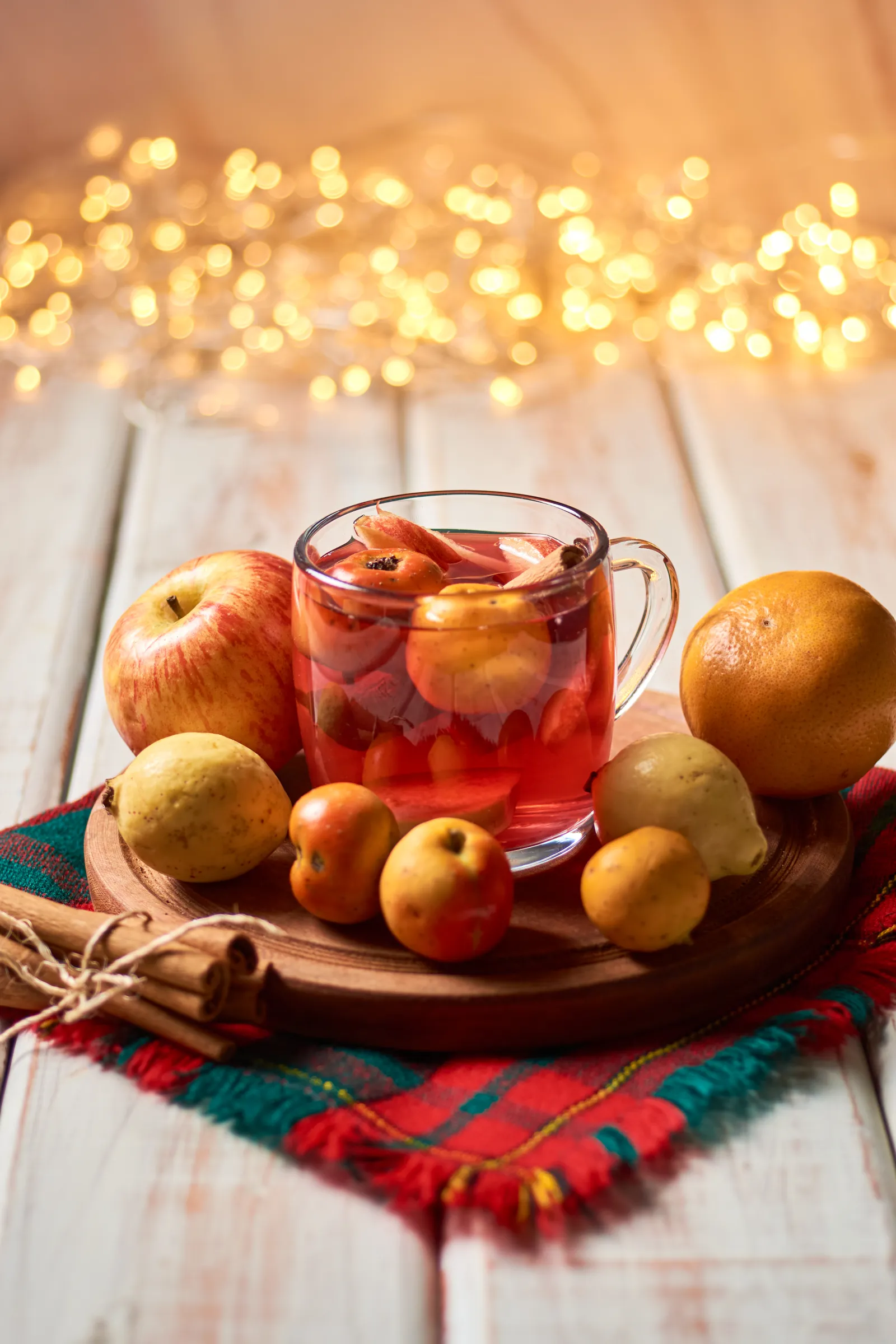

Ponche navideño (PON-cheh nah-vee-DEH-nyoh) is what fills the big pot at a Mexican posada, the nine nights of neighborhood Christmas parties from December 16 to 24: a hot, ruby-red punch of fruit, raw cane sugar and cinnamon, ladled into clay mugs with a chunk of every fruit and a stick of sugarcane to chew. The fruit you won’t know is the tejocote, a small orange Mexican hawthorn that turns tender and perfumed after 50 minutes in the pot. Everything here is about getting each fruit to the finish line at the same time, and about what to do in a US or UK kitchen when tejocotes are nowhere to be found.
What is ponche navideño, and is it worth making?
How do you make Mexican Christmas punch? Simmer 5 liters (21 cups) of water with 300 g (10.5 oz) piloncillo, cinnamon and tamarind until the sugar dissolves, then add hibiscus steeped separately. Add fruit by firmness: peeled tejocotes and sugarcane for 25 minutes, prunes for 10, guava and apple for the last 15, always at a gentle simmer. 90 minutes for 20 servings.
It’s a fruit punch you eat with a spoon as much as drink. Think mulled cider without the cider: the base is water, sweetened with piloncillo (unrefined cane sugar with a molasses edge) and soured with tamarind and hibiscus, and the fruit stays in the mug. It has nothing to do with Venezuelan ponche crema, which is a cold eggnog-style liqueur; the shared word is the only link.
Worth it when you’re feeding a crowd. One pot makes 20 mugs, the shopping is cheap, and doubling it to 40 is barely more work. Kids drink it too, since the alcohol is added mug by mug.
Skip it when you’re cooking for two (fruit is sold by the piece, so the recipe doesn’t shrink well below 8 cups) or watching sugar closely: a cup carries about 15 g of sugar from the piloncillo alone, plus what’s in the fruit. There’s a no-added-sugar version below.
Time and effort. 90 minutes on the clock, about 35 of them hands-on, nearly all of it peeling tejocotes and sugarcane. Easy, as long as you respect the order and keep the simmer gentle.
Tejocotes, what they are and how to get them
Tejocotes are the fruit of a Mexican hawthorn, Crataegus mexicana (US agencies list it as Crataegus pubescens), the same genus as the hawthorn hedges of Britain but with fruit the size of a cherry tomato, 2 to 3 cm (about 1 in) across. Raw they’re mealy and sour, with a slightly bitter skin and three to five hard seeds. Cooked, they hold their shape and taste somewhere between a tart apple and a quince.
Can you buy them in the US?
Yes, though not for long. Fresh Mexican tejocotes couldn’t legally be imported into the US until the USDA’s Animal and Plant Health Inspection Service (APHIS) authorized them, effective March 30, 2015, for the continental United States, with three conditions: commercial shipments only, a phytosanitary certificate from Mexico stating the fruit was inspected and found free of pests, and inspection at the port of entry. A bag in your suitcase is not a commercial shipment, so it isn’t allowed in.
In practice: fresh tejocotes show up in Mexican and Latin markets in December, sold by the pound. Frozen tejocotes (often already peeled) and jarred tejocotes in syrup are on Latin supermarket shelves most of the year.
And in the UK?
I couldn’t find a UK shop selling them fresh. Bringing them home yourself isn’t simple either: the UK has its own plant health rules for fresh fruit carried in from abroad, so check GOV.UK before packing any, and across the EU a phytosanitary certificate has been required since December 14, 2019 for almost any fresh fruit from outside the bloc, luggage included, with five exceptions (pineapple, banana, coconut, durian and dates). Your realistic option is jarred tejocotes in syrup from a Mexican online grocer, or a substitute.
What each swap changes.
- Frozen tejocotes → the best fallback. Add them at minute 50, 10 minutes after fresh.
- Jarred in syrup → already cooked. Drain, rinse and add for the last 10 minutes, and cut the piloncillo by 50 g (1.75 oz), since the syrup sweetens.
- Quince → my pick in the UK. Peel and cut into 2 cm (¾ in) cubes; it goes in at minute 40 like the real thing and holds up for 50 minutes. Use 300 g (10.5 oz).
- Crab apples → closest in size and tartness, a fall fruit in both countries. Halve and seed them.
- Bosc pear → sweet, no tang. Add it with the guava. It’s the flattest option.
The shopping list, with US and UK names
The amounts are in the recipe card, for 20 cups of 250 ml (about 8½ fl oz), roughly 5 liters (5.3 quarts) with the fruit.
| What the recipe says | What it is | US | UK | If you can’t find it |
|---|---|---|---|---|
| Piloncillo | unrefined cane sugar cone | Latin aisle, Walmart | Latin grocers; panela or jaggery | dark brown sugar, 1 to 1 by weight |
| Caña (sugarcane) | fresh cane, peeled into sticks | Latin markets, also canned or vacuum-packed | Asian and Caribbean grocers | leave it out; slightly less sweet |
| Flor de jamaica | dried hibiscus calyces | Latin aisle | tea shops, as hibiscus | 4 hibiscus tea bags |
| Tamarindo | tamarind pods | Latin and Asian grocers | Asian grocers | 50 g (1.75 oz) block pulp, dissolved |
| Guayaba | guava | Latin markets, frozen halves | larger supermarkets, Asian grocers | frozen halves, added frozen |
| Canela | Ceylon cinnamon | Mexican spice bags | as Ceylon cinnamon | one stick of cassia, it’s stronger |
The hibiscus here is the same flower used for agua de jamaica, the cold hibiscus water, so a bag bought for the punch won’t go to waste.
You’ll need an 8 liter (8 quart) pot, a heavy knife for the cane, a bowl and a ladle. No pot that big? Split everything between two 5 liter (5 quart) pots.
How to time the fruit
The whole trick is that every fruit finishes together. Tejocotes and cane take 50 minutes, prunes 25, guava and apple 15. The first half hour is prep; after that you add fruit three times and keep an eye on the simmer.
How to tell it’s going right
| Stage | What you should see |
|---|---|
| Sugar, 10 min | nothing solid left on the bottom; amber water |
| Hibiscus, 10 min steep | deep burgundy; the pot turns red when you strain it in |
| Tejocotes, 25 min in | starting to give; by the end a fork slides in and they’re still round |
| Simmer | small bubbles at the edge, never a rolling boil |
| Sweetness | taste at the end; cane and fruit sweeten as they cook. Short? Add 50 g (1.75 oz) piloncillo, 5 minutes |
Batch sizes for 8, 20 and 40 cups
| Ingredient | 8 cups | 20 cups | 40 cups |
|---|---|---|---|
| Water | 2 L (8½ cups) | 5 L (21 cups) | 10 L (10.5 qt) |
| Piloncillo | 120 g (4.2 oz) | 300 g (10.5 oz) | 600 g (1.3 lb) |
| Cinnamon sticks, 10 cm (4 in) | 1 | 2 | 4 |
| Tamarind pods | 40 g (1.4 oz) | 100 g (3.5 oz) | 200 g (7 oz) |
| Dried hibiscus | 8 g (⅓ cup) | 20 g (¾ cup) | 40 g (1½ cups) |
| Tejocotes | 200 g (7 oz) | 500 g (1.1 lb) | 1 kg (2.2 lb) |
| Sugarcane | 200 g (7 oz) | 500 g (1.1 lb) | 1 kg (2.2 lb) |
| Prunes | 60 g (2 oz) | 150 g (5.3 oz) | 300 g (10.5 oz) |
| Guava | 200 g (7 oz) | 500 g (1.1 lb) | 1 kg (2.2 lb) |
| Apples | 1 | 2 | 4 |
| Pot | 4 L (4 qt) | 8 L (8 qt) | 16 L (17 qt), or two 8 L |
For 40 cups in two 8 liter pots, the timings don’t change. In one 16 liter stockpot, the water takes about 15 minutes longer to boil, and I give the tejocotes 10 extra minutes.
A make-ahead plan for Christmas Eve
- Two days before → buy the fruit. Tejocotes keep in the fridge; very ripe guavas are better bought the day before.
- The day before → blanch and peel the tejocotes, peel and cut the cane, shell the tamarind. Refrigerate, covered. That’s the 30 minutes of prep out of the way.
- On the day, 75 minutes before guests → water, sugar, cinnamon and tamarind on the stove, then follow the card. Cut the apples at the last moment so they don’t brown.
Keeping it hot through the party
The USDA Food Safety and Inspection Service (FSIS) says hot food held for serving should stay at 140°F (60°C) or above. With ponche, safety is the easy part; the real issue is that the fruit keeps cooking.
- On the stove, lowest heat, lid on → steaming, no bubbles. Fine for about 3 hours.
- Slow cooker on warm or low → best for a long night. Transfer the finished punch; don’t try to cook it from cold in a slow cooker the same day.
- Guava in two rounds → for parties past 3 hours, cook half the guava with the batch and add the rest 15 minutes before the second round.
- Top up the water → if the level drops by more than a finger’s width, I add a cup of hot water and taste again.
Spiked, no added sugar, or for the kids?
Spiked. My measure is 30 ml (1 fl oz) of rum, brandy or tequila per 250 ml cup, poured into the mug. The US National Institute on Alcohol Abuse and Alcoholism (NIAAA) defines a standard drink as 1.5 fl oz (44 ml) of 80-proof spirits, 14 g of pure alcohol, so each spiked cup is about two-thirds of a standard drink. Go to 1.5 fl oz (44 ml) and it’s a full one; I wouldn’t go higher. Count on 25 cups from one 750 ml bottle at 1 fl oz each.
Why not pour it into the pot? Ethanol boils at 173°F (78°C) and the punch sits between 176 and 212°F (80-100°C). In the USDA’s nutrient retention tables, alcohol stirred into a boiling liquid and taken off the heat keeps about 85 %, and after an hour of simmering about 25 % is left. You’d have no idea what’s in each mug, and the kids can’t drink from that pot anymore.
No added sugar. Leave out the piloncillo. The cane, prunes and apple sweeten it enough for many people; if it tastes sharp, add 100 g (3.5 oz) more prunes. A cup drops from about 126 to about 69 kcal. The fruit and cane still bring natural sugar, so if you manage diabetes, treat it as a sweet drink, not a free one.
For the kids. The unspiked punch is the kids’ version. Give them more fruit and less liquid, and skip the cane stick for little ones: it’s hard and fibrous.
Spice and allergens. No heat at all; the cinnamon is aroma, not spice. No gluten, dairy, eggs or nuts.
Mistakes I’d avoid.
- Cloudy punch, broken guava → guava went in early or the pot boiled hard. Last 15 minutes, gentle simmer.
- Hard tejocotes → not enough time. Fresh need 50 minutes; frozen, 40.
- Bitter → blanching water in the pot, skins left on, or hibiscus steeped in the pot for the whole hour.
- Too sweet → piloncillo cones vary. Start with 250 g (8.8 oz) and adjust at the end.
What it costs
In Mexico this is a cheap pot. At Mexico City’s Central de Abasto, the government’s market information service SNIIM recorded the most common wholesale prices on December 17, 2025 at 17.69 pesos per kilo for tejocotes, 32.50 for guavas and 32.63 for Red Delicious apples. The fresh fruit for 20 cups comes to 38.15 pesos, under 2 pesos a cup. Tejocotes are the cheapest fruit in the pot there.
In the US, the Bureau of Labor Statistics put sugar at $1.024 a pound in August 2026, which I use as a stand-in for piloncillo: the 10.5 oz (300 g) here is about $0.68. The BLS doesn’t track tejocotes, guavas, sugarcane or tamarind, so I can’t give you an honest total. What drives the price outside Mexico is the tejocotes, especially jarred ones, and the cane.
Yield. About 5 liters (5.3 quarts) with the fruit: 20 cups of 250 ml (8½ fl oz) or 25 smaller 200 ml (7 fl oz) mugs.
How it tastes, what to serve with it, and how to store it
Taste and texture. A clear, ruby broth, molasses-sweet with a sour edge from tamarind and hibiscus, cinnamon in the background. In the mug, soft perfumed tejocotes, guava that melts, tender apple, plump prunes and a stick of cane to chew.
What to serve with it. At a posada it sits next to tamales and a stack of crispy Mexican buñuelos; Mexican green chicken tamales are a classic pairing. For something thicker and chocolatey there’s champurrado, and for the adults who need caffeine at midnight, café de olla uses the same piloncillo and cinnamon. In January the pot comes back out for rosca de reyes, and at my own mixed Venezuelan-Colombian table it shares the night with Colombian buñuelos.
Fridge. Leftover rules, according to the USDA’s FSIS: no more than 2 hours at room temperature, then 3 to 4 days in the fridge. I store it with the fruit in covered jugs; it’s very good cold the next day.
Freezer. FSIS gives 3 to 4 months for frozen leftovers. The liquid freezes well; the guava and apple turn soft. Strain and freeze the liquid, then add fresh fruit when you reheat.
Reheating. Over medium-low heat to 165°F (74°C), the FSIS reheating temperature, without a hard boil. In the microwave, mug by mug in 1-minute bursts. Spike after heating.
Frequently asked questions
What does tejocote taste like? Raw, sour and mealy. Cooked for 50 minutes, it’s tender and fragrant, like a cross between a tart apple and a quince.
What can I use instead of tejocotes? Frozen or jarred tejocotes first. Otherwise quince cubes, which hold their shape and perfume, or crab apples for tartness.
Can I bring fresh tejocotes from Mexico in my luggage? No. APHIS allows fresh tejocotes from Mexico only in commercial shipments with a phytosanitary certificate and port inspection.
How much rum goes in ponche? 1 fl oz (30 ml) per 250 ml cup, poured into the mug: about two-thirds of a standard drink. One bottle covers 25 cups.
Does the alcohol cook off if I add it to the pot? Only partly. USDA retention data show about 25 % left after an hour of simmering, and no way of knowing what each mug holds.
How much ponche for 40 people? 10 liters (10.5 quarts) of water, 600 g (1.3 lb) piloncillo, 1 kg (2.2 lb) each of tejocotes, cane and guava, 4 apples, 300 g (10.5 oz) prunes, 200 g (7 oz) tamarind, 40 g (1½ cups) hibiscus and 4 cinnamon sticks, in two 8 liter pots.
Can I make it the day before? Yes. Refrigerate it and reheat to 165°F (74°C); the fruit softens and the flavor deepens.
How long does it keep? Three to four days in the fridge, by FSIS guidance, if it’s chilled within two hours.
Nutrition per cup
Per 250 ml (8½ fl oz) cup with its share of fruit, unspiked, calculated from USDA FoodData Central (SR Legacy) using this recipe’s amounts. Brown sugar stands in for piloncillo and crab apple for tejocote, which isn’t in the database; I count half the tamarind weight as pulp and leave out the cane, which you chew and discard.
- Calories: 126 kcal
- Protein: 1 g
- Carbohydrates: 32 g
- Fat: 0 g
- Fiber: 3 g
- Sodium: 6 mg
Take out the piloncillo and a cup falls to about 69 kcal: the cane sugar accounts for about 57 kcal and 15 g of sugar per cup. A 1 fl oz (30 ml) shot of 80-proof rum adds about 65 kcal. If you drink the liquid and leave the fruit, the numbers drop, though I can’t say by how much.
Where I grew up in Venezuela, “ponche” meant the bottle of ponche crema in the fridge, so a punch you eat with a spoon was new to me as an adult. The hardest part was patience: leaving the guava on the board until the last 15 minutes, even when the pot looks empty. Josnaisis.