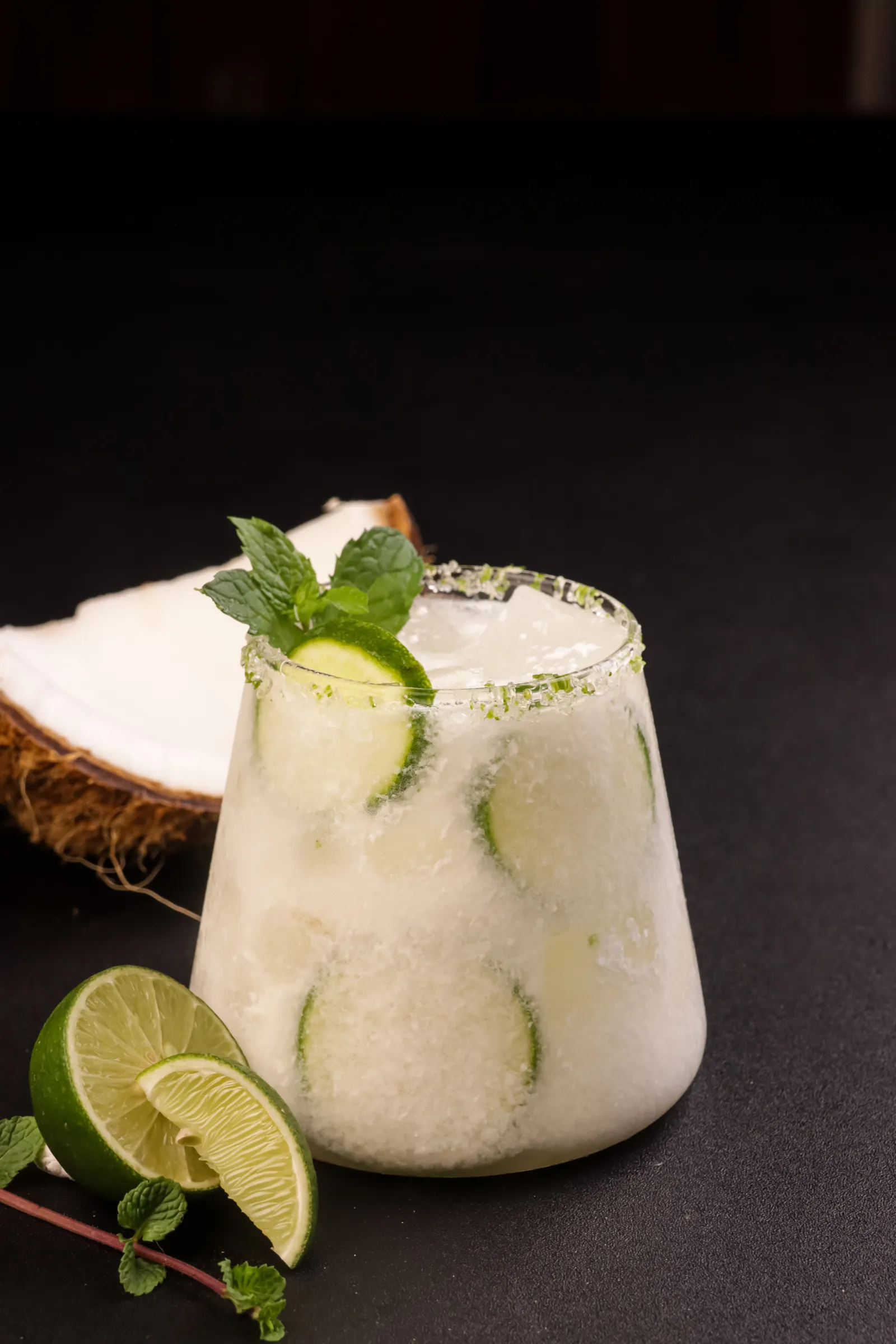

The “lemonade” in Colombian coconut lemonade is made with limes. In Colombia the green Persian lime is called limón, so limonada de coco is, to an English speaker, a frozen coconut limeade: cream of coconut, fresh lime juice and a lot of ice, blended until it’s thick and white with a froth on top. On Colombia’s Caribbean coast it’s what you drink with fried fish, and the Cartagena newspaper El Universal calls it the city’s unofficial welcome drink. The part that trips people up outside Colombia is the coconut product on the shelf, so that’s where this recipe spends its time.
Is Colombian coconut lemonade worth making?
How do you make Colombian coconut lemonade? Blend 200 g (⅔ cup) of cream of coconut with 120 ml (½ cup) of lime juice, a teaspoon of lime zest, 300 ml (1¼ cups) of cold water and a pinch of salt for 10 seconds, then add 400 g (14 oz) of ice and blend on high for 30 to 40 seconds until thick and frothy. Serve right away. 10 minutes for 4 servings.
If you have a blender and a can of cream of coconut, yes: it takes 10 minutes, no stove and six ingredients. It tastes like a virgin piña colada with the pineapple swapped for lime, sweet coconut first and a sharp, clean finish.
It’s worth knowing what it isn’t. At 186 calories a glass it’s a treat, not a thirst-quencher, about twice a plain limeade. It doesn’t keep once blended, so it’s a make-and-pour drink. And there’s no stand-in for coconut if someone can’t have it.
Cream of coconut, coconut milk or coconut cream?
Use cream of coconut if you can find it; if not, coconut milk plus 90 g (scant ½ cup) of sugar gets you nearly the same drink. These are three different products and US and UK shelves put them side by side:
- Cream of coconut is the sweetened, syrupy one sold for piña coladas. It carries 357 calories, according to the USDA, with 51.5 g of sugar per 100 g, so it’s already sweetened for you. This is what’s used in Cartagena.
- Coconut milk (canned, full-fat) is unsweetened and pourable, with about 21 g of fat per 100 g. Use 200 ml (a generous ¾ cup) with 200 ml water and 90 g sugar.
- Coconut cream (canned, unsweetened) is the thick, richer cousin of coconut milk, about 35 g of fat per 100 g. Use 120 g (½ cup) with 280 ml water and 90 g sugar.
A UK trap. A hard white block labelled creamed coconut is none of the above: it’s dried coconut meat ground to a paste. It’s unsweetened and has to be dissolved in hot water first. It works in a pinch if you treat it like unsweetened coconut cream and add sugar, but the drink is grainier.
What you need, with US and UK swaps
For 4 glasses of about 270 ml (9 fl oz): 200 g (⅔ cup) cream of coconut, 120 ml (½ cup) lime juice, 300 ml (1¼ cups) water, 400 g (14 oz) ice, plus zest and salt. If you’d rather think in proportions, it’s 1 part cream of coconut, ¾ part lime juice and 2 parts water by volume, with about 400 g of ice for every 580 ml (2½ cups) of that base. One batch makes a little over 1 liter (1 quart).
Where to buy cream of coconut. In the US it sits with the cocktail mixers, in 15 oz (425 g) cans or squeeze bottles; Latin grocery stores always have it. In the UK, look on the cocktail-mixer shelf of larger supermarkets or order from a specialist online grocer. If the only coconut you can find is in the Asian aisle, it’s almost certainly unsweetened.
Which citrus. The Colombian limón Tahití is the same fruit as the ordinary Persian lime in a US or UK supermarket. By USDA figures one lime gives about 44 g (3 tbsp) of juice, so 3 large limes cover the batch; buy 4 in case one is dry.
Equipment. A blender of at least 1.5 liters (6 cups) that can crush ice, a juicer, a fine grater and a small strainer. No fine grater? Peel a strip of green zest with a vegetable peeler, no white, and blend it with the base.
How to make it, and how to tell it’s right
Blend the base first, ice second. If everything goes in together, the ice breaks up before the cold cream of coconut has mixed in and you get little beads of coconut stuck to the jar.
- The base should be opaque white with no clear streaks, and taste too sweet and too sour on its own.
- The ice is done when, after 30 to 40 seconds on high, you stop hearing it rattle and the surface is white with a fine foam.
- The texture should pull up a straw with a little effort, like a thin milkshake.
- The taste goes coconut first, lime last. A bitterness that lingers on the tongue means pith or seeds got in.
The ice ratio that gives the frozen texture
400 g (14 oz) of ice per 580 ml (2½ cups) of base is the slushy, frothy texture you get on the coast. Less ice and it’s a cold drink you pour over cubes; around 600 g (21 oz) the blender stalls, you add water to free it, and the flavor thins out. If your blender struggles with cubes, use crushed ice, or blend with 200 g of ice and pour over another 200 g in the glasses. You lose the froth, not the flavor.
Who this recipe is for
- If you’ve never had it → make the cream of coconut version first; it’s the reference taste.
- If you only have coconut milk → 200 ml milk, 200 ml water, 90 g sugar, same method.
- If you’re cooking for kids → coconut milk with 60 g (5 tbsp) of sugar instead of 90 g; it isn’t spicy and it’s usually a hit.
- If you’re hosting → the party plan below; the only last-minute job is blending.
Making it for a party of 12 to 20
Don’t scale the batch in the blender; repeat it. A 1.5-liter blender packed with more ice leaves chunks. For 20 glasses that’s 5 batches, three 15 oz (425 g) cans of cream of coconut, about 600 ml (2½ cups) of lime juice, 1.5 liters (6⅓ cups) of water and 2 kg (4½ lb) of ice.
Make-ahead. The day before, juice and strain the limes and keep the juice covered in the fridge at 40°F (4°C) or below; chill the cans and the water. Up to 4 hours ahead, I measure each batch’s base (cream of coconut, juice, zest, water, salt) into its own jar and refrigerate it. At serving time I shake a jar, tip it into the blender with 400 g of ice, and pour. Lime juice also freezes well in an ice-cube tray, 30 ml (2 tbsp) per cube.
Mistakes, bitterness and why it separates
Why it turns bitter. Bitterness comes from the white pith and the seeds. This version uses only green zest, which carries the fragrant oils, and strained juice, so the base can sit in the fridge without turning. Blending whole limes, rind and all, is a different technique that only works against the clock, as in the Colombian lemonade with condensed milk, blended whole for 12 seconds.
Why it separates. Coconut fat turns solid below about 75°F (24°C). With all that ice it forms tiny flecks that float up, the foam collapses and the ice melts. In my kitchen a clearer layer shows at the bottom after 10 to 15 minutes. Nothing is wrong with it; 5 seconds in the blender fixes it.
Other mistakes.
- Cloying → it was cream of coconut and you added sugar too. Stir in 100 ml (scant ½ cup) cold water and 1 tbsp lime juice.
- Bland and watery → it was coconut milk with no sugar, or you used only the thin liquid from an unstirred can.
- Lumps of coconut → the cream was fridge-cold and not stirred, or the ice went in first.
- Watered down at the table → it was blended too early. Blend each batch as you serve.
Allergens. Coconut. No dairy, gluten or egg; some cans of cream of coconut contain stabilizers and emulsifiers, so read the label if that matters at your table.
Which version should you make?
- Sugar-free → canned coconut milk, no sugar, or your usual sweetener to taste. About 100 calories a glass. Cream of coconut can’t be made sugar-free; the sugar is in the can.
- Lighter → 150 g (½ cup) cream of coconut and 350 ml (1½ cups) water; thinner, about 141 calories a glass.
- Fresh coconut → blend the flesh of one coconut with its water and 500 ml (2 cups) warm water, strain hard and use that milk like canned, sweetened to taste. The cleanest coconut flavor, 20 minutes more work.
- With rum → 30 ml (1 oz) white rum per glass, added with the ice. Adults only.
Next to the condensed milk lemonade, this is a different drink: that one is sharp and light at 95 calories and tastes of lime peel; this one is thick, coconut-first and twice the calories. For something tart from the same coast with no coconut at all, try Colombian lulo juice.
What it costs
The can is the cost. In Colombia, the 425 g (15 oz) can of sweetened cream of coconut was 25,250 pesos at the Éxito supermarket’s online store on 11 October 2026, so the 200 g in one batch is about 11,900 pesos, more than 90% of the jug; the limes cost 808 to 941 pesos at wholesale, from the SIPSA-DANE bulletin for 12-18 September 2026. In the US the BLS average price survey tracks lemons (2.11 dollars a pound in August 2026) but not limes or cream of coconut, so I can’t give you a verified US total. Compare cans by price per ounce; one opened can keeps 3 to 4 days in the fridge in a non-metal container, the USDA FSIS window for opened low-acid canned food.
What to serve it with, and how long it keeps
On the coast it comes in a tall glass with a straw next to fried fish, a Colombian seafood stew or Cartagena’s sweet-and-sour posta negra. The coconut echoes the golden Colombian coconut rice that sits beside all of those, toasted and salty there, cold and sweet here. As a snack, it works with stuffed cassava fritters called carimañolas or a Colombian egg arepa.
Storage. Drink it within 15 minutes. Leftovers can go into the fridge covered and be re-blended with a little ice the same day; out of the fridge, 2 hours at most, the USDA FSIS limit for perishable food. Don’t freeze it once blended: the coconut fat thaws into grains.
Frequently asked questions
Is coconut lemonade made with lemons or limes? Limes. In Colombia the green Persian lime is called limón, so the drink is a coconut limeade. Lemons work but taste different.
Can I use coconut milk instead of cream of coconut? Yes: 200 ml (¾ cup) coconut milk, 200 ml water and 90 g (scant ½ cup) sugar per 4-glass batch.
What’s the difference between cream of coconut and coconut cream? Cream of coconut is sweetened, with 51.5 g of sugar per 100 g by USDA data. Coconut cream is unsweetened and richer in fat.
How many calories are in a glass? 186 calories for a 270 ml (9 fl oz) glass made with cream of coconut; 100 calories sugar-free with coconut milk.
Can I make it ahead? The base without ice, yes, up to 4 hours in the fridge. Blend with ice just before serving.
Why did mine turn bitter? White pith or seeds got in. Use green zest only, strain the juice and don’t twist the rinds when juicing.
Can I add alcohol? 30 ml (1 oz) of white rum per glass, blended in with the ice.
Nutrition
Per glass of about 270 ml (9 fl oz), a quarter of the cream of coconut batch, worked out ingredient by ingredient from USDA SR Legacy data:
- Calories: 186
- Protein: 1 g
- Carbohydrates: 29 g, of which sugars 26 g
- Fat: 8 g, of which saturated 8 g
- Sodium: 48 mg
The cream of coconut supplies 714 of the batch’s 745 calories and almost all the sugar. The ratio most often printed in English, a full cup (296 g) of cream of coconut for two glasses, comes to roughly 540 calories a glass.
I grew up in Venezuela drinking lime with sugar and water, nothing else, so my first glass of this on the Colombian coast tasted like dessert to me. What won me over was how the lime cuts through at the end of each sip. Now when people come over, the jars of base are lined up in my fridge by noon and the blender does the rest. Josnaisis.