Eight people, 3.3 lb of beef in a single piece and a pan of sugar taken to the edge of burning: that is the whole idea. The 5 oz of panela melt alone in a dry pan and climb to about 365 °F, and that single step hands the dish both its dark color and the faintly bitter backbone that sets it apart from every other beef in sauce. After that it is 150 minutes of covered braising and 20 of resting. It is the party dish of Cartagena, on Colombia’s Caribbean coast, and 3.3 lb of eye of round feeds 8 people at 340 calories and 44 g of protein a plate.
How do you make Colombian posta negra? Marinate a whole piece of eye of round for 12 hours, sear it on every face, then caramelize panela to dark amber. Add the sofrito to the caramel, return the beef with stock and braise covered for 150 minutes. Rest 20 minutes and slice across the grain. 210 minutes for 8 servings.
What posta negra is
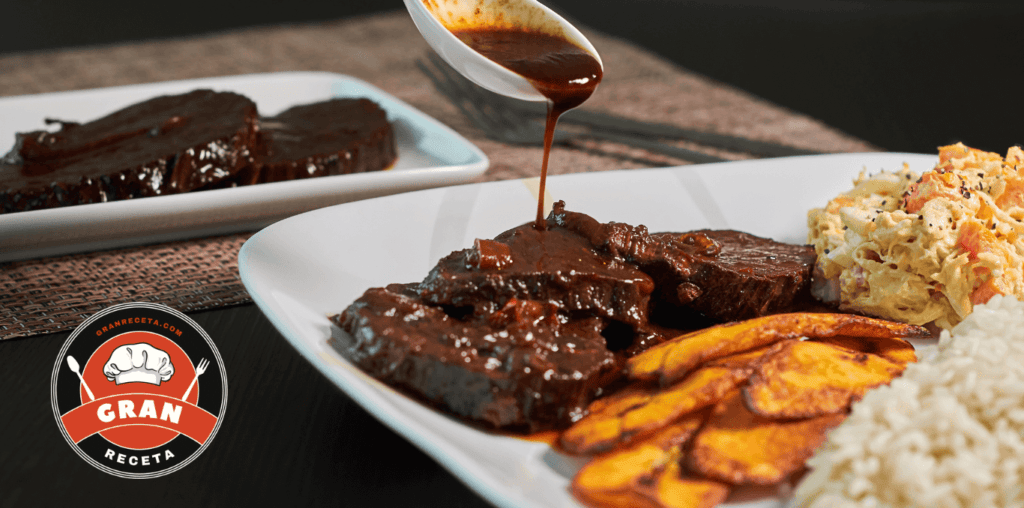
Posta is the Colombian word for a lean whole cut of beef, and negra describes what the sugar does to it. On the Caribbean coast this is what comes out on a platter at a birthday or a christening, 8 servings sliced and fanned out under its sauce, next to coconut rice and fried sweet plantain.
It carries no chili at all and no smoke. The flavor runs sweet, then dark, then savory, and the texture is the point: ⅜-inch slices that hold together, rather than the pulled strands an American pot roast gives.
The caramel, and the 25 °F that decide everything
Panela melts in a dry pot and passes through three stages within a few minutes: liquid, amber, then dark amber. At that last point, around 365 °F, the sugar has developed the bitterness the dish needs. Push it 25 °F further and it smokes black, the bitterness turns dry and harsh, and there is no fixing it: wash the pot and start over.
So you watch rather than time it. The caramel announces itself by color and by smell, which shifts from sweet to toasted, and the moment it arrives the vegetables go in all at once to drop the temperature and stop the sugar cooking. It spits, so have them chopped and within reach before you start.
Which cut to buy
Ask for eye of round, whole and untrimmed of its shape, roughly 3.3 lb. It is the same muscle Colombians call muchacho or centro de pierna: very lean, with a long straight grain that slices cleanly, which is exactly what this dish needs.
What you should not substitute is chuck. A chuck roast has the marbling that makes pot roast fall apart, and falling apart is the one thing posta must not do. Top round and bottom round both work; rump works if you trim the fat cap. Anything fatty turns this into a different, looser dish.
Twelve hours of marinade, and why the piece stays whole
A 3.3 lb piece is about 3 inches thick, and seasoning does not cross that in an afternoon. Twelve hours in the fridge is what garlic, cumin and vinegar need to reach the middle, and you taste it at the table: the slice is seasoned at the center, not just at the rim.
It stays whole for the same reason a roast does. Cut into chunks, lean beef gives its juice to the liquid and dries out; whole, those 3.3 lb cook in their own moisture and keep it until the knife goes in.
The braise and the rest
One hundred and fifty minutes, covered, over low heat, with liquid halfway up the piece and a turn every half hour. Eye of round carries just 2.52 g of fat per 100 g according to the USDA, so what tenderizes it is not fat but time: collagen turns to gelatin and the fiber gives.
Then 20 minutes of rest before slicing, which is not a garnish of a step. Juices redistribute inside the meat as it cools slightly; cut it immediately and that juice runs onto the board. Slice across the grain, ⅜ inch thick, so each slice has short fibers and gives way rather than resisting.
Who this recipe is for
- If your butcher has no eye of round → top or bottom round work; keep the piece under 3 inches thick
- If you have no panela → 5 oz of dark brown sugar makes the same caramel with less molasses depth
- If you burn the caramel → wash the pot and start again; that bitterness cannot be covered
- If you use a pressure cooker → 50 minutes at pressure replaces the 150, though the sauce comes out thin and needs reducing separately
- If you want it for a party → make it the day before; sliced in its sauce it is better on day two
Make ahead, storage and reheating
This is one of the rare dishes that genuinely improves overnight. Cooked whole, cooled in its sauce and refrigerated, it keeps 4 days, within the 3 to 4 day window the USDA gives cooked dishes, and the slices absorb sauce as they sit.
Reheat the slices in the sauce over low heat, covered, about 10 minutes. It also freezes well for 3 months, which almost nothing else in this style does, because the sauce protects the lean meat from drying. Thaw overnight in the fridge before reheating.
Posta negra, pot roast and brisket
If you have made a pot roast, the method will feel familiar and the result will not. A pot roast leans on a fatty cut and rewards you with shreds; this one uses the leanest cut in the round and rewards you with slices.
The color is the other difference. Brisket takes its darkness from tomato or barbecue sauce, a pot roast from browning and stock, and this one from sugar alone, which is also why it tastes faintly of molasses underneath the savory layers.
What goes wrong
Burnt caramel. The most expensive mistake, because it poisons the whole pot with a dry bitterness.
Slicing it hot. The juice ends up on the board and the meat is dry after two and a half correct hours.
Slicing with the grain. Stringy slices, however tender the meat is.
Braising uncovered. The liquid evaporates, the top of the piece sits above it and dries out.
Salting early. The soy in the marinade already brings about 500 mg of sodium; salt at the end, once the sauce is reduced.
Variations
With cola. Half a bottle replacing some of the stock, a widespread coastal habit. It adds sugar and acidity and shortens the braise slightly.
With prunes. Eight or ten in the last 30 minutes, dissolving into the sauce and thickening it.
With dark beer. Replacing about ¾ cup of the stock, reinforcing the caramel’s bitterness.
Pressure cooker. Fifty minutes at pressure, with the sauce reduced separately afterwards.
What to serve with it
In Cartagena this comes with Colombian coconut rice and fried ripe plantain, about 6 oz of beef a person, which is sweet against sweet-bitter. Plain white rice works too if the sauce is already sweet enough for you.
As a starter, Colombian patacones or Colombian carimañolas, and for a full coastal menu the Colombian seafood stew first and the posta after is the order you see on the coast. To drink, cold Colombian aguapanela with lime.
Frequently asked questions
Why is it called posta negra? Because of the color the panela caramel gives the meat. No coloring or bottled browning sauce is involved.
What cut is posta? Eye of round, the muscle Colombians call muchacho: lean, long-grained and cooked as one whole piece.
Can I skip the marinade? You can, but it shows. In a 3-inch-thick piece, unrested seasoning stays near the surface.
How long does it cook? One hundred and fifty minutes covered over low heat, or 50 minutes at pressure.
Why did mine come out dry? Almost always from slicing without resting, or from braising uncovered. A lean cut forgives neither.
Nutrition
Per serving, an eighth of the piece with its sauce, calculated with the USDA database for the beef, panela and vegetables:
- Calories: 340 kcal
- Protein: 44 g
- Carbohydrates: 21 g
- Fat: 9 g, of which 2 g saturated
- Fiber: 1 g
- Sodium: 520 mg
This is one of the highest-protein-per-calorie dishes on the site, because eye of round is about as lean as beef gets: per the USDA it carries 2.52 g of fat and 23.41 g of protein per 100 g. The carbohydrate is almost entirely the 5 oz of panela spread across 8 servings, which is where the 17 g of sugar a plate comes from.
The first time I made posta negra I burnt the caramel twice and then pulled it too early on the third try, ending up with brown sweet beef that was not the dish at all. What fixed it was putting the timer away and using my nose: when the smell stops being sweet and turns toasted, that is the moment, and it lasts a few seconds. Josnaisis.