

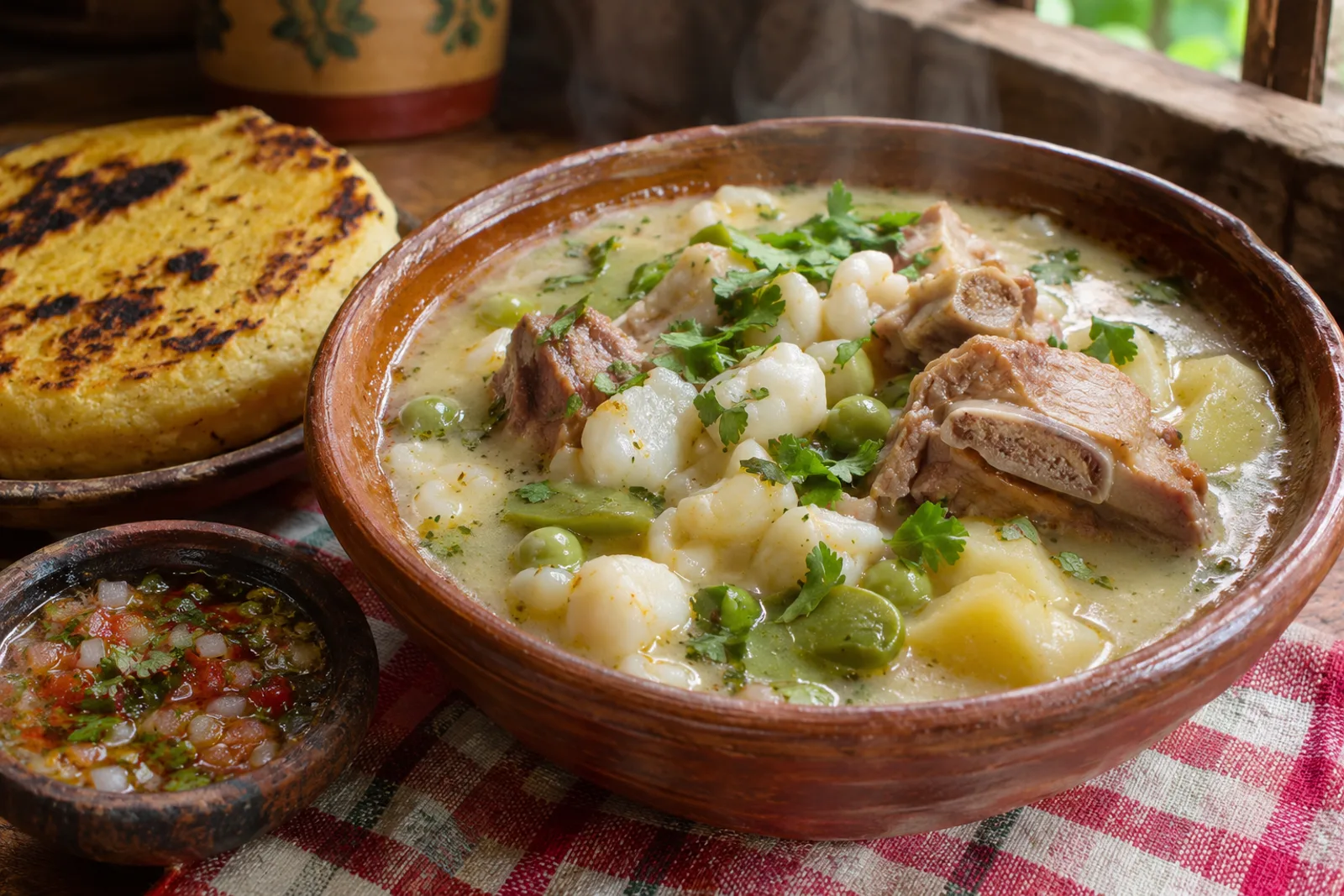

Mute boyacense (MOO-teh boh-yah-SEN-seh) is a thick Colombian soup of whole white corn, beef ribs, pork neck bones, potatoes, fava beans and peas. The corn looks like hominy, and canned hominy will do the job, but in Colombia it’s usually a plainer grain, machine-hulled rather than lime-treated, so it tastes of corn rather than of tortilla. It soaks overnight and then simmers for three and a half hours, and every other ingredient in this pork, beef and fava bean soup is timed backward from that. This recipe fills a 12-quart pot for 10 bowls and is written for a cook in the US or UK: which corn to buy, when each thing goes in, a pressure-cooker shortcut and how to scale it for 20 or 40.
What Boyacá mute is, and how long it takes
How do you make mute boyacense? Soak 1.1 lb (500 g) of dried white corn for 12 hours, then simmer it in 4¼ quarts (4 liters) of water with scallions and garlic. Counting from the boil, add beef ribs at minute 60, pork neck bones at 105, potatoes, squash and carrot at 150, and fava beans, yellow potatoes and peas between 180 and 190. Turn off the heat at 210 and rest with cilantro. 250 minutes for 10 servings.
Mute is a thick whole-corn soup from Colombia’s Andean highlands, in Boyacá and Santander, eaten as a full lunch in one deep bowl. The Boyacá version is the gentler of the two: beef and pork on the bone, two kinds of potato, and fresh fava beans and peas, all in a broth that the melting potatoes and squash thicken to a gold, spoon-coating soup. No chile, no tomato sofrito.
If you know the Santander-style Colombian mute with tripe, here is how the two compare:
Time. 250 minutes on cooking day, about 40 of them hands-on, plus 10 minutes the night before to start the soak. Medium difficulty: nothing is technically hard, but the order matters.
It belongs with the soups and stews of the food of Bogotá and Boyacá, a high, cold region where potatoes, corn and fava beans go into almost every pot.
Ingredients, and what to buy in the US and UK
Each of the 10 bowls is about 750 g (1⅔ lb) of broth, corn, potato and a piece of each meat.
| Ingredient | Metric | US | Notes and swaps |
|---|---|---|---|
| Dried white corn | 500 g | 1.1 lb | See the corn chart below |
| Beef short ribs | 750 g | 1⅔ lb | Cut through the bone in 2 in pieces |
| Pork neck bones | 750 g | 1⅔ lb | UK: pork ribs or bones from the butcher |
| Floury potatoes | 600 g | 1⅓ lb | Russet, Yukon Gold; UK Maris Piper |
| Papa criolla | 400 g | 14 oz | Frozen in Latin shops; small yellow potatoes |
| Butternut squash | 300 g | 10½ oz | Stands in for Colombian ahuyama |
| Fava beans, peas | 250 g each | 9 oz each | Frozen is fine; UK broad beans |
| Water | 4 L | 4¼ qt | Plus hot water to top up |
Use fresh or frozen favas here, not dried ones: dried favas need a full day of soaking and are the base of a different Boyacá pot, Boyacá fava bean soup.
The corn, and the closest thing on your shelf
Colombians call it maíz peto, maíz pelado or maíz trillado: dried white field corn, hulled by machine rather than nixtamalized. If a bag says precooked (precocido), it needs far less time, so follow the package. Hominy and Mexican pozole corn are cooked with lime first, which puffs the kernel and gives the nixtamal flavor you know from pozole. Either works; the soup just leans a little Mexican.
- Canned hominy is the practical US choice. Two 29 oz (822 g) cans, drained and rinsed, replace the 1.1 lb dried. They go in with the yellow potatoes for the last 25 minutes, and since the canning liquid is salted, season at the end.
- Dried mote pelado, sold in Peruvian and Ecuadorian shops and online in the US and UK, is the closest to the Colombian grain. It’s hulled with lime or wood ash, so it tastes faintly of nixtamal.
- Dried hominy or pozole corn needs an overnight soak and about 90 minutes, so it goes in at minute 120. The Mexican pozole rojo uses the same corn.
- Cracked corn turns into a different, porridge-like soup, closer to Colombian cracked wheat soup.
The meat
Beef short ribs give the broth body and some fat. Pork neck bones are mostly bone, and that’s the point: flavor and gelatin for very little money. In the UK, ask the butcher for pork bones with meat on them, or use pork ribs.
Potatoes, favas and the rest
- Two potatoes, two jobs. The floury cubes hold for 60 minutes and only crumble at the edges. Papa criolla, a small, buttery yellow Andean potato, collapses in 25 minutes and thickens the soup. Small yellow potatoes hold their shape more, so the broth stays thinner; mash a few against the pot.
- Fava beans. If the skins are thick and pale, slip them off before cooking; they won’t soften in 30 minutes.
- Guascas (Galinsoga parviflora, called gallant soldier in English) are a Colombian herb sold dried in Latin shops. Leave them out and you lose a mild herbal note, nothing more.
Equipment. A 10 to 12 quart (10 to 12 liter) stockpot with a lid and a long wooden spoon. No pot that big? Make two half batches in two 6-quart pots all the way through: half the corn, water, meat, vegetables and salt in each, timing each pot from its own boil.
Cooking day, minute by minute
The corn simmers 210 minutes from the boil. Each ingredient goes in when the minutes left match what it needs: beef ribs 150, pork 105, floury potatoes and squash 60, favas 30, yellow potatoes 25, peas 20.
Boil and skim. Corn, water, two whole scallions and crushed garlic, high heat for about 20 minutes. Lift off the gray foam, drop to a gentle simmer with the lid ajar, and start your timer.
Minutes 60 and 105, the meat. Beef first, pork 45 minutes later. Scrape the bottom every 20 minutes and keep the water above the corn with hot water from the kettle.
Minute 150, the vegetables. First bite a kernel: nearly tender with a firm center is right. If it still crunches like raw corn, give it 30 more minutes and push every later step back. Then floury potatoes, squash, carrot, cumin and 2 tsp salt. From now on, stir along the bottom every 10 minutes.
Minutes 180 to 190, the greens. Favas, then yellow potatoes, then peas.
Minute 210. Remove the scallions, taste for salt, add cilantro and guascas off the heat and rest 10 minutes covered.
Signs it’s ready
- Corn: soft and whole, with a slight chew in the center. Still hard at minute 210? The corn was old or under-soaked: lift the meat out, keep simmering gently 15 to 30 minutes more, scraping the bottom, and return the meat at the end. The potatoes will melt further, which is fine. The minute-150 bite test is what prevents this.
- Beef: the meat slides off the bone when pushed with a spoon.
- Favas: they squash easily between your fingers.
- Thickness: the broth coats the back of a spoon. Too thin, mash potato and squash cubes against the pot and simmer 5 minutes; too thick, add hot water 100 ml (scant ½ cup) at a time.
Pressure cooker or Instant Pot
It doesn’t shorten the day much, because the cooker takes time to come up to pressure and down again and the vegetables still need their hour, but it guarantees tender corn from an old bag and spares you watching the pot for the first hours. It doesn’t replace the soak. In a 6-quart cooker, cook the soaked corn with 1.8 liters (7½ cups) of water, never more than half full because corn foams, for 60 minutes at high pressure, then let the pressure release naturally. Cook the beef and pork with 2 liters (2 quarts) of water for 30 minutes at high pressure, again with natural release. Combine everything in the big pot, top up to 4 liters (4¼ quarts) of water in total and finish uncovered on the stove: floury potatoes, squash and carrot for 60 minutes, and the favas, yellow potatoes and peas staggered over the last 30.
Make ahead and cook for a crowd
The day before. Cook the corn, beef and pork up to minute 150, with the pork going in at minute 105 as usual. Cool within 2 hours in shallow containers and refrigerate. Next day, bring it back to a simmer and carry on with the vegetables from minute 150.
Scaling. Allow 50 g (1¾ oz) of dried corn and 400 ml (1⅔ cups) of water per bowl, and scale everything else the same way.
Cooking times don’t change, but 16 liters of water take a long while to boil, so time each pot from its own boil. For 40, use two large pots, or cook the corn and meat the day before up to minute 150.
Cost. Beef is what makes it expensive, and the corn is the cheapest thing in the pot. More neck bones and fewer short ribs bring the price down without changing the soup much.
What goes wrong, and how to fix it
- Corn still hard. Too short a soak or an old bag. There’s no shortcut with dried corn except time or pressure.
- Burned on the bottom. Melting squash and corn starch settle from minute 150. Low heat and a spoon along the bottom every 10 minutes.
- Yellow potatoes vanished. They went in too early. Last 25 minutes only.
- Pork falling apart into threads. It went in with the beef. It needs 45 minutes less.
- Tough favas. Large beans with thick skins. Peel them first.
- Too salty. Salted at the start, or unrinsed canned hominy.
Heat level. None. Put Colombian ají on the table for anyone who wants it.
Allergens. Gluten-free and dairy-free, with no eggs, nuts or fish. It contains legumes (favas and peas). People with G6PD deficiency (favism) must not eat fava beans: use extra peas instead.
Variations
- With beef foot. 1 kg (2.2 lb) cow’s foot, cut by the butcher, goes in with the corn at the start, since both need the same time. The broth turns richer and more gelatinous. Many Boyacá cooks make it this way.
- Northern Boyacá style, with tripe. Add 500 g (1.1 lb) cleaned, precooked tripe with the corn; cleaning it is covered in Colombian mondongo.
- All beef. Swap the pork for another 750 g (1⅔ lb) of short ribs, added at minute 60.
- Short on time. Canned hominy plus pressure-cooked meat: no soak, about 2 hours.
- More vegetables. 150 g (5 oz) shredded cabbage and 100 g (3½ oz) green beans go in with the peas.
Serving, storing and reheating
Serve in deep bowls with a piece of each meat, plenty of corn, and chopped scallion and cilantro on top. In Colombia it comes with white rice, sliced avocado and ají, and often a Boyacá-style arepa stuffed with cheese. It’s a full meal.
- Fridge. Into sealed containers within 2 hours; keeps 3 to 4 days at 40°F (4°C) or below. A 12-quart pot won’t cool fast enough whole, so divide it.
- Freezer. 2 to 3 months. The corn, meat and beans freeze well; potatoes turn a little mealy, so if you’re cooking to freeze, add the yellow potatoes when you reheat. Thaw overnight in the fridge.
- Reheating. It sets thick in the fridge. Add ½ cup water for every 2 cups of soup and heat gently, stirring, until it simmers or reaches 165°F (74°C). On high heat it scorches.
Frequently asked questions
Is mute the same as pozole? No. Pozole uses lime-treated corn that blooms open and, in the red version, a chile broth. Boyacá mute uses plain hulled corn, potatoes, favas and peas, and isn’t spicy. Canned hominy makes a good mute anyway.
What’s the difference from Colombian cocido boyacense? Cocido is a pot of meats with Andean tubers and corn on the cob, no dried corn and no soak. You’ll find it as Colombian Andean tuber stew.
Can I skip the soak? Not with dried corn: unsoaked kernels take hours longer and cook unevenly. Use canned hominy instead.
How many people does 1.1 lb (500 g) of corn feed? Ten deep bowls as written, or 12 with rice on the side.
Nutrition
Per serving (about 750 g / 1⅔ lb, without rice or avocado), worked out ingredient by ingredient, counting 450 g of meat in the 750 g of short ribs and 410 g in the 750 g of neck bones:
- Calories: 583 kcal
- Protein: 24 g
- Carbohydrates: 68 g
- Fat: 25 g, of which 9 g saturated
- Sodium: 690 mg
About 22 g of the fat comes from the meat, and much of it can be lifted off if you chill the pot and remove the layer that sets on top. Most of the sodium, about 580 mg, is the salt you add. The corn gives 183 kcal per bowl.
In Venezuela, big soups were thickened with taro and yam; in Colombia I learned to let the little yellow potatoes do it, which is why they go in so late. I set a separate timer for each addition, because by the third hour the favas are the easiest thing to forget. Josnaisis.