

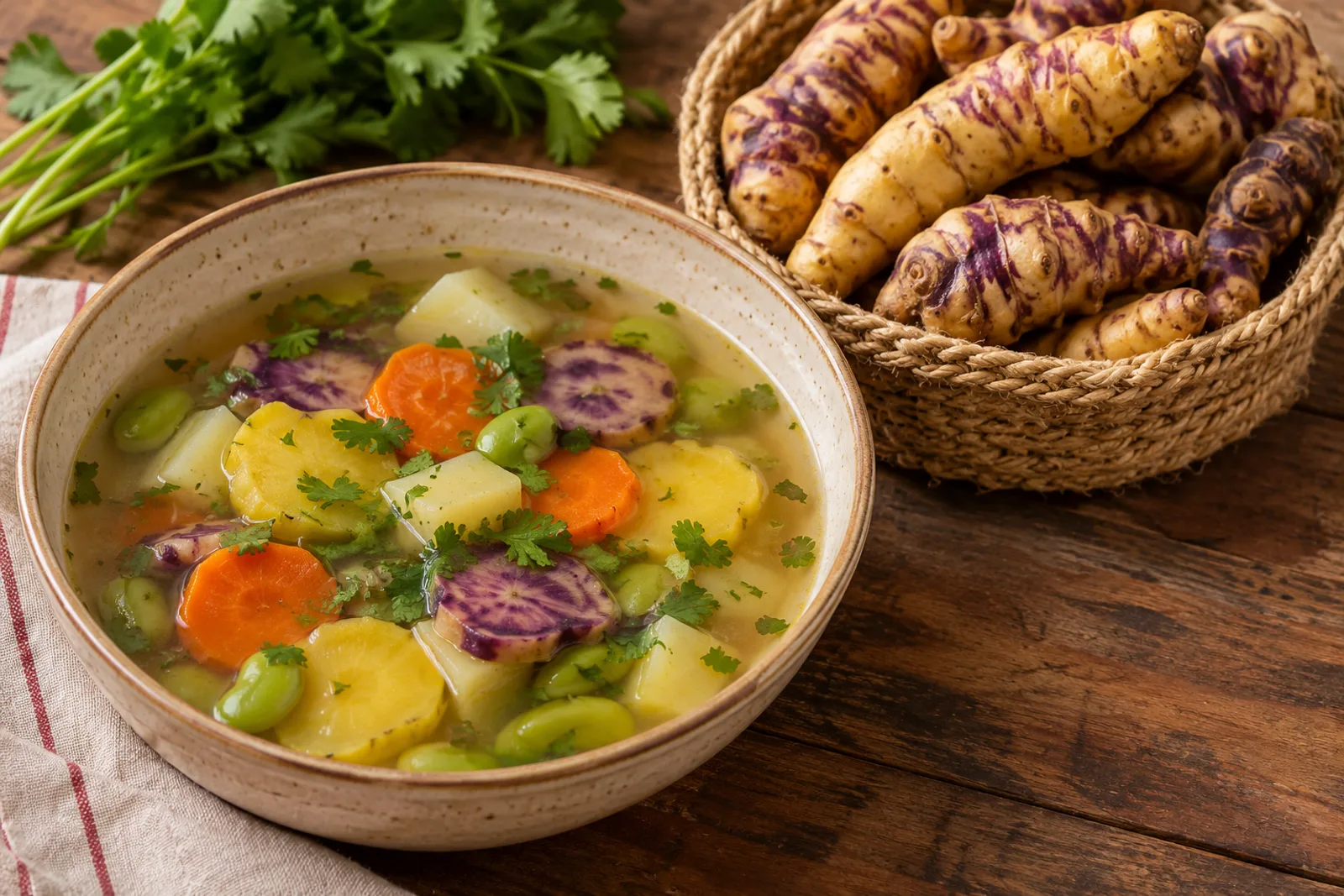

Cubio (KOO-bee-oh) is what Colombians call mashua, Tropaeolum tuberosum, an Andean tuber in the same family as the garden nasturtium. Raw, it bites like a radish. Simmered for about 15 minutes in a rib broth with potatoes, fava beans and peas, it usually turns mild and faintly sweet, closer to a young turnip than to a potato, and that is sopa de cubios, a weekday lunch soup from the highlands of Boyacá and Cundinamarca, north of Bogotá. Fresh mashua is rare outside the Andes, so this recipe also works with peeled white turnips; just check them with a knife, since they can take a few minutes longer.
What cubio soup is, and how long it takes
How do you make Colombian cubio soup? Simmer 2 lb (900 g) of beef short ribs in 10½ cups (2.5 liters) of water, skimming for the first 15 minutes, then 70 minutes over low heat. Add a quick tomato and scallion guiso, cubed potatoes and fava beans, and 5 minutes later the sliced cubios (or turnips), small yellow potatoes and peas for a final 15 minutes. Finish with cilantro. 130 minutes for 6 servings.
The result is a spoon-thick soup with no cream and no blender: the floury potato breaks down and thickens the broth, the small yellow potatoes color it, and the cubio gives it the flavor that sets it apart from a plain Colombian beef rib soup. It isn’t spicy. Colombians add heat at the table.
Total time 130 minutes, about 45 of them hands-on. Easy: the only thing to watch is when the tubers go in.
If you’ve seen cubios in cocido boyacense, that’s a different dish: a one-bowl stew with hen, pork ribs, corn and two more Andean tubers, oca and ulluco. This soup keeps cubio as the only star.
What is cubio, or mashua?
Mashua is the tuber of a climbing Andean plant, a relative of the nasturtium (both are Tropaeolum). The tubers are elongated and slightly conical, with smooth, shiny skin, and come yellow, white with red flecks, or purple, often several colors on one market stall. They grow in cold, high country, roughly 2,400 to 4,300 meters (8,000 to 14,000 ft) up. In Colombia they’re grown mainly in Boyacá and Cundinamarca.
The names change every few hundred miles: cubio in Colombia (and, confusingly, nabo, “turnip,” in parts of Boyacá), mashua in Peru and Ecuador, añu around Cusco and isaño near Lake Titicaca and in Bolivia. Seed and plant catalogs in English sell it as mashua or tuberous nasturtium.
What mashua tastes like
Raw mashua is sharp and peppery, like radish or watercress, from the same kind of compounds that give mustard its bite. Boiling knocks most of that out and leaves a gentle, slightly sweet flavor reminiscent of cooked turnip. Cooked, it’s softer than potato and less floury.
Where to buy mashua, and the turnip swap
In Colombia cubios are an everyday item in the produce markets of Boyacá, Cundinamarca and Bogotá. In the US and UK you’ll almost never find them fresh to eat; the places that sell mashua are specialist nurseries offering tubers for planting. If you garden in a cool climate, the plant grows well there as long as it’s protected from frost.
For the pot, the honest substitute is white turnip, the kind with a purple shoulder. Cooked mashua and cooked turnip are close in both flavor and texture. In the UK, ask for white turnip: in Scotland and parts of northern England “turnip” or “neep” often means swede (rutabaga), which is yellow, denser and sweeter, and not what you want here.
If turnip tastes too strong to you, go half turnip and half yellow potato: you lose some of the cubio character and gain body. All potato makes a decent soup, but not this one.
Ingredients and shopping list
The recipe makes 6 generous deep bowls. The cubio weighs in at almost the same as the floury potato, which is why the soup tastes of cubio and not of potato broth.
- Beef short ribs. Bone-in, cut across into 2-inch (5-6 cm) pieces; ask the butcher. Pork neck bones or pork spine, also common in Boyacá, make a fattier broth with a different flavor; test with a fork rather than the clock.
- Floury potatoes. Russet or Yukon Gold in the US, Maris Piper in the UK, in place of Colombia’s papa pastusa. They’re the thickener: the edges of the cubes melt into the broth.
- Small yellow potatoes. Papa criolla is sold frozen in many Latin American stores in the US. Baby Yukon Golds or other small waxy yellow potatoes are the closest fresh option; they hold together more than criolla does.
- Fava beans and peas. Frozen are fine and go in at the same point. Dried favas, soaked a full day, make a different soup from the same region, Boyacá fava bean soup.
- Scallions. They stand in for cebolla larga, Colombia’s long green onion; use thick ones.
Equipment. A 6-liter (6-quart) pot with a lid, a small skillet, a ladle for skimming and a vegetable brush. A Dutch oven is ideal.
Preparing cubios before cooking
Do you peel mashua?
No, as long as the tubers are fresh, firm and smooth: scrub them under running water and trim the thin, slightly stringy tip. The skin is thin and helps the slices hold together in the broth. Peel only tubers that have gone old, wrinkled or tough, and cut away any soft or bruised spots. Turnips, on the other hand, should be peeled.
Should you sun them?
In the Andes, freshly harvested mashua is often left in direct sun for a few days before cooking, to make it sweeter and less sharp; the sun raises its sugar content. The effect varies from tuber to tuber and is sometimes hard to notice. You usually don’t need to for soup, since boiling already softens the bite. To try it, leave them spread out on a tray in a sunny, dry spot for a few days, bringing them in at night, then taste a raw slice before cooking.
Cutting and cooking time
Even rounds about ⅝ inch (1.5 cm) thick need 15 minutes at a gentle boil. Whole medium tubers take longer, so go by the knife. They’re done when the tip slides in without resistance and a slice comes out of the pot whole on a spoon. Overcooked, they turn soft like overboiled turnip and shred.
Storing raw cubios
Unwashed, in a cool, dry, dark place, they keep several weeks, and a little longer in a paper bag in the crisper drawer. Wash just before using. Use wrinkled ones soon, and peel them; throw out any with mold or rot.
Cooking the soup, step by step
The rib broth
Start with cold water over medium-high heat and skim for the 15 minutes before it boils. If it boils hard before the foam is off, the broth stays cloudy. Then low heat, lid ajar, 70 minutes at a bare simmer. The ribs are ready when a fork slides in easily and the meat still clings to the bone.
Pressure cooker or Instant Pot. Skim with the lid off, lock it and cook 30 minutes at high pressure, then let it release naturally, about 10 minutes. Finish the tubers with the lid off. Never pressure-cook the cubios or potatoes; they disintegrate.
At altitude. In Bogotá or Tunja, 2,600 meters (8,500 ft) and up, water boils below 212°F (100°C) and everything takes a little longer. If you cook in Denver, trust the knife, not the clock.
The guiso and the tubers, in order
While the ribs simmer, cook the guiso for 8 minutes in all, until the tomato has collapsed and the scallions are soft. It goes into the broth with the potato cubes and favas, which need a short head start. Five minutes later the cubios, small potatoes and peas go in, and all three finish together in 15 minutes.
How to tell it’s ready
- Cubio. A knife passes straight through, and the slice lifts out whole.
- Small potatoes. They give when pierced and their edges begin to dissolve.
- Broth. Cloudy, slightly thick and yellowish. For a thicker soup, press 4 or 5 potato cubes against the side of the pot.
What goes wrong, and how to fix it
- Cubios added with the meat. They break into strands and the broth turns gray and pasty. They go in for the last 15 minutes.
- Uneven slices. Thin ones fall apart before thick ones cook. Keep them all at 1.5 cm (⅝ in).
- Old cubios left unpeeled. Wrinkled skin turns leathery. Peel any that are soft or shriveled.
- Cloudy, greasy broth. It boiled hard before skimming. You can’t fully fix it, but you can chill the pot and lift off the solid fat.
- Thin soup. Not enough floury potato, or cubes cut too big. Mash some against the pot and give it 5 minutes more uncovered.
- Too sharp or bitter. Some tubers are stronger than others. Next time sun them for a few days, or go half cubio, half potato.
Heat, kids and allergens. No heat at all; chili sauce goes on the table. Most kids eat it like potato soup. It’s dairy-free and gluten-free. Fava beans are unsafe for people with G6PD deficiency (favism); double the peas instead.
Variations
- Faster → ribs in the pressure cooker, about 100 minutes total; or simmer the ribs the day before, so serving day takes about 50 minutes including the chopping.
- Blended cubio soup → simmer 1 lb 2 oz (500 g) cubios or turnips and 10½ oz (300 g) potato in the broth for 20 minutes, without the favas or peas, lift out the meat and blend until smooth. Serve topped with the shredded beef or small cubes of fried cheese.
- With corn → 2 ears cut into 1¼-inch (3 cm) wheels, added with the potato cubes.
- Vegetarian → vegetable stock made with scallion, garlic and cilantro, plus 5 oz (150 g) more fava beans. It loses body; a spoonful of annatto oil in the guiso helps.
- For 12 → double everything in a 10 to 12-liter (10 to 12-quart) pot. With that many tubers the boil takes longer to come back: count the 15 minutes from when it bubbles again.
- For 4 → two-thirds of everything: 1⅓ lb (600 g) ribs, 12 oz (330 g) cubios, 7 cups (1.7 liters) water, same times.
The ribs are what cost money here. Half the meat and twice the fava beans makes it a much cheaper pot.
Serving, storing and reheating
Serving. Deep bowls, a piece of rib, a bit of everything and the broth shared evenly among the six. On the table: Colombian ají picante, sliced avocado, and a Boyacá-style arepa or white rice. For the other big pot of the same region, there’s Colombian ajiaco, and the cracked-grain soup Boyacá eats on weekdays is cuchuco. The food of Bogotá and Boyacá has the rest of the highland table. Cubios also go into mazamorra chiquita, the Boyacá soup thickened with corn flour, alongside tripe and beef.
Fridge. Within 2 hours, in shallow covered containers, at 40°F (4°C) or below: 3 to 4 days. It thickens a lot as it cools because the potato keeps releasing starch; add ½ cup (120 ml) water or stock per 4 bowls when reheating.
Freezer. The broth with the ribs freezes well for 2 to 3 months. Potatoes don’t (they go grainy), and I haven’t tested frozen cubio enough to recommend it: freeze without the tubers and cook fresh ones, 15 to 20 minutes, when you reheat.
Reheating. On the stove over medium heat until it boils and steams all over. In the microwave, covered, in 2-minute bursts, stirring in between, until it steams in the center too (165°F / 74°C on a thermometer).
Frequently asked questions
Is mashua the same as oca or ulluco? No. They’re three different plants that Andean cooks often use together: mashua (cubio) is peppery, oca (ibia in Colombia) is small and sweet, and ulluco (chugua) is glossy with a slippery texture.
Is mashua related to nasturtium? Yes, same genus. The garden nasturtium is Tropaeolum majus; mashua is Tropaeolum tuberosum. Mashua leaves and flowers are eaten too, mostly in salads.
Does mashua lower libido? That’s an old Andean belief: 16th-century chroniclers wrote that the Inca fed it to soldiers so they’d forget their wives. The little research there is has been done in male rats, and in some of it testosterone dropped while fertility didn’t. None of it shows that eating mashua lowers libido in people.
Is mashua good for you? Andean folk medicine credits it with benefits for the kidneys and prostate and as a diuretic; those are traditional uses, not proven treatments. What is measured is its makeup: raw, it’s high in vitamin C, about 77 mg per 100 g (3½ oz), and some of that is lost in cooking.
Can you roast mashua? Yes. Halved, lightly oiled and roasted at 350°F (175°C), it takes 30 to 60 minutes depending on size and comes out soft and aromatic, a little like sweet potato. Cumin suits it well.
Nutrition
Worked out ingredient by ingredient from the recipe, per bowl with its share of rib and tubers (the pot makes six):
- Calories: 385 kcal
- Protein: 25 g
- Carbohydrates: 44 g
- Fat: 13 g, of which 4 g saturated
- Fiber: 7 g
- Sugars: 7 g
- Sodium: 865 mg
The beef brings about 160 kcal a bowl and the potatoes about 115. I worked out the cubio from published figures for fresh mashua, about 45 kcal per 100 g (3½ oz), under two-thirds of potato. Made with white turnip, which is lighter still, each bowl drops by roughly 15 kcal. Untrimmed ribs push the fat up a lot.
When I cook with a tuber I don’t know well, I taste a raw slice before deciding how much goes in. If it’s fierce, I split it with potato; if it’s mild, it all goes in. And it always goes in last, once the meat is tender, because I’d rather find a whole, firm piece on my spoon than a broth full of shreds. With turnips I do the same thing, and the soup still tastes like the highlands. Josnaisis.