

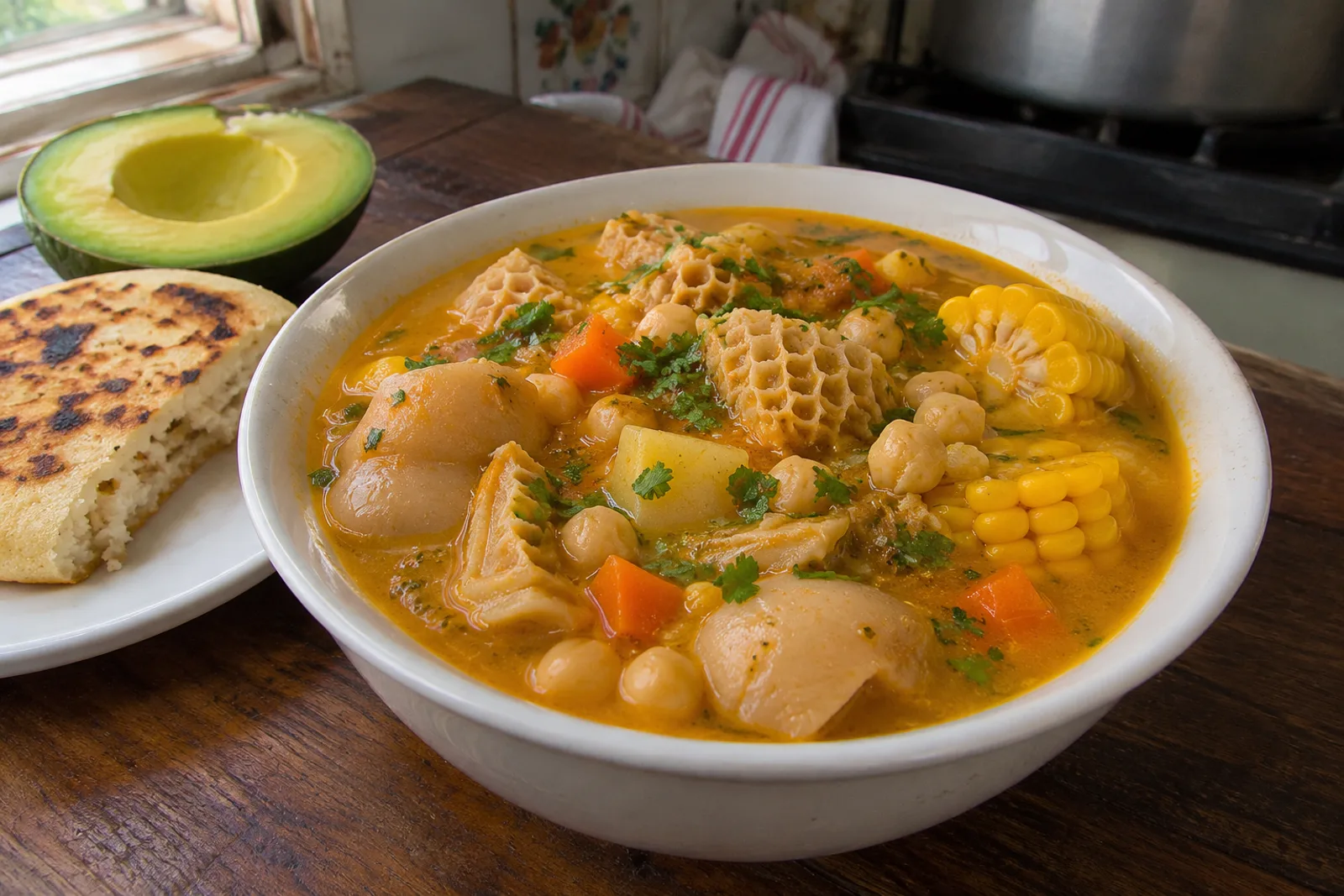

Mondongo (mon-DON-go) is what Venezuelans call both beef tripe and the soup made from it: 3¼ lb (1.5 kg) of tripe and a beef foot cooked until tender, then simmered with cassava, corn, carrots, potatoes, chickpeas and squash in a broth seasoned with sweet peppers, leek and scallions. It isn’t spicy, and it’s thick enough to eat with a fork as much as a spoon. If tripe is new to you, this is a forgiving place to start, because the vegetables carry half the bowl. Below is the recipe for 10 bowls, the cleaning that keeps the smell under control, pressure cooker and stovetop timings, and what to buy in a US or UK store.
What Venezuelan mondongo is, and how it compares
How do you make Venezuelan mondongo? Rub 3¼ lb (1.5 kg) of beef tripe and a beef foot with lime and coarse salt, boil them 5 minutes and pour that water away, then pressure-cook them for 60 minutes. In that broth, cook cassava, carrots and corn for 10 minutes, add potatoes, a sweet pepper and leek sofrito and the chopped foot for 10, and finish with squash and chickpeas for 20 more. 180 minutes for 10 bowls.
It’s a Sunday pot in many Venezuelan homes, eaten as a one-bowl meal with arepas or cassava bread and sliced avocado. In this version the squash partly dissolves, turns the broth orange and thickens it, and the gelatin from the beef foot does the rest.
Two other tripe soups on this site start from the same cut:
- Colombian mondongo, from Antioquia, adds pork ribs, chorizo and a tomato sauce, with peas and corn, and it’s brothier, served with rice on the side.
- Mexican menudo has tripe and beef foot too, but no vegetables in the pot: it’s built on a red guajillo chile sauce with hominy, and finished at the table with raw onion and lime.
- The Venezuelan pot has no chile and no sausage. Its flavor comes from the sofrito, and its body from squash, potato and the foot.
Time and effort. 3 hours with a pressure cooker, about 70 minutes of it hands-on; a little over 4 hours on the stovetop. It’s rated medium: nothing is technically hard, but you have to taste the tripe before moving on and keep the vegetables in order.
Shopping list and US and UK swaps
Full amounts are in the recipe card. The ones that cause trouble outside Venezuela:
| Ingredient | Amount | US | UK | What changes |
|---|---|---|---|---|
| Beef tripe | 1.5 kg (3¼ lb) | Latin or Asian grocery meat counter, often frozen: smooth tripe or honeycomb tripe | Butchers and halal butchers, as dressed tripe; Caribbean and African grocers | Honeycomb softens sooner and costs more; smooth alone works fine |
| Beef foot | 1 (2½ lb / 1.2 kg) | Beef feet or cow feet, pre-cut | Cow foot or cow heel at Caribbean and African grocers | Pork trotters give the same gelatin, slightly sweeter |
| Ají dulce | 6 (60 g / 2 oz) | Frozen in Latin stores | Rare | ½ extra red bell pepper: flatter aroma, no heat either way |
| Auyama (squash) | 500 g (1 lb 2 oz) | Butternut or kabocha | Butternut | Same job, thickens the pot |
| Cassava (yuca) | 400 g (14 oz) | Fresh or frozen, Latin aisle | Frozen in Asian and African shops | Frozen is already peeled |
| Corn | 2 ears | Fresh or frozen cobs | Sweetcorn cobs, frozen mini cobs | No difference |
Equipment. A pressure cooker of at least 8 liters (8½ quarts) (with a 6-liter one, cook the tripe in two batches or use the stovetop), a 10-liter (10½-quart) pot for the soup, a large bowl, a colander and a skimmer.
How to clean tripe so the smell stays down
Store-bought tripe has already been scalded and bleached, so the inside of the stomach and its dark lining are gone. What’s left to do takes about 20 minutes:
- Scrape off the yellow fat with the tip of a knife. It’s what smells most once it cooks.
- Scrub for 15 minutes with lime and coarse salt, working into the folds. The salt acts like sandpaper.
- Rinse in cold water until it runs clear.
- Give it a quick first boil and throw that water away. Within a couple of minutes gray foam rises; after 5 minutes, drain it all. Never use that water.
The tripe will still smell while it simmers, however clean it is; it’s offal. Open a window and run the extractor. What is a warning sign is raw tripe that smells sour or of ammonia, or feels sticky: that goes back to the store, it doesn’t get washed. Do the cleaning inside a bowl rather than under a hard tap, and wash the sink and counter with soap afterwards.
Raw tripe keeps only 1 to 2 days in the fridge, and frozen tripe should thaw in the fridge, not on the counter.
Pressure cooker or stovetop
The tripe and foot cook without salt, with half an onion, garlic and bay. The timing is a guide; the bite decides. Fish out a piece of tripe: it should give when you bite it, still with a little resistance, and not spring back. If it springs back, it needs more time: another half hour on the stovetop, or 10 minutes under pressure. The foot is done when the skin slides off the bone with a fork. Overcooked tripe falls apart into threads, so don’t leave it for hours past that point.
Keep this broth. Unlike the first boil, it carries the gelatin from the foot. You’ll have less than you started with; top it up with hot water to about 4 liters (4¼ quarts) before the vegetables go in.
Adding the vegetables in the right order
The vegetables go in three batches, timed so they all finish together:
- Cassava, carrots and corn, with 1½ tsp salt, for 10 minutes. They’re the hardest.
- Potatoes, the sofrito and the chopped foot, for 10 minutes.
- Squash and chickpeas, for 20 minutes. The squash melts at the edges and turns the broth orange. Put it in first and it disappears completely.
Everything in at once means that by the time the cassava is tender, the potato and squash have turned to purée and the soup is a thick cream with no pieces in it.
How thick it should be, and how to tell it’s done
Venezuelan mondongo is thick: the broth coats a spoon and the pieces sit up above the surface of the bowl. If it looks watery at the end, mash a handful of potato and squash pieces against the pot and simmer it uncovered for 10 minutes. If it’s too thick, add hot water half a cup (120 ml) at a time. It thickens more overnight as the gelatin sets.
Common problems
- Tough tripe. It came off on the clock, not on the bite. Test before the vegetables and give it 10 more minutes under pressure if it bounces.
- Too strong a smell. The fat wasn’t scraped, or the first-boil water was kept.
- Too salty. Salt went into the tripe pot. The broth reduces, so salt goes in with the vegetables and gets adjusted at the end.
- Thin and watery. No beef foot, or too little squash. Mash potato and squash into the broth and reduce for 10 minutes.
- Vegetables collapsed. They went in together, or the pot boiled hard. Gentle simmer, three batches.
Heat, kids and allergens. No heat at all; ají dulce is a sweet pepper. Kids usually go for the corn, potatoes and chickpeas before the tripe, so ladle them more vegetables. It’s free of gluten, dairy, egg, nuts and fish.
Variations Venezuelans actually make
- Pork trotters instead of beef foot, about 2¼ lb (1 kg), cleaned and cut, in the same pot. Cheaper, same gelatin.
- Oxtail, 2¼ lb (1 kg), cooked with the tripe, for more meat and a richer broth.
- Olives and capers, added for the last 20 minutes with the squash, for a salty, sour edge; some cooks add cabbage too.
- Corn dumplings: 1 cup precooked white cornmeal (the arepa flour), 1¼ cups water and ½ tsp salt, rolled into hazelnut-size balls and added with the squash. They’re done when they float.
- Lime or a pinch of sugar. In central Venezuela it’s eaten with lime squeezed in; in the east some cooks add a pinch of sugar at the end.
- For 20 bowls, double everything and use two pots rather than one huge one, which takes forever to boil and catches on the bottom.
For a Venezuelan Sunday soup without offal, the Venezuelan beef hervido is beef and vegetables, and the cruzado combines beef and hen. The Venezuelan pigeon pea soup is the other thick pot, with beans instead of tripe.
Make ahead, storing and reheating safely
Serving. Very hot, in deep bowls, with Venezuelan arepas or cassava bread, sliced avocado and lime wedges. A glass of cold papelón con limón, the brown sugar limeade, goes with it.
A day ahead. Cook the tripe and foot, chill them in their broth, and the next day lift the hard fat off the top with a spoon. On the day, the sofrito and vegetables take 60 to 70 minutes.
Cool it fast. A full soup pot takes hours to cool by itself, and the middle stays warm for a long time. Divide it into shallow containers about 2 in (5 cm) deep and get them in the fridge within 2 hours. To speed things up, set the pot in a sink of ice water and stir for a few minutes first.
Fridge. 3 to 4 days. It sets like jelly because of the foot; that’s a good sign.
Freezer. 2 to 3 months, with broth covering the tripe. Potato and cassava come out a little softer. Thaw it overnight in the fridge.
Reheating. Over medium heat with a splash of water, stirring, until it boils, or to at least 165°F (74°C) in the middle. In the microwave, 2 minutes at a time, stirring in between.
Frequently asked questions
What does tripe taste like? Mild, a little like the broth it’s cooked in. The draw is the texture: tender with a slight chew when it’s done right.
Smooth or honeycomb tripe? Either. Honeycomb softens a little sooner and costs more; smooth tripe alone makes an equally good mondongo.
Can I make it in an Instant Pot? For the tripe, yes. An 8-quart insert (about 7.5 liters) is just big enough if the tripe, foot and water stay below the two-thirds line; in a 6-quart, cook them in two batches. High pressure for 60 minutes with natural release, then move everything to the 10-liter (10½-quart) pot for the broth and vegetables, which won’t fit in the insert.
Is it the same as menudo? No. Menudo is Mexican, built on dried red chiles and hominy with no vegetables; Venezuelan mondongo has no chile and is full of vegetables and chickpeas.
Nutrition
Per bowl, a tenth of the pot, calculated from the recipe weights (for the beef foot I count 420 g / 15 oz of edible skin and tendon):
- Calories: 488 kcal
- Protein: 36 g
- Carbohydrates: 53 g
- Fat: 16 g, of which 4 g saturated
- Fiber: 8 g
- Sugars: 10 g
- Sodium: 806 mg
Most of the protein comes from the tripe, foot and chickpeas. Skimming the chilled fat the next day trims the fat further.
I make mondongo the way you make anything for a crowd: early, unhurried, and more than you need. My rules don’t change. Clean the tripe properly, taste it before anything else goes in, and stay near the pot once the vegetables start. Then leave some for the next day, because cold, set and reheated, it’s even better. Josnaisis.