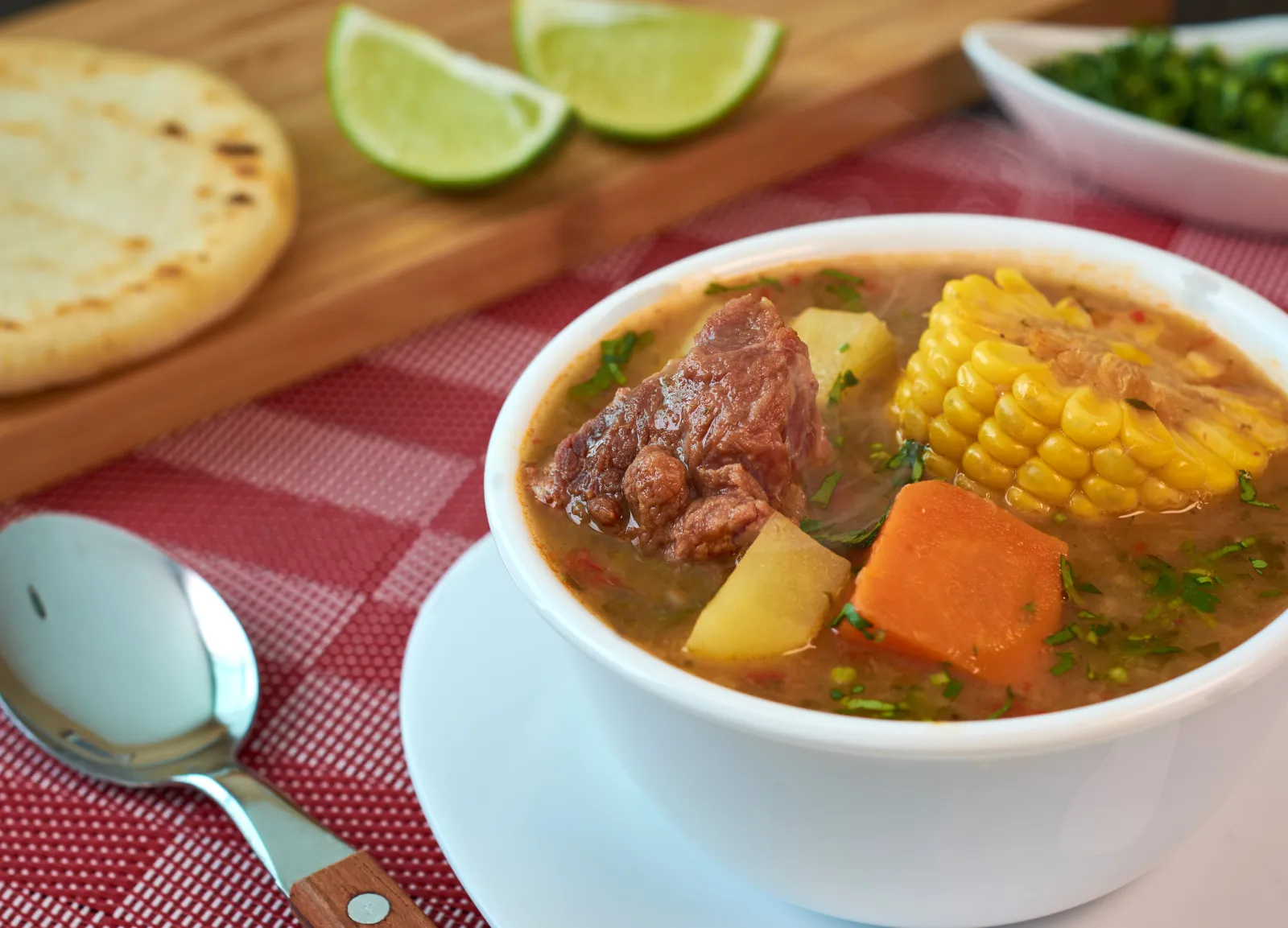

Hervido (ehr-VEE-doh) means “boiled”, which undersells it. In Venezuela it’s the Sunday pot: bone-in beef simmered until it slides off the bone, with cassava, true yam, malanga, squash, corn and potato cooked in the broth and served all together in a deep bowl. If you’ve had Colombian or Dominican sancocho, you’re close; Venezuelans use both names for the same soup. What makes this one work is timing. The beef gets 105 minutes on its own, and then the vegetables follow in three rounds, hardest to softest, so every piece reaches the bowl whole and tender at the same moment.
What is Venezuelan hervido, and is it the same as sancocho?
How do you make Venezuelan beef soup (hervido de res)? Start bone-in short ribs and beef shank in 4 liters (17 cups) of cold water, skim for 15 minutes, then simmer 90 minutes with onion, bell pepper, leek and garlic. Add cassava, yam, corn and diced squash; 15 minutes later malanga, potato and carrot; then large squash chunks, and cilantro at the end. 170 minutes for 8 servings.
Yes, it’s the same dish with two names. A study of restaurants in eastern Venezuela, published by researchers at the Universidad de Oriente in the journal Estudios Sociales, found that 93.33 % of them treated “sancocho” and “hervido” as synonyms. The Spanish-language Wikipedia notes that the beef version belongs to the Llanos, the cattle plains, that chicken and hen versions are more common in the center and west, and that a pot with two meats is called cruzado and one with three, trifásico.
What sets the Venezuelan pot apart from its Colombian cousins is the vegetables: ocumo (malanga), ñame (true yam) and auyama (squash) almost always go in, and the aromatics are leek, sweet ají dulce peppers and bell pepper. If you’d like to compare, the Colombian three-meat sancocho cooks beef, pork and chicken together, and Colombian chicken sancocho uses a stewing hen and arracacha.
Is it worth making, and who is it for?
Worth it for a slow Sunday, a crowd, or a freezer you want full. One pot feeds 8 as a complete meal, and nothing else needs cooking. It also scales to 20 with no new technique.
Skip it on a weeknight unless you have a pressure cooker, because it’s nearly 3 hours on the clock. And it isn’t light: a bowl is 700 kcal.
Real time. 170 minutes total, about 70 of them hands-on. With a pressure cooker, about 140.
Honest difficulty, medium. Nothing is technically hard. Two things go wrong: a rolling boil, which clouds the broth, and adding all the vegetables at once, which turns the soft ones to mush.
Shopping for hervido in the US and UK
Exact amounts are in the recipe card: 1.8 kg (4 lb) of bone-in beef, about 2.4 kg (5¼ lb) of vegetables and 4 liters (17 cups) of water for 8 bowls.
The beef
You need bones and connective tissue, because the bones make the broth. I use short ribs for fat and flavor plus beef shank for gelatin and neat rounds of meat. In the US, shank is sold as osso buco or cross-cut shank; in the UK, ask the butcher for shin of beef on the bone and Jacob’s ladder or short rib. Oxtail works too and gives the most gelatinous broth, but in my kitchen it needs about 3 hours rather than 2. Boneless stew meat makes tender beef in a thin broth; if that’s all you have, add a marrow bone.
The vegetables, and where to find them
- Ocumo is a starchy tuber with white or purple flesh that turns creamy in the broth. In the US it’s sold as malanga or yautía in Latin markets; in the UK, look for eddoes or malanga at Caribbean and African grocers. A floury potato is the fallback, a little less creamy.
- Ñame is a true yam, a big rough-skinned root with firm white flesh, sold as ñame or white yam in US Latin markets and as white or puna yam in UK African shops. It is not the orange sweet potato American supermarkets label as yam; that one sweetens the broth and falls apart. Without ñame, add more cassava.
- Auyama is a West Indian pumpkin. Look for calabaza in US Latin markets, or use butternut squash on either side of the Atlantic.
- Cassava (yuca) is sold fresh and frozen in most US supermarkets and in UK world-food aisles. Frozen chunks go in without thawing.
- Ají dulce is a small, fragrant, not-hot pepper, sold frozen in US Latin markets. In the UK, use an extra 50 g (2 oz) of red bell pepper and accept that some perfume is lost.
Equipment
An 8-quart (8-liter) stockpot, a ladle for skimming, a sharp knife for peeling cassava and yam, and a board. With a 6-quart pot, start with 3 liters (12½ cups) of water and add 1 liter (4 cups) of hot water when the vegetables go in.
Make-ahead plan and the order the vegetables go in
170 minutes on the clock, 70 of them hands-on. Peeling 2.4 kg (5¼ lb) of roots takes me about 30 minutes, and it fits comfortably inside the 90 minutes the beef simmers alone.
| Minute (from beef in water) | What goes in | Cooks for | Done when |
|---|---|---|---|
| 0 | beef, cold water | 15 min skimming | no more gray foam, water clear |
| 15 | onion, peppers, leek whites, celery, garlic | 90 min at a tremble | beef gives, still on the bone |
| 105 | cassava, yam, corn, half the squash diced | 45 min | cassava splits open in the center |
| 120 | malanga, potato, carrot | 30 min | a knife slides in, pieces still whole |
| 130 | the rest of the squash, in big chunks | 20 min | tender, holding its shape |
| 145 | cilantro leaves, leek greens | 5 min | salt adjusted, heat off |
Make ahead. Cook the beef with the aromatics up to minute 105, cool it fast and refrigerate it in its broth. The next day, lift off the layer of set fat, bring it back to a simmer and carry on with the vegetables: 60 minutes to the table. Peel the vegetables on the day; peeled malanga and cassava darken overnight even in water.
Keeping the broth clear
Three habits give a golden broth with the fat floating in drops rather than mixed through. Start the beef in cold water, so proteins release slowly and rise as foam you can remove. Skim for the first 15 minutes, before a hard boil. Then keep it at a tremble with the lid ajar: a rolling boil emulsifies the fat into the broth and no amount of straining clears it. The melted squash will turn the broth orange and slightly opaque; that’s color, not cloudiness.
Pressure cooker or Instant Pot
In a 6-quart (6-liter) pressure cooker, use 2.5 liters (10½ cups) of water for the beef, since the pot shouldn’t be more than two-thirds full. Skim with the lid off for 15 minutes, add the aromatics, lock the lid and cook 40 minutes at high pressure, then let it release naturally for 10 minutes. Open, add 1.5 liters (6⅓ cups) of hot water, and cook the vegetables uncovered with the timings in the table above. Never pressure-cook the vegetables: malanga and potato collapse in 5 minutes.
Scaling up for 20
Multiply everything by 2.5: 2 kg (4½ lb) short ribs, 2.5 kg (5½ lb) shank, 10 liters (10½ quarts) water, 1.25 kg (2¾ lb) each of cassava and squash, 1 kg (2.2 lb) each of yam, malanga and potato, 5 ears of corn. Use a 20-quart stockpot or two 10-quart pots side by side. The water takes about 15 minutes longer to heat and the beef needs 15 to 20 minutes more before the vegetables; the vegetable timings don’t change. Start with 30 g (5 tsp) of salt and adjust at the end rather than multiplying blindly.
Mistakes to avoid, spice level, kids and allergens
- Cloudy, greasy broth → it boiled hard, or wasn’t skimmed early. Rest the pot off the heat for 10 minutes and ladle the fat off the top; the flavor is fine.
- Malanga dissolved → it went in with the cassava. It goes in 15 minutes later, in 5 cm (2 in) chunks.
- Cassava still hard after 45 minutes → an old or fibrous root, not a timing problem. Good cassava is bright white with no dark streaks when you peel it.
- Beef still tough when the vegetables are done → lift the vegetables out with a little broth, give the beef 20 more minutes, and return them at the end.
- Thin broth → not enough diced squash, or too much water. Crush 3 pieces of squash and 2 of potato against the side of the pot and simmer 10 minutes uncovered.
- Too salty → all the salt went in at the start. Add it in three goes, the last after tasting.
Spice, 0 out of 5. Ají dulce isn’t hot. Any hot sauce goes on the table.
Kids usually love it: the squash and corn make it sweet and the shank comes in tender rounds. Check for bone splinters and cut the corn small for little hands.
Allergens. No gluten, dairy, egg, nuts or fish in the pot, so with arepas or cassava bread the whole meal is gluten-free. Celery is a declared allergen in the UK and EU; leave it out if you need to.
Versions worth knowing
- Weeknight → pressure cooker, 40 minutes for the beef, about 140 minutes in all.
- Cheaper → all short ribs, 1.8 kg (4 lb); fattier, richer broth. Strip it down to short ribs and potatoes and you have a different dish, caldo de costilla, the Colombian breakfast rib soup.
- Leaner → all shank, 1.8 kg (4 lb), no short ribs: about 570 kcal and 8 g of fat a bowl, with a more gelatinous, milder broth.
- Cruzado → 1 kg (2.2 lb) beef plus a stewing hen in pieces, added 30 minutes after the beef.
- With plantain → 1 green plantain in chunks with the first round of vegetables.
- Vegetarian → there’s no beef hervido without beef, but the same vegetables in the same order in 3 liters (12½ cups) of vegetable stock make a hearty Sunday soup.
What it costs in the US
The US Bureau of Labor Statistics doesn’t track short ribs or shank. Its closest series, boneless chuck roast, averaged $9.448 per pound in August 2026; at that price, the 2.8 lb (1.28 kg) of meat this pot gives once the bones are out would cost about $26.66. White potatoes averaged $0.976 per pound, so the 0.9 lb (400 g) here cost $0.86. The BLS has no series for cassava, yam, malanga, calabaza or corn, which come from Latin markets at prices that vary by city.
In Colombia, where I live, the same pot cost 54,314 pesos at wholesale prices in Cúcuta on the Venezuelan border (DANE’s SIPSA bulletin, September 12 to 18, 2026), and the beef was 83 % of it. That ratio holds anywhere: the roots are cheap, the beef is the bill.
Yield. 8 deep bowls as a full meal, or 12 as a starter.
Serving, storing, freezing and reheating
How it’s served. In a deep bowl with meat, a piece of every vegetable and broth to cover. Wikipedia notes it’s eaten with arepas or cassava bread, and some people squeeze lime over it; at my table the lime is never missing. Nothing else is needed for lunch. If you want a Venezuelan menu for the rest of the week, leftover beef shreds well for pabellón criollo with Venezuelan black beans, the slow-cooked, papelón-glazed Venezuelan asado negro is the other great beef dish of a Sunday table, and Venezuelan quesillo is the dessert. When the Sunday lunch comes out of the oven instead of the pot, it is usually Venezuelan pasticho, a lasagna with ham and béchamel.
Fridge. Soups with meat keep, per the USDA Food Safety and Inspection Service, 3 to 4 days at 40°F (4°C) or below, provided they’re refrigerated within 2 hours. Divide the pot into shallow containers so it cools fast.
Freezer. 2 to 3 months for best quality, and safe indefinitely at 0°F (−18°C). Texture is the issue: in my experience potato turns grainy and malanga gummy, while beef, broth, cassava and corn freeze well. If you’re freezing, pull out the potato and malanga and add fresh ones when you reheat, 25 minutes.
Reheating. Covered, over low heat, to a gentle simmer and 165°F (74°C) in the center. High heat makes the squash catch on the bottom. If it thickened in the fridge, add ½ cup of water per 2 cups of soup.
Frequently asked questions
Is hervido the same as sancocho? In Venezuela, yes: two names for one soup. More than nine in ten restaurants in the Universidad de Oriente survey treated them as synonyms.
What’s the best beef for Venezuelan sancocho? Bone-in cuts with collagen: short ribs, shank (osso buco), brisket or oxtail. I use 800 g (1¾ lb) short ribs and 1 kg (2.2 lb) shank for 8.
What can I use instead of malanga or ñame? Malanga: yautía or eddoes, or a floury potato. Ñame: white yam from an African or Latin grocer, or more cassava. Never orange sweet potato.
What order do the vegetables go in? Hardest first. Cassava, yam and corn get the longest, 45 minutes. The big squash chunks go in last, for 20 minutes, after the malanga, potato and carrot.
Can I make it in an Instant Pot? The beef, yes. Let the pressure drop naturally for 10 minutes after 40 on high, then cook the vegetables on sauté with the lid off.
Can you freeze sancocho? Yes, for up to 3 months. Remove the potato and malanga first and add fresh ones when reheating.
Is Venezuelan beef soup spicy? No. Ají dulce is a sweet pepper; hot sauce goes on the side.
Nutrition
Per serving (one-eighth of the pot), calculated ingredient by ingredient from the USDA FoodData Central database (SR Legacy) with the quantities above, counting 480 g of meat and fat in the 800 g of short ribs, 800 g of meat in the 1 kg of shank, malanga as yautía, and the 15 g of salt:
- Calories: 700 kcal
- Protein: 37 g
- Carbohydrates: 80 g
- Fat: 27 g, of which 11 g saturated
- Fiber: 8 g
- Sugars: 10 g
- Sodium: 884 mg
Most of the fat comes from the short ribs, about a third of the pot’s calories. Chill the broth and lift off the set fat and the bowl gets noticeably leaner, though how much depends on how thoroughly you skim it.
For years I made hervido the way I learned it in Venezuela, adding vegetables “when it felt right”, and it came out perfect maybe half the time. Writing the minutes down is what fixed it. Three rounds, hardest first, and nothing turns to mush. Josnaisis.