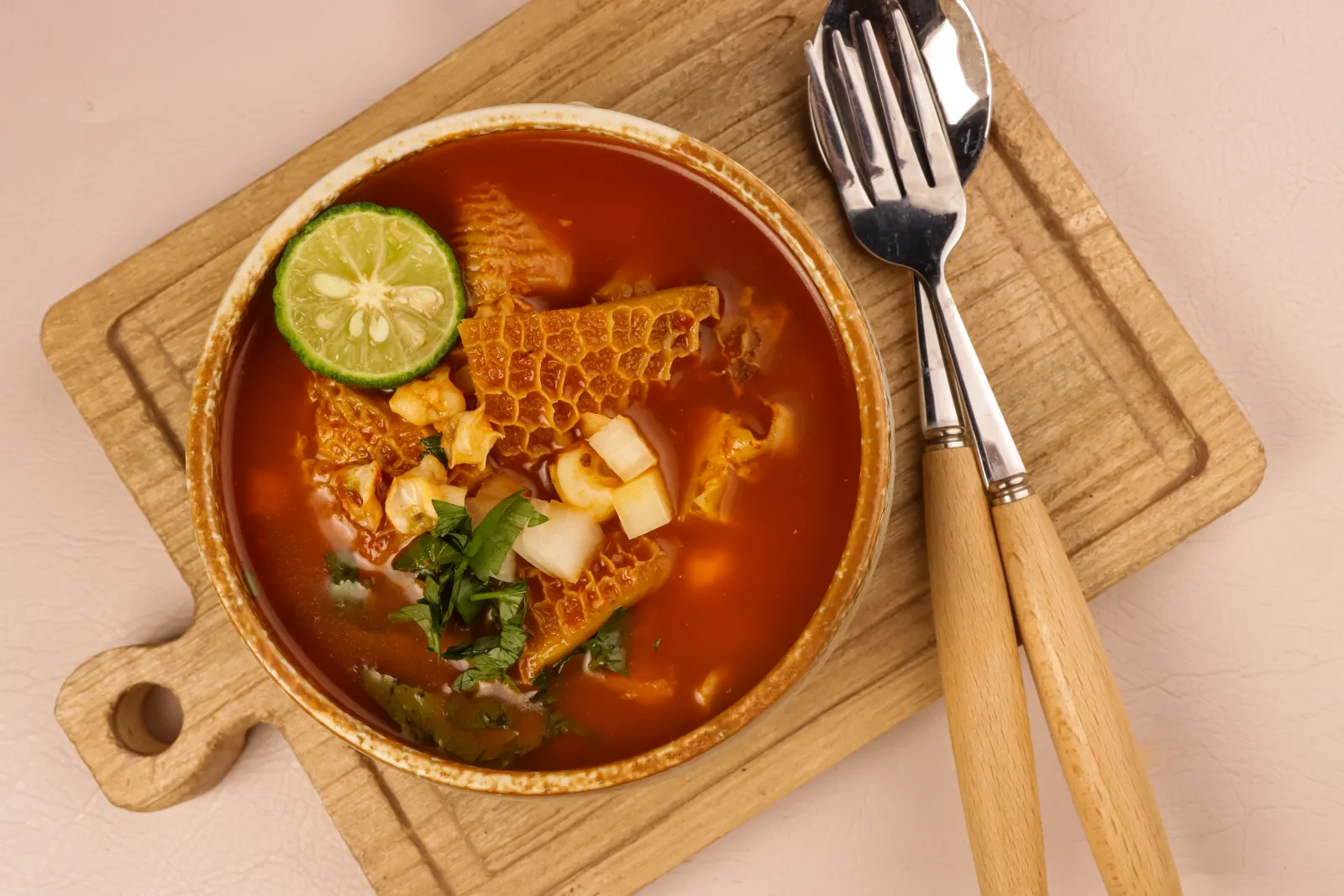

Menudo (meh-NOO-doh) is the Mexican tripe soup that shows up on weekend mornings and on New Year’s Day: chewy-soft pieces of beef stomach in a brick-red guajillo chile broth, thickened with the gelatin from a beef foot and, in the northern style, bulked out with hominy. The table finishes it, with raw onion, lime and oregano. If you’ve only had tripe in an Italian tomato sauce or a British pub, the texture is the same and the flavor is entirely different. This recipe makes 10 bowls, and it covers what to buy in a US or UK shop, how to clean tripe without folklore, the pressure cooker shortcut and how long it safely keeps.
What menudo is, and whether it’s worth a weekend morning
How do you make menudo? Scrub the tripe with coarse salt, soak it 30 minutes in vinegar water and boil it 5 minutes, then discard that water. Simmer the tripe with a beef foot, onion, garlic and bay leaves for 150 minutes, or 50 minutes in a pressure cooker. Stir in a fried guajillo and ancho chile sauce and hominy for 25 minutes more, and serve with onion, lime and oregano. 270 minutes for 10 servings.
It is, if you’re feeding a crowd. Cleaning 2 kg (4.4 lb) of tripe takes barely longer than cleaning half that, the pot does most of the work, and one batch is breakfast for 10 or two days of lunches for a household. In Mexico the same soup is called pancita or mole de panza in the center of the country, where it usually skips the hominy; in the north it’s menudo, and the hominy goes in.
When it’s a good idea. A slow Sunday, the morning after a party, January 1st (in Mexican-American families eating menudo on New Year’s Day has been a reported custom for decades), or any time you want to cook the day before and just reheat.
When to skip it. In a small flat with poor ventilation: simmering tripe smells strong, however well you cleaned it. If you don’t eat offal at all, Mexican pozole rojo gives you the same red chile broth and hominy with pork, and chicken pozole verde with pepitas swaps the chile for a tomatillo and pumpkin seed sauce in 90 minutes. And on a weeknight, because the stovetop version is 4½ hours on the clock.
Honest difficulty, medium. Nothing here is technically hard. It goes wrong in two places: stopping the simmer before the tripe is tender, and scorching the chiles.
Buying tripe in the US or UK, and which cut to ask for
A beef stomach has four chambers, and each one gives a different tripe. Blanket or flat tripe (rumen, toalla in Mexico) is thick, smooth and the cheapest. Honeycomb (reticulum, panal) has the hexagonal pockets, is softer, and is the one menudo lovers look for. Book or bible tripe (omasum, libro) has thin leaves. Reed tripe (abomasum) is rarely sold.
My mix is half honeycomb, half blanket. The honeycomb gives the bite people expect; the blanket brings the cost down, and it’s the slower of the two, so it sets the cooking time.
Nearly all tripe sold in shops is dressed: cleaned, trimmed, boiled and bleached, which is why it’s creamy white. USDA purchasing specifications describe it as scalded and bleached, and that’s how it’s traded. You won’t be dealing with an uncleaned stomach.
- In the US, look in the meat case of any Mexican or Latin supermarket, often frozen and labeled honeycomb tripe or menudo. Beef feet are sold as beef feet or cow feet, already sawn.
- In the UK, ask a traditional butcher or a market tripe stall (the northern English markets still have them) for dressed honeycomb. Cow heel is the British name for the foot.
- Hominy is the canned white corn sold in most US supermarkets; in the UK, buy it online from Mexican grocers. Weigh it drained: the can weight includes the liquid.
Cleaning tripe, what works and what’s folklore
Four steps, about 60 minutes including the soak, and each one has a job.
- Scrape the fat → the yellow fat clinging to blanket tripe is what smells most when it cooks. Use the tip of a knife; 10 to 15 minutes for 4.4 lb.
- Rub with coarse salt → it works as an abrasive in the folds of the honeycomb, nothing more mysterious. Rinse afterwards.
- Soak 30 minutes in vinegar water → 125 ml (½ cup) vinegar in 2 liters (2 quarts) water. Pati Jinich’s red menudo uses the same 30-minute vinegar soak; lime juice does the same job.
- Boil 5 minutes and throw the water away → the one step you’ll actually notice. The grey foam and the strongest smell leave with that water.
None of this sterilizes tripe or makes it odorless. Safety comes from hours of cooking, and the kitchen will smell while it simmers; open a window. What is a real warning sign is raw tripe that smells sour or of ammonia, or feels slimy: don’t wash it, return it. And because USDA FSIS advises against washing raw meat under a running tap (the splashes spread bacteria), do all of this in a bowl and wash the sink and counters with soap afterwards.
Stovetop or pressure cooker
On the stovetop, the tripe and foot simmer 150 minutes below a boil, and the whole recipe takes 270 minutes. In a pressure cooker or Instant Pot it’s 50 minutes at high pressure plus 15 of natural release, the timing Excélsior’s pancita recipe gives; published Instant Pot menudo recipes run from 35 to 60 minutes. That brings the total to about 185 minutes.
After releasing the pressure, bite a piece of blanket tripe. If it still springs back, lock the lid and give it 10 more minutes. Fill the pot no more than two-thirds full; 4 liters (4¼ quarts) of water is enough under pressure because almost nothing evaporates.
Make ahead. Cook the tripe and foot and make the sauce the day before, and refrigerate them separately. Next morning the fat will have set on top and lifts off with a spoon in a minute. Serving day is then about 40 minutes: bring the broth to a boil, add sauce and hominy, 25 minutes, chop the onion while it simmers.
The chile sauce, step by step
Ten guajillos and two anchos, about 104 g (3.7 oz) of dried chile, for 10 bowls. Toast them 15 to 30 seconds per side, just until they smell toasty and turn flexible; any smoke means bitterness that will run through the whole pot. Soak 20 minutes, discard the soaking water (it’s bitter too) and blend with broth instead. Then fry the strained sauce 10 minutes in a little oil: it darkens, stops spattering and loses its raw-chile taste. The same guajillo base runs through beef birria, which is planned the same way, the pot the day before.
Scaling menudo for 4, 10 or 20
Per person, 200 g (7 oz) tripe, 120 g (4 oz) beef foot, 100 g (3.5 oz) drained hominy, 1 guajillo and 500 ml (2 cups) water.
| People | Tripe | Beef foot | Hominy, drained | Chiles | Water | Pot |
|---|---|---|---|---|---|---|
| 4 | 800 g (1¾ lb) | 500 g (1 lb) | 400 g (14 oz) | 4 guajillo, 1 ancho | 2 l (8 cups) | 4 qt |
| 10 | 2 kg (4.4 lb) | 1.2 kg (2.6 lb) | 1 kg (2.2 lb) | 10 guajillo, 2 ancho | 5 l (5¼ qt) | 8-10 qt |
| 20 | 4 kg (8.8 lb) | 2 feet | 2 kg (4.4 lb) | 20 guajillo, 4 ancho | 10 l (10½ qt) | two 8-10 qt |
Feeding a crowd? Two 8-10 quart pots beat one giant stockpot, which takes forever to boil and lets the tripe on the bottom stick. Allow about 20 minutes more simmering, and blend the sauce in two or three batches. For 4, ask the butcher for half a foot.
Food safety for tripe and leftovers
Tripe is offal, and raw offal keeps for less time than muscle meat. The FoodSafety.gov cold storage chart, built on USDA data, gives raw variety meats 1 to 2 days in the fridge at 40°F (4°C) or below and 3 to 4 months frozen. Thaw frozen tripe in the fridge, not on the counter.
- Cooling. Into the fridge within 2 hours. Divide a big pot into shallow containers so it cools fast.
- Fridge. Cooked menudo keeps 3 to 4 days at 40°F (4°C) or below, like other soups and stews with meat.
- Freezer. 2 to 3 months for best quality. I freeze it in two-bowl containers with broth covering the tripe so it doesn’t dry out; the hominy comes out a little softer.
- Reheating. Bring it back to a boil, which is FSIS’s rule for soups, or at least 165°F (74°C). Cold menudo sets like jelly from the foot’s gelatin; that’s a good sign, and it turns liquid in about 5 minutes over the heat.
- For a party. Keep the pot at 140°F (60°C) or above on the lowest flame.
Mistakes that ruin menudo
- Tough, rubbery tripe → the simmer stopped by the clock, not by the bite. Test the blanket tripe before the sauce goes in; another 30 minutes if it bounces.
- A barnyard smell in the broth → the fat wasn’t scraped, or the first-boil water was kept. That water always goes down the drain.
- Bitter broth → scorched chiles, or chiles blended in their soaking water. Seconds per side, and blend with broth.
- Thin broth with no body → no foot. Without skin and tendon there’s no gelatin.
- Too salty → salted at the start. The broth reduces for 150 minutes and canned hominy is already salted.
- Tripe falling apart in shreds → overcooked. In my kitchen the thin book tripe is the first to break, so if you use it with blanket tripe, add it 30 minutes later.
Heat level, 2 out of 5. Guajillo with the seeds and veins removed gives a gentle warmth. The real heat goes on the table with ground chile de árbol. Allergens: none of the major ones in the pot; check tortilla or tostada labels for wheat if you’re cooking for someone with coeliac disease. Kids tend to like the broth and hominy more than the tripe; 6 guajillos and 3 anchos make a milder pot.
Red, white or pancita, which style to make
- Northern red menudo (this recipe) → guajillo broth with hominy, the style usually found in Chihuahua and Nuevo León. Hominy stretches 2 kg of tripe to 10 bowls.
- Pancita, central Mexico → no hominy, a sauce of guajillo, ancho and pasilla, and a sprig of epazote for the last 30 minutes, as in Excélsior’s recipe. About 8 bowls from the same tripe.
- Menudo blanco → no chile in the pot, common in Sonora and Sinaloa; the heat comes from chiltepín at the table.
- Short on time → pressure cooker and canned hominy, about 185 minutes.
- Cheaper → 1.5 kg (3.3 lb) blanket and 500 g (1 lb) honeycomb. Same cooking time.
- Lighter → chill the pot and lift off the fat. Every 100 g (3.5 oz) of fat removed is about 88 kcal less per bowl.
How it differs from Colombian mondongo. Same stomach, different pot. Colombian mondongo is a vegetable soup with potato, cassava, corn, pork ribs and a tomato hogao; menudo has no vegetables in the pot, leans entirely on guajillo and beef foot, and gets its freshness from raw onion, oregano and lime at the table.
What menudo costs to make
The BLS doesn’t track tripe in its retail price data, but the USDA Agricultural Marketing Service reports it at wholesale. On October 9, 2026 it put bleached honeycomb at $4.25 a pound, scalded, bleached tripe at $2.03 and bleached beef feet at $0.97. For this recipe that’s $16.40 of meat, $1.64 a bowl, at wholesale.
Retail is higher, and varies a lot by shop, but the ratio is what helps you decide: honeycomb is about twice the price of blanket tripe. All-honeycomb, the meat for 10 bowls would be about $21.30 at those prices. The chiles barely register: at the Mexico City wholesale market on the same day, Mexico’s SNIIM listed guajillo at 130 pesos a kilo, so the 70 g in this pot cost 9.10 pesos.
How menudo tastes, and how to serve it
Flavor and texture. A red, slightly sticky broth with gentle heat and the earthy, fruity note of guajillo. Properly cooked tripe is soft with a little spring, never chewy; the honeycomb holds broth in its pockets, and the foot melts. Raw onion and lime cut the richness, and oregano rubbed over the top perfumes it.
At the table. Each bowl gets about 1 tbsp (10 g) of chopped onion and half a lime. Serve in deep bowls, very hot, with chopped white onion, lime halves, dried oregano, ground chile and warm corn tortillas or bread on the side. It’s a breakfast and weekend-lunch dish, so it pairs naturally with a pot of Mexican café de olla and, for anyone who won’t touch tripe, a plate of chilaquiles verdes. If offal doesn’t scare you, Colombian beef tongue in sauce is another slow-simmered cut that pays back the patience.
Menudo FAQ
What is menudo made of? Beef tripe, usually honeycomb and blanket, simmered with a beef foot, then finished with a guajillo chile sauce and often hominy. It’s served with onion, lime and oregano.
What’s the difference between menudo and pancita? Mostly the region. Northern Mexico calls it menudo and adds hominy; central Mexico calls it pancita or mole de panza and usually leaves the hominy out.
How long does tripe take to cook for menudo? On the stovetop, two and a half hours at a bare simmer. Under pressure, 50 minutes plus a natural release. Either way it’s done when blanket tripe cuts with a spoon.
How do you get the smell out of tripe? Scrape off the yellow fat and rub the tripe with coarse salt. Then a half-hour vinegar soak, and a short first boil whose water you pour away. It will still smell while it simmers; raw tripe that smells sour should not be used.
Can you make menudo in an Instant Pot? Yes: 50 minutes at high pressure with a 15-minute natural release, then the sauce and hominy uncovered on sauté for 25 minutes. About 185 minutes in all.
How much tripe do I need for 20 people? 4 kg (8.8 lb) of tripe, 2 beef feet, 2 kg (4.4 lb) drained hominy, 20 guajillos and 4 anchos, split between two pots.
Can you freeze menudo? Yes. Keep the tripe under the broth, use it within 3 months for best quality, thaw it in the fridge and reheat to a boil.
What’s the difference between menudo and pozole? The meat. Menudo is beef tripe; pozole is pork or chicken. Both can have hominy and a guajillo broth.
Menudo nutrition per bowl
Per serving (one bowl, without tortillas or toppings), calculated ingredient by ingredient from USDA FoodData Central (SR Legacy) with this recipe’s quantities. The tripe uses raw beef tripe values; for the foot, which the database doesn’t list for beef, I counted 420 g (15 oz) of edible skin and tendon at pork-foot values; guajillo uses dried ancho values:
- Calories: 407 kcal
- Protein: 37 g
- Carbohydrates: 25 g, almost all from hominy
- Fat: 17 g, of which 5 g saturated
- Fiber: 6 g
- Sodium: 989 mg
Raw tripe has 12 g of protein and 3.7 g of fat per 100 g, according to the USDA, which is why menudo is so high in protein for its calories. Leave out the hominy, as in pancita, and each bowl comes to roughly 10 g of carbohydrates and 335 kcal. Of the 989 mg of sodium, 267 mg come from the canned hominy’s liquid and 465 mg from added salt, so rinsing the hominy and salting at the end both help.
Tripe was never foreign to me; in Venezuela it went into a vegetable mondongo, and in Colombia I learned the paisa version. Menudo came later, from reading, asking butchers and cooking it more than once. The first pot I pulled off the heat at two hours because the honeycomb was tender, and the blanket tripe was still like a shoe sole. Now I bite the blanket tripe, never the honeycomb, and I simmer on Saturday so Sunday is just sauce, hominy and a chopped onion. Josnaisis.