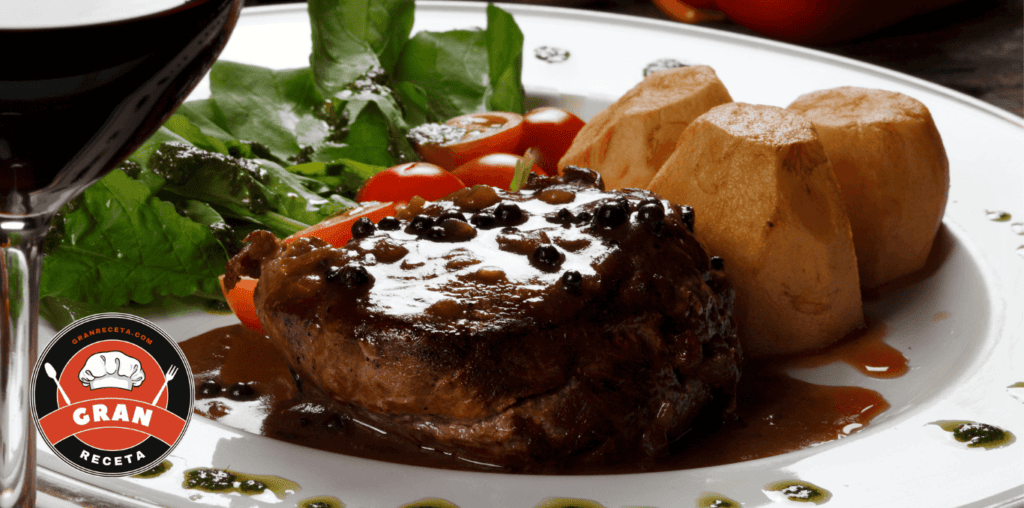

At about 2.5 lb, a beef tongue is the cheapest tender thing in the butcher’s case, and the only reason more people do not cook it is a single step that has a five-minute window. The skin has to come off while the tongue is hot: score it lengthwise straight out of the pot and it peels away in one piece, like a glove. Let it cool and it grips the meat. This is how Colombia cooks it, sliced into a tomato, wine and caper sauce. Six servings in 130 minutes, 90 of them unattended.
How do you cook beef tongue in sauce? Scrub it with salt and lime, simmer 90 minutes with aromatics and peel it hot the moment it comes out. Slice ⅜ inch across the grain and finish the slices for 15 minutes in a sauce of tomato, onion, wine and capers. 130 minutes for 6 servings.
Why it is cooked twice
The first simmer is not about tenderness. A tongue is wrapped in a tough, pebbled skin that nobody eats, and it only releases when the collagen holding it to the meat breaks down, which happens after roughly an hour and a half of gentle simmering, or half that at pressure.
At 60 minutes the skin resists and the tongue goes back in. At two hours it has gone so soft that it deforms when you slice it thin, and half an hour later it falls apart under the knife. Test it by tugging at the tip: if the skin gives, it is ready.
The second cook, 15 minutes in the sauce, does a different job. There the cooked meat takes on the tomato, wine and salt, turning a boiled tongue with sauce on it into tongue in sauce.
The peeling window
Lift the tongue out, put it on a board and run a knife along its length. From there the skin lifts with your fingers and comes off whole. Hold it with a towel, because it is hot enough to hurt.
You have about 5 minutes. After that the gelatin between skin and meat re-sets, the skin sticks, and scraping it off leaves a ragged surface and takes meat with it. If it does cool, drop it back into the hot water for 5 minutes and it will release again.
Buying it in the US
Beef tongue is sold at Latin and halal markets and at most full-service butcher counters, usually frozen, in the 2 to 3 lb range. It is one of the cheapest cuts per pound in the case, which is the other reason to know this recipe.
Two things at the counter. Ask for it whole and untrimmed, and check whether it still has the root, the thick gristly end, which is trimmed off and does not go into the dish. Frozen is fine; thaw it overnight in the fridge.
The five steps
The scrub decides what the dish tastes like. The surface of a tongue carries a membrane that, left in place, gives the strong flavor people associate with offal and that no sauce corrects afterwards.
The slice is the other fixed rule. The fibers run the length of the tongue, so the knife goes across them, ⅜ inch thick. Cut along the grain and a tender tongue turns chewy.
Colombia, Mexico and the deli counter
If you know tacos de lengua, you know the first half of this recipe exactly: the same simmer, the same hot peel. Mexico dices it and crisps it on a griddle; Colombia slices it and simmers it in sauce; a Jewish deli brines it for a week first and serves it cold.
That shared beginning is worth noticing, because it means the hard part is the same everywhere. Once you can peel a tongue, three cuisines open up.
Why it eats so rich
Tongue is by a wide margin the fattiest beef offal: according to the USDA it carries 16.09 g of fat per 100 g raw, roughly four times what heart, tripe or liver carry. That fat is marbled through the muscle rather than sitting in a cap.
Two things follow. The texture is unctuous rather than fibrous, unlike tripe, and the sauce needs no added fat, since two tablespoons of oil for the sofrito is enough and the meat supplies the rest as it finishes.
Who this recipe is for
- If you have never cooked tongue → buy it cleaned and ask the butcher to weigh it without the root
- If it cooled before you peeled it → back into the hot water for 5 minutes and the skin releases again
- If you use a pressure cooker → 45 minutes at pressure instead of 90, same result
- If you want it leaner → trim the visible fat at the base of the tongue before the second cook
- If there are leftovers → they keep 3 days in the sauce and are better the next day
Make ahead, storage and reheating
The whole first stage can be done a day ahead: simmer, peel and refrigerate the tongue whole, then slice and sauce it when you want to eat. Cooked and sauced, it keeps 3 days, within the 3 to 4 day window the USDA gives cooked dishes.
It freezes 3 months sliced and covered in its sauce; without sauce it dries out. Reheat gently, covered, about 10 minutes over low heat.
What goes wrong
Skipping the salt and lime scrub. The strong taste that remains cannot be fixed with sauce.
Peeling it cold. The skin grips, has to be scraped, and comes away with meat attached.
Slicing with the grain. Chewy strips, however well it cooked.
Overcooking the first simmer. Past 2 hours it cannot be sliced neatly.
Capers in early. They dissolve and salt the whole sauce; they go in at the end.
Variations
With red wine. 7 tbsp in the sauce, darker and heavier.
With mushrooms. 7 oz sautéed separately and added with the slices.
Plain tomato sauce. No wine, no capers, which is the everyday household version.
Pressed, for sandwiches. Simmered and peeled, then pressed and chilled 4 hours and sliced thin.
What to serve with it
Serve it over white rice with the sauce spooned on top, about 4.5 oz of meat per person, with boiled or mashed potato and a simple avocado and tomato salad on the side.
If you are interested in offal done properly, Colombian mondongo treats tripe with the same logic of scrubbing first and cooking long, and Colombian chicken giblet soup does it with gizzards and livers in under an hour. For a Sunday pot that also looks after itself for an hour and a half, there is Colombian sancocho, and Colombian stewed chicken is the weekday version of meat in sauce over rice. With a cold beer or Colombian aguapanela with lime alongside.
Frequently asked questions
How do you peel a beef tongue? Hot, within 5 minutes of lifting it from the pot: score it lengthwise and the skin comes off in one piece.
How long does it need to cook? Ninety minutes in a pot or 45 at pressure. It is ready when the skin gives as you pull it.
Why does it taste so strong? Usually because the salt and lime scrub was skipped, which is what removes the surface membrane.
Can it be frozen? Yes, cooked and sliced in its sauce, up to 3 months. Without sauce it dries out.
Which part is discarded? The outer skin and the root, the thick gristly end, which is cut away before cooking.
Nutrition
Per serving, a sixth of the tongue with its sauce, calculated with the USDA database:
- Calories: 400 kcal
- Protein: 23 g
- Carbohydrates: 4 g
- Fat: 30 g, of which 10 g saturated
- Fiber: 1 g
- Sodium: 620 mg
Cooked tongue carries 19.29 g of protein and 22.3 g of fat per 100 g according to the USDA, at 284 calories, so this is a rich dish rather than a light one. The sodium comes largely from the capers, and rinsing them before they go in brings it down.
Tongue was a Sunday dish at my grandmother’s and I did not try it until I was twenty, convinced it would taste strange. What changed my mind was watching it peeled: the skin came off whole like a glove and underneath was meat that looked nothing like what I had imagined. Now I cook it when I want to surprise someone. Josnaisis.