
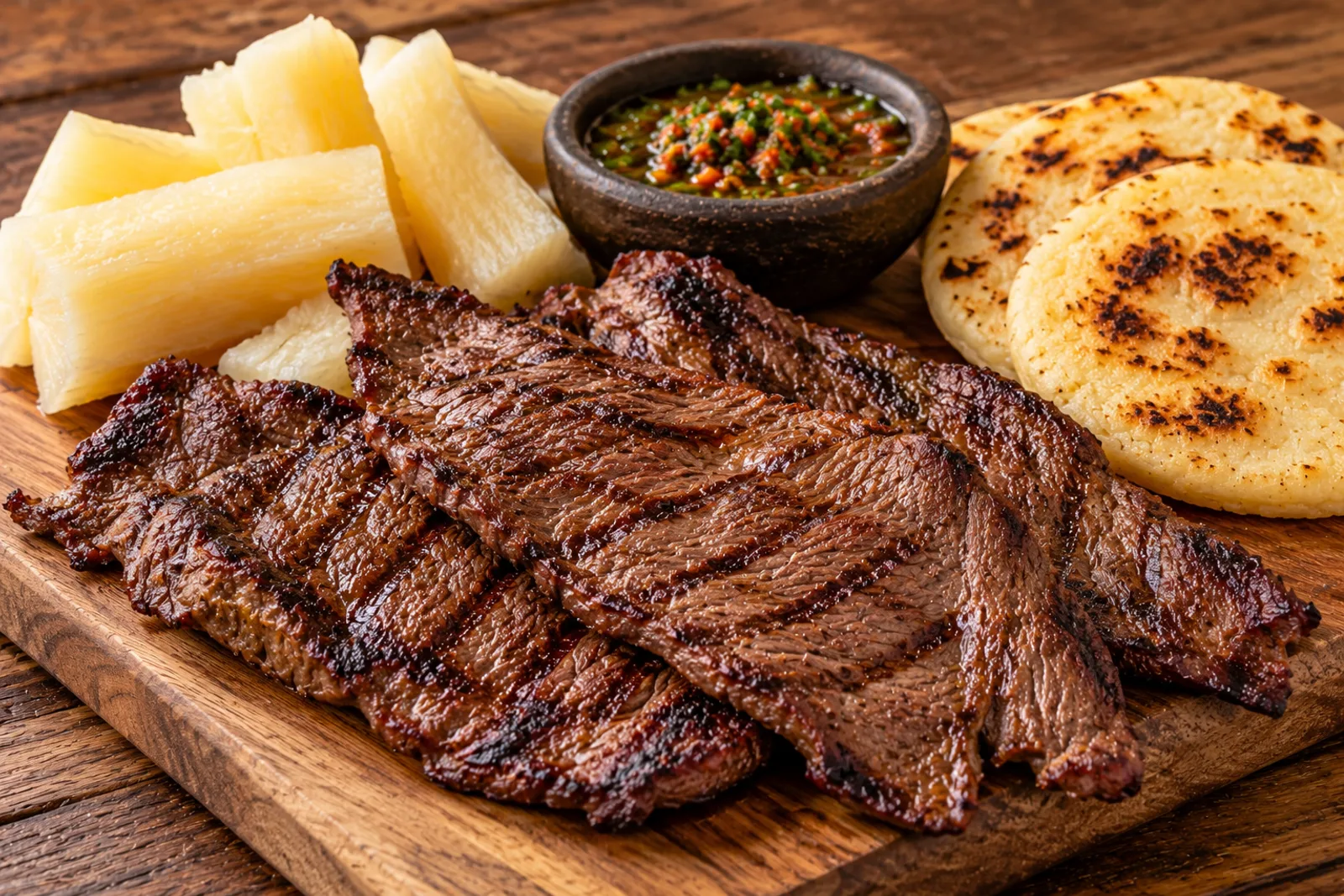

Carne oreada (KAR-neh oh-reh-AH-dah) means “aired beef”. It comes from Santander, in northeastern Colombia: thin slices of beef rubbed with panela, Colombia’s unrefined cane sugar, plus sour orange, garlic and cumin, then left to dry on the outside before they hit the grill. Traditionally that drying happened on a line in the sun. This version moves it into the fridge, which is safer and gives you almost the same crust, and the beef ends up sweet-salty, deeply browned at the edges and pleasantly chewy, the way it’s served with boiled cassava, arepas and guacamole in Santander.
What carne oreada is, and what to expect
How do you make Colombian carne oreada? Slice 2.2 lb (1 kg) of eye of round or flank steak ¼ to ⅜ inch (0.5 to 1 cm) thick, coat it with a blended paste of onion, garlic, sour orange, panela and cumin, and refrigerate 8 to 12 hours. Scrape it off, rub the slices with salt and more panela, and dry them uncovered on a rack in the fridge for 12 to 24 hours. Grill over medium-high heat 3 to 5 minutes per side. 1480 minutes for 4 servings, only 40 of them hands-on and at the grill.
If you’ve had Mexican cecina or Brazilian carne seca, carne oreada sits somewhere short of both. It’s cured only on the surface: the inside is still fresh beef, so it lives in the fridge until it hits the grill (or in the freezer), not in the pantry like jerky. The drying is what separates it from a marinated steak. It concentrates the flavor and leaves a dry skin that browns fast, so the sugar in the rub caramelizes before the thin slices overcook.
Expect a firm steak you chew rather than one that melts, salty first and then sweet from the panela. It isn’t spicy.
Time and effort. About 20 minutes of slicing, blending and rubbing, 20 minutes at the grill in two batches, and a full day in between that needs nothing from you. Not hard, but it takes planning: start the night before the day you want to eat it.
Which beef to buy
Budget 250 g (9 oz) raw beef per person. It loses water while drying and on the grill, which still leaves a generous plate next to cassava and an arepa.
- Eye of round. The Colombian cut is muchacho, which is eye of round: lean, long-grained, no gristle inside, and easy to open into one long sheet. UK butchers sell it as the salmon cut or eye of silverside. This is what I use.
- Flank steak. More flavor and a little more fat, with very visible grain. In the UK it’s sold as bavette or flank. Slice it with the grain for drying, then cut across the grain into strips at the table.
- Top round or sirloin. Any lean, single-muscle cut you can slice evenly works.
Ask the butcher to slice it for you at the thickness above; their knife gets the slices more even than yours will. Even slices are the whole game: one ¾-inch slice next to a ¼-inch one comes out raw or dry.
The Colombian pantry, and supermarket swaps
| Ingredient | What it is | US | UK | What changes |
|---|---|---|---|---|
| Panela | Unrefined cane sugar sold in blocks | Latin aisle, block or grated; Mexican piloncillo is the same idea | Latin grocers or online; dark muscovado | Dark brown sugar is milder and scorches a little faster |
| Sour orange | Bitter orange, as tart as lime | Bottled naranja agria in the Latin aisle | Seville oranges, January and February | 2 parts orange juice to 1 part lime is close |
| Beer (optional) | A splash some Santander cooks add to the marinade | Any lager, about ⅓ cup (80 ml) | Any lager | Slightly bitter edge and darker color on the grill |
Equipment. A wire cooling rack that fits on a sheet pan and in your fridge, a grill or a large cast-iron skillet or griddle, and ideally an instant-read thermometer. No rack? Lay the slices across wooden skewers on the sheet pan and turn them more often.
Why the fridge and not the sun
In Santander the marinated beef was hung on a line or a rack in the sun, anywhere from an hour to several days depending on how dry the cook wanted it, and in country kitchens it also hung high above a wood fire where the smoke helped. I don’t recommend that at home. Raw beef should not spend more than 2 hours between 40 and 140°F (4 and 60°C), or more than 1 hour above 90°F (32°C), which is any sunny midday. The salt in this rub is seasoning for meat you’ll eat today, not the heavy cure of real dried beef, so it won’t protect the meat outdoors.
A fridge does the same job more slowly. Cold, dry air pulls moisture off any meat left uncovered on a rack, the same trick used to dry steaks before searing. The crust comes out a little less toasty than sun-dried beef, and on the grill you’ll barely notice.
How to make carne oreada
Night one, slice and marinate
Cut with the grain, every slice the same thickness. To open an eye of round into a sheet, use a long knife and cut in a spiral around the roast, keeping the slice the same thickness and unrolling it as you go.
Blend the marinade until it’s a thick paste and rub it into both sides. 8 to 12 hours covered in the fridge; less than 8 and the garlic and cumin stay on the surface.
Day two, dry it uncovered
In the morning, scrape off the marinade with the back of a knife. Wet bits of onion keep the surface from drying and burn on the grill. Pat dry, rub with the salt, panela and cumin, and lay the slices on the rack without touching.
12 to 24 hours, uncovered, on the bottom shelf so nothing drips onto other food, and away from anything you eat raw. Turn them halfway. Freshly marinated beef looks wet and shiny and gives when you press it. At 12 hours it’s dry, matte and firm, still juicy once grilled; at 24 it’s darker and closer to what a Santander grill house serves. Sticky, slimy or sour-smelling beef goes in the trash, not on the grill.
Grill or sear
Medium-high, not full blast. The sugar on the surface burns before thin beef is cooked, and burnt panela tastes bitter in a way you can’t fix.
Grease the grill or pan, lay the slices down without crowding and leave them 3 to 5 minutes without moving, until they release on their own and the edges are dark. Flip and give the second side the same time. Crowded slices steam instead of browning.
At ¼ to ⅜ inch they’re usually cooked through in that time. If you check, the thickest slice should reach 145°F (63°C) in the center, followed by a 3-minute rest. In Santander it’s served browned outside and still juicy inside.
Fixing common problems
- Burnt outside, raw inside → heat too high or slices too thick. Medium-high, ⅜ inch (1 cm) at most.
- Pale and steamed, no crust → marinade not scraped off, not dried long enough, or a crowded pan. Scrape, pat dry and cook in batches.
- Tough as leather → overcooked, or dried for days. Pull each slice as soon as both sides are browned, and slice across the grain to serve.
- Too salty → more salt than listed, or bottled sour orange or beer that already contained some. Grill one small piece and taste before salting a full batch.
- Bitter → the panela burned. Lower the heat and scrape the grates between batches.
Allergens and heat. No gluten, dairy, egg or nuts, unless you add beer, which contains gluten. Not spicy at all, and kids usually like the sweetness; cut theirs into thin strips across the grain.
Variations and scaling
- Same-day version. Marinate in the morning for 6 hours, scrape and salt, then dry uncovered in the fridge for 6 more hours. Less flavor and less crust, but it works.
- With beer. About ⅓ cup (80 ml) lager in the blender with the marinade.
- Drier, grill-house style. Up to 48 hours of fridge drying. Firmer and more concentrated; grill a minute less per side.
- For 12. Triple everything, 6.6 lb (3 kg) of beef. You’ll need two or three racks. On a grill it all goes on at once; in a skillet, keep finished batches covered in a 200°F (95°C) oven.
Serving, storing and reheating
How it’s served. In Santander it comes with boiled or fried cassava, the corn-and-cassava Santander arepa with pork cracklings, guacamole or sliced avocado, and a tomato and onion salad. At home I serve it with crispy fried yuca, a bowl of guacamole and Colombian ají picante with scallion and cilantro on the table. For a big Santander lunch it follows a bowl of Colombian mute, the corn and rib stew, and it’s the beef on the Santander version of a Colombian fritanga platter, next to Colombian pepitoria, rice with goat offal and blood.
Raw, already dried. Keeps in the fridge for 3 to 5 days counted from when you bought the beef, not from when drying ended. For longer, freeze the raw slices in a zip-top bag with parchment between them so you can take out just what you need. Frozen at 0°F (−18°C) it stays safe indefinitely; for best flavor use it within 4 months and thaw overnight in the fridge.
Cooked. 3 to 4 days in the fridge, covered, refrigerated within 2 hours of coming off the grill. 2 to 3 months in the freezer.
Reheating. In a covered skillet over medium heat with a splash of water, 2 to 3 minutes per side, until steaming and 165°F (74°C). The microwave makes it leathery.
Frequently asked questions
Is sun-dried beef safe to make at home? Not the traditional way. Raw beef shouldn’t be out of the fridge more than 2 hours, or 1 hour above 90°F (32°C), and a sun-dry takes several hours. Drying it uncovered in the fridge gives a similar crust without that risk.
Does carne oreada keep without refrigeration? No. It’s dry only on the surface and fresh inside, so store it like any steak. Shelf-stable dried beef, like jerky or carne seca, uses much more salt and days of drying.
How is it different from Colombian sobrebarriga? Both can use flank. Colombian sobrebarriga, braised flank steak, is simmered for hours until it cuts with a fork. Carne oreada is sliced thin, dried and grilled in minutes, and it stays chewy. Venezuela’s version of dried beef is carne salada from the plains, salted heavily, dried for days and soaked before it becomes Venezuelan pisillo.
Nutrition
Per serving (9 oz / 250 g raw eye of round with its marinade, no sides), worked out from the quantities above and counting the whole marinade, though some stays behind in the container:
- Calories: 390 kcal
- Protein: 59 g
- Carbohydrates: 14 g
- Fat: 11 g, of which 4 g saturated
- Fiber: 1 g
- Sugars: 11 g
- Sodium: 1,290 mg
Eye of round is one of the leanest beef cuts, which is why protein is high and fat low; the sugars come from the panela. Flank steak raises the fat. Cassava and an arepa on the side add more calories than the beef itself.
I dry mine for the full 24 hours, because that’s when the crust browns on the grill before the beef has a chance to dry out, and I slice it just under ¼ inch so Dylan can eat it without a fight. That’s the difference from Venezuelan salted beef: here the panela leads and the salt only backs it up. Josnaisis.