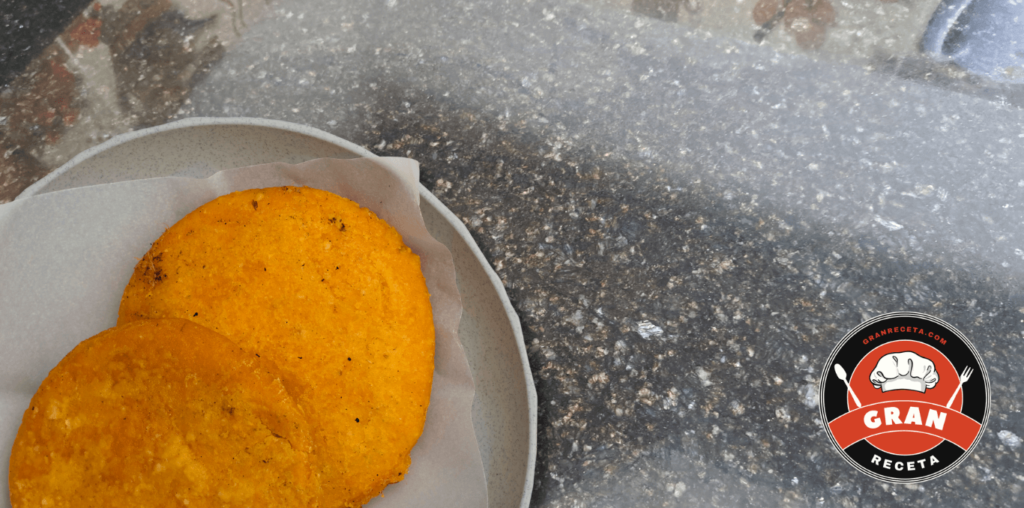
In Santander the arepa is built on three things with nothing in common — corn, cassava and pork cracklings — and each one does a different job. The corn gives the grainy texture, the cassava gives the starch that holds it together, and the cracklings give the fat and salt. Take out the cassava and the dough cracks as you press it. Eight arepas at 490 calories, three hours.
How do you make a santandereana arepa? Cook 1.1 lb of field corn with wood ash for 120 minutes until the hull rubs off, then rinse it 4 times. Grind it with 7 oz of boiled cassava and 10 oz of pork cracklings into a grainy dough, knead with lard, and cook 8 thin arepas on a dry griddle, 5 minutes a side. 8 arepas, 180 minutes.
What each ingredient is for
Field corn is whole dry grain, not flour, and ground after cooking it leaves a dough with texture you notice when you bite. That is the opposite of Colombian cheese arepas, made from precooked flour and smooth.
The cassava contributes gelatinised starch, which acts as glue: it binds the corn particles and makes the dough workable. It is the ingredient people leave out and the one most needed, because without it the dough tears as you stretch it.
Ground cracklings bring fat, salt and flavour, and they are why the arepa cooks on a dry griddle. With 10 oz in a batch, the dough browns on its own.
Shopping note: bagged hominy from the Latin aisle replaces the ash-cooked corn and cuts an hour and a half. Pork cracklings are sold as chicharrón in Latin markets, and crisp fried bacon stands in if there are none.
Hulling the corn, with ash or lime
Sifted wood ash dissolved in water provides alkalinity, and that alkalinity loosens the hull from the grain. It is nixtamalisation, the same technique that makes tortillas possible, solved in Santander’s wood-fired kitchens with what was already in the stove.
Pickling lime does exactly the same thing and takes half an hour less, and is sold wherever canning supplies are. If you want neither, bagged hominy skips the step entirely and cooks in 45 minutes, with a slightly flatter flavour.
What does not work is precooked corn flour: it makes a smooth arepa, which is a perfectly good thing and a different one.
How long to cook, and how much to rinse
The corn is ready when the hull rubs off a grain between your fingers: 45 minutes under pressure, or about two hours in an open pot. Past 150 minutes the grain starts breaking down and the arepa loses the texture that defines it.
Then come the rinses, the step nobody mentions. Four or five of them, rubbing the corn with your hands, until the water runs completely clear. Any ash left behind leaves a soapy taste that no amount of salt corrects.
It is the tedious part of the recipe and the reason many households buy the corn already hulled. That is a fair trade: a little flavour for an hour and a half.
Where the three hours go
Two hours of unattended boiling, 15 minutes of rinsing, 15 of grinding, 20 of resting and 10 on the griddle. The overnight soak sits outside the clock.
Make it ahead
The dough keeps two days tightly covered in the fridge, and cooked arepas freeze for up to 8 weeks. Reheat them straight on the griddle or in a skillet, 2 minutes a side, and they come back close to fresh. Cooking the corn is the long part, so many cooks do a double batch of that and freeze half of it drained.
Five things that go wrong
Under-rinsing the corn. Fewer than 4 rinses and a soapy ash taste stays for good.
Leaving out the cassava. The dough cracks as you press it and the arepa falls apart.
Grinding it smooth. The grain in the texture is part of the dish.
Making them thick. Past ⅜ inch the middle stays raw.
Greasing the griddle. The cracklings supply enough; more and they fry instead of toasting.
Four variations
More cracklings. 14 oz in the batch, the roadside-stall version.
With cheese. Three and a half ounces of salty white cheese ground into the dough.
With potato. Boiled potato in place of the cassava, slightly less elastic.
Very thin. At ⅛ inch, as Bucaramanga makes them to go with soup.
What to serve with them
In Santander they go with everything: breakfast with Colombian hot chocolate, lunch in place of bread, and dried beef at any hour. Two of them come to 980 kcal, so one per person is usually plenty.
For the other end of the family, the boyacense arepa from the next department is sweet, thick and stuffed with fresh curd. Colombian cheese arepas are the quick version made with precooked flour, and on a cold-country table cuchuco de trigo asks for an arepa beside it.
Frequently asked questions
What is the ash for? It provides alkalinity, which loosens the corn’s hull. It is nixtamalisation, the same as lime.
Can I use precooked corn flour? You get a different arepa: smooth, without the grain. Perfectly good, but not this one.
How many times do I rinse the corn? Four or five, until the water runs clear. That is what prevents the ash taste.
Why cassava? For its starch, which binds the dough. Without it the dough cracks as you press it.
Can I freeze them? Yes, cooked, for up to 2 months. Reheat 2 minutes a side in a skillet.
Nutrition
Per arepa of about 5 oz, calculated from each ingredient according to the USDA SR Legacy database:
- Calories: 490 kcal
- Protein: 29 g
- Carbohydrates: 56 g
- Fat: 17 g, 5 g of it saturated
- Fibre: 5 g
- Sodium: 950 mg
The cracklings supply nearly all the protein, nearly all the fat and almost all the sodium — the USDA puts salted pork rinds at 1,818 mg per 100 g. Use 7 oz instead of 10 and each arepa lands near 420 calories with 640 mg of sodium, and still tastes the way it should.
In Santander the arepa does not accompany the meal: it is the meal, at any hour of the day. The first time I watched someone rinse the corn five times I thought it was that household being fussy; the time I rinsed it four and a half, I understood why they insisted. Josnaisis.