
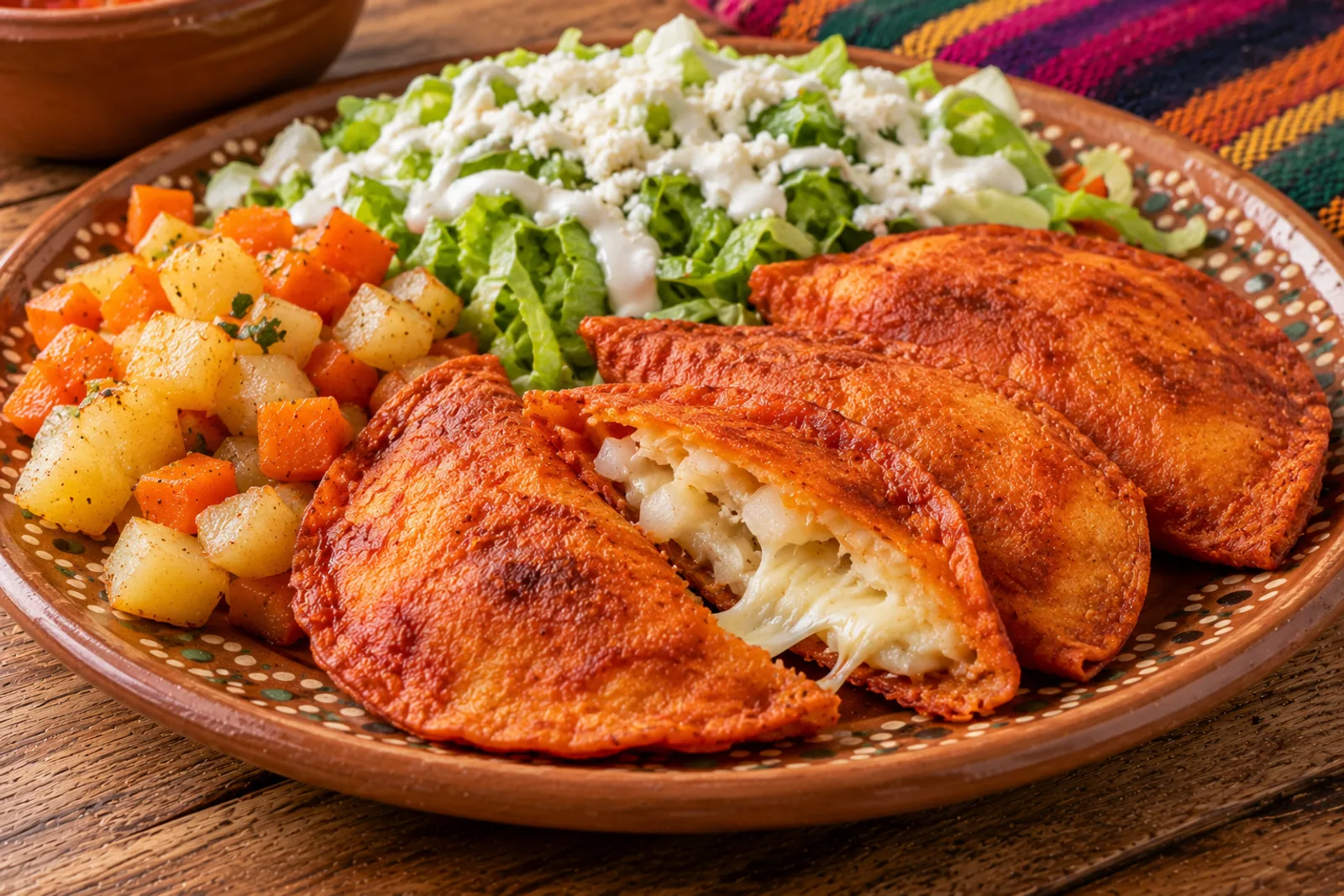

Enchiladas potosinas (poh-toh-SEE-nahs), from the Mexican state of San Luis Potosí, turn the usual enchilada inside out. Instead of rolling a tortilla in chile sauce, you blend 2 ancho and 3 guajillo chiles into the corn dough itself, press it into small red rounds, fill them with crumbled cheese and onion, fold them like tiny turnovers on a hot griddle and fry them just before serving. There’s no sauce poured over the top. If you’ve only had the baked, sauce-smothered kind, think of these as crisp red cheese quesadillas.
What you’re making, and how long it takes
How do you make enchiladas potosinas? Toast 2 ancho and 3 guajillo chiles, soak them 15 to 20 minutes and blend them into 2 cups (230 g) of masa harina. Press 16 rounds of 4 in (10 cm), cook each 30 seconds on a griddle, add ¾ oz (20 g) of queso fresco and onion, fold, seal and fry 1½ to 2 minutes per side. 85 minutes for 4 servings.
The result is crisp and golden at the edges, soft in the middle, with warm, slightly melted cheese and a toasted dried-chile flavor that’s mild rather than hot. Ancho and guajillo are both mild dried chiles, so most kids eat them happily.
Total time 85 minutes, of which 37 are soaking and resting. Medium difficulty: the first two or three come out lopsided while you learn how to seal them, and after that it’s a rhythm.
If red enchiladas are what you had in mind, the classic red enchiladas in guajillo and ancho sauce use store-bought tortillas dipped in sauce, and the green chicken enchiladas and baked enchiladas suizas are the saucy, oven-friendly options. These are closer to a griddled Mexican quesadilla than to any of them.
Finding the ingredients in the US and UK
Masa harina, not cornmeal
The dough has to be nixtamalized corn, meaning corn cooked with lime (calcium hydroxide) before grinding. That treatment is what makes it hold together and taste like a tortilla.
- US. Maseca or another masa harina is in the Hispanic aisle of most supermarkets. Some cities have tortillerias that sell fresh masa by the pound; use 1.1 lb (500 g) in place of the masa harina and water.
- UK. Masa harina is sold online and in Mexican and Latin American food shops. Check the bag says nixtamalized or masa harina.
- Not these. Cornmeal, polenta, cornflour (UK) and arepa flour such as P.A.N. are not lime-treated. They crack, refuse to seal or taste of arepa.
Dried chiles and how much to use
Two anchos and three guajillos per 2 cups (230 g) of masa harina give an even brick-red dough with a clear chile flavor that doesn’t bury the corn. Ancho brings the dark color and a raisin-like sweetness; guajillo, the bright red and a little tang.
- Milder. Anchos only. Darker, browner color and no heat at all.
- Redder. One extra guajillo. More than 4 makes the dough wet and slightly bitter.
- Hotter. Soak 1 chile de árbol with the others. The color stays the same.
In the US, bags of dried anchos and guajillos hang in the Hispanic aisle. In the UK they’re easiest to find online. Always strain the paste: bits of skin show up as black specks and start cracks when you press the rounds.
The cheese, and what to use instead
Queso fresco softens in the heat without turning runny, so it stays put inside the seam.
| Cheese | Where | What changes |
|---|---|---|
| Queso fresco or queso ranchero | US supermarket dairy case | The original: soft, mild, salty |
| Half feta, half drained ricotta | US and UK supermarkets | Close in texture; feta alone is too salty |
| Wensleydale or Caerphilly | UK supermarkets | Crumbly and mild, a little tangier; seal well |
| Monterey Jack, Oaxaca, mozzarella | Anywhere | Very melty and tasty, but leaks if the seam isn’t perfect |
Equipment. A cast-iron skillet or griddle, a 10 in (26 cm) skillet for frying and a tortilla press. No press? Use a heavy flat-bottomed plate and a zip-top bag cut open along the sides.
Mixing the red dough
Toast the chiles for 15 to 20 seconds per side, no longer. A blackened chile makes the whole batch bitter; throw it out and toast another. Blend with only ½ cup (120 ml) of the soaking water so the paste stays thick. Extra liquid turns fresh masa sticky.
The dough is right when it feels like modeling clay: it doesn’t stick to your hands, and a ball flattened between your palms has a smooth edge. Cracks mean it needs water, a tablespoon at a time. Sticking to the plastic means it’s too wet; knead in a tablespoon of masa harina. The 20-minute rest under a damp towel matters more with masa harina than with fresh masa, because freshly mixed masa harina cracks even when the water is right.
Pressing, filling and sealing
Each 1½ oz (40 g) ball gets pressed to 4 in (10 to 11 cm) across and about 1/16 in (2 mm) thick: thin enough to fold without breaking, thick enough to hold the filling.
Here’s the step that makes them stay closed. Lay the round on the griddle over medium heat and leave it alone. After 30 to 40 seconds the edge looks dry and it releases. Don’t flip it. The underside is now cooked and the top is still raw, so fill it right there and fold it with the raw side in. Raw masa sticks to raw masa, and the seam fuses when you press it with the spatula. Then 1 minute per side and into a towel.
Wrapped up, they steam a little and soften, which keeps them from cracking when they hit the oil.
Frying, or finishing on the griddle
Heat ½ cup (120 ml) of oil in a 10 in (26 cm) skillet over medium heat. It’s ready when a pinch of dough bubbles as soon as it goes in. Fry 4 at a time, 1½ to 2 minutes per side, until golden with crisp edges, and drain on paper towels.
For a lighter version, skip the frying and finish them on the griddle with a few drops of oil, 2 minutes per side. They’re softer and paler, and about 90 calories lighter per serving.
When they split, crack or turn greasy
- They split in the oil. The edge wasn’t sealed, or there’s more than ¾ oz (20 g) of filling. Fold raw side in and press the whole edge.
- They break when folded. The dough is dry, or the round sat on the griddle too long before filling. Fill it the moment it releases.
- They’re greasy. The oil was too cool, or you crowded the pan.
- They taste bitter. Burned chiles, or seeds and veins left inside.
Allergens. Milk (cheese and crema). No wheat; if you need them gluten-free, check the masa harina label.
Make ahead, serving a crowd, storing
The easiest plan for a party is to fill, seal and griddle them the day before, cool them and refrigerate in a sealed container within 2 hours. At serving time, frying 16 takes about 13 minutes. The chile paste can also be blended a day ahead.
Serving. Hot, 4 per person, on shredded lettuce with crema, crumbled cheese and salsa. Refried beans and guacamole are good on the side. Diced potato and carrot are the classic side for San Luis Potosí’s tacos rojos, not for these enchiladas, but they make a good optional extra: 2 potatoes and 2 carrots in ½ in (1 cm) dice, boiled 8 to 10 minutes and browned in the frying oil before the enchiladas go in.
Fridge. Fried or just griddled, refrigerated within 2 hours, they keep 3 to 4 days.
Freezer. Best unfried. Freeze them apart on a tray, then bag them, for 2 to 3 months. Thaw in the fridge overnight and fry as usual.
Reheating. In a skillet over medium-low heat, 3 to 4 minutes per side, until hot in the center (165°F / 74°C). The microwave makes them leathery.
Cost. The cheese is the expensive part; masa harina and dried chiles are cheap, and one bag of masa harina covers several batches.
Frequently asked questions
Can I use store-bought corn tortillas? Not for this. A cooked tortilla won’t seal, so what you get is a quesadilla in sauce, which is really a red enchilada. The point here is the raw red dough.
Why are they called enchiladas if there’s no sauce? Because the chile is in the dough. The tortilla itself is “enchilada,” chile-coated. The salsa goes on the side.
What do I do with leftover red dough? Press 6 in (15 cm) tortillas and cook them like homemade corn tortillas for tacos or tostadas. Wrapped in plastic it keeps a day in the fridge; knead in 1 tbsp water before using.
Can I bake them or use an air fryer? You can finish them brushed with oil in the oven or an air fryer, but they come out drier than fried, and I haven’t tested them enough to give you a reliable time. The griddle with a few drops of oil is the no-fry method I’d recommend.
Nutrition per serving
Per serving of 4 enchiladas, without lettuce, crema, extra cheese or salsa, worked out from the recipe amounts and counting about 40 g (3 tbsp) of oil absorbed during frying:
- Calories: 528 kcal
- Protein: 18 g
- Carbohydrates: 54 g
- Fat: 28 g, of which 10 g saturated
- Fiber: 7 g
- Sugars: 3 g
- Sodium: 770 mg
The dough brings about 210 kcal per serving, the cheese about 187 and the frying oil about 90. Griddled instead of fried, they come to about 440 kcal.
Coming from arepas and empanadas, my instinct is to fill dough right to the edge, and with a dough this thin that’s exactly what makes it split. I weigh the filling, always fold raw side in, and for Dylan I color part of the dough with ancho only, which has no heat. Josnaisis.