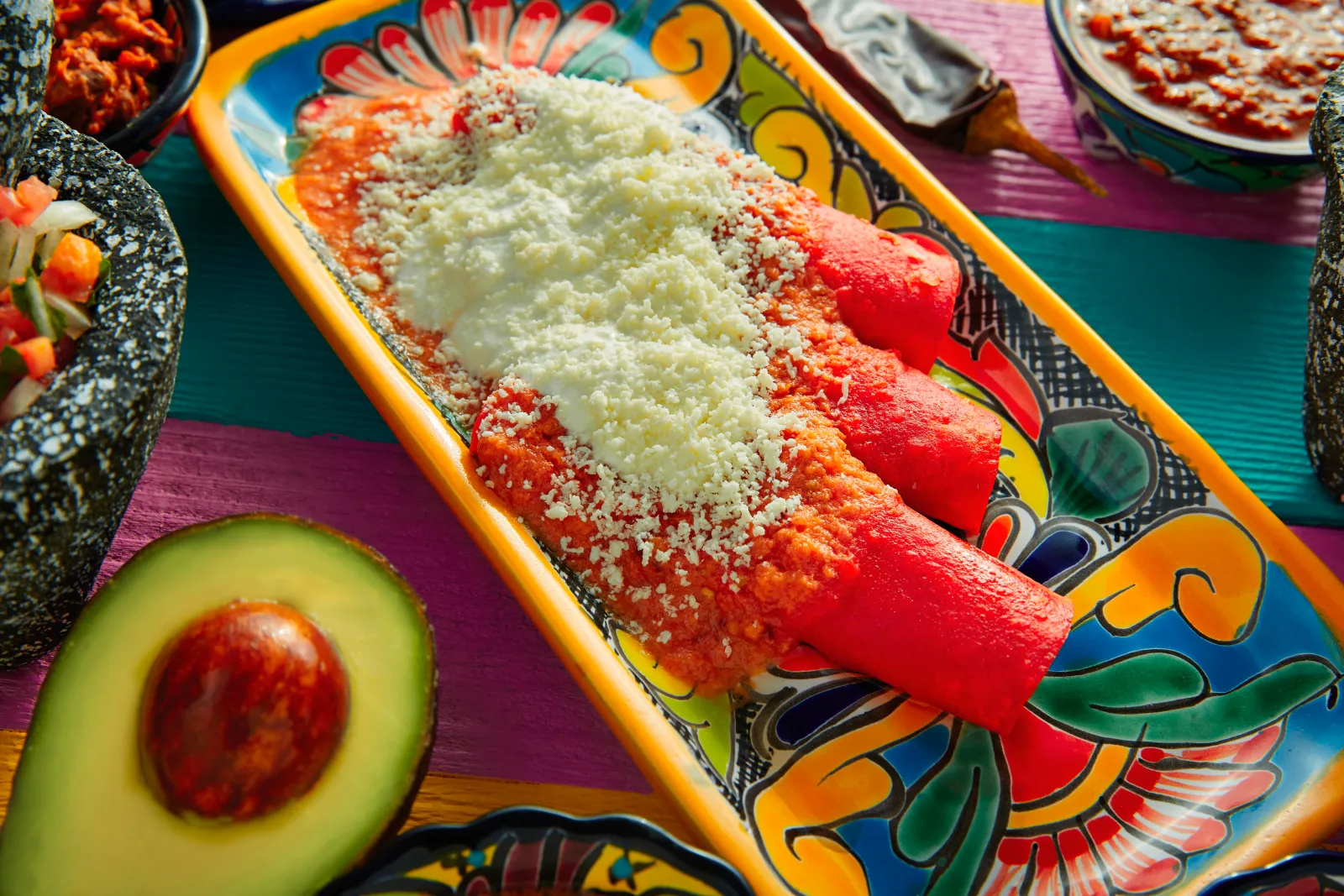

A 28-ounce can of Las Palmas red enchilada sauce lists water, dried chile, salt, oil and vinegar, and tastes mostly of the vinegar. The sauce Mexican home cooks make starts with whole dried chiles, toasted for 20 seconds, soaked, blended and fried until it turns brick red, and the difference is the whole point of the dish. Enchiladas rojas (en-chee-LAH-dahs ROH-hahs) are corn tortillas softened in oil, dipped in that sauce, rolled around shredded chicken or crumbled cheese, and finished with crema, queso fresco and raw onion. In most Mexican kitchens they’re sauced and eaten straight away, not baked under a blanket of yellow cheese.
What are red enchiladas, and are they worth making from scratch?
How do you make red enchiladas? Poach chicken breast for 20 to 25 minutes and shred it. Toast 6 guajillo and 2 ancho chiles for 15 to 20 seconds a side, soak them 15 minutes with tomatoes, blend with onion, garlic, cumin, oregano and broth, strain, and fry the sauce for 8 to 10 minutes. Soften corn tortillas in hot oil for 10 seconds a side, dip them in the hot sauce for 2 to 3 seconds, fill, roll and top with crema, queso fresco and onion. 60 minutes for 4 servings.
Yes, if you care about the sauce. An hour on the clock, about 40 minutes of it hands-on, and the sauce keeps for days, so a second batch takes 25 minutes. What you get is a sauce that tastes of toasted dried fruit with a faint bitterness at the end, mild enough for kids, and nothing like the vinegar edge of a can.
When they make sense. A family dinner for 4, a relaxed lunch with friends, or a crowd of 12 to 20 if you bake them. They’re also a good home for leftover poached or rotisserie chicken.
When they don’t. A 20-minute weeknight with nothing made ahead. Then canned sauce is a fair call, and below I show how to make it taste better.
Difficulty, medium. Two moments need your eyes on the pan: toasting the chiles, which burn in seconds, and the oil-then-sauce dip, which has to happen in one quick chain.
Red enchilada sauce, homemade from dried chiles or canned?
Homemade, whenever you have 40 minutes. A mild red can from Las Palmas, a common US brand, lists water, dried red chile peppers, salt, cottonseed oil, cider vinegar and fumaric acid, with 370 mg of sodium in every ¼ cup. This sauce comes to about 240 mg for the same amount, not counting the salt in the poaching liquid, and it’s built on fresh tomato, garlic, cumin and oregano. The can tastes sharper and thinner; homemade is rounder and clings to the tortilla.
The two chiles. Guajillos are long, smooth and wine-red, and bring color and a fruity, gentle heat. Anchos are dried poblanos, wide, wrinkled and nearly black, and add body and sweetness. Six guajillos to two anchos keeps the sauce red rather than brown. By the Food.com Scoville chart, an ancho sits around 1,000 heat units and a guajillo around 5,000; a serrano, the chile in green chicken enchiladas, runs 5,000 to 15,000 according to North Dakota State University Extension. I’d call this sauce a 1 out of 5. For more heat, soak 1 or 2 chiles de árbol, about 25,000 units, with the others.
Three steps that matter. Toast for 15 to 20 seconds a side to wake up the aroma; longer and the chiles turn bitter. Strain, because guajillo skin never fully breaks down in a blender and leaves the sauce gritty. Fry the sauce for 8 to 10 minutes in a tablespoon of oil, which cooks out the raw chile taste and thickens it just enough. I pour the soaking water down the sink: it holds some of the skins’ bitterness, and broth gives a rounder sauce.
If you go canned. Fry it 5 minutes in a tablespoon of oil with a crushed garlic clove and ½ teaspoon of oregano, and reduce it 3 or 4 minutes more if it’s watery. One 28-ounce (794 g) can gives roughly the 600 ml (2½ cups) you need for 12 enchiladas.
What to buy, with US and UK swaps
The exact amounts are in the recipe card: 600 g (1⅓ lb) chicken breast, 6 guajillos, 2 anchos, 200 g (7 oz) of tomatoes and 12 corn tortillas for 4 plates of 3.
Where to shop. In the US, bagged guajillos and anchos are in the Hispanic aisle of most large supermarkets, next to the dried beans, and crema and queso fresco sit in the Latin dairy case. In the UK, look for dried Mexican chiles from specialist online grocers; Cool Chile Co sells 50 g bags of guajillo, which covers this recipe with a little to spare. Kept in a sealed jar away from light, they last for months.
Tortillas. Corn, 6 inches (15 cm). Flour tortillas go limp in the sauce and aren’t used for this dish in Mexico.
Equipment. A dry heavy skillet or griddle for the chiles, a small pot, a blender, a fine-mesh strainer, a wide skillet for the sauce, an 8-inch (20 cm) skillet for the oil, tongs and paper towels. No fine strainer? Blend a full extra minute; you’ll feel a few flecks of skin, but it won’t ruin anything.
How to keep corn tortillas from tearing in red sauce
Three things tear a tortilla, and you can see all of them coming. It goes in cold and dry, so the starch is stiff and cracks when bent. The sauce is too thick, so it grips the surface and pulls it off as you lift. It sits too long in the sauce, past about 5 seconds, and goes soggy in the tongs.
- Oil first. 1 cm (½ in) of oil over medium heat for about 3 minutes, until the edge of a tortilla bubbles the instant it touches. Ten seconds a side: soft, sealed, no color.
- Sauce second. Straight from the oil into hot sauce, kept at the texture of heavy cream, for two or three seconds. Loosen it with broth whenever it thickens in the pan.
- Fill and roll at once. Set the oil pan and the sauce pan side by side and work one tortilla at a time.
Some cooks do it the other way round, sauce then oil. It gives a deeper, toastier flavor but spatters hard and muddies the oil with every tortilla, so I keep it for when I’m cooking for two. For a lighter version, warm tortillas on a dry griddle for 15 to 20 seconds a side and skip the oil; they tear more easily, so the sauce has to be very hot and the dip no longer than 2 seconds.
Game plan for 4, make-ahead and scaling up to 20
The chicken poaches on its own for 25 minutes, and toasting and soaking the chiles fit inside that window. Tortillas come last, once the sauce is fried and hot.
Make ahead. Fry the sauce and shred the chicken up to 3 or 4 days before, stored separately in the fridge. The sauce thickens as it chills, so thin it with broth when you reheat it. On the day, it’s about 25 minutes to the table.
How to tell it’s going right.
| Stage | What you should see |
|---|---|
| Toasted chiles, 15-20 s a side | fragrant, small blisters, no black spots or smoke |
| Soaked chiles, 15 min | they fold without snapping |
| Fried sauce, 8-10 min | brick red, no raw chile smell, runs slowly off a spoon |
| Oil, ~3 min | a tortilla edge bubbles on contact |
| Dipped tortilla | glossy red, pliable, rolls without cracks |
Scaling. Three enchiladas per person. From 12 people up, bake them: a 9×13-inch (23×33 cm) dish holds 12 in one layer.
| People | Tortillas | Chicken breast | Guajillo + ancho | Tomatoes | Broth | Crema | Queso fresco | 9×13 dishes |
|---|---|---|---|---|---|---|---|---|
| 4 | 12 | 600 g (1⅓ lb) | 6 + 2 | 200 g (7 oz) | 500 ml (2 cups) | 120 ml (½ cup) | 100 g (3½ oz) | 1 |
| 6 | 18 | 900 g (2 lb) | 9 + 3 | 300 g (11 oz) | 750 ml (3 cups) | 180 ml (¾ cup) | 150 g (5 oz) | 2 |
| 12 | 36 | 1.8 kg (4 lb) | 18 + 6 | 600 g (1⅓ lb) | 1.5 l (6 cups) | 360 ml (1½ cups) | 300 g (10½ oz) | 3 |
| 20 | 60 | 3 kg (6⅔ lb) | 30 + 10 | 1 kg (2¼ lb) | 2.5 l (10½ cups) | 600 ml (2½ cups) | 500 g (1 lb 2 oz) | 5 |
For 12 or 20, make the sauce the day before in blender batches and fry it in a 5-quart (5 liter) pot. On the day, dip and roll the tortillas, line them up in the dishes and keep them covered for up to 2 hours. Just before baking, pour over the rest of the hot sauce, add cheese and bake 10 to 15 minutes at 375°F (190°C). If the dishes won’t fit on one rack, swap racks halfway and add a couple of minutes.
Mistakes, spice level and allergens
- Bitter sauce → burnt chiles, or seeds and veins left in. 15 to 20 seconds a side over medium heat, chiles cleaned well.
- Gritty sauce → it wasn’t strained. Strain it even with a powerful blender.
- Torn tortillas → thick or cold sauce, no oil, or more than 5 seconds in the sauce. Thin it with broth and keep it hot.
- Soggy enchiladas → unfried sauce, or they sat too long before eating. Fry it 8 to 10 minutes and serve within 5 minutes.
- Flat-tasting sauce → under-salted or under-fried. Taste at the end of frying, once it has reduced.
- Greasy tortillas → the oil wasn’t hot enough, so they soaked it up instead of sealing.
Spice level, 1 out of 5 with 6 guajillos and 2 anchos, seeds and veins removed. With 2 chiles de árbol it’s closer to 3.
Kids. Usually a hit: the sauce is mild and slightly sweet, and the cheese version tends to win over picky eaters.
Allergens. Dairy in the crema and cheese; leave them off and it’s dairy-free. Corn tortillas are naturally gluten-free, but check labels for someone with celiac disease, because some brands blend in wheat flour, and so do some canned sauces. No egg, nuts or fish.
Which enchiladas should you make?
- Red, sauced to order (this recipe) → deep dried-chile flavor, low heat, for 2 to 6 people.
- Green → tomatillo and serrano, tangier and a little hotter; the full method is in green chicken enchiladas with tomatillo salsa.
- Suizas → green sauce blended with cream and baked under cheese; see enchiladas suizas, creamy and baked.
- Baked, Tex-Mex style → these same enchiladas in a 9×13-inch dish under all the sauce and 150 g (5 oz) of shredded Monterey Jack, 10 to 15 minutes at 375°F (190°C) until bubbling. Softer tortillas, but you can roll them 2 hours ahead. My pick for a party.
- Cheese enchiladas → 300 g (10½ oz) crumbled queso fresco mixed with 40 g of chopped onion instead of the chicken.
- A different filling → smoky chicken tinga in place of plain shredded chicken.
What red enchiladas cost
At the US city average prices the Bureau of Labor Statistics published for August 2026, boneless chicken breast was $4.17 a pound, so the 1⅓ lb (600 g) here comes to $5.52, about $1.38 a plate; the 7 oz (200 g) of tomatoes add $0.87. BLS doesn’t track dried chiles, corn tortillas, crema or queso fresco, and I won’t invent a total for them.
For scale, at Mexico City’s Central de Abasto wholesale market on October 9, 2026, the Ministry of Economy’s SNIIM listed guajillo at 130 pesos a kilo and ancho at 140, which puts the chiles for this recipe at about 8 pesos and the whole sauce at about 16.
Yield. 12 enchiladas, 4 plates of 3, with about 600 ml (2½ cups) of sauce. Alongside rice and beans, 2 each is enough and it feeds 6.
What drives the price. The chicken. A whole chicken, $2.01 a pound in the same BLS data, gives more meat per dollar and a better broth for the sauce.
Serving, storing and reheating
What to serve with them. Mexican rice made with fresh tomatoes and homemade refried beans on the side. If you want a table salsa with more kick, the red taco salsa with chile de árbol is the one. Shredded lettuce and sliced radishes on top are a common extra.
Fridge. The USDA Food Safety and Inspection Service numbers for leftovers: 2 hours at most out of the fridge, 3 to 4 days at 40°F (4°C) or below. Sauce and chicken keep better apart than assembled enchiladas, which soften from day one.
Freezer. The fried sauce freezes beautifully, and so does the shredded chicken, in separate containers, with 3 to 4 months of best quality per FSIS. I freeze sauce in 600 ml (2½ cup) bags, exactly one batch of 12. Assembled enchiladas thaw soft; if you must freeze them, freeze the baked version without crema or cheese.
Reheating. Sauce and chicken in a saucepan over medium heat until the sauce boils and the chicken reaches 165°F (74°C), then dip fresh tortillas and roll. Assembled enchiladas, covered with foil, 15 to 20 minutes at 350°F (175°C). The microwave softens them further: one plate at a time, a minute at a time.
Frequently asked questions
What is red enchilada sauce made of? Dried chiles, usually guajillo and ancho, soaked and blended with tomato, onion, garlic, cumin, oregano and broth, then strained and fried. This one uses six guajillos and two anchos for a dozen enchiladas.
Is red enchilada sauce spicy? Not very. Guajillo and ancho are mild chiles, around 5,000 and 1,000 Scoville units. Add one or two chiles de árbol for real heat.
Why do my enchiladas fall apart? Cold, dry tortillas, sauce that’s too thick or cold, or tortillas left in the sauce too long. Ten seconds a side in hot oil, then two or three seconds in hot sauce the texture of heavy cream.
Do you fry tortillas before dipping them in enchilada sauce? For this recipe, yes: a quick 10-second dip per side in hot oil seals them so they don’t soak through. Some cooks dip in sauce first and fry after, which tastes toastier but spatters.
Can I use chili powder instead of dried chiles? Only in an emergency. Chili powder makes a flat, dusty sauce that needs flour to thicken; a decent canned sauce, fried with garlic and oregano, is the better shortcut.
Why is my enchilada sauce bitter? Almost always burnt chiles or seeds left in. Toast them for fifteen to twenty seconds a side over medium heat and discard the soaking water.
What’s the difference between red and green enchiladas? The sauce. Red uses dried guajillo and ancho chiles and tastes toasted and mild; green uses tomatillos and serranos and tastes tangy and hotter.
Can I bake red enchiladas? Yes. Roll them in a 9×13-inch dish, cover with the sauce and Monterey Jack, and bake 10 to 15 minutes at 375°F (190°C). It’s the easiest way to feed 12 or more.
Nutrition per serving
Per serving of 3 enchiladas with crema, queso fresco and onion, calculated ingredient by ingredient from USDA FoodData Central (SR Legacy) with this recipe’s amounts. Guajillos were calculated as dried ancho, the closest match in that database, and crema as sour cream. The oil the tortillas absorb, about 60 g in total, is my own estimate.
- Calories: 701 kcal
- Protein: 46 g
- Carbohydrates: 47 g
- Fat: 38 g, of which 10 g saturated
- Fiber: 9 g
- Sodium: 889 mg
Leave off the crema and cheese and it drops to 567 kcal. The salt in the sauce accounts for 581 mg of the sodium.
Dried Mexican chiles weren’t part of my kitchen growing up in Venezuela, and my first guajillo sauce went straight into the trash: I left the chiles on the skillet while I answered the door. Now I toast them two at a time and don’t step away. Good red sauce is mostly patience measured in seconds. Josnaisis.