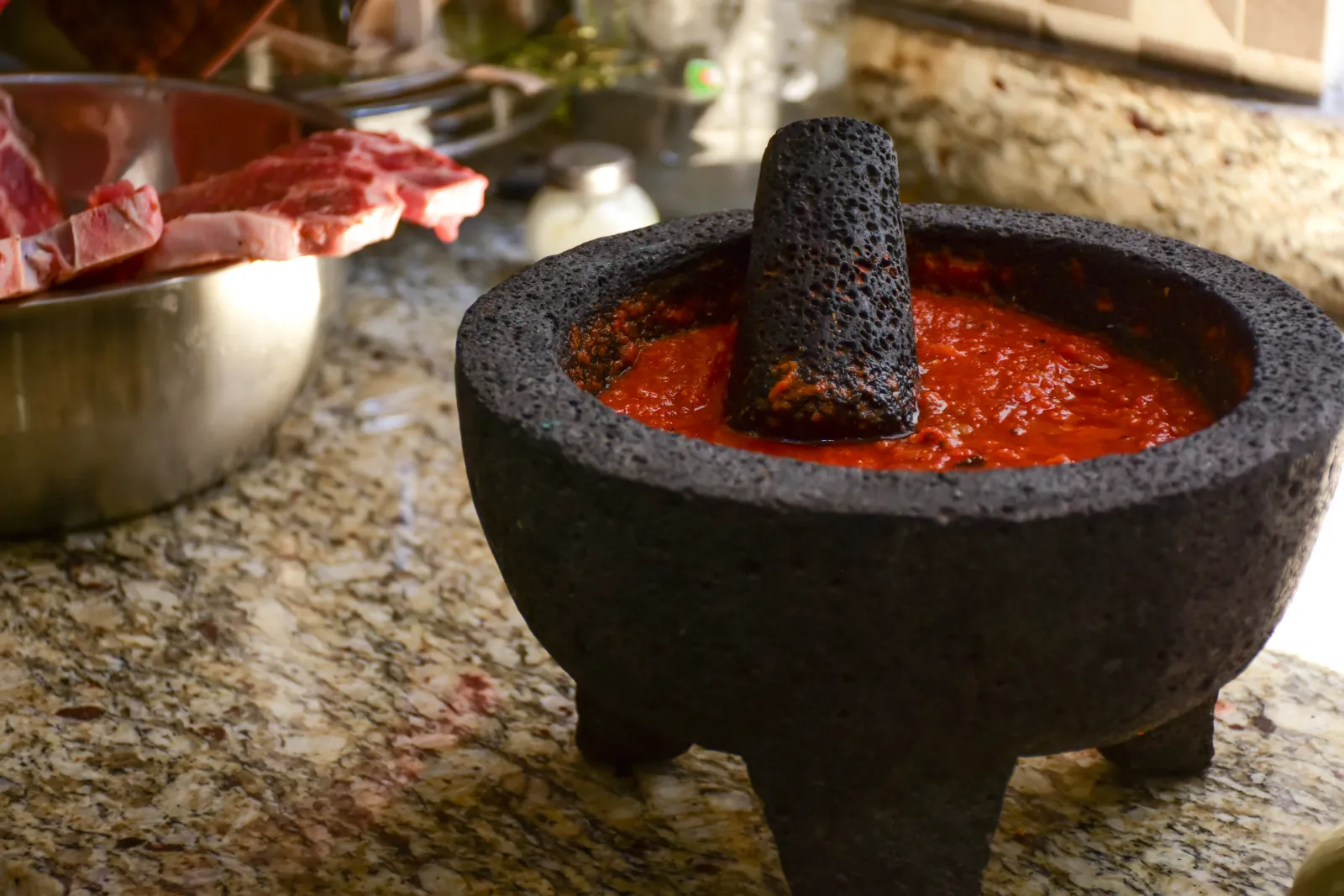

Of the salsas on a Mexican taco stand counter, the red one is the one to approach with care. Salsa roja taquera (SAHL-sah ROH-hah tah-KEH-rah) is a cooked, blended salsa built on dried chiles de árbol, small, skinny red chiles that run several times hotter than a jalapeño, plus tomatoes and tomatillos charred in a dry skillet. It’s what goes over al pastor, carne asada and carnitas, a teaspoon at a time. This version makes about 21 oz (600 g), takes 30 minutes, and lets you set the heat by counting chiles.
What is taqueria red salsa, and is it worth making at home?
How do you make taqueria-style red salsa? Char 9 oz (250 g) of Roma tomatoes, 7 oz (200 g) of tomatillos, a piece of white onion and two garlic cloves in a dry skillet until blistered, then toast 12 dried chiles de árbol for 20 to 30 seconds per side without burning them. Blend everything with ½ cup (120 ml) of water and salt, then simmer for 5 minutes in a tablespoon of oil until brick red. 30 minutes for 10 servings.
Yes, if you like heat. A batch of about 2½ cups takes around $1.33 of fresh produce plus a handful of dried chiles, there’s no vinegar or preservatives in it, and the result tastes of the skillet in a way bottled salsas don’t. The trade-off is that it’s genuinely hot at 12 chiles, a 4 out of 5, and it won’t suit a table that wants mild.
How it’s different from salsa verde and pico de gallo
They do different jobs. A tomatillo salsa verde uses fresh green chiles and tastes bright and tart. Pico de gallo is raw and chopped, more of a relish. This red salsa is the only one of the three made with a dried chile, which brings a sharper, faster heat, and it’s charred and cooked, so it tastes smoky rather than fresh. Put two on the table and nobody will say they’re the same.
Ingredients, and where to find them in the US and UK
The recipe card has the exact amounts: 12 dried chiles de árbol (about ¼ oz / 7 g), 9 oz (250 g) Roma tomatoes, 7 oz (200 g) tomatillos, 1½ oz (40 g) white onion, 2 garlic cloves, ¾ teaspoon salt, ½ cup water and 1 tablespoon oil. If you want to scale by weight, my ratio is 2 to 3 chiles, about ⅓ oz (9 g) of onion and 1 g of salt for every 3½ oz (100 g) of tomato and tomatillo combined.
Chiles de árbol, and how many to use
The name means “tree chile”. Wikipedia rates them at 15,000 to 30,000 Scoville heat units; the University of Arizona Cooperative Extension puts jalapeños at 2,500 to 5,000, so a single árbol carries about six jalapeños’ worth of heat in a pod that weighs around 0.6 g (Spices Inc. counts roughly 50 to the ounce). Dried, they keep their bright red color, which helps you judge the toast.
In the US they’re sold in cellophane bags in the Hispanic aisle of most large supermarkets and in Mexican grocery stores, next to guajillos and anchos. In the UK they’re mostly an online buy from Mexican food specialists; supermarkets rarely stock them.
Tomatoes and tomatillos, and why both
The Roma tomatoes give color, sweetness and body. Romas have less water and fewer seeds than round salad tomatoes, so the salsa doesn’t go thin. The tomatillo, Physalis philadelphica, is a tart green fruit in a papery husk, not an unripe tomato; it adds acidity and, through its pectin, a little thickness. With tomatoes alone, the salsa comes out sweeter and runnier; with tomatillos alone, sour and orange.
Fresh tomatillos are easy in the US produce section. In the UK, the practical option is canned: Ocado listed La Costeña whole tomatillos, 794 g (28 oz), at £3.95 in October 2026.
Swaps that work, and what they change
Whole dried cayenne chiles are the nearest substitute: thin, red, dried, and they toast the same way. Most varieties run 30,000 to 50,000 Scoville units according to Wikipedia, so start with 6 instead of 12 and taste. Crushed red pepper or chilli flakes rescue a salsa in an emergency, but they can’t be toasted whole and leave it slightly gritty. A guajillo chile doesn’t bring enough heat to replace árbol; one alongside the árboles makes the salsa redder and a touch sweeter.
Equipment
A cast-iron skillet or comal about 10 inches (26 cm) across, tongs, a blender and a small saucepan. An immersion blender in a tall jug works, with slightly coarser flecks of chile. A nonstick pan chars more slowly and shouldn’t be heated empty on high, so if that’s all you have, use medium-high and be patient.
Step by step, with the cues that tell you it’s right
30 minutes on the clock, about 15 of them hands-on. The order matters more than the timing: everything else comes off the skillet before the chiles go on.
What to look for at each stage:
- Tomatoes → black blisters on every side, skin wrinkling, soft when squeezed with tongs. If they’re still firm inside at 15 minutes, cover them with an upturned bowl on the skillet for 2 minutes.
- Tomatillos → bright green turns olive green and they slump. Pull them before they split and leak.
- Garlic → golden spots on the papery skin and soft when pressed. Fully blackened skin usually means a bitter clove; peel and check.
- Chiles → bright red goes a shade darker, they puff slightly and smell toasty. If they smoke or look black, they’re burnt.
- In the saucepan → it bubbles, darkens to brick red and loses its foamy look within about 5 minutes.
Why red salsa turns bitter, and other ways it goes wrong
Almost every problem with this salsa starts on the skillet, not in the blender.
- Bitter salsa → a burnt chile, nearly always. One is enough to ruin 21 oz (600 g). Toast on medium-low, 20 to 30 seconds per side, and bin any that blacken.
- Acrid, harsh garlic → the garlic stayed on for the full 15 minutes with the tomatoes. It comes off at 5.
- Thin and watery → round salad tomatoes instead of Romas, or too much water. Start with ½ cup (120 ml) and add by the tablespoon. If it’s already thin, simmer it 3 to 5 minutes longer.
- Far hotter than expected → chiles vary from bag to bag. Blend with half, taste, then add the rest.
- Too hot to eat → char one more tomato and a tomatillo and blend them in. The heat drops without the salsa getting watery.
Heat level. At 12 chiles, a 4 out of 5: properly hot, meant to be used by the teaspoon. 8 chiles gives you a 3, and 4 chiles a 2.
Handling the chiles. Capsaicin stays on your fingers after seeding a dozen chiles. Wear gloves, or wash your hands well with soap before touching your eyes or a child’s face. Toasting them also throws off a pungent smoke that makes people cough, so turn the extractor fan on and open a window.
Kids. Not this one. Set some aside before the chiles go in: the charred tomatoes, tomatillos, onion, garlic and salt blended on their own make a mild red salsa most children will eat with tortilla chips.
Allergens. No gluten, dairy, egg, nuts or fish. It’s vegan.
Roasted, boiled or fried, and other versions worth knowing
- Short on time → boil it. Simmer the tomatoes, tomatillos, onion and peeled garlic in water to cover for 10 minutes, adding the untoasted chiles for the last 5. Drain and blend with ½ cup (120 ml) fresh water. It’s lighter, tarter and thinner, and there’s no need to fry it.
- No skillet → use the oven broiler (grill in the UK) on high, with the tray on the top shelf, for 10 to 15 minutes, turning halfway, until blackened in patches. Toast the chiles in an ordinary frying pan on low.
- Fried-chile version → instead of toasting, fry the chiles in the tablespoon of oil over medium heat for 10 to 15 seconds, until they puff, and blend them with the oil. Richer and more toasted.
- Milder → 4 seeded chiles de árbol plus 1 seeded guajillo for color.
- No tomatillos → 1 lb (450 g) of Romas and the juice of ½ lime to stand in for their acidity.
- Canned tomatillos → drain and add them straight to the blender without roasting; they’re already cooked and salted, so halve the salt and taste.
Every taqueria has its own red salsa and changes the ratio of tomato to tomatillo, the chile or the oil. This is the base I make at home, and the versions above are the ones that actually change the result.
What it costs, and how much it makes
In the US, using the USDA Agricultural Marketing Service weekly retail report for October 9, 2026 (Roma tomatoes $1.27/lb, tomatillos $0.99/lb, white onion $1.22/lb, garlic $5.99/lb), the fresh produce for one batch comes to about $1.33. Dried chiles de árbol aren’t tracked in that report or in the BLS average prices, so I won’t put a number on them; one small bag covers several batches.
For reference, at Mexico City’s Central de Abasto, the Mexican government’s SNIIM wholesale price service put the whole batch, chiles included, at 12.11 pesos on the same date, with the chiles at 175 pesos a kilo, more than seven times the price of the tomatoes, but only 7 g of them.
Yield. About 21 oz (600 g), 2½ cups, or 10 servings of ¼ cup (60 g). As the only salsa on a taco night, it covers 6 people comfortably.
Make ahead, scaling for a crowd, and how long it keeps
Make it the day before. Overnight in the fridge, the flavors settle and the heat spreads evenly. For a weekend taco party I make it on Friday night.
How much for a crowd. Allow ¼ cup (60 g) per person for 3 or 4 tacos. One batch covers 4 to 6 people with some to spare; for 12, make two batches, and for 20, three (about 4 lb / 1.8 kg). Your skillet is the bottleneck, so roast in rounds, blend in two or three loads so the jar is never more than two-thirds full, and simmer everything together in a wide pot for 8 to 10 minutes.
Fridge. USDA FSIS guidance for cooked leftovers: no more than 2 hours at room temperature, and 3 to 4 days in a sealed jar at 40°F (4°C) or below. Serve it with a clean spoon rather than dipping tacos into the jar.
Freezer. It freezes well in ½-cup portions or ice-cube trays for 3 to 4 months of best quality, per FSIS. Thawed, it weeps a little water; stir it back in, or bring it to a boil for 2 minutes in a saucepan.
Reheating. It’s served cold or at room temperature. If you want it hot, to spoon over fried eggs or into a soup, bring it to a boil in a saucepan, stirring, which takes it well past 165°F (74°C).
How to serve it
Cold or at room temperature, in a bowl with a spoon in the middle of the table, and at 12 chiles, 1 to 2 teaspoons (5 to 10 ml) per taco is plenty for most people. It belongs on tacos al pastor, carne asada and bistec a la mexicana steak tacos, and on carnitas tacos it adds the heat that the classic green salsa doesn’t. A few drops go a long way on crispy chicken flautas or inside quesadillas, and a spoonful cuts through the cheese and beans on Oaxacan tlayudas, and a bowl of guacamole on the side gives the cool fat that calms the chile down.
Taqueria red salsa FAQ
What chile is in taqueria red salsa? Dried chile de árbol, which brings the heat. Some taco stands add a guajillo for color. For about 21 oz (600 g) of salsa, anywhere from 4 to 20 chiles depending on how hot you like it; this recipe uses 12.
Is chile de árbol hotter than jalapeño? Yes, by a lot: 15,000 to 30,000 Scoville units against 2,500 to 5,000 for jalapeño, roughly six times hotter.
Why does my red salsa taste bitter? Almost always a burnt chile or burnt garlic. Toast the chiles last, on medium-low, 20 to 30 seconds per side, and take the garlic off after 5 minutes.
What can I use instead of chiles de árbol? Whole dried cayenne chiles, starting with half the number because they’re hotter. Red pepper flakes work in a pinch but leave the salsa gritty.
Should I roast or boil the tomatoes? Roast them for tacos: the salsa is smokier, thicker and redder. Boiling is quicker, 20 minutes, and gives a lighter, tarter salsa.
How long does red salsa last in the fridge? 3 to 4 days in a sealed jar at 40°F (4°C) or below, per USDA FSIS guidance for cooked leftovers. Frozen, 3 to 4 months.
Can I make it without tomatillos? Yes: use 1 lb (450 g) of Roma tomatoes and the juice of half a lime. It’s sweeter and a little runnier.
Nutrition per serving
Per ¼ cup (about 60 g), calculated ingredient by ingredient from USDA FoodData Central (SR Legacy) with the quantities in this recipe, including the salt and the tablespoon of oil. SR Legacy has no entry for chile de árbol, so it’s calculated with the dried red (cayenne) pepper entry:
- Calories: 28 kcal
- Protein: 1 g
- Carbohydrates: 3 g
- Fat: 2 g
- Fiber: 1 g
- Sugars: 2 g
- Sodium: 176 mg
Nearly half the calories come from the tablespoon of oil; skip the simmer and it drops to about 16 kcal per serving. With ½ teaspoon of salt instead of ¾, sodium falls to about 118 mg.
I grew up in Venezuela with a jar of pickled ají on the table and moved to Colombia, where the ají is green and full of cilantro, so dried-chile salsa came late to me, and I learned it by burning chiles. My rule now is simple: the chiles go on last, on low heat, tongs in hand, and I don’t walk away. Dylan’s portion gets poured off before they go in; mine gets all twelve, and the smoke is the warning, not the reward. Josnaisis.