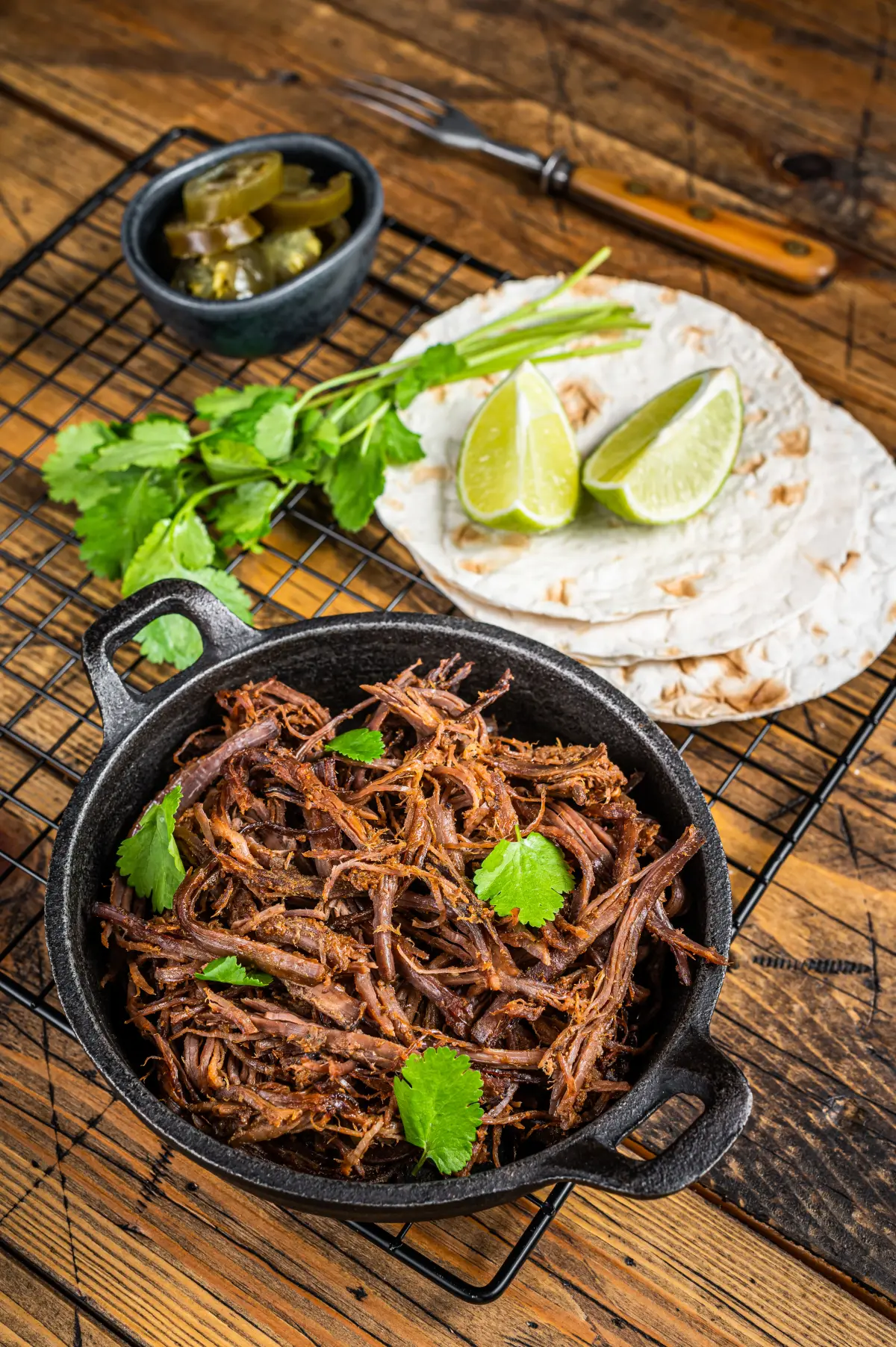

Carnitas (car-NEE-tahs) means “little meats”, and in Mexico it is pork cooked slowly in fat until the inside falls apart and the outside turns crisp and mahogany. The famous version comes from Michoacán, where it is cooked in copper cauldrons of lard over a wood fire. You can get very close at home with a wide pot, a pork shoulder and just ¼ cup of lard: the shoulder simmers uncovered in water and orange juice for 90 minutes, the water boils off, and the pork finishes frying in the fat it released along the way.
How to make carnitas tacos, and is it worth it at home
How do you make carnitas at home? Cut 1.5 kg (3.3 lb) of pork shoulder into 2-inch chunks, salt them and simmer uncovered in a wide pot with 3 cups of water, orange juice, garlic and bay for 90 minutes, until the liquid evaporates and the pork is tender. Brown the chunks for 20 minutes in their own fat plus ¼ cup of lard, chop, and serve in corn tortillas with onion, cilantro and salsa verde. 145 minutes for 6 servings.
It is worth it if you are feeding four or more. The work is light, about 50 minutes hands-on out of 145, and most of that is the last 20 minutes of browning. What you get is the filling of a Mexican carnitas stand: juicy shredded pork with crunchy edges and no marinade, so the meat tastes of pork, orange and salt.
Good for: a weekend lunch, game day, a birthday taco bar. The braise can be done two days ahead, so on the day you only brown.
Not ideal for: a quick weeknight dinner, or anyone after a lean meal. Even with little added lard, shoulder is a fatty cut, and that fat is the point.
Difficulty, honestly: medium. Nothing is technically hard; the only skill is hearing the moment the pot stops simmering and starts frying.
Carnitas vs pulled pork vs al pastor
All three are pork, and they end up very differently. Pulled pork is smoked or slow-cooked shoulder, shredded and usually sauced. Carnitas are cooked in fat and then browned, so the texture is crisp outside and soft inside, with no sauce at all. Tacos al pastor use thin slices marinated in a red chile and achiote adobo, then seared. If you have eaten all three, carnitas are the plainest and the crunchiest.
The best cut of pork for carnitas, and what to ask for
Buy pork shoulder: boneless Boston butt in the US, a shoulder joint in the UK, paleta or aguja in Spain. It has enough fat and collagen to cook for two hours and stay juicy. Pork loin, even though it costs more, turns dry and stringy in 90 minutes.
In Mexico, carnitas stands sell the pig by the part. Maciza is boneless lean meat, costilla is rib, buche is stomach, cuerito is skin, and surtida is a mix of several. At home I stick to shoulder, sometimes with 300 g (10 oz) of meaty spareribs in place of 300 g of shoulder for a more taquería-style mix. Stomach and skin need separate cleaning and longer cooking, so I leave them to the professionals.
US and UK swaps, and what changes:
| If the recipe says | Buy this | What changes |
|---|---|---|
| Boneless pork shoulder | Bone-in shoulder, 1.8 kg (4 lb) | Same result; pull the bone out when you chop |
| Lard | Neutral oil, 4 tbsp | Slightly less pork flavor; browning is the same |
| Fresh orange juice | Bottled not-from-concentrate OJ, ½ cup | No real difference here |
| Mexican oregano | Regular dried oregano | Mexican is more citrusy; small difference |
| Pork belly | Use up to 300 g (10 oz) only | More crunchy edges, a lot more fat |
For lard, the hydrogenated blocks in US supermarkets work, but the freshly rendered lard sold at Mexican butchers tastes of pork and is what I buy when I can. In the UK, plain lard is sold in blocks in most supermarkets.
Why orange juice, Coca-Cola or milk in carnitas
They all add sugar to the pot, and sugar browns faster. That is their real job. Orange also brings acidity and aroma, mostly from the peel; milk brings lactose and proteins that toast in the fat; Mexican Coca-Cola brings cane sugar rather than the corn syrup in the US version.
None of them makes the pork tender. Shoulder softens because its collagen turns into gelatin with time and moist heat, and that happens with or without juice. The ½ cup of juice from one orange adds about 10 g of sugar to 1.5 kg (3.3 lb) of meat, enough for color without scorching. If you want to experiment, stir ½ cup of evaporated milk or Mexican Coke into the pot for the final half hour of simmering and stay close during the browning, because extra sugar takes the pork from mahogany to burnt in minutes.
Stovetop, oven, Instant Pot or slow cooker carnitas
The stovetop method in the recipe card is my default. These are the alternatives, all for 1.5 kg (3.3 lb) of shoulder:
Oven carnitas, no added fat. Pack the salted chunks into a baking dish where they fit snugly, add ½ cup (120 ml) orange juice or water, cover tightly with foil and bake 90 minutes at 325°F (165°C). Uncover, raise the oven to 450°F (230°C) and roast about 30 minutes until the liquid is gone, then about 20 more, turning every 7-8 minutes, until browned. These are the temperatures in Rick Bayless’s home-style carnitas, and it is the method I use for a crowd.
Instant Pot carnitas. Add the pork with 1 cup (250 ml) water, the orange juice, garlic, bay and salt; cook 45 minutes at high pressure with a 15-minute natural release. Drain (save the broth for soup) and brown the chunks in a skillet with the ¼ cup of lard for about 20 minutes. Never pressure-cook pork in a pot of lard: Instant Pot manuals specifically forbid pressure frying with oil.
Slow cooker carnitas. The chunks with orange juice, garlic and salt, 8 hours on low. They come out tender but pale, so finish them under a hot broiler for about 10 minutes or in a very hot skillet with the lard.
Traditional lard confit. The chunks fully submerged in about 1.2 kg (2.6 lb) of lard with orange and salt, held at a gentle bubble for around 2 hours, with the heat raised for the last 10-15 minutes to brown. The strained lard keeps in the fridge for the next batch.
Getting carnitas crispy
Three things make the crust, and lard is not one of them. First, no water left: while there is broth, the pot cannot rise above 212°F (100°C) and the pork boils instead of browning. Second, big chunks: 2-inch pieces brown on the outside without drying out, and you only chop at the end. Third, patience: leave each side alone until it lets go of the pot by itself, usually around five minutes. For the extra crunch you get at a taco stand, chop the browned pork and return it to a smoking-hot skillet with a spoonful of its fat for a minute or two right before serving.
Make-ahead plan and timeline for 145 minutes
The day before (or two). Do the whole simmer until the water has evaporated, cool the pork in its fat and refrigerate it covered. On the day, brown it in the same pot or in a 450°F (230°C) oven. Make the salsa verde the same day; the guacamole right before serving. A bowl of fresh pico de gallo can be diced and drained while the pork browns.
How to tell each stage is on track:
- 10 minutes: the liquid is boiling and grey foam rises; skim it.
- 45 minutes into the simmer: the liquid is down to about a third and fat is showing on the surface.
- Around 90 minutes: a fork goes in and comes out without lifting the chunk.
- Water gone: the bubbling turns finer and louder, like frying, and the bottom of the pot holds clear fat.
- Browned: mahogany on every side, edges that crackle under the spatula, after 15-20 minutes.
Carnitas for a crowd, how much pork to buy and what it costs
Plan on 3 tacos per person with about 40 g (1.4 oz) of carnitas each. Pork shoulder loses about half its weight between raw and crisp, so that means roughly ½ lb (250 g) of raw shoulder per guest.
USDA data puts braised shoulder at about 64 % of its raw weight (a 288 g raw blade steak weighs 185 g braised), and the browning takes out more water. Rick Bayless’s home-style recipe turns 3 lb of shoulder into about 1½ lb of carnitas, half. In my kitchen, 1.5 kg (3.3 lb) gives about 750 g (1.65 lb), which is 18 tacos.
What it costs in the US. At the BLS average price for “all other pork” in August 2026, $3.74 per pound, the 3.3 lb of shoulder for this recipe cost about $12.36, a little over $2 per person. Pork is almost the whole bill; onion, cilantro, limes and one orange add a couple of dollars. Tortillas and lard are not in the BLS price series.
For 20 guests: 5 kg (11 lb) of shoulder, 75 tortillas (60 plus spares), 3 onions, 3 bunches of cilantro and 10 limes. Split the pork between two pots or two oven dishes, because a crowded pot steams instead of browning. Braise the day before, brown in a 450°F (230°C) oven for about 30 minutes on the day, and keep the carnitas covered in a low oven at 140°F (60°C) or above while people serve themselves. A second filling off the grill, such as carne asada with citrus-marinated skirt steak, uses the same tortillas, onion and salsas.
Serving, storing and reheating carnitas
Chop the pork into ½-¾ inch pieces and pile it onto two warm corn tortillas with white onion, cilantro and lime. Salsa verde made with tomatillos is the classic; a red chile de árbol salsa works too. The carnitas themselves are not spicy at all, so kids usually love them; keep the salsa on the side. The recipe has no gluten, dairy, eggs, nuts or soy, though if you add evaporated milk it contains lactose, and store-bought corn tortillas are worth a label check for gluten.
If you like slow-cooked Mexican pork, cochinita pibil is the Yucatán cousin, marinated in achiote and sour orange and cooked in banana leaves with no final browning. The broth left from the Instant Pot method is also a good start for pozole rojo.
Fridge. USDA FSIS guidance for cooked leftovers is 3-4 days at 40°F (4°C) or below, and no more than 2 hours at room temperature. Store the carnitas with a spoonful or two of their fat on top; it keeps them from drying out.
Freezer. FSIS suggests eating frozen leftovers within 3-4 months for best quality; at 0°F (-18°C) they stay safe longer but lose moisture. Freeze flat in bags with some of the fat and thaw in the fridge. Thawed and drained, leftover carnitas also roll into corn tortillas the same way as crispy chicken flautas.
Reheating without drying them out. In a skillet with a spoonful of their fat over medium-high heat, 3-4 minutes, leaving them alone for the first minute so the crisp edges come back. If they look dry, add 2 tbsp water, cover for a minute, then uncover to crisp. They should reach 165°F (74°C) in the center. The microwave works but softens them; finish with a minute in the skillet.
Carnitas tacos FAQ
What is the best cut of pork for carnitas? Pork shoulder (Boston butt). It has the fat and collagen to stay juicy through 2 hours of cooking. Loin dries out.
Can you make carnitas without lard? Yes. In the oven, 90 minutes covered at 325°F (165°C) and about 50 minutes uncovered at 450°F (230°C), the pork browns in its own fat. On the stovetop, 4 tbsp of oil replaces the ¼ cup of lard.
Why do people put orange juice or Coke in carnitas? For the sugar, which speeds up browning. Neither one tenderizes the meat; time and moist heat do that.
How long do carnitas take in an Instant Pot? 45 minutes at high pressure with liquid, a 15-minute natural release, then about 20 minutes of browning in a skillet.
How many pounds of carnitas for 20 people? About 11 lb (5 kg) of raw shoulder, which makes roughly 5.5 lb (2.5 kg) of carnitas for 60 tacos.
How long do carnitas last in the fridge? 3-4 days at 40°F (4°C) or below, per USDA FSIS. Reheat to 165°F (74°C).
Carnitas nutrition per serving
Figures are per serving of three tacos with onion and cilantro (salsa, guacamole and lime not included), worked out from USDA SR Legacy data for each ingredient in the amounts above. The pork is counted as braised shoulder at USDA’s cooked yield, so the fat that stays behind in the pot is left out; the lard is counted in full:
- Calories: 690 kcal
- Protein: 45 g
- Carbohydrates: 39 g (mostly tortillas)
- Fat: 39 g, including 14 g saturated
- Fiber: 5 g
- Sugars: 4 g
- Sodium: 905 mg
The pork accounts for about 430 kcal and 28 g of fat per serving, the tortillas about 160 kcal. Salt is where most of the sodium comes from: about 775 mg of each serving. Two tacos instead of three bring a serving down to about 460 kcal.
I grew up in Venezuela, where pork meant the Christmas pernil roasted whole, and in Colombia I learned to ask the butcher for brazo, the shoulder, for almost everything. Carnitas are the opposite of the shredded beef in pabellón criollo, which simmers in broth and never browns. They taught me to cook with my ears: the dish really starts when the pot stops bubbling and begins to sizzle. Josnaisis.